The day after the New Delhi G20 Summit ended yesterday, the world media has gone agog over the announcement of the India Middle East Europe Connectivity Corridor (IMEECC)! Hyperboles are flying around hail it as the signal of a new emerging world order about to “overcome many geopolitical hurdles.”
Here is a one sample of the effusive comments currently doing the rounds on social media about IMEECC (“IM-double-E-double C”):
QUOTE: “This Economic Corridor is a historic collaboration led by Bharat and the US. It involves cooperation on connectivity and infrastructure and includes India, UAE, Saudi Arabia, Jordan, Israel the EU, France, Italy, Germany, and the US. The corridor could significantly reduce shipping times.

“Bharat foreign trade agreements and supply chain initiatives strengthen its role. Bharat can take a long-term strategic view and engage in project participation. The project’s success depends on overcoming geopolitical hurdles and fostering trade in the region. UAE’s Etihad Rail completed a 139 KM track connecting UAE to the Saudi Arabian Railway network. A long Saudi North-South rail line from Haradh to the Saudi-Jordan border is already operational. A 300-km stretch to Israel’s Haifa port is planned, with part of it already functional. DP World, Dubai’s logistics company, plays a significant role in the corridor. Israel supports the rail network, and trilateral connections with Bharat and UAE are forming. UNQUOTE
“Overcoming many geopolitical hurdles“
The “Bharath foreign trade agreements” mentioned above is none too veiled reference to the work-in-progress on the Free Trade Agreement (FTA) between India-UK, India-EU, India-Saudi Arabia which are all on the anvil.
The phrase “overcoming geopolitical hurdles” means many things. It can be taken to be a veiled reference to Saudi Arabia’s attempts to deftly outmaneuver its regional rivals Iran and Egypt. The “IM-double-E-double-C” when fully operational sometime sooner or later in this decade or next, will most likely erase Iran’s footprint in Yemen and the Port of Aden. It will also make the Suez Canal shipping route and Egypt less important as a world maritime hub. And if under the IMEECC, Dubai’s Jebel Ali port becomes an even more pivotal transshipment hub than it already is today, Pakistan’s Gwadar port connection with China will have much of its vantage position dimished.

From far away across the Atlantic, super-big-brother United States America, and its allies in the European Union, also give their fulsome blessings to this Economic Corridor. They are willing to throw their weight behind the IM-double-E-double-C project since they see it as potentially the most powerful non-military weapon of containment they could ever wield against two of its greatest rivals in Asia, Russia and China.
The mainstream Indian media in the past few days has been even more effusive in its editorials and op-eds than the social media. Below is an example:
QUOTE: “During the two-day G20 Summit in New Delhi, Saudi Arabia was one of the signatories to the ambitious India-Middle East-Europe Economic Corridor. The initiative, seen by many as a potential alternative to China’s Belt and Road Initiative, was jointly announced by PM Modi and the leaders of the United States, Saudi Arabia, the United Arab Emirates, France, Germany, Italy, and the European Union on the sidelines of the G20 summit. Once completed, the project can serve as a modern-day Silk Road that functioned as the central trade route facilitating economic partnerships, political alliances, and cultural integration across continents.” https://www.ndtv.com/india-news/prince-salman-state-visit-g20-pm-meets-saudi-crown-prince-today-trade-connectivity-defence-on-agenda-4378507
“THE BRI” Vs “THE IM-double-E-double-C”
As the map above of the “IM-DoubleE-DoubleC” clearly tell us, it is truly a a new visionary geostrategic mega-project. It’s sweep can be grandiose, transcontinental, multinational, multi-civilizational and multigenerational.
More than half-a-dozen countries have pledged to partner in the project which will straddle India, two major Arabian Gulf Countries, Israel, France, Italy, Germany with neighboring Japan, Jordan, Iran, Iraq, Turkey and a few EU countries lending active geospatial or technology support. This project — if it gets off the ground as soon as possible rather than late — will put a big spanner in the works of China’s BRI (Belt and Road Initiative) which got underway in the year 2013.
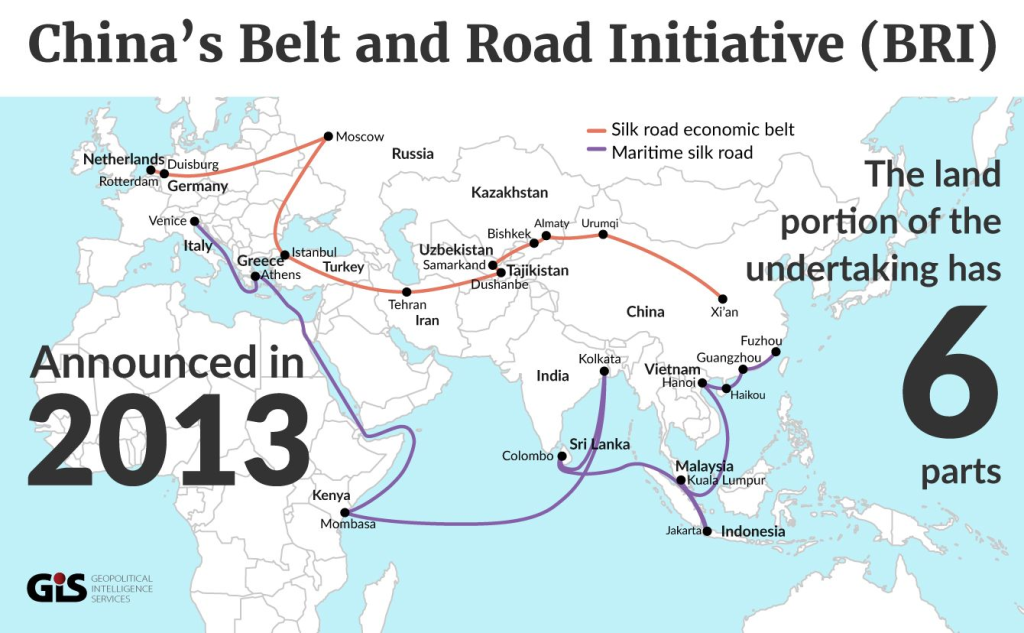
The map above tells an intriguing story: BRI was conceived as having two prongs.
There was to be a northern land portion of road-and-rail infrastructure running right through Central Asia and the “-stan” countries which stretch right across the underbelly of Russo-Eurasia. And then there was to be built the southern sea portion i.e. long trans-oceanic sea-lane going through most strategically situated ports of the South-China Sea, the Indian Ocean, the Red Sea and the Mediterranean Sea.
It is now the “southern” or the “sea portion” or prong of the BRI which will now get upended and effectively replaced by the IMEECC.
The IMEECC thus represents virtually a geostrategic coup de grace delivered by a group of countries of the so-called Global South led by India and Saudi Arabia against China’s BRI which in one fell swoop had earlier aimed at securing long-term domination of both the Central Asian geopolitical land-mass as well as the entire Indian Ocean/Afro-Middle-Eastern maritime regions.
The vision of President Xi Xin Ping — who as on date, rules China as its unchallenged “emperor” — in launching the BRI project was essentially his grand, magnificent ambition of a 30-year future. It was to effectively establish China’s overwhelming presence and effective control over the entire gamut of economic and trade supply-chain networks right across the Eurasian, East African, Middle-Eastern and Indian Oceanic gateways leading all the way up to farthest reaches of the European continent.
BRI was to be in Xi Xin Ping’s grandiose world vision, a resurrection of the ancient Silk Route once connecting the European with the Asian trade-routes for hundreds of centuries. Except that BRI as the “Silk Route.2” was designed in Beijing to be not merely an intercontinental trade-route but was aimed to serve much larger Chinese ambitions, It was meant to be China’s way of projecting its newly acquired self-identity as a world economic, military and trading superpower. If China had its way, the BRI ultimately would thus become the symbol of the “Chinese Middle Kingdom” — virtually, the famed, mythic “Centre of the whole World”.
In other words, if one were to use the metaphor quintessentially Indian — that is Bharath — the BRI was one of many subtle ways in which China expressed its ambition to be a “Vishwaguru“.
The “Vishwaguru” ambition
Two major regional powers India and Saudi Arabia took a hard and long look at the BRI map above and quickly realized that if China’s 30-year strategic plan — i.e. the two-pronged landward and seaward push into Central Asia and Indian Ocean — were to turn out successful, they would then get downgraded from being middling world-powers in the global pecking order that they regarded themselves presently to be, to mere second-string instrument players in China’s grand philharmonic geopolitical orchestra of 128 other countries through which BRI would be running . Saudi Arabia would be relegated gradually to the position of China’s gas-station and India would become no more than China’s biggest and most lucrative marketplace and dumpground of mass-manufactured consumer and electronic goods.
Neither India nor Saudi Arabia was however going to accept China’s emergence as the new “vishwaguru” in a new world order. Neither was willing to cede geopolitical space in Asia or Middle-East where China could exert project its dominance unchallenged.
So, enter Narendra Modi in India in 2014. And similarly, enter Mohamed Bin Salman around the same in Saudi Arabia into the seat of power.
Mohamed Bin Salman was a visionary young leader of a new generation of Saudi Arabians. His 30-year ambition for his country he articulated in no unclear terms in a rare public interview to a pan-Arabia TV news-channel. It is on YouTube at the link below.
In the interview, Mohamed Bin Salman spelt out his vision for Saudi Arabia saying this: “I know exactly what I want Saudi Arabia to be 30 years from now. I am not going to die in that period. And I will not rest until my vision is realized. In 30 years time, mark my words, the Middle-East will be the NEW EUROPE”!”
Mohamed Bin Salman has an ebullient style of speaking. His body language is regally imperious. The way he spelt out his vision for Saudi Arabia immediately got many thinktanks and strategic affairs pundits in Europe and UK into a real tizzy. The Economist in the UK called him a “dangerous man” in the below specially produced video-documentary on him:
In the year in which Mohamed Bin Salman spoke about the Middle-East becoming the “new Europe in 30 years time”, Europe and UK were both reeling under an immigration crisis of apocalyptic proportion. There were millions of refugees from war-ravaged Syria, Libya, Afghanistan and Sub-Saharan Africa streaming across the land and sea-borders of Europe into central and western Europe. Many European countries suddenly found themselves faced with a massive humanitarian crisis on their borders. Some like Hungary refused to accept refugees, many others baulked and only a few like Germany and Sweden accepted to give asylum-seekers a safe haven but then only in a very small trickle.
Under the circumstances, Europe and Britain easily mistook Mohamed Bin Salman’s vision statement to be the title of a nefarious plan to Islamize Europe in 30-years!
Nothing could have been more ridiculous and farther from the truth.
When Mohamed Bin Salman spoke of the Middle-East becoming the Europe of the next 30 years, he was not referring to the waves of refugees from the Middle-East or MENA washing up on Italian, French, Greek, Albanian, French or British shorelines. He was talking really about his vision of the Middle-East being on the cusp of a historic shift in its destiny. And in his discourse, he was only drawing a comparison with the European Age of Reason, the European Renaissance, the Industrial Revolution and the European Ideal of Social Contracts. He was hearkening to a past age of Renaissance being ushered into Saudi Arabia and the larger Middle-East under his leadership of the Arab world.
In his landmark public policy and programs document published in his country titled Saudi Vision 2030 (Arabic: رؤية السعودية ٢٠٣٠ ruʾyat al-suʿūdiyah alfayn thalāthūn) he spelt out his aims to achieve the goal of increased diversification economically, socially and culturally, in line with his vision of Saudi Arabia. It was first announced on 25 April 2016 by the Saudi government .
It was exactly in pursuance of that grand vision of his that Mohamed Bin Salman soon began to put the strategic blueprint for his country in place and to get his act together in the pre-Covid and post-Covid years. He began cultivating a more independent foreign policy, freeing himself and his country gradually from the shadowy influence of big-brother United States of America.
He extricated his country out of the mess it had got itself into in the war in Yemen.
He began a process of rapprochement and accommodation with both Iran and Qatar.
Above all, most importantly he began to lay the foundation for a long-term geostrategic relationship with India without in any way damaging ties with China. In much the same way as India itself deftly balanced its relationships with both Russia and America, Saudi Arabia too balanced itself between India and China. In the process, Mohamed Bin Salman all but abandoned its old subcontinental ally, Pakistan.
The situation today in 2023 after the G20 Summit is that the IMEECC puts Mohamed Salman’s Kingdom of Saudi Arabia in a place of far greater and more crucial global importance than it ever hitherto enjoyed as the leader of the OPEC Cartel. If the IMEECC project succeeds, Mohamed Bin Salman’s vision of Saudi Arabia and the whole Middle-East turning new Europe — both geopolitically, economically and culturally — will experience a historic Arab Renaissance similar to Europe’s own way back in history. Saudi Arabia could then become the “vishwaguru” of the entire Middle-East, North Africa and Sub-Saharan Africa.
INDIA, that is BHARATH, as “vishwaguru“
When Narendra Modi took power in 2014 as Prime Minister of India, he took a rather benign view of China’s BRI map above. He saw it as more of a foreign policy opportunity to open a new chapter in friendly ties under the umbrella of broader South Asia-China collaboration rather than as a geostrategic threat.
Modi invited Xi Xin Ping first to Ahmedabad in September 2014 for a famous “jhula” (swing) diplomatic bilateral meeting. Then again in October 2019, Modi invited Xi Xin Ping for yet another round of diplomatic wooing at Mahabalipuram.
The agenda at both meetings was broadly to forge a long-term stratetic partnership with China in Asia at a time when America and China relations were deteriorating on several fronts — trade, currency, military, intellectual property and space exploration.


India’s diplomatic good gestures were rebuffed by China. China persisted in its long unresolved and outrageous claims to territory on India’s borders in the north and north-east. China blocked India’s bid for a UNSC permanent seat. China thwarted India’s efforts to internationalize Pakistan support for terror organizations.
Very soon, Modi realized the futility of building bridges with China’s Xi Xin Ping. It was at the same time that he also realized that the new CPEC — China Pakistan Economic Corridor agreement of 2015 was actually one of the building blocks of the BRI strategy of encirclement of India’s norther borders abutting Kashmir Valley and Ladakh. BRI stood exposed then for what it was. It was not only going to serve China as a global economic and trade route but also going to serve Xi Xin Ping’s two-pronged, land and sea-based Asian “vishwaguru” strategy to encircle India north and south respectively.
By the year 2018, Prime Minister Modi had disabused himself of any fancy notions of a new chapter in Sino-India relations. Realpolitik awareness dawned. He now turned to nurture his own vision for India emerging as “vishwaguru” by the year 2050! Like the Saudi Arabian Crown Prince who saw a Middle East turning new Europe, Modi saw India turning world power!
In his Independence Day address, 2018, from the ramparts of the Red Fort in New Delhi, he proclaimed his vision to his countrymen:
QUOTE: “In this era of global economy, the entire world is looking at every development in India, big or small, with deep interest and hope and expectations … There was a time when the world used to comment about red tape in India but now they talk about a red carpet … There was a time when the world counted India among the ‘fragile five”. They were concerned that India was pulling down the world economy, but now their tone has changed as India has become a multi-trillion dollar investment destination.”
“The same set of experts who had earlier dubbed India as a “sleeping elephant” are now saying that “sleeping elephant” has woken up and started running. Economists and international institutions are saying that India will provide momentum to the world economy for the next three decades and will spur the growth of the world.
“Today, India’s stature at international fora has risen greatly. India’s voice is being heard in every organisation of which she is a member. India is playing a crucial role in shaping the discourse and providing leadership to these organisations.” https://indianexpress.com/article/political-pulse/india-vishwa-guru-g20-summit-pm-modi-vision-world-8933278/ UNQUOTE
Next year, at the ET Global Business Summit, 2019, Modi’s vision became even more transparent:
QUOTE: “What happened in the past is not in our hands, but what will happen in the future is firmly in our hands. We often lament missing the industrial revolutions in the past, but today it is a matter of pride that India is an active contributor to the fourth industrial revolution. The extent and magnitude of our contribution will surprise the world. I am also confident that India may have missed the bus during the first three industrial revolutions, but this time, it is a bus India has not only boarded but will also drive.” UNQUOTE
This was India voicing its “vishwaguru” ambitions — loud and clear!
Between 2015 and 2019, Modi’s government implemented some of the most far-reaching economic and social transformations ever seen in India since the 1992 reforms.
The JAM — Jan Dhan Yojana, Aadhaar and Mobile DBT (Direct Bank Transfer) — was a revolution for billions of Indians who were brought into the banking and financial system for the first time in half a century. The dismantling of several state VAT taxes in one go and replacing it with GST VAT unified indirect taxation across the country was another. The removal of wasteful government subsidies, the launch of government-guaranteed universal pension and health insurance social security schemes and the restoration of the banking system to good health — all further resulted in the consolidation of the Indian economy on a firm fiscal grounding.
The Covid years of 2020-22 saw India conquer the pandemic in ways so remarkably successful that the whole world could only gape with amazement and not without a tinge of envious grudge too. India, the vishwaguru wannabe, was exporting vaccines free of cost to dozens of countries throughout the world, while pharma-multinational giants like Pfizer, Novartis and Johnson & Johnson were made to look like immoral profiteers.
In the ensuing years when the rest of the world came to be gripped by stagflation thanks to years of profligate monetarism and interest-rate manipulation, India’s economy alone stood resilient, being able to insulate itself from massive debt-crises of the sort into which many African and Latin American countries plunged. Long after India had tamed the Covid pandemic in 2022, China was still grappling with the problem.
On August 23, 2023, the crowning moment arrived for India. India’s space mission Chandrayan landed on the moon’s south pole and India joined the elite and exclusive club of moonlanders — America, Russia, and China. It was the first signal that India’s ambition to be “vishwaguru” was not an empty dream.
The Arab and Indian Renaissance
Prime Minister Narendra Modi and Crown Prince of Saudi Arabia Mohammed bin Salman on September 9, 2023 jointly expressed their happiness at the launch of the IMEECC. The two leaders recognised it as one of the major outcomes of the New Delhi G20 Summit. They hailed it as the biggest plurilateral agreement connecting several countries. “It is actually connecting our like-minded partner countries in different geographic zones which is extremely important – Asia, Middle East and Europe,” said a spokesperson for the Crown Prince.
“The two sides identified areas such as energy cooperation, defence, security, education, technology, transportation, healthcare, tourism and culture. Both sides considered space and semiconductors as other areas of cooperation. They agreed to diversify the current status of hydrocarbon relations into a comprehensive energy partnership,” he wnet on to say.
The two sides also agreed to expedite the India-GCC Free Trade Agreement negotiations that “would act as a catalyst” for economic cooperation between India and Saudi Arabia. “They also agreed to strengthen cooperation in the FinTech field and also explore trading in the local currencies. The two leaders expressed their satisfaction at the volume of trade level both countries have reached,” stated the Indian diplomat speaking on behalf of Prime Minister Modi.
A total of eight major agreements were signed in areas of energy, digitalisation and electronic manufacturing, anti-corruption and national archives. Other agreements including one on grid connectivity are already currently in progress. PM Modi also mentioned areas of cooperation such as critical minerals, food security, startup bridge, education and filmmaking during his bilateral meeting with the Crown Prince, not to mention defense cooperation.
India today is Saudi Arabia’s second-largest trading partner whereas Saudi Arabia is India’s fourth-largest trading partner.
There is no doubt therefore that both Saudi Arabia and Bharath now each nurture ambitions for “vishwaguru” status in the world. And the IM-double-E-double-C vision is what they both believe will get them to where they want their respective country to be before year 2050. The IMEECC might well usher in by the middle of the 21st century both a pan-Arab and pan-South Asian Renaissance.
The great superpowers of the world today, America, China and Russia are “vishwagurus” of quite a different order. They seek mainly to project intercontinental military might across Asia; their template is 20th century and Cold War. Whereas, in contrast, Bharath and Saudi Arabia are aiming for “vishwaguru” status of the 21st century kind knowing fully well they could never match the military might of the 3 present superpowers. Instead, they have chosen a different road to travel — one that will spawn and project trade, commerce, technology and cultural development transcontinentally right across 8166 Kilometrers from India all the way to the Atlantic! To understand that difference watch the video-clip below.
Sudarshan Madabushi