The author of this article has waxed eloquent in paying effusive tribute to the memory of the great freedom fighter, Jayaprakash Narayan, being commemorated on his 121st Birth Anniversary which fell on October 11th 2023.
https://thewire.in/rights/bjp-rss-erase-jayaparakash-narayan-significance
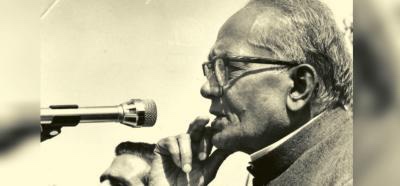
The author’s main grouse is that the present BJP Government has not celebrated JP in the way he deserves to be nor is it giving him his due place of honour amongst the pantheon of great freedom-fighters of modern India.
Many historians are fond of observing that amongst “free and democratic nations” of the world, India can be likened to a “Dvija” —- the “twice born Brahmin”.
India’s first birth was at the stroke of the midnight hour on August 15th 1947 when she threw off the yoke of slavery of 300 years under British Colonial Rule .
The second birth was on 21 March 1977 when the country which since June 1975 had been under the draconian autocratic rule of Mrs. Indira Gandhi’s Congress Party was ended and India became free again.
The author of the above Op-Ed in The Wire feels that JP was a great champion of India’s “twice-born democracy” since not only had he been Mahatma Gandhi’s able lieutenant in the first freedom struggle that ended in 1947 but that he was also the architect of the latter-day fight for India’s freedom from the dreaded Emergency of 1975. So, according to the author, JP doubly deserves the greatest of awards and accolades from the nation. But he wails and laments that an ungrateful nation is not giving a forlorn JP his due and just desserts.
The author is not entirely wrong in his lamentations. It is true that JP the freedom fighter does not get often classed in the same league as Nehru, Patel, Azad, Netaji or Rajaji. The Congress Party has always given JP the short shrift since he was a sworn adversary of Mrs Indira Gandhi ever since she first came to power in 1967 as Prime Minister of India.
The BJP Government today under Narendra Modi too does not hold JP in the same high esteem as it does its own pantheon of leaders — Golwalkar, Savarkar or Shyama Prasad Mukherjee. The BJP does not care to eulogise JP since all his life he was a carping critic of the RSS, the papal centre of the Sangh Parivar.
In Bihar, the home-state of JP, his memory ought to be celebrated with great fervour but unfortunately nothing of that sort happens because JPs so-called socialist-acolytes like Lalu Prasad Yadav and Nitish Kumar and Sharad Yadav (since deceased) are all fading washed- out political leaders. And the brand of politics they play today would do no credit at all to JP’s illustrious stature and legacy.
So, if JP is not given his due credit or any great public acclamation today in India, it is because of his own fault and flaw in character that he endeared himself to no political class greatly and, in fact, throughput his life, remained adversarial to all others in the political spectrum of India.
JP fancied himself to be Gandhi’s natural heir and even deemed himself in moral stature to be a cut above even Nehru and Mrs. Gandhi . He irked everyone with a chip that often sat smugly on his political shoulder on which shone his great Gandhian halo. He carried around himself with the Ceasar-like aura he gave unto himself much like his erstwhile mentor, M.K. Gandhi. JP imperiously turned down offers of public office; he refused to engage in mainstream electoral politics; he instead gave his support to fringe Gandhian causes such as Bhoodaan and Sarvodaya movements etc . He was a commissar at heart although he projected himself as a yogi. Which was precisely the reason why everyone in the Indian political class gave him bland respect and never warm adulation that otherwise a leader of his stature ought to have commanded.
In the same league as JP perhaps belonged too his political fellow-travellers such as Acharya Vinobha Bhave, Acharya Kripalani and a few others in the same Gandhian mould. It is the doleful comment of the Wire Op-Ed writer that they all like JP deserve better too from their countrymen who seem to have all but forgotten them.
Is there any great weight of substance in such lamentations? My answer is this:
I think the Gandhian acolytes like JP and Bhave were blind followers of the Mahatma with no wisdom or discrimination. They failed to recognise and understand 2 fundamental realities of the Indian landscape:
1. That Gandhi’s philosophy was founded on the fundamental principle of “thyaga” or self-sacrifice — ahimsa, Satyagraha, bhoodan, ram Rajya etc . are all concepts flowing only out of the principle of “thyaga”… i.e. putting “loka kshema” before self-interest.
2. That Gandhi’s philosophy was good effective prescription for a very short and particular period of time in history— the time when people of India had no other viable means to fight for their freedom and had nothing else to resort to.
People in the Pre-Independence era looked upon Gandhian means as merely the most cost-effective weapon with which to fight the British. No more, no less.
Gandhian means of struggle entailed the least possible amount of “thyaga” in terms of giving up life, livelihood, blood, personal and family safety, or too much of time, money, dedication and toil …
The people realized that to follow the Gandhian path of Non-violent, Non-Cooperation, Civil Disobedient Sathyagraha involved certainly the least amount of “thyaga” on their part when compared with the amount of “thyaga” that would have been otherwise demanded of them if they had been asked to come forward to join much more active revolutionary forms of freedom struggle (such as for example the means espoused by Netaji or Bhagath Singh or Savarkar).
The Gandhian way seemed a very good, risk-minimal bet indeed for a people with little material resources to fight the battle for freedom in more vigorous manner. Gandhism was in that sense no more than a special purpose vehicle — “SPV”— for the people of India who would, once freedom was won, have no more use for it. This was clearly proved when Gandhi after Independence urged the Indian National Congress Party to disband and rededicate itself to social work . Instead, the Congressmen, Gandhi’s erstwhile compatriots, simply dismantled Gandhism.
JP , Bhave, Kripalani and a few others embraced Gandhism as though it were universal and eternal philosophy . Instead of regarding Gandhism as an expedient tool of political revolution they deified it as a near religious creed. That was both their folly and the main reason for their fading away into irrelevance and eventual oblivion in the post-independence era.
Post Independence, these high-souled Gandhian apostles simply and almost naively failed to correctly read the mind of the Indian people and their new aspirations. Indian people intrinsically tended to put their native faith in centuries-old values of rugged individualism and naked capitalism and placed it far above those of “thyaga”.
In post-Independence era, when the rat-race for rapid economic development and industrialisation of INDIA began with the dawn of the great Nehruvian era , Gandhian Philosophy quickly became passé . And therefore the same people of INDIA who had earlier sworn by Gandhian values during the years of freedom struggle, quickly became utterly blasé towards Gandhian modes of thinking and ways of living.
Today , we all know that the common Man in India has only one overarching principle in life: to get ahead in life by all means, fair or foul. To realize that goal he is willing to endure any degree of “thyaga” but only so long as such “thyaga” serves self-interest.
In the times we live in , to now hearken to the good ol’ days of JP , Bhave and Bhoodaan et al … as this author of the Op-Ed in The Wire has done, sad to say so, but it is nothing but maudlin reminiscence .
Sudarshan Madabushi