For me and my family, Deepavali in Kashi did not quite end there at the Hanuman Ghat with “Ganga-snaanam” alone.
Deepavali for all Hindus is “Festival of Lights” symbolized by the lighting of oil-wick lamps, tiny earthen shapes placed in all quarters of the home and outside too. Village and cities across the country glow and shimmer in the night… The lighting of lamps on Deepavali is a peoples’ custom dating back centuries.
At Kashi that day, my family could not have asked for a more luminous, more dazzling display of festive lights! On the banks of the Dasaashwamedha Ghat, that evening was where the famous “Ganga Aarthi puja” was scheduled to begin at 6 PM.
By the time we arrived there at the ghat it was about 10-15 minutes past 6pm and the “Aarthi” ceremony had already begun. A massive crowd of pilgrims, spectators and international tourists, all dressed in fine new clothes, had already gathered there on the banks of the Ganga. To my eyes, there must have been at least 3000+ people assembled on the steps of the ghat. They had the best seating and the best view of the proceedings. They had probably all come in very early — say, at least an hour earlier, I’d have thought — to have been able to occupy all vantage seating available. The rest of us who had not booked the tickets in advance , nor had taken the trouble to arrive early to get ringside free-seating chairs, were left to stand, craning our necks to peer at the magnificent spectacle. It was a rare religious “son et lumiere” (sound and light) show to witness which all travellers to Kashi had rushed.
Upon the river bank, we saw there were the 7 piers jutting out slightly onto the riverfront on which were erected 7 makeshift stages. There were 7 designated priests who stood and performed the glittering, energetic and carefully choreographed “Ganga Aarthi” — waving of giant-sized hand-held lighted-lamps and whisks facing Maatha Ganga. As we pushed, shoved and heaved our way forward through the thronging crowds, we saw the priestly dancers swaying, whirling and piroutteing, all in graceful unison to the rhythms and sounds of Bhajan melodies composed in praise of Ganga. The music broacasted on the blaring public-address system was quite pleasing to hear. What a breath-taking sight indeed!
“This has been a Deepavali for me today in every true sense of the word!”, I thought to myself. Could there have been any better or more delightful way my family and I could have celebrated this joyous festival ?… To be able to stand there on the banks of the River Ganga and watch with a thousand other pilgrims, the ceremonial prayers to her with hundreds of lighted lamps, all flickering and dancing in the surrounding night-air and hazy skylines of Varanasi?!
******************
“Shraadham”
At Kashi the “shraadham” ceremony in worship of one’s ancestors (pitrus) can be performed by any son along with his spouse and brothers as elaborately as his means or station in life may afford.
The mode and procedure for performing shraadham however is based on ‘sastra-s’, “aachaara” and “sampradaaya” which may vary from region to region in India and from sect to sect as practised by the various communities living in the far flung corners of our great land.
The abiding and fundamental belief in the ritual of “pitru kaaryam” is firm and steadfast and is common to all Hindus but then different “sampradaayam-s” (traditional denominations) amongst them follow slightly variant sacerdotal manuals (i.e. smriti/purana/dharma sastra), practices (kramam) and customs (desaachaaram). These differences are neither substantial nor significant but from the standpoint of “sampradaayam“, they can be easily discerned in the way and style “shraadham” is performed according to “smaartha“, “saiva“, “vaishnava” and other such sects. The denominations are many. They are like branches that since ages have grown out of the large, sprawling unitary Vaideeka family-tree of India. If one takes a leisurely stroll across the ghats along the River Ganga one cannot fail to observe this fact.
At Kashi, the “shraadham” is performed generally in accordance with the local Saivite sampradaya being followed by Pandits. One can avail of their services right along the many ghats of the Ganga. Common people who come to Kashi take the help of these local pandits and purohits in performing “shraadham“. But most people from South India who go to Kashi to do “shraadham“, avail of the services of only priests belonging to the “smaartha” or “saiva” sampradaayam“. These “smaartha” priests adhere to ancient manuals of “dharma sastra” in which they are very well-versed. The priestly smaartha community in Kashi affiliated to the Sankara Muttam there offers very valuable facilities and amenities for thousands of people from South India who arrive in Varanasi in great eagerness to perform “pitru shraadham“.
***************
Just a few observations about Kashi.
Varanasi is one of the oldest living cities in the world– at least, 3000 years old, say modern historians. It has always been the capital of Saivism in India, predating the Buddha and Jain Mahaveera, the Mauryan, Nanda and Gupta era even.
The great Vedic Meemaamska acharyas such as Kumarila Bhatta and Mandana Misra and the Vedantic Acharyas, Adi Sankara, Madhwacharya and Sri Ramanujacharya have all either visited or else lived for a while at Kashi and had had “snaanam” in the Ganga ghats here.
Kashi indeed has been the loom where so many varying strands of Saivism were woven over several centuries into a rich and diverse religious tapestry — Pashupata, Kaapaalika, Mahavrata, Kaalamukha and Aghori Saivism, to name only a few. Any student of the history of Indian Philosophy will be able to recount the numerous Agamas, Smritis and Siddanthas of Saivism which were born and developed too in the religious crucible of Kashi. I happened to recall then, in fact, reading about it all in Surendranath Dasgupta’s magnum opus, “A History of Indian Philosophy” where the Saiva Agamas have been listed (Volume 5, Page 16): “Kaamika, Yogaja, Cintya, Kaarana, Ajita, Deepta, Sookshma, Amshumaana, Suprabheda, Vijaya, Nihsvaasa, Svaayambhuva, Vira, Raurava, Makuta, Vimala, Candra-gnyana, Bimba, Lalita, Santaana, Sarvokta, Parameshwara, Kirana, Vaatula, Siva-gnyaana-bodha, Anala, Prodgita”.
Many of the “shraadham” rituals practised and in vogue amongst the Smaartha priests and local Pandits today at Kashi are either extracted from or they are adaptations derived from one or more of the above ancient Saiva agama or smriti texts.
*****************
Just a few personal observations of mine on Kashi and Vaishnavism.
Long before the great Sri Vaishnava or Sri Sampradaya preceptor, Sri Ramanuhacharya came to Kashi sometime around the 12th century CE, Saivism had already established itself as the predominant religious order all across the Awadh or Doab country (parts of the Gangetic plains of present day UP and Bihar states) at the centre of which Kashi stood. Adi Sankara had already founded his first Muttam at Kashi almost two centuries before Ramanuja… And much water had indeed flown past the steep banks of the River Ganga where the ancient temples of Vishwanath, Visalaakshi and Annapoorneshwari stood. Although Vaishnavism flourished in these parts of India for many centures during and after the Gupta Dynasty , it was Saivism however that prevailed across much of North India, from Ujjain in the West all the way to Varanasi in the East.
Later, when Vaishnavism revived in a significant way all across South India around the 10th century CE and spread to North India too thanks largely to the 11th-12th century CE influence of Sri Ramanujacharya, still in the city of Kashi itself, Sri Vaishnavism did not really make much headway…
Later around the 14th-15th century CE, Vaishnavism began to grow rapidly, and to even parallel Saivism in the Awadh and Magadh regions, thanks mainly to the Ramanand sect — an offshoot of the Ramanuja siddhantha — that established itself in the holy city of Ayodhya.
Kashi however remained then and remains today the citadel of Saivism and Smaartha traditions just as Ayodhya now stands as the capital of Ramanandi Vaishnavism.
Everywhere one goes to in Kashi today, wandering its streets, ghats, outskirts, shrines and great temples and monastries, one can see, unmistakably, that the city’s holy history is really all only about the confluence of Buddhist, Meemamsaka, Saivite, Tantric, Advaitin and Smaartha sampradaaya influences and historical movements. Which is why there is a common belief amongst Kashi-vaasis (residents) that there are at least 33,000 Shiva-lingas, big and small, famous and obscure, in homes, wayside shrines, in winding gullys and alleys…. all present, consecrated and being worshipped by millions of people within the city itself!
Everywhere one goes to in Kashi, one can hear people, walking about in the streets and in the jostling bazaars around the temple of Kashi Vishwanath-ji, crying aloud every now and then, in sheer religious fervour the slogan, “Hara Hara Mahadeva!“! They remind us they are nothing but echoes of past voices floating across to us now from Time immemorial.
It is probably because Kashi represents such a rich, diversely and deeply entrenched blend of Saivite, Tantric, Advaitin, Smaartha sacerdotalism and tradition that amongst sectarian followers “sri vaishnava siddhaantam” from South India, there is a certain degree of hesitation to accord Kashi the same recognition it commands from the Saivite and Smaartha sects. They thus fall a little short of regarding Varanasi to be the foremost of “teertha-sthalas” where “pitru shraadham” ought to be performed by one and all.
The reason for such hesitation is unclear to me. However, I am willing to speculate on the matter.
For Sri Vaishnavas, the foremost consideration in matters relating to religious observances is firm adherence to the guidance provided by their Acharya Parampara — the Acharya lineage. Their principal Acharyas are the Azhwars of the c.4th-to-6th century CE, then followed by Nathamuni, Yamunacharya and Ramanujacharya (9th-to-11th Century CE). With the exception of Ramanujacharya, there is no clear historical evidence to show that any of those other Acharyas ever visited Kashi to compose and perform “mangalaasaasanam” (hymn of benediction) to any deity at Varanasi, although there is evidence to show that the Azhwars did set foot upon nearby holy kshetra-s of Ayodhya and Naimishaaranya. Most of the Acharaya in the Sri Vaishnava “sampradaaya” seem to have clearly by-passed Kashi during their travels to these parts of the Doab, Awadh and Magadh.
Hence, the pre-eminent position or status which Varanasi commands amongst Saivite and Smaartha sects, is conferred by the Sri Vaishnava “sampradaayam” instead only upon Gaya.
Gaya is the other “shraadha-bhoomi” where the principal Deity is that of Vaishnavas. Vishnu presides here in the iconic form as “Vishnu Paadam“(imprint on the sanctum stone-floor, of the Almighty’s sacred foot) inside the temple of Vishnu (about which more will be described in ensuing blogposts). While there is no misgiving whatsoever about a Sri Vaishnava doing “snaanam” in the River Ganga at Kashi, there is however a certain reluctance or restraint arising out of “sampradaaya” fealty when it comes to performing “pitru-shraadham” at Kashi. One might say that it arises for really no reason other than this: performing the rite at Gaya renders it superfluous to repeat it at Kashi.
****************
Being a Sri Vaishnava myself, I confess I did initially have a wee bit of qualm over performing shraadham at Varanasi where I first landed en route Gaya and Ayodhya. But the thought was soon quickly and completely dispelled from my mind when the following clarifications were given to me by the very kind and learned Veda ghanapaatins of Kashi who had extended their hospitality to us during our entire stay while camped in Varanasi:
- While the “paarvana shraddham” i.e. the full-fledged 3-stage ritual procedure of homam, brahmana-bhojanam and pinda-pradaanam, could be performed at Gaya, it would not at all be inappropriate in any way to go ahead and still perform the same at Kashi and Prayag in the “hiranya shraadham” mode. In fact, the puranas and sastras lay down that the yaathra underaken to perform “pitru shraadham” must be a round-trip to all the 3 “sthala-s” of Prayag, Kashi and Gaya. It is also optional for one to limit the number of rites and observances to a few main ones only at Kashi and Prayag while at Gaya the ceremony can be performed more elaborately, procedure-wise, as prescribed by sastra.
- Kashi is a mokshapuri too as much as Kanchipuram is. A shraadham at any mokshapuri is gladly welcomed and accepted by one’s “pitrus“. Kashi’s eminence is that it has the sacred Ganga flowing past it.
- Irrespective of sectarian considerations, the fact of the matter is that barring a few very minor differences in the ritual procedures, the “shraadham” is conducted in almost the same way in all “vaideeka sampradaayam-s“. So, a Sri Vaishnava performing “shraadham” in Kashi gains the same phalan (spiritual fruition) as when it is done at Gaya. That is what we can understand from a proper reading of the relevant Sastra. (In fact, a very telling example supporting this view was revealed to me. I learned that even back at home while performing the “varshika pitru-shraadham” –– i.e. the annual ritual performed in memory of parents and grandparents — certain specific procedures undertaken in the course of the “shraadha- homam” actually symbolize Kashi, Prayag and Gaya : i.e. when with the blade of kusha grass (darbha) held in hand, the officiating priest instructs me to move it sideways back and forth thrice over three separate vessels in which water, ghee and rice are contained, waiting to be offered into the ritual-fire as oblation. I am asked then to solemnly utter the phrase “argham, madhyam, moolam”, again and again….thrice over ! I learned that “argham“, water, symbolizes Kashi, “madhyam“, ghee, symbolizes Gaya and “moolam“, the rice, represents Triveni, or Prayag. Thus, it is the trio of Kashi, Gaya and Prayag “sthala-s” which together constitute the “Pinda-Daanam” offered as oblation to the spirits of the “pitru-s”).
- All the great puranas such as the Garuda Purana, in particular, also extol the ritual of“pitru shraadham” irrespective of whether it is performed at Kashi, Gaya or any of the other “7 mokshapuri-s”. There is however no gainsaying the fact that it is presence of the holy Ganga, Yamuna, Saraswathi and Phalguni at Prayag, Kashi and Gaya that truly makes all the unique difference.
After carefully considering the above clarifications provided to me, I no longer held any hesitation. I was so keen then to go forward and perform “shraadham” for my “pitrus” at Prayag and Kashi in the manner prescribed by the “sastras“.
Moreover, and more significantly, the 13th of November, 2023, the day we were scheduled to be in Prayag, happened to be the holy “Amavaasyai” day when even as per routine monthly “naimittika karma“, a son is mandated to perform “tila tarpanam” to his departed parents and ancestors. Thus, it was by divine will — and my own exceptionally fortuitous God-given fortune — that I was blessed with the unique opportunity to perform “Amavaasyai tarpanam” for my “pitrus” at Triveni and not at home in Chennai as usual!
******************
According to “sastra”, I learned that the following rituals are performed at the confluence of “Triveni” at Prayag:
“Anugnai, Ganapathy pooja, Graha preethi daanam, Veni Go-daanam, dissolving at Veni madhava (i.e. the handful of mud taken earlier from the sethu-madhava shrine at Rameshwaram), ritual tonsuring of head, triveni sangama snanam; collecting pure Ganga waters in a vessel to be taken back home for daily puja.
After the “triveni-snaanam”, the following rites are performed:
Hiranya shraadham; Pinda Pradhaanam; Kshetra pindadaanam; Thila Tharpanam; Brahma Yagnam; Veni Madhava Perumal and Sayana Hanuman temple darshan.
At Prayag, all the above rituals were performed by me and my wife under the guidance of the Vedic brihaspathi-swami there, Sri Vasudeva ghanapaati Sastrigal, a Smaartha brahmin whose family-members have lived for generations at Prayag rendering priestly services to all people who come there to perform Triveni snaanam and pitru-Tharpanam.
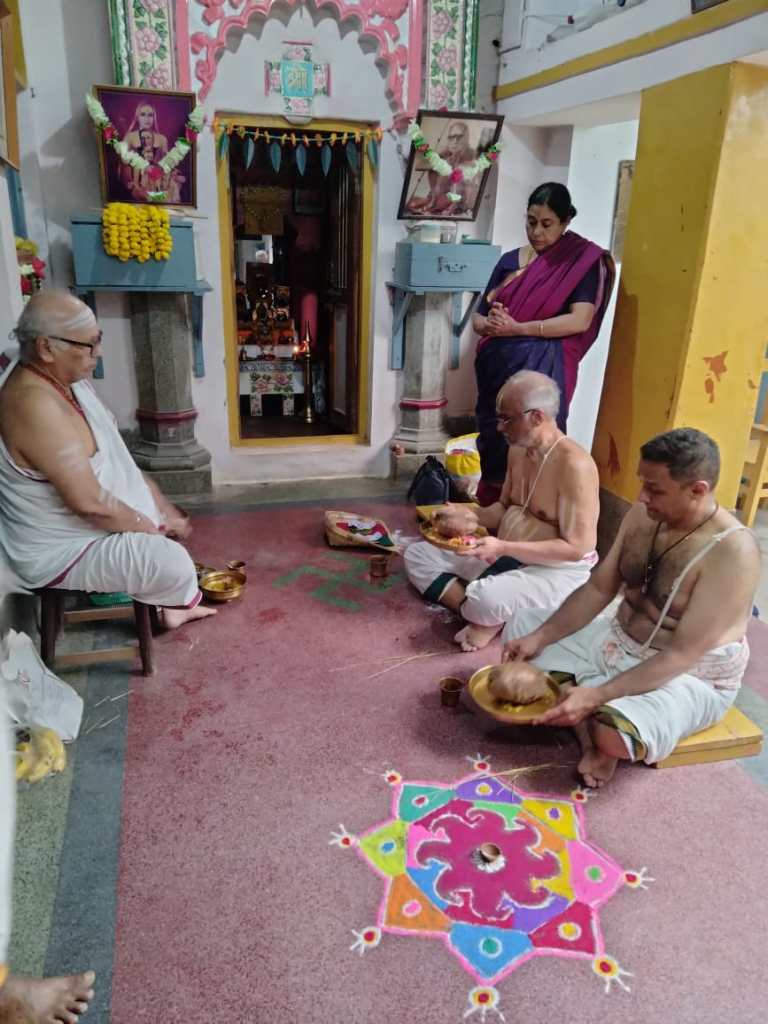
Sri Vasudeva Sastrigal was kind enough to initiate my wife and I into all the rituals commencing first with the “Prayachitta sankalpam“. This is a rite of expiation of one’s sins of commission and omission and transgressions againt dharma and sastra. The expiation is self-purificatory in nature and is in preparation for the other ensuing rituals listed above.
Usually, in performing the “prayaschitta sankalpam” — a fairly elaborate one where many sacred “mantras” and procedures are invoked — it is only the male householder who is the “karta” i.e. the principal and sole performer. The householder’s wife fufills only a secondary role in the proceedings, She either sits or stands beside her husband and participates as aide to him through all the motions. But here at Prayag, there is unique departure from the usual! Here the after the Sankalpam rite is completed by the husband, the same rite is repeated with the wife as the main performer and the husband acts only as secondary participant.
The reason why this is so was well explained to us by the Sastrigal: At Prayag, the ceremonies are to be conducted for the pitrus by individual souls acting in their own capacity as separate Atma-s. The husband and wife are united as couple in life through marriage rites but that does not deny or detract the fact that the wife’s soul is a separate Atma in its very own right…. Therefore, as an individual Atma, she has every right and the solemn duty to be initiated into “prayaschitta sankalpam” as a separate and sovereign Atma, nothwithstanding her other role and normal status in life as a “saha-dharmachaarini” of the husband.
******************
All the rituals mentioned above following the “prayaschitta sankalpam” — “triveni snaanam” “daanam” etc… were conducted aboard the sailing boat that took us across the waters of the River Yamuna to a spot where it merged with the Ganga and the underground Saraswati. The choppy boat-ride lasted less than half an hour.
When we reached the farside of the Triveni confluence, the boatman lashed the vessel to a peg sunk into the shore. Another local pandit appeared suddenly from nowhere, climbed on board and started the ritual proceedings.
After the rites, again suddenly out of nowhere, a barber appeared and climbed on board and informed me it was time for tonsuring my scalp before I went for “snaanam“. (Much to the chagrin of my wife, I resolved to undergo total “shiras” tonsuring. After my having my head clean shaven I sported a small “shika” or tuft as prescribed by sastra. And by the way, as part of the same ritual, the husband too must perform symbolic tonsuring of his wife’s head by snipping off a few strands of the hair falling on her back and then replait it too!). Thereafter, along with the rest of my family members, I took the ritual “triveni” bath.
It felt like a cathartic experience to me as I dunked myself into the cool gushing waters of the Triveni! It did feel like what may be called “janma-saapalyam” — a platonic, ineffable sense of lifetime fulfilment…
I then stood waist deep in the Ganga and performed the “maadhyaanika sandyavandanam” and offered my prostrations to the memory of my parents, grand and great grandparents, maternal and paternal.
Before we had sailed by boat to Triveni-sangam from the the house of Sri.Vasudevan Sastri, we had stopped at and offered prayers to the Deity at the famous Veni Madhava temple where the presiding deity is Vishnu.
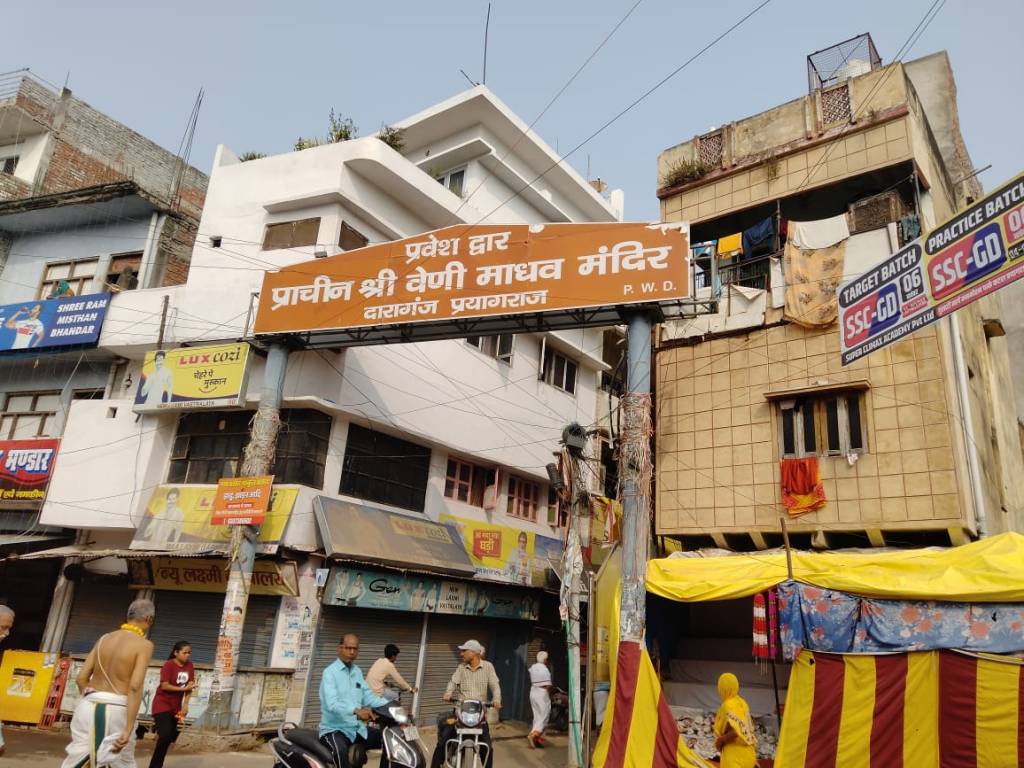
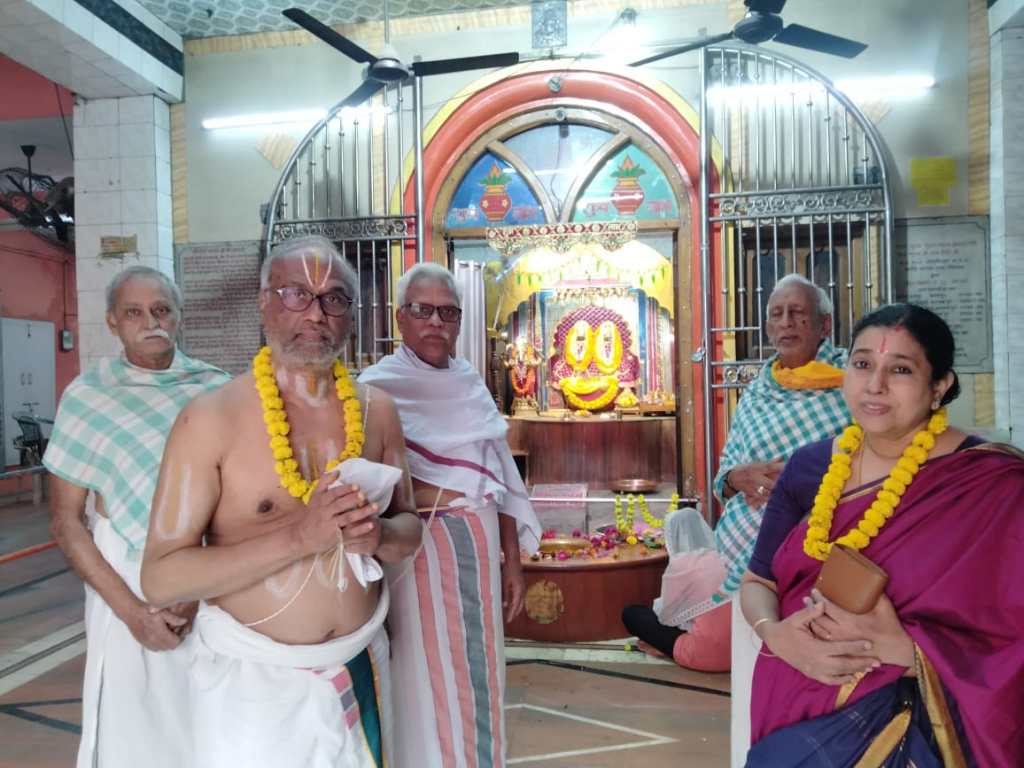
Back in the house of the Sastrigal, my wife and I performed the “Amavaasya and Veni thila tarpanam” and “pinda pradaanam” ceremony in all solemnity and with “shraddha” and all humility.
Thereafter, the family adjourned for the traditional meal that follows all “shraadham” ceremonies.
The entire Prayag ceremony which began at around 7.30 AM was all over by 3 PM when we set out on the return journey to Varanasi.
*****************
More on “shraadham” in the next blogpost.
Sudarshan Madabushi