“Gaya Shraadham” (continued)
The distance from Kashi to Gaya is about 210 kms and the journey by road in a car took us nearly 5 hours with coffee-layabouts on the way as well as the half-hour we also spent on a quick tour of the famous Buddhist pilgrim-centre of Bodh Gaya along the way … about 25 kms ahead of Vishnu Paadam temple in Gaya.
Our walkabout around the Bodh Gaya temple of the Buddha was in the first hour after dusk when darkness was already setting in. No cameras or mobiles were allowed inside the temple of Buddha and hence what I briefly describe below is just a few mental snapshots of mine taken from memory.
The temple complex is a vast rectangular area of several hundred square meters at the centre of which stands a 150+ ft. tall Buddhist Vihaara — gopura, in Hindu parlance. It is said this tower and the adjoining stupas and other structures are as old anywhere between 2nd BCE and 3 and 4th Century CE. This temple too bore the brunt of destruction during the 10-12th century CE Islamic invasions.
The atmosphere within the whole temple complext exudes an ambience of tranquility — so characteristic of the Buddhist tradition. A very tall idol of Buddha is erected in the sanctum where we saw and heard Buddisht monks chanting in sonorous unison from their scriptural texts in Pali. The pilgrims who flocked into the temple precincts seated themselves randomly everywhere — on the manicured lawns, under the planted trees, beside the temple pond; and many more were seated rigid, upright and in silent contemplative pose right opposite the famous Pupil Tree under which it is believed the Buddha sat and meditated and finally attained Enlightenment — he became an “awakened Boddhisatta“. I could see that many of the boddhisattva pilgrims came from faraway countries like Myanmar, Vietnam, South Korea, Thailand… many were Japanese and Sri Lankans.
Within the complex, there is a very sacred spot for all the Buddhist pilgrims. It is a narrow garden pathway on which at equal distance from each other are consecrated the “7 Padma Paadams” of the Buddha. It is is believed that the Buddha in the course of his daily meditations used to constantly pace up and down this garden pathway. His footprints were found on the very same spot by his disciples who then out of veneration for the Buddha, erected stone replicas atop his footprints. The “7 paada padmams” are architectured beautifully as seven large Lotus flowers. The stone structures are ornamented with lovely floral decorations. Many pilgrims seat themselves around these Lotus footprints of the Buddha and meditate for hours on end.
The sight of the 7 footprints of the Buddha at Bodh Gaya, it struck me, was perhaps yet another example of the religious leitmotif of all religions of India where “paada puja” — the concept of worshipping Divinity’s Feet — is so central.
My family and I would wound up our tour of Bodh Gaya and then made our way to Gaya to the temple of Vishnu where the Almighty reveals himself to his devotees as “Vishnu Paadam” — revealing his sacred foot, too.
****************
When we drove into Gaya, it was already well past 7pm in the evening. From a distance, the magnificent temple tower of the Vishnu Paada rose above us in splendour and glory! Almost instantly, for some strange reason, a line from Sri Andal’s Tiruppaavai lines sprang to my mind as I looked up at the “gopuram“: “thoomaNi maadaththuc cuRRum viLakkeriyath * thoopam kamazhath thuyilaNaimEl kaN vaLarum *
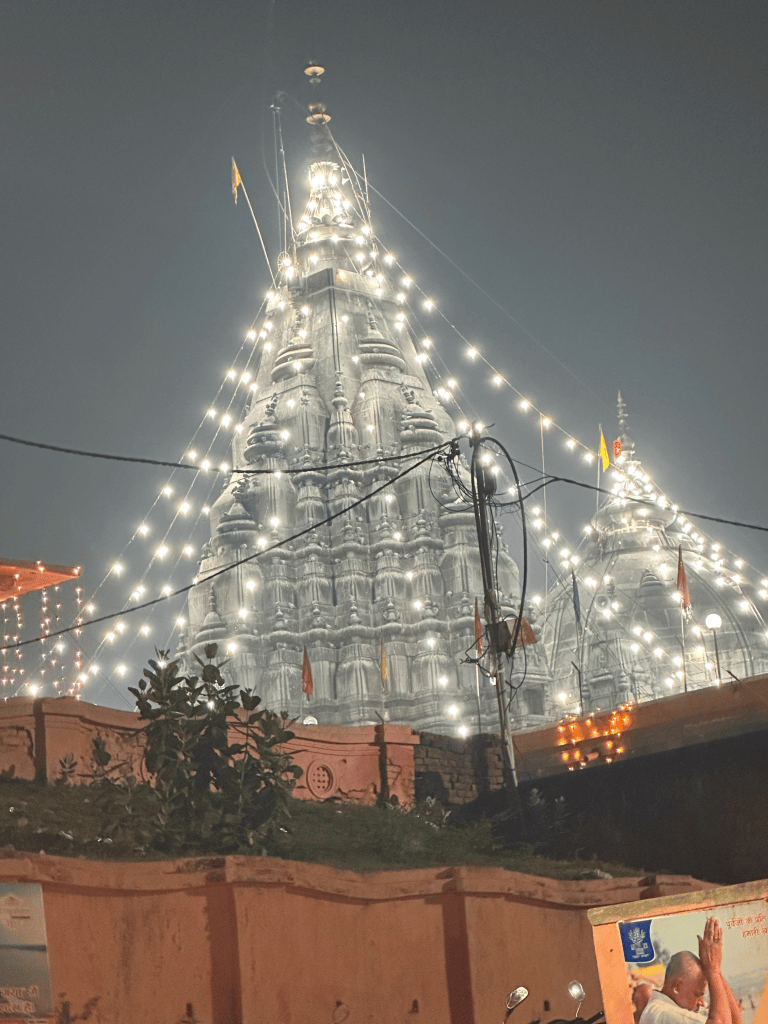
We went inside and had darshan of Vishnu Paadam…
The temple is built of huge grey colored granite blocks. The dome is in the shape of a pyramid and rises to a towering 100 feet. The tower slopes down with alternative indented and plain sections. The tower resembles the peak of a mountain. The temple is in an octagonal shape facing east. There are 45 sacred places said to be between Pretashilla Hill (north) and Bodh Gaya (south), but most are in Gaya itself.
Pretashilla Hill (meaning Hill of Ghosts), is where the ritual “Pinda Daanam” is done for ancestors. It is said that there is a temple of Yama, the God of Death too, on the hilltop, although it was not on our list of shrines to be visited. My family and I were all focused on the main purpose of our pilgrimage to Gaya which was to perform the ritual “shraadham”, the most important funerary rite that a Hindu must perform for his “pitrus” at least once in a lifetime.
******************
That ritual began at dawn the following morning on the banks of the River Phalguni.
Surprisingly, the river which we were earlier told by everyone would be dry as it always was (thanks to the mythical curse of Sita!) , was actually in full and cheerful spate! Her rippling waters washed ashore on the bank where we stood and Phalguni gently lapped against the muddy edge as she seemed to accept and gather up all the littered “pindam” offerings left behind by the many who had already completed the “pinda pradaanam” rite there.
After our ritual dip in the Phalguni, my wife and I were ready for the officiating priest to commence the “gaya shraadham” which comprised of the following main ritual procedures (kramam):
(1) maha sankalpam Palghuni Theerthasnanam (2) Palghuni Hiranya srardham (3) Pinda dhanam, kshetra pinda dhanam, (4) thila tharpanam (5) Vishnu padha hiranya srardham pinda pradhanam kshetra pinda dhanam (6) vishnu padha dharisanam (7) Mathru shodachi (8) Akshya vata anna srardham (with homam) Pinda pradhanam kshethra pinda pradhanam (9) Mathru Shodachi Shaka, patra, pala dhanam Bodhi vruksha Dharshan (10) Braahmana bhojana, dakshina and vastra daanam.
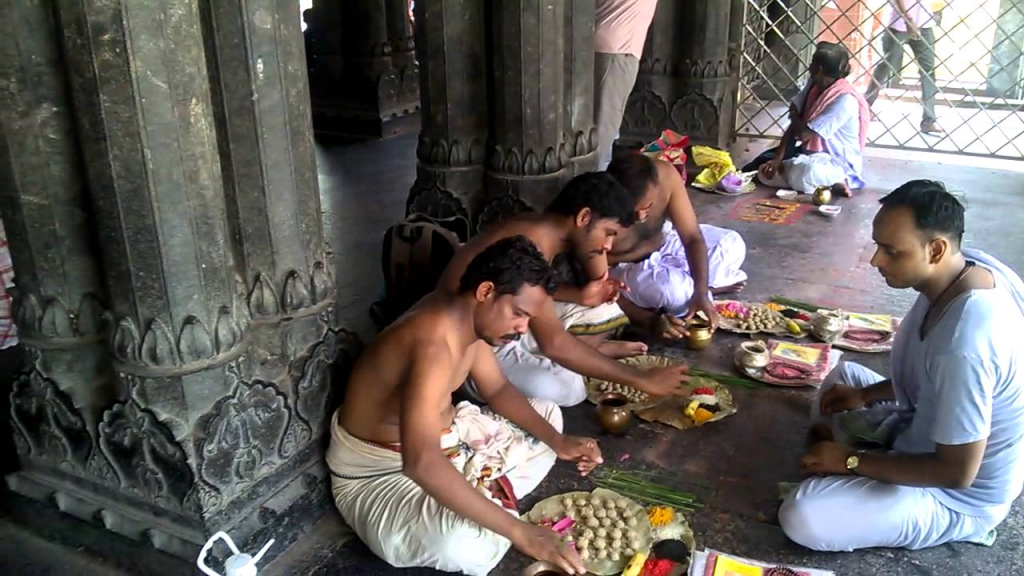
The priest led us up a short but steep flight of stone steps from the river bank into a small “mantapam” overlooking the Phalguni. Unfortunately, we were not allowed to carry cameras or mobiles, so there was no way the “shraadam” ritual could be recorded the family members who accompanied me and my wife. But just to give an idea of the surroundings in which I performed the ritual was conducted, I attach below a stock image of how they looked:
***************
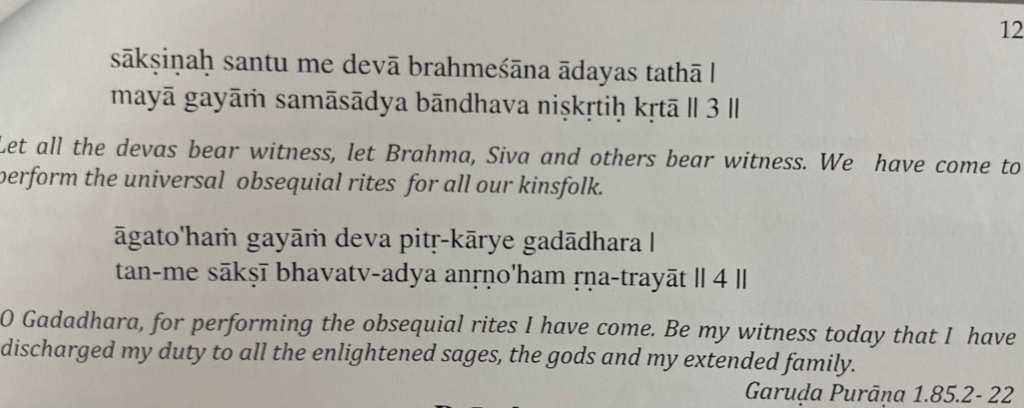
The ritual is conducted with the priest chanting the Vedic mantras as laid down in the relevant “sastra”. Every mantra chanted by him had to be repeated by me after him faithfully, in tone, diction and voice inflection. Every mantra indeed contained very deep spiritual significance. Given below are a few of the main mantras I was guided by the priest to repeat after him in the course of the “shraadham“:

After invoking one’s mother and father, I had to chant the following mantras and offer libations of water and til seeds to the souls of my mother, then father, then to grand-parents and great-grandparents, both paternal and maternal. :

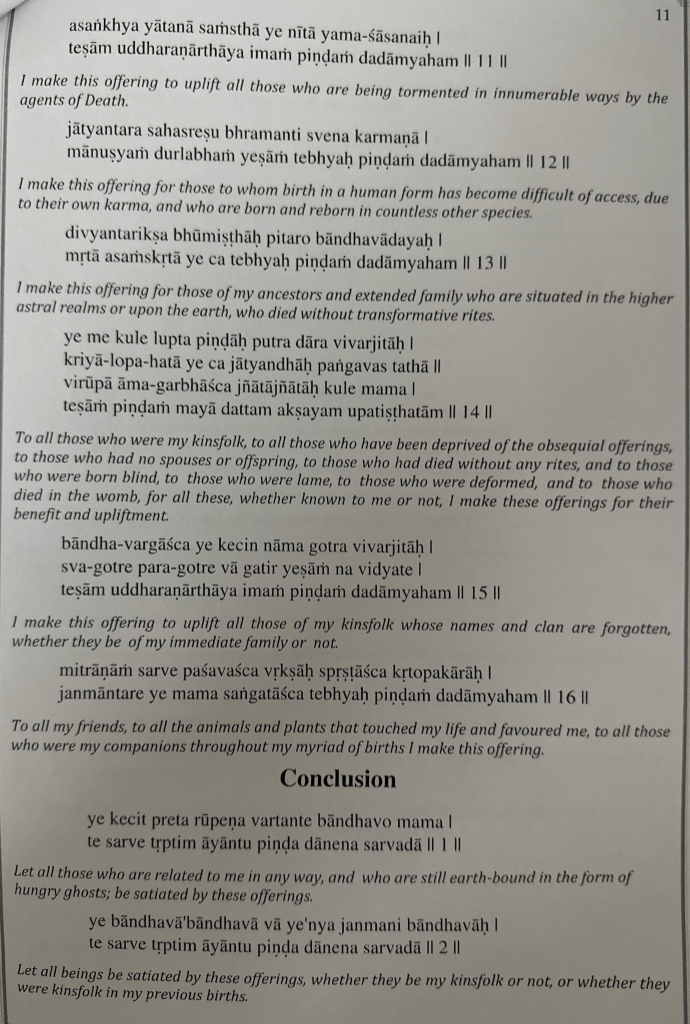
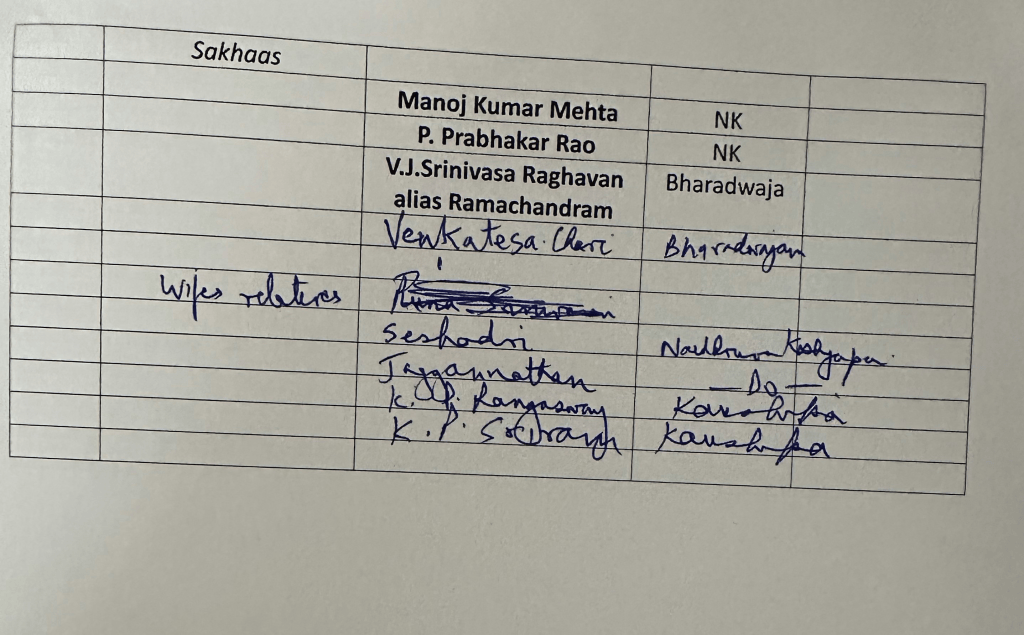
Next, came the part of the ritual where the “pinda pradaanam” is offered again first to mother, then father, then to grand-parents and great-grandparents, both paternal and maternal. Thereafter, the remaining “pindams” are offered as oblations to all other departed “bandhus” (relatives), “mitras” (friends) and “sakhas” (wellwishers to whom I owe some gratitude for help rendered by them to me).
Sixty-four (64) tiny balls (pindam) made of fresh, steamed puffed-rice had to be rolled by hand by my wife.
Sixteen of the “pindams” were then first offered to my mother to the chant of various mantras together with handful of oblations of sacred river-water, til (black sesame) seeds mixed with the rice-ball “pindam“.
In the “gaya shraadham”, the rituals recognise the great role of the mother in a son’s life, the powerful and life-long influence she wields on him, and the pain, suffering and sacrifices she underwent to make a man of him in the world…..
The verses chanted by the priest in this part of the ritual are extremely poignant and can move any son to tears while bringing back a flood of old memories of the thousand little and great kindnesses received from the mother… It certainly did move me to tears even as I choked, blubbered and struggled to get on with the routine of the “shraadham” rite. I suddenly began to remember the day my mother had passed away suddenly, leaving with me stricken with a permanent sense of guilt that I could not be by her side when she breathed her last….
The pain and grief I had experienced then was relived fleetingly by me at Gaya. (In an essay on that distressing experience I had had, became a chapter in my later published book, “The Unusual Essays of an Unknown Sri Vaishnava” (2016 and 2021) and can be read at this URL by those who are interested :
As per the “sastra“, out of the balance left of the 64 “pindams”, all were offered b by me and my wife as our grateful oblations to several other people in my life to whom I was beholden for help, kindness, friendships and affections received in some way or the other.
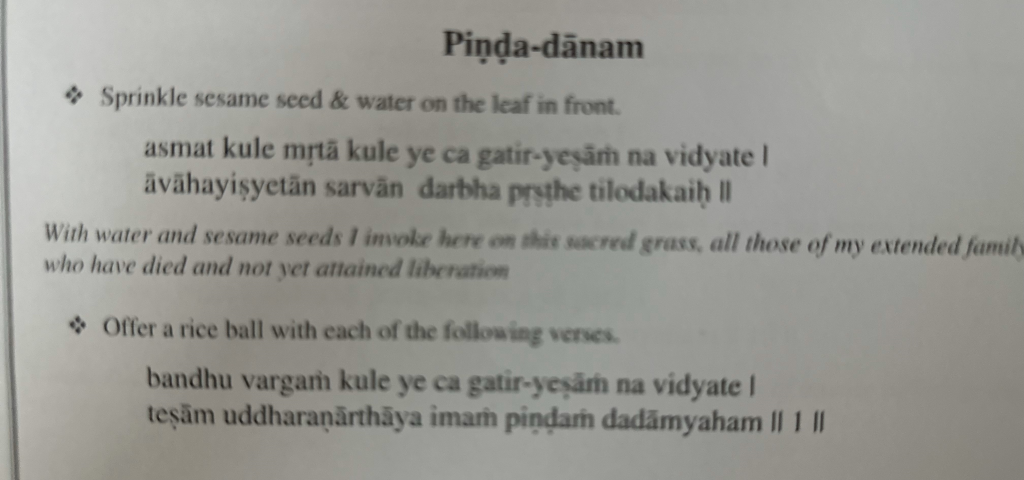
I had already prepared a list of such people and here below I share it:

One rice-ball known as “dharma pindam” was at the end then also offered as universal libation to all ancestors.

The next procedural step in the “shraadham“, as guided by the officiating priest, was for me and my wife to gather up all the 64 “pindams” and bundle them carefully into a cloth bag. We then carried the bundle and began walking from the banks of the Phalguni a short distance into the gates of the “Vishnu Paada mandir” again. There we entered the sanctum and as per the rite laid down in the “sastra“, the priest instructed us to open the cloth-bundle and empty its contents of “pindam” and reverentially place them all upon the consecrated icon of “Vishnu Paadam”.
One part of the Gaya Shraadham was completed.
We went back to the “mantapam” on the Phalguni banks for the second part of the rite viz. the “homam“, the fire ritual in which pindams with ghee are offered as oblations to the pitrus to the chant of Vedic mantras… This “homam” took about 30 minutes to complete. We were not allowed to take photos or videos shots of these proceedings.
My wife and I were now ready for the next rite of “pinda pradaanam” at the site of the “akshaya vatta”, the great Banyan Tree which as per the account in the “purana” had been blessed by Maatha Sita…. A short 10 minute trip on an autorickshaw took us from the Vishnu Paadam temple to Akshaya Vattam site.
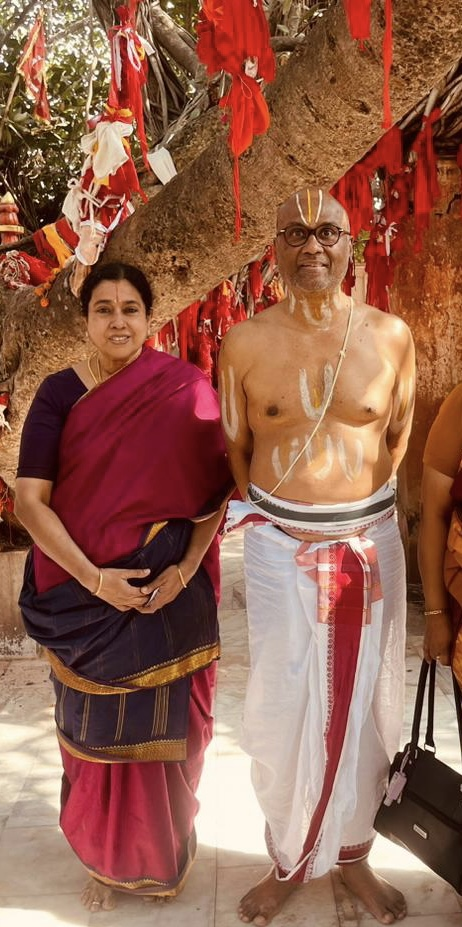
There under the shade of the massive, ageless Banyan Tree whose giant boughs spread high over our heads like a great awning in the sky, we again performed the “shraadham” for our “pitrus” — 64 “pindams” in all…. Thereafter, we did a “pradakshina” of the “akshaya vattam” (circumambulation) and duly completed the penultimate part of the “gaya shraadham“.
*******************
We returned to Gaya, to the home of our “ghanapaadigal” hosts where the officiating priest forthwith commenced the last part of the “gaya shraadham” — Braahmana upachaaram, bhojana, dakshina and vastra daanam.
These rites were allowed to be photo and video-graphed and here below are a few clips:
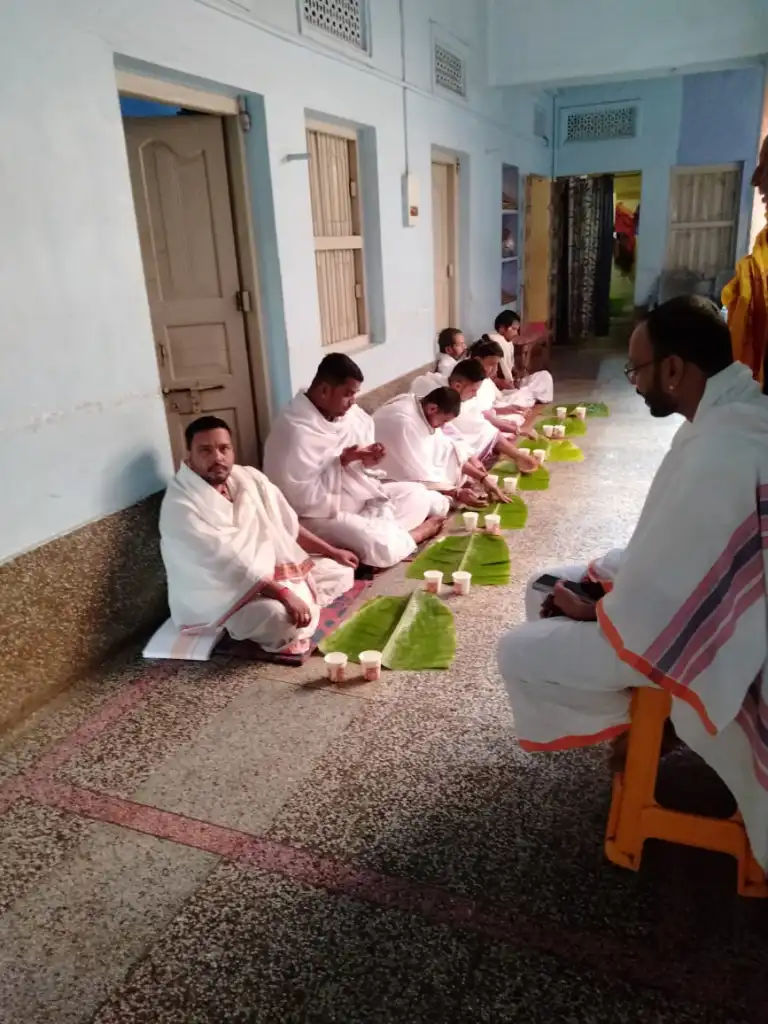
It is customary for the “karta” to chant the Rig Veda passage “Purusha Suktam” during “braahmana bhojanam”. It was my exceptional privilege that I could do so at Gaya.
On the special occasion, I considered it also most apt that I must also recite the “maathru panchakam” additionally to please my “pitrus“, especially my mother.
“maatru-panchakam” of Sri Adi Sankara Bhagavagthpaada
- “aasthAm tAvadiyam prasUti samayE durvArshUla’vyayAda nairUchyE tanushOshaNam malamayee sharayyA cha sAmvatsaree I ekasyApi na garbha-bhAra bharaNa-klEsha-sasya yasyamakshamah: dAtUm nishkrutimmunanntOpi tanayah: tasyai janannyai namah: II
In the throes of painful labor, O mother, You suffered much to beget me who was then but mere burden of ugly, noxious fetal flesh to be borne long and patiently. And so you did with loving expectation! For that one act of love — One act and the gift of suffering, O mother, nothing that I offer thee shall ever suffice as fitting repayment except eternal worship at thy feet!
- gurukulamupasrutya svapnakAlE tu dhrushtvA yatisamuchitavEsham prArudO mAm tvamuchhyai: I gurukulamaBhasarvE prArudathE samaksham sapadi charanayOh: tE mAtarastu praNAmah: II
How can I forget the overwhelming love you felt for me! Remember the day, O mother, when you came running from home all the way to the doorsteps of my teacher’s school with tears welling up in your eyes to tell us about an ill-omened dream you’d had the night before— s dream that spoke of the imminence of a mother’s loss ehen the son appeared dressed in the ochre robes of a renunciate: the nomadic mendicant ‘sannyAsi’. You were heart-broken that day, O mother, snd you broke the hearts of my teacher and my fellow-students too, so forceful was your motherly passion!
- na dattam mAtastE maraNasamayE tOyamapi vA svabaddhA bA nOdEyA maraNadivasE shradha-vidhinA I na japtO mAtastE maraNa-samayE tArakamanuh: a kAlE samprAptE mayi kuru dayAm mAtaratulAm II
In your final moments, O mother, I regret I wasn’t around to able to hold you in my arms, help quench your parched throat with those morsels of water every son pours into the lips of a dying parent as last farewell gift. The vows of ‘sannyAsa’ I embraced, O mother, held me back from the rites of “shrAddha” meant for your soul; Nor could I administer thee, as every dutiful son should, the words of the sacred chant of “taraka-nAma mantra” as you breathed your last. I turned up late, so very late, O mother of mine, to bid farewell. Show me kindness, a mother’s kindness, in your very last act of forgiveness for the son that failed you.
- mUkthA maNistvam nayanam mameti rAjEti jeevEti chiram sutathvam I ithyukthavatyA tava vaachi mAtah: dadAmyaham tandulamEva-shushkam II
“My precious gem”, “My precious eyes”, “My little king”, “My very breath and life!”…. Such were the terms of endearment you used to heap upon me, O mother! For all the love showered on me in such phrases, I have only these few uncooked seeds of rice to pour upon your lifeless lips in solemn and final thanks — a sacred obsequy: a token of the un-cancellable debt this son owes his mother.
- ambEti tAtEti shiveti tasmin prasUtikAlE yadavOcha ucchaih: I krishnEti gOvinda hare mukundE tyahO janannyai rachitOyamajalih: II
When you brought me forth into the world from out of your agonized but compassionate womb, you uttered aloud, it is said, the holy names of God: “O Divine Mother! O Lord my Father! “O Shiva! O Krishna! Govinda! “Harey! Mukunda!” That was an act of kindness too, O mother! For that was the chant of sacred names and the moment of my deliverance too! How shall I thank thee for that deed except by offering thee my soul’s eternal worship!
*******************
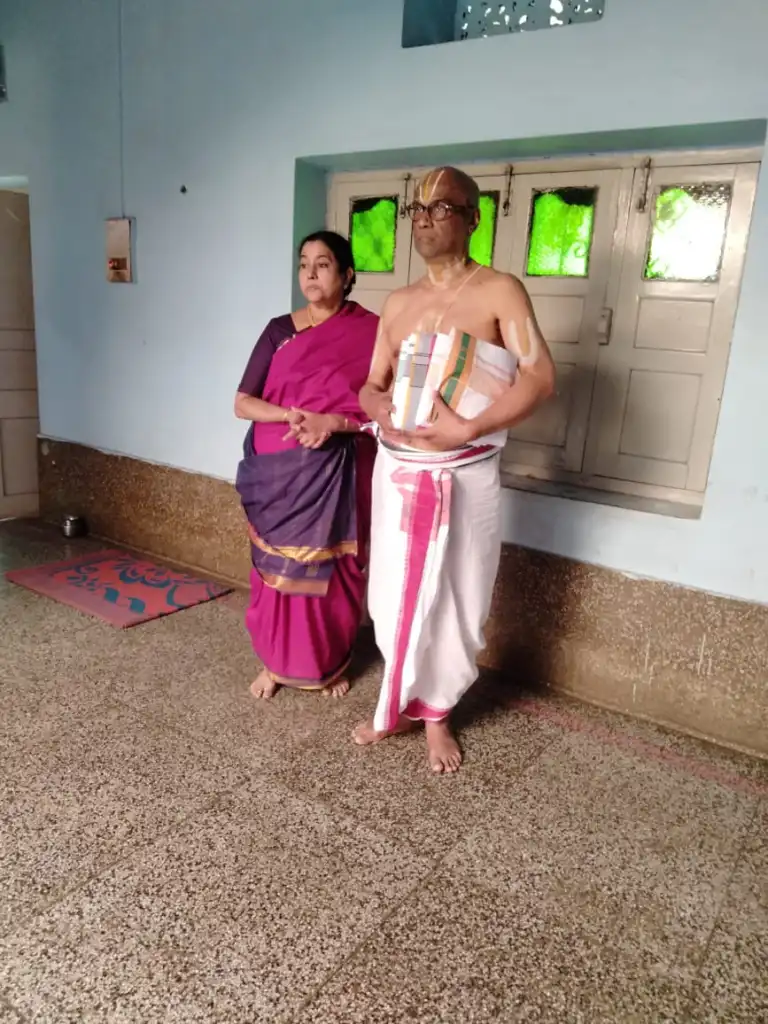
The final part of the “shraadham” ritual was “daanam” to the “Vaideeka Braahmanas”:
*******************
Thus ended the “Gaya Shraadham” — a lifetime experience for me and my wife, from which we gained the fulsome blessings of our “pitrus” as ordained by the Vedic “sastras”.
We were now ready to journey through the last leg of our pilgrimage — to Ayodhya, the City of Sri Rama!
Sudarshan Madabushi
Unbelievably well written.No body equals mother.So I have always felt that death will be a great occasion for me too.
For I will be fortunate to go back to the roots.That is back to my mother from whom I came .
Thanks for recording the various procedures regarding the Gaya Shradhdham. Very useful info. Dhanyosmi
🙏💐