“Alinganam”
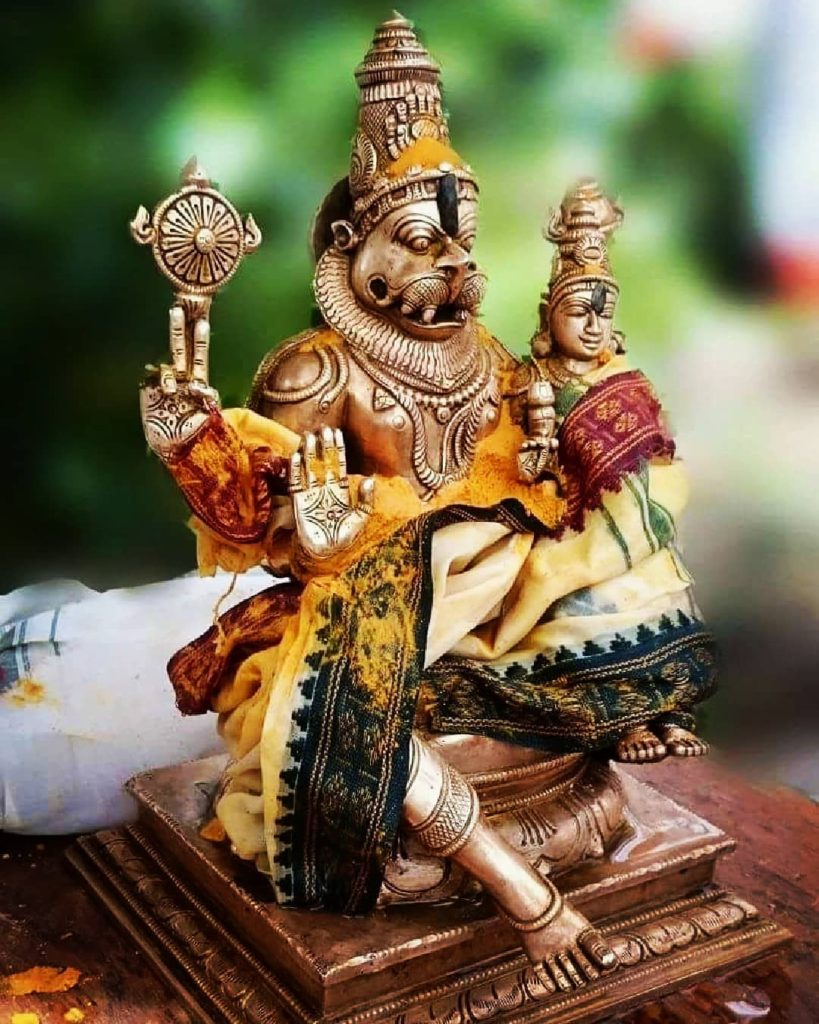
This word “aalinganam” is one of the most beautiful sounding words in the Sanskrit language. One needs to read only two lines of poetry quoted below to understand what I mean…. They are found in an invocatory verse (in the stotra “narasimha prappathi”) sung in praise of the Deity of the great temples on the lovely Hills of Ahobilam (Andhra Pradesh), Sri Lakshminarasimhaswamy also known as Sri Maalolan:
“AhobilE Garuda shaila madhyE krupAvashAth kalpitha sannidhanam | lakshmyA samAlingitha vAmaBhAgam Lakshminrusimham sharaNam prapadyE ||“
(meaning): My Lord LakshmInrsimha, out of compassion reveals his divine, glorious presence (“kalpita sannidhAnam”) thus on the high hills of GaaruDa Sailam! He is seen with Goddess Mahalalakshmi on his left side (“vaama bhaagam”) embracing him tightly (“samaalingitha”) ! I seek eternal refuge in you, Lord Almighty!
The avataric appearance of Sri Nrisimhan is so unique, special and glorious. But that is not only due to the fact that he assumed a fearsome Man-Lion form; nor the fact that he resides today in nine different forms (nava narasimha svarupam) on the high and secluded, inaccessible hills of Ahobilam. What makes him so unique is that his beloved Consort is seen in an endearingly tender pose with him. She is seen embracing him, holding him in a tight but gentle clasp in her arm… as if to suggest to devotees, “Look, He is of fearsome, terrible mien, yes, but He is still mine…. and mine alone!” That pose of hers is truly classic and beatific… It is classic “aalinganam“!
*************
The act of Embracing is a singularly human gesture.
A person is moved to embrace when there is really no other adequate means of experessing to another person sudden and spontaneous feeling. Such feelings may be various and complex. They can descend upon one in a sudden and unexpected rush of love, affection, admiration, of gratitude and pure joy…
When words fail, when it is impossible to vent overwhelming flood of emotion, it is only to the act of “aalinganam” that one can ever turn to and be able to reveal what springs forth from the heart.
The act of “alinganam” is reflective also of a certain subconscious sense of Possessiveness. When one embraces another out of Joy, Gratitude, Love, Affection, Admiration... no matter of what degree of intensity…. the act of “aalinganam” itself signifies — in a very deep sort of way — one’s claim to complete possession of the other. Embracement is very much a subconsciously made physical statement. The person embracing is expressing an unspoken thought : this person who I have gathered in my arms now in an intimate “aalinganam” is so much my very own … my own belonging, is a part of me, inseparable from me …. So, “alinganam” is in a very real sense an instinctive, spontaneous expression of protective possessiveness. It is akin to a mother embracing her infant; she feels both possessive and protective towards the child, does she not?
In the Bhagavath-Gita, through one of his utterances, Sri Krishna affirms that very same sense of protective possessiveness which he confesses he himself feels towards those devotees he describes as “madhbhaktha” — “my very own”! :
अनपेक्ष: शुचिर्दक्ष उदासीनो गतव्यथ: |
सर्वारम्भपरित्यागी यो मद्भक्त: स मे प्रिय: || 12. 16||
anapekshah shuchir daksha udasino gata-vyathaht
sarvarambha-parityagi yo mad-bhaktah sa me priyah
He who is indifferent to worldly gains, is pure, externally and internally, is productive in life, is not care worn, untroubled, and free from selfishness…. such devotees of Mine are very, very dear to Me.
****************
In the Valmiki Ramayana, the act of “aalinganam” is described by the poet in 4 memorable, tender scenes. In each of them, Sri Rama either embraces someone or is embraced himself.
In the Ayodhya Kandam, out of gratitude for the service the tribal boatman, Guha, rendered to him in the forests, for having ferried him, Sita and Lakshmana safely across the River Tamasa to Chitrakoot, Rama embraced Guha. That “alinganam” sealed the pact of loyalty of Guha to Rama… That’s possessive protection granted in a sense to a tribal of the forests by the great Sovereign of Ayodhya.
Later, in the Dandakaranya forests, from the scenes described in the Aranya Kanda, we learn how when Rama single-handedly defeated the armies of Khara and killed the dreaded rakshasa, Sita was thrilled to witness the heroism of her husband ! She was filled with so much admiration for his extraordinary valour in battle, that she couldn’t help rushing to him and embracing him! …. Possessive protection again, and a very natural conjugal emotion under the circumstances.
In the Kishkinda Kandam, the Ramayana tells us that after Hanuman returned from his whirlwind reconnaisance mission to Lanka and gave to Rama the happy news of Sita’s whereabouts, Rama’s joy knew no bounds…. He gathered up Hanuman in his arms in a warm embrace and smothered him! Possessive protection again! Hanuman became the quintessential “ram-bhakth” — a liege of Rama and very dear to him. Hanuman was assured of Rama’s eternal grace and protection.
The fourth scene of “aalinganam” in the Ramayana is described towards the end of the Yuddha Kandam. It is such a moving scene too …. It happens at Nandigram.
After the war in Lanka, Rama returns to Nandigram first where he meets with Bharatha who is waiting for him eagerly. When the two brothers meet, after 14 long years of separation, neither Rama nor Bharatha are able to control their emotions! They shed tears and embrace each other! Their act of “aalinganam” is described very vividly by Rishi Valmiki:
तंसमुत्थाप्यकाकुत्स्थश्चिरस्याक्षिरथंगतम् ।। अङ्केभरतमारोप्यमुदितःपरिषस्वजे ।
“Kakuthsa Rama, in unbounded joy, gathered Bharatha up in his arms, lifted him off his feet, and embraced him, holding him thigh-high in the air!”.
The phrase अङ्केभरतमारोप्य…. refers to the “thigh“! Which one must imagine means that Rama held Bharatha in more than a just a fraternal hug or embrace …. it was not even just “aalinganam“… it was “परिषस्वजे …”! It was almost a cramping bear-hug! In other words, Bharatha was swept of his feet by the elder brother, lifted off the ground, thigh high, and clasped tight in “aalinganam”! Such was the intense love and affection between the two long-lost brothers!
****************
It was to witness and relive by imagining that scene again of Rama- Bharatha “alinganam” that my family and I drove the short distance of about 28 Kms. from Ayodhya city to the small nearby town of Nandigram — to the exact spot where as per the Valmiki Ramayana, Bharatha retired and lived in long ascetic seclusion during the entire period of Rama’s exile away from Ayodhya.
It was at Nandigram where the “Rama paadukas” (the sacred Sandals of Rama) were consecrated by Bharatha (i.e. “paaduka pattaabhishekam“). It was from those “paadukas” that he drew power and inspiration to rule the vast kingdom of Ayodhya as Rama’s appointed regent and delegatee.
The Nandigram we saw was a very small, non-descript enclave utterly unlike the grandeur of Ayodhya city. It’s ambience was sparse, very austere and so very reflective of the personality and character of Bharatha himself — reclusive, self-abnegating, pure of spirit, equanimous, unselfish, and utterly indifferent to wordly gains.. in other words, exactly as the Bhagavath-Gita might itself have described him with the same words : अनपेक्ष: शुचिर्दक्ष उदासीनो गतव्यथ:… सर्वारम्भपरित्यागी !

My wife and I offered worship at the small shrine where it is believed Bharatha did consecrate the sacred “Rama paadukas”…..

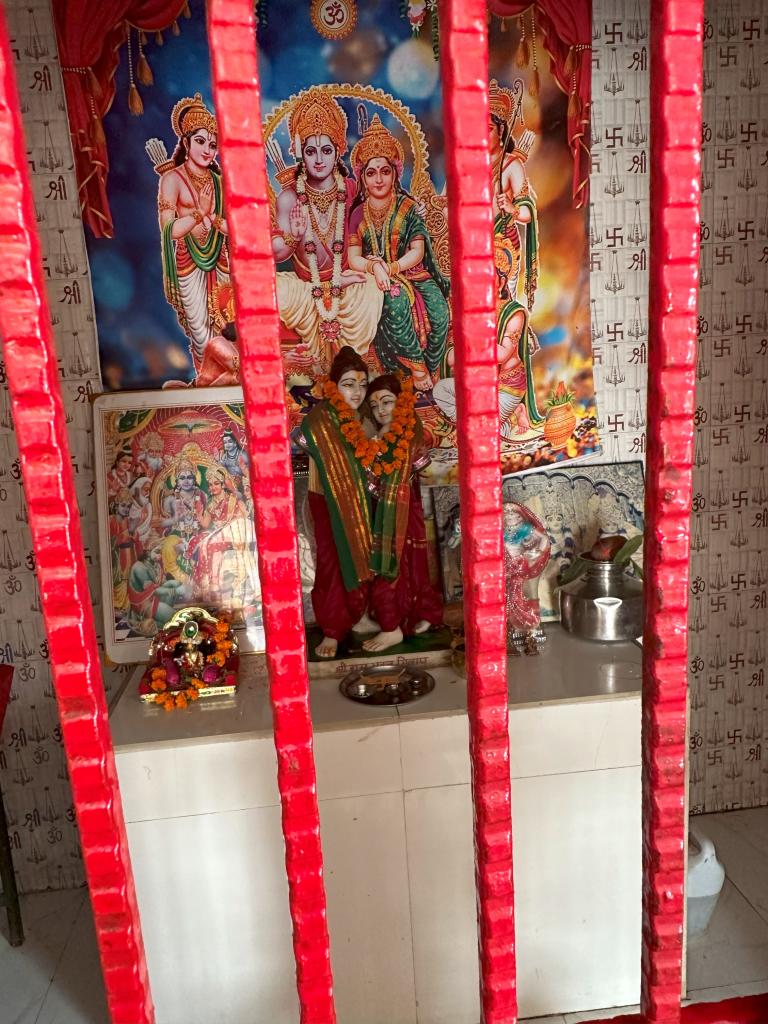
Thereafter, my family and I offered our worship at the adjacent “sannidhi” where there is beautiful iconic enactment of the “Rama-Bharatha aalinganam“:

Below is a close-up photograph and if you zoom in and look closely you will see 2 small icons embracing — the momentous “alinganam” of Bharatha and Rama in the Valmiki Ramayanam:
So soul-stirring was the tranquil ambience of Nandigram, that it impelled me at once to seat myself outside the “sannidhi“, take out my copy of the “Gayatri Ramayana” and begin recital of the brief story of the Ramayana :
गायत्री रामायण
(गायत्रीमन्त्र अक्षराणां (वर्णानां) श्रीमद् वाल्मीकिरामायणे प्रदर्शिताः)
तपस्स्वाध्यायनिरतं तपस्वी वाग्विदां वरम् । नारदं परिपप्रच्छ वाल्मीकिर्मुनिपुङ्गवम् ॥ (बालकाण्ड १.०१.००१॥१॥)
स हत्वा राक्षसान्सर्वान् यज्ञघ्नान् रघुनन्दनः । ऋषिभिः पूजितस्तत्र यथेन्द्रो विजयी पुरा ॥ (बालकाण्ड १.०३०.०२४२॥)
विश्वामित्रः सरामस्तु श्रुत्वा जनकभाषितम् । वत्स राम धनुः पश्य इति राघवमब्रवीत् ॥ (बालकाण्ड १.०६७.०१२॥)३॥
तुष्टावास्य तदा वंशं प्रविश्य च विशाम्पतेः । शयनीयं नरेन्द्रस्य तदासाद्य व्यतिष्ठत ॥ (अयोध्याकाण्ड २.०१५.०२०॥)४॥
वनवासं हि सङ्ख्याय वासांस्याभरणानि च । भर्तारमनुगच्छन्त्यै सीतायै श्वशुरो ददौ ॥ (अयोध्याकाण्ड २.०४०.०१४॥ ५॥)
राजा सत्यं च धर्मश्च राजा कुलवतां कुलम् । राजा माता पिता चैव राजा हितकरो नृणाम् ॥ (अयोध्याकाण्ड २.०६७.०३४॥ ६॥)
निरीक्ष्य स मुहूर्तं तु ददर्श भरतो गुरुम् । उटजे राममासीनं जटामण्डलधारिणम् ॥ (अयोध्याकाण्ड २.०९९.०२५॥ ७॥)
यदि बुद्धिः कृता द्रष्टुमगस्त्यं तं महामुनिम् । अद्यैव गमने बुद्धिं रोचयस्व महामते ॥ (अरण्यकाण्ड ३.०११.०४३॥ ८॥)
भरतस्यार्यपुत्रस्य श्वश्रूणां मम च प्रभो । मृगरूपमिदं व्यक्तं विस्मयं जनयिष्यति ॥ (अरण्यकाण्ड ३.०४३.०१८॥ ९॥)
गच्छ शीघ्रमितो राम सुग्रीवं तं महाबलम् । वयस्यं तं कुरु क्षिप्रमितो गत्वाऽद्य राघव ॥ (अरण्यकाण्ड ३.०७२.०१७॥ १०॥)
देशकालौ भजस्वाद्य क्षममाणः प्रियाप्रिये । सुखदुःखसहः काले सुग्रीववशगो भव ॥ (किष्किन्धाकाण्ड ४.०२२.०२०॥ ११॥)
वन्दितव्यास्ततः सिद्धास्तपसा वीतकल्मषाः । प्रष्टव्या चापि सीतायाः प्रवृत्तिर्विनयान्वितैः ॥ (किष्किन्धाकाण्ड ४.०४३.०३३॥ १२॥)
स निर्जित्य पुरीं लङ्कां श्रेष्ठां तां कामरूपिणीम् । विक्रमेण महातेजा हनूमान् कपिसत्तमः ॥ (सुन्दरकाण्ड ५.०४.००१॥ १३॥)
धन्या देवाः सगन्धर्वाः सिद्धाश्च परमर्षयः । मम पश्यन्ति ये वीरं रामं राजीवलोचनम् ॥ (सुन्दरकाण्ड ५.०२६.०४१॥ १४॥)
मङ्गलाभिमुखी तस्य सा तदासीन्महाकपेः । उपतस्थे विशालाक्षी प्रयता हव्यवाहनम् ॥ (सुन्दरकाण्ड ५.०५३.०२६॥ १५॥)
हितं महार्थं मृदु हेतुसंहितं व्यतीतकालायतिसम्प्रतिक्षमम् । निशम्य तद्वाक्यमुपस्थितज्वरः प्रसङ्गवानुत्तरमेतदब्रवीत् ॥ ६.०१०.०२७॥ १६॥
धर्मात्मा रक्षसश्रेष्ठः सम्प्राप्तोऽयं विभीषणः । लङ्कैश्वर्यमिदं श्रीमान्श्रुवं प्राप्नोत्यकण्टकम् ॥ (युद्धकाण्ड ६.०४१.०६८॥ १७॥)
यो वज्रपाताशनिसन्निपातान्न चुक्षुभे नापि चचाल राजा । स रामबाणाभिहतो भृशार्तश्चचाल चापं च मुमोच वीरः ॥ (युद्धकाण्ड ६.०५९.१३९॥ १८॥)
यस्य विक्रममासाद्य राक्षसा निधनं गताः । तं मन्ये राघवं वीरं नारायणमनामयम् ॥ (युद्धकाण्ड ६.०७२.०११॥ १९॥)
न ते ददृशिरे रामं दहन्तमपिवाहिनीम् । मोहिताः परमास्त्रेण गान्धर्वेण महात्मना ॥ युद्धकाण्ड ६.०९३.०२६॥ २०॥
प्रणम्य देवताभ्यश्च ब्राह्मणेभ्यश्च मैथिली । बद्धाञ्जलिपुटा चेदमुवाचाग्निसमीपतः ॥ युद्धकाण्ड ६.११६.०२४॥ २१॥
चलनात्पर्वतस्यैव गणा देवाश्च कम्पिताः । चचाल पार्वती चापि तदाश्लिष्टा महेश्वरम् ॥ (उत्तरकाण्ड ७.०१६.०२६॥ २२॥)
दाराः पुत्राः पुरं राष्ट्रं भोगाच्छादनभोजनम् । सर्वमेवाविभक्तं नौ भविष्यति हरीश्वर ॥ (उत्तरकाण्ड ७.०३४.०४१॥ २३॥)
यामेव रात्रिं शत्रुघ्नः पर्णशालां समाविशत् । तामेव रात्रिं सीतापि प्रसूता दारकद्वयम् ॥ (उत्तरकाण्ड ७.०६६.००१॥ २४॥)
इदं रामायणं कृत्स्नं गयत्रीबीजसंयुतम् । त्रिसन्ध्यं यः पठेन्नित्यं सर्वपापैः प्रमुच्यते ॥
इति गायत्रीरामायणं सम्पूर्णम् ।
*********************
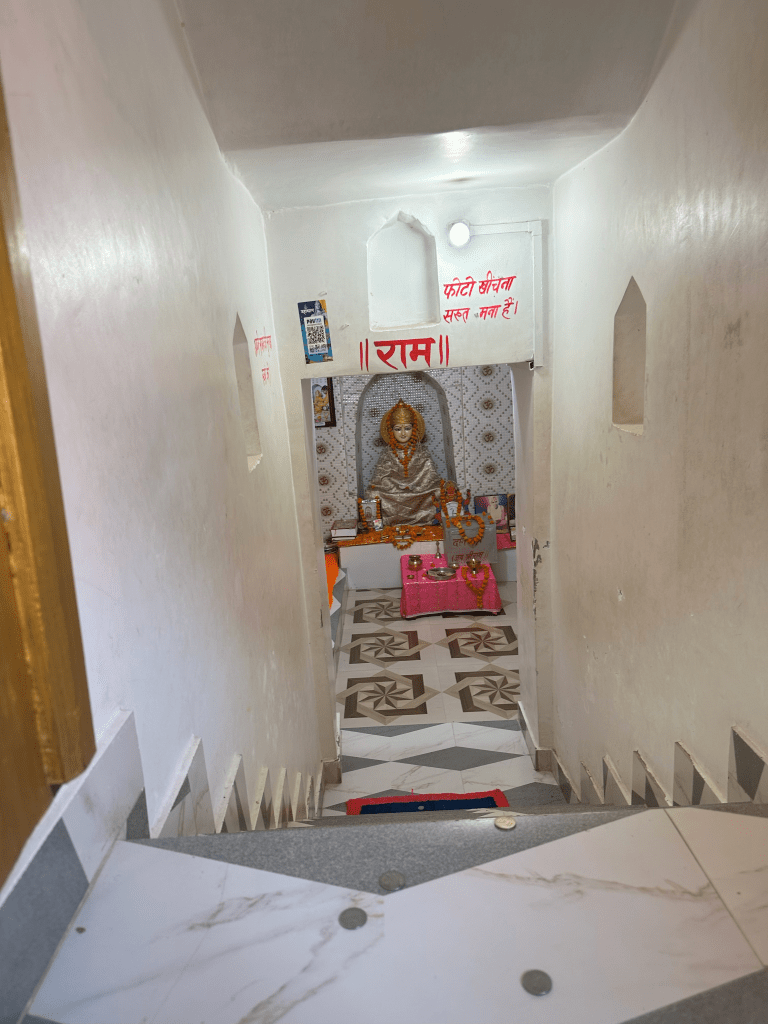
Within the same Nandigram enclave, at a little distance away from the main shrine, there is small structure housing the underground declivity (a cave like enclosure) in which it is believed Bharatha used to retire into to perform deep meditation.
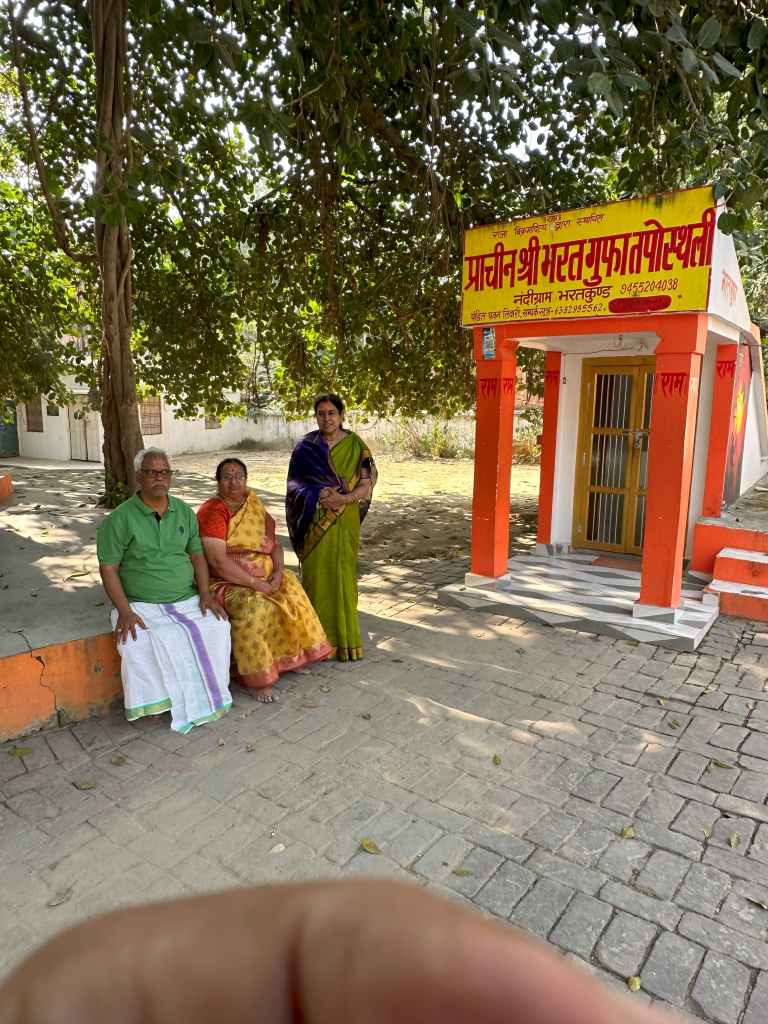
Peering into that small cave gave me mild horripilations… I felt a little claustrophobic. And to think that many millennia ago, inside the very same desolate cave in Nandigram, the ascetic Bharatha lived for 14 long years while he waited for the return of Sri Rama! The very thought must send a shiver of profound sadness indeed down anyone’s heart….
*******************
As we drove away from Nandigram late that afternoon back to Varanasi, I found myself still dwelling upon the images I had just witnessed of the “rama bharatha aalinganam” and the austere surroundings in which for 14 long years Bharatha had chosen to sequester himself and perform his severe “tapas“…. self-flaggelating “tapas“, torturous sacrifice he endured for the sake of his brother, Sri Rama.
Bharatha’s “tapas“, both in intensity and duration, had indeed been no less painful than the “tapas” Rama endured himself during his long exile away from Ayodhya. The whole story of the Ramayana is thus a tale of “tapas” told by a “tapasvi” about the unceasing, uncompromising “tapas” of two other “tapasvis”… ! So it is not just mere coincidence that that the Valmiki Ramayana itself begins with the word “tapas“:
तपस्स्वाध्यायनिरतं तपस्वी वाग्विदां वरम्। नारदं परिपप्रच्छ वाल्मीकिर्मुनिपुङ्गवम् ॥ (१.१.१)
Sage Valmiki, ever engaged in austerities and reading of scriptures, asked Narada, foremost among Munis and a Master in the art of word craft (speech).
What were Valmiki’s questions? They are in the following slokas:
कोन्वस्मिन् सांप्रतं लोके गुणवान् कश्च वीर्यवान्।
धर्मज्ञश्च कृतज्ञश्च सत्यवाक्यो दृढव्रतः ॥ (१.१.२)
चारित्रेण च को युक्तः सर्वभूतेषु को हितः ।
विद्वान् कः कस्समर्थश्च कश्चैकप्रियदर्शनः॥(१.१.३)
आत्मवान् को जितक्रोधः द्युतिमान् कोऽनसूयकः।
कस्य बिभ्यति देवाश्च जातरोषस्य संयुगे ॥(१.१.४)
एतदिच्छाम्यहं श्रोतुं परं कौतूहलं हि मे।
महर्षे त्वं समर्थोऽसि ज्ञातुमेवं विधं नरं ॥(१.१.५)
O Naradamuni, Is there any man on this earth now who has all sterling qualities, who is valiant, who knows what is dharma, who acknowledges with gratitude whatever help is rendered to him, who always speaks the truth, who is firm on his commitments, whose conduct is unblemished, who thinks of the welfare of all beings, who is wise and competent, who has a pleasing appearance, who is rooted in his Atma, who has conquered anger, who gives out light, who is not envious and whom even the devas fear when he is afire with anger in a war? I want to hear about him from you. I am keenly interested in this. You must be knowing someone with all these attributes?
And Sage Narada then replied saying that, in his knowledge, there was only one man with those sterling qualities that walked the earth… And then he began narrating for the benefit of Valmiki, a synoptic story of the Ramayana.
As we left Nandigram miles and miles behind us on our own journey by road back to Kashi, my mind that evening was in a state of strange stillness. I was thinking to myself, if ever there had been a “tapasvi” equal to Sri Rama himself, and if Rishi Valmiki had then asked Narada Muni, about such a man, surely, wouldn’t his reply have been only this?
“If you put the question that way, then I must say there is none other on earth than Bharatha!”
*******************
TAILPIECE
I now end this 8-Part series of blogposts with a tailpiece about my own personal experience of “alinganam” during the 2-week long pilgrimage of “snaanam”, “daanam”, “shraadham” and “darsanam” at Kashi, Prayag, Gaya and Ayodhya.
You must first look at these photos below and then also watch the short video-clip :
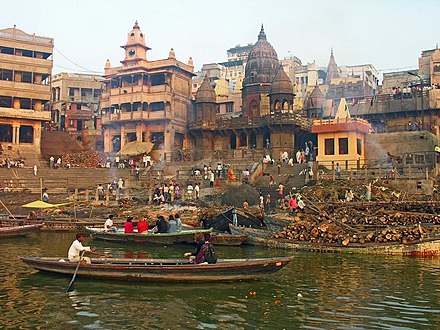
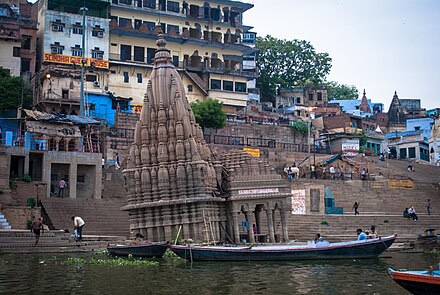
The two photos above are of the famous Manikaarnika Ghat. As I have already written in Part-6, Manikarnika Ghat (मणिकर्णिका घाट) is one of the holiest cremation grounds among the sacred riverfronts located on the River Ganges at Varanasi. https://timesofindia.indiatimes.com/readersblog/aashutosh-kumar/manikarnika-ghat-where-bodies-are-consumed-by-flames-50694/. It is where I went along with my family members to perform the ritual “snaanam” that precedes the conduct of “Kshetra shraadham and pinda daanam” in honour of my “pitrus”.
In the photo above, will be seen a small Mantapam — a stone-enclosure adjoining a larger tower-like structure . It is inside this enclosure that pilgrims come with their officiating priests to perform funerary rites at Kashi. The edge of the enclosure overhangs the great, majestic Ganga as she flows past the Ghat. Watch the video-clip:
***************
It was not only the religious significance of the “snaanam” at the Manikaarnika Ghat that seemingly cast a spell of enchantment on me… it was also just the thought of immersing myself, for the first time in my life, in the cold, deep and clear waters of the great, mythic River Ganga that filled me with a strange exhilaration.
I stood on the bare, wet stone floor of the “Mantapam” and gazed long at the magnificent sight of the swift Ganga waters flowing past me below my feet…. In hindsight, I think I momentarily and unknowingly went into a bit of a trance…
At the Manikaarnika Ghat, the civic authorities strictly forbid pilgrims from having “snaanam” anywhere other than on the Ghat steps that gently slope down from the water’s edge and descend for a few metres into the muddy and shallow depths of the bathing sections near the Ghat. They are the safest outer limits upto which people are allowed to wade waist or neck-deep into the river for ritual “snaanam” .
The boatman who ferried me and my family from Hanuman Ghat to Manikaarnika Ghat brought us safely ashore, lashed the boat securely there and told us to de-board and proceed with our rituals. “Please do not bathe anywhere else other than in the safe areas marked at the Ghat”, he politely cautioned us and disappeared away for a cup of morning tea at a stall somewhere in the vicinity of the Ghat.
All my family stepped gingerly on to the steps of the Ghat and proceeded to perform their “snaanam” and “anushtaanam”, while I proceeded to climb up the steep flight of steps and walk a couple of hundred metres to the “Chakra Pushkarani Kund” , the sacred pond which in mythic times was believed to have been built by Vishnu Himself and where his divine weapon the Chakraayudha was washed off its stains.
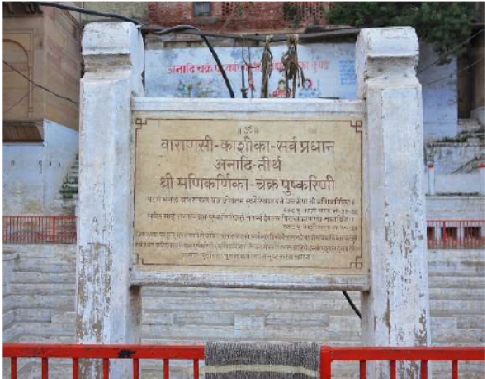
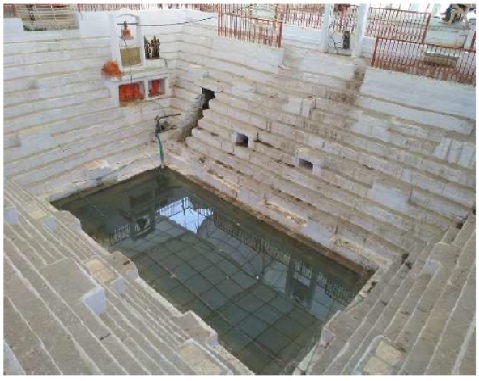
The Chakra Theertha Kund was absolutely dry… So, the only “snaanam” possible for me there was to gather a handful of caked soil strewn upon the pond-bed and worshipfully smear it upon my head.
Thereafter , I returned to the Ghat again and prepared to perform my own ritual “snaanam” while the other family members, having finished theirs already, were readying to board the boat and sail the return journey back to our camp-base at Hanuman Ghat.
************
I ascended the stone steps and climbed into the Mantapam ….
The sight of the rapid Ganga waters then in that precise moment — the river’s sheer volume, ineffable beauty and grandeur —- simply took my breath away.
An instantaneous, irrepressible desire to plunge into Maa Ganga’s embrace seized me. Without stopping for even a fraction of a second to heed the earlier warning given me by the boatman —not to venture into the river from anywhere but the sandy slopes of the Ghats — from the stony edge of the high platform abutting the Mantapam , I found myself diving headlong into the lovely, bewitching arms of Ganga….
In the instant I plunged in, the only sound I heard was the screaming voice of the boatman behind me, “O maama-ji, wahaan nahaana mana hai! Math jaao wahaan! Waapas aao, o Maama-ji! Lowt aao! Abhi! Police log aayega Abhi !”
He stood on the edge of the stony ledge of the Mantapam and yelled angrily at me in Hindi: “Abhi waapas aao! Turanth! Khatarnaak”!
“Get back , right now ! Danger ! You’re crazy! The police will come now ! Come back, maama-ji , right now!”
***************
Back when I was in high school, I was a reasonably good swimmer. I used to join my schoolmates going to the Eliots Beach in Chennai which 50 years ago was a tranquil picturesque spot for good fun and frolic in the waves. I’ve also gone swimming in many swimming pools… I’ve also had swims in many temple ponds too … why, I’ve even gone swimming in the Rivers Cauvery, Kollidam and Krishna …
Confident in my swimming skills, and utterly bewitched by the beauty of the grand River Ganga I was witnessing for the first time in my life , I had given in to an instant impulse and plunged into the river , thinking there would be no great harm in a quick dip in the rejuvenating waters… I knew it was forbidden …. But then the temptation to enjoy a fleeting few moments in the arms of Maatha Ganga got the better of me…
I felt my body plunge under the surface and immediately felt the rush of Ganga’s waters envelop me … I felt a nameless bitter-sweet, mortal sensation of slowly going under… It was the instant I realised the great power of Ganga ….
From the outside and standing on the Manikaarnika Ghat Mantapam, looking down upon her, the flow of the Ganga had seemed serene, gentle and beckoning. But once all folded up in her arms, I could sense her overpowering nature…. She seemed to want to wrap herself all around me — head, limbs, soul and all…
For the majority of the Ganga’s roughly 1500 miles course, the river is a wide and slow-moving massive body of rapid waters. The river varies in its width and is much narrower in some portions; however, on average the river ranges from around 5 miles in width down to 1 mile. At the Manikaarnika Ghat, I estimated, she must have been no less than at least 3 miles in width and — as I later came to learn — anywhere between 60 to a 100 ft. in depth. One can imagine the sheer volume of water flowing through her depths!
As I momentarily found myself sinking into the dark waters, I sensed the tremendous drag of the Ganga’s undertow… Instantly I knew the strong current below was far too stronger than the natural buoyancy of the deep river .. I may have once been a good swimmer as a young man of 25 years, but now, at age 67 years, my swimming strokes were not going to be strong enough to help me try and ride the force of the upthrust and come floating up….
I began thrashing my legs and arms as vigorously as I could; I felt my head slowly arise and bob over the surface. I heard the boatman still screaming after me frantically in desperation: “Come back, come here, maama-ji! You crazy old man! Here, come ! Hold my hand!” .
An instant later, with one final kick of the legs and arms, I managed to heave myself over to the edge of the stone platform atop the Mantapam . The boatman grabbed my outstretched hand and hauled … I was fished out of the river waters; I then lay down on firm ground again on the Manikaarnika Ghat…
It all started and ended within no more than a few minutes of frenzy and desperate fear.
**************
The incident that seemed no more than a minor flutter to me — an accident that got thankfully averted in just the nick of time and from which I had recovered, in fact, in no time at all — however became headline breaking news by the time my family and I sailed the boat back to the home of our “ghanapaatigal” hosts in Hanuman Ghat!
My family members were outraged by my behaviour ! Everyone began giving me a tongue-lashing for being so foolhardy. “What were you trying to do jumping into the river like that? Being a hero?! Showing off your swimming prowess?! You nearly drowned, oh God!” My wife was livid and so was the rest of the family .
At the home of Sri Ramana Ghanapaatin, the word about the incident had already travelled to everyone there including many of the co-guests and families who, when I reached there, began crowding and fussing around me asking solicitously: “How did it happen, Sir? Why did you do it?! It’s a miracle nothing untoward happened! Sir, you should have been careful!”
Then someone came up and said to me: “It’s evil eyes cast upon you ! there were 3 or 4 drownings in the Ganga in the last few months! It’s Viswanathan’s grace nothing happened to you! Come now , we must perform “Drishti sutthal” ritual for you to ward off evil forces!”
A person came up with a small plate in hand, struck a camphor-lit flame and waved it before my face as in an “aarthi” …. It was to mark my miraculous escapade from what everyone else by then — except my lone self — was led to believe had been death by drowning in the sacred Ganga at Kashi!
Although the whole incident left me far more bemused than shamefaced, embarrassed, belittled and apologetic, I could see that it had left my wife and family terribly shaken by fright. They were relieved, of course, but it didn’t stop them haranguing me for my utter thoughtlessness and tomfoolery which might have just perhaps ended fatally! I did express my contrition to them but then I also thought that they were all only over-exaggerating a very minor accident.
************
It was then time for me to go and get ready for the “shraadham” rite. Sri Shankar raman ghana Paatin beckoned me but then he probably saw me looking a tad downcast and rather glum. He must have understood the depressed state of my mind for he sidled up to my side and quietly commiserated with me:
“Do not dwell too much upon what happened to you at the Manikaarnika Ghat. You gave in to an impulse, that’s all. It’s natural for one to get excited and carried away by the sight of the graceful and mighty Ganga.. Think of it all not as an accident. Think of it as a blessing instead —- the blessing of Maa Ganga’s “aalinganam”! She embraced you, didn’t she?”
Sri Shankar ghanapaatin was right! What he whispered to me made me sit up and think:
Yes, it really was no accident, indeed! Maatha Ganga had held me in her embrace for those few unforgettable moments and then she had let me quietly go…. Her “aalinganam” was only to remind me of who I was: I was her very own. She possessed me and she would always protect me. And when the time did come at last in life, it was she, Ma Ganga, who would be there to reclaim me”….
“Shubamasthu”
—- END —
Sudarshan Madabushi