Like many millions of people in our country I too have been in the last one week closely following the rather unseemly politico-religious goings-on at Ayodhya leading up to the “praana pratishta” inauguration of Ramajanmabhoomi temple . It is disheartening to see that the planned event at Ayodhya has now caused yet another polarisation in the country simultaneously amongst the 4+1 Sankaracharya Muttams (Jyotismath, Puri, Dwaraka, Sringeri and Kanchi), the Ayodhya Akhaaras (Nirmohi) and the Ramanandi sect.
The result of the religious polarisation in the ranks of the Sanatani family has unfortunately been whipped up into a real political dust storm of considerable velocity thanks to the print, TV and social media. In the middle of this storm ordinary lay Hindus like me see only a lot of terrible noise and nonsense and very little light and enlightenment.
Let me explain why.
The polarised camps on either side of the Sanatani tussle are incensed over mainly 2 contentious issues :
1. The planned “praana pratishta” ceremonies are non-compliant with Sastra.
2. The new Ram temple is still very much work-in-progress and hence not ready for “praana pratishta” .
The 3rd contentious issue of course is purely all about politics. The timing of the inauguration — coming as it does hardly a month and a half before the 2024 General Elections in the country — is mischievous to say the least since it is seen by the Opposition parties as providing huge and unfair campaign mileage to the ruling dispensation.
As a lay Hindu observer I am not really too bothered about the 3rd issue above since it is par for the course in the rough and tumble and play-dirty games of Indian electoral politics. As a Hindu I am more disturbed by the polarisation of the Sanatani fold and the disquieting positions of the Sankaracharya muttams and the other sectarian establishments. I have watched the public debates on the issues between them that has been aired in the media in the whole of last week and all I can make of them is nothing but confusing, confounding “noise, noise and noise” … especially with regard to the 2 principal religious issues flagged above. Nothing that the Sankaracharyas have said so far is comprehensible to an ordinary, lay Hindu like me living in Chennai so far away from Ayodhya. And here is the reason:
It is not clear :
- Exactly which Sastra, according to the Sankaracharyas, has been violated ? And ,
- If the Temple construction is according to the Sankaracharyas “incomplete” which such parts of the temple structure that is now work-in-progress are they talking about ?
The Sankaracharyas have been specific about neither of the 2 questions above.
As for Question 1 above, I have already aired my thoughts in a blog I published a few days ago here https://mksudarshans.blog/2024/01/14/7-questions-submitted-to-hh-the-sankaracharya-of-puri-by-an-unknown-sri-vaishnava/
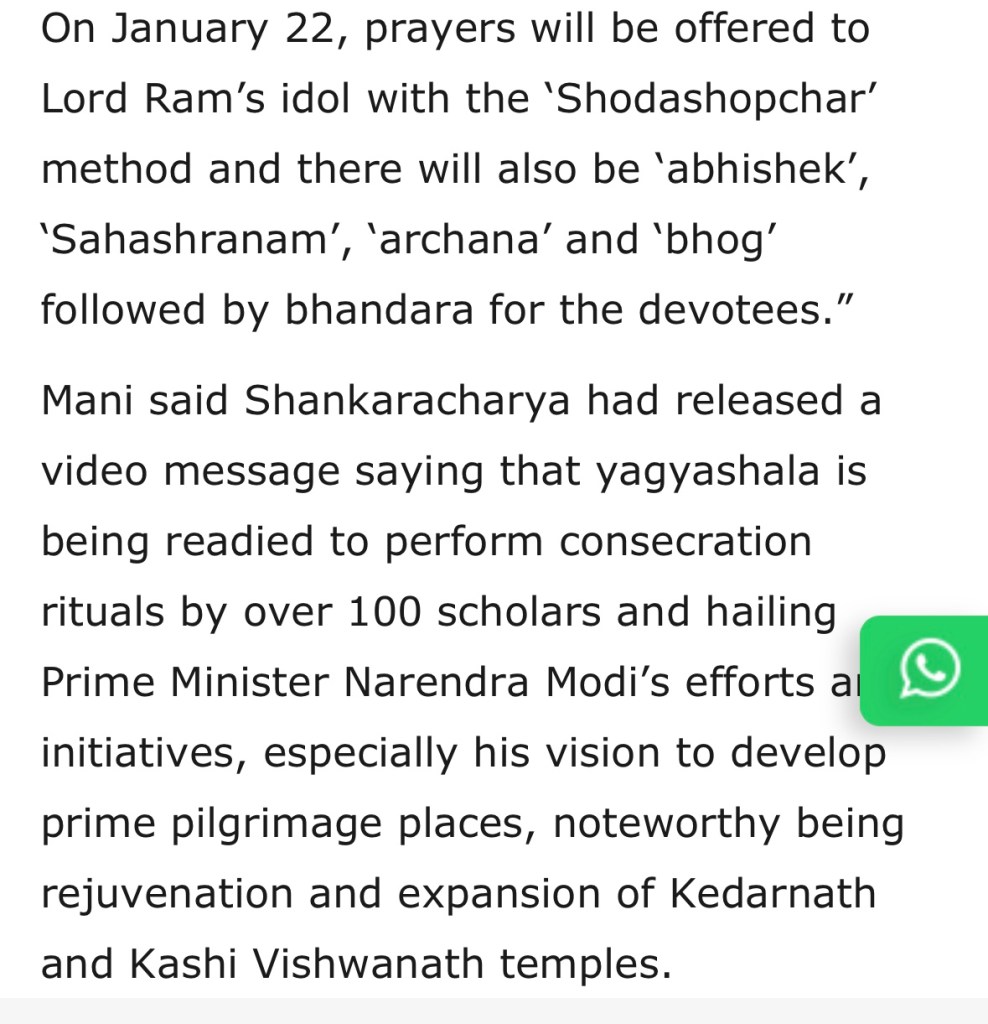
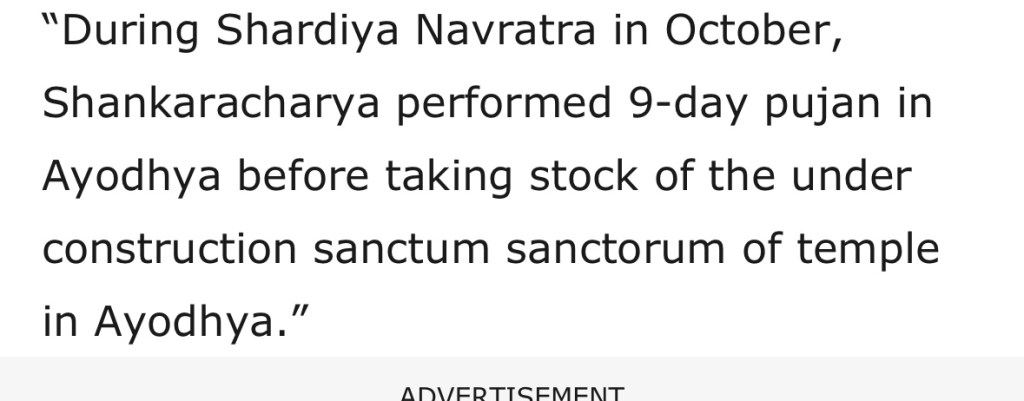
Since I wrote the above blogpost, however, much water has flown under the bridge . It turns out that the Sastra being followed for the “pratishta” rituals have all been planned and scheduled as per the guidance of the Kanchi Shankaracharya . A TOI news report confirms this :



Read more at:
http://m.timesofindia.com/articleshow/106827266.cms?utm_source=contentofinterest&utm_medium=text&utm_campaign=cppst
*************
So, the answer to Question 1 raised above now becomes evident that it is the “shodasa upachaara sastra-Vidhi” or methodology that is going to be followed for the “praana pratishtaapanam”. And this “sastra Vidhi” has been prescribed by none other than HH Sankaracharya of Kanchi Kamakoti Muttam.
The question now which arises :
Why are the Sankaracharyas of Puri and Jyotismath not in agreement with the Sastra guidelines given by the Kanchi Sankaracharya to the Ayodhya temple event organisers ? What are their objections based upon ? Why didn’t the Kanchi Acharya consult beforehand with his fellow Muttaadipathis before deciding upon the guidelines HH issued to the Ayodhya temple Trustees? Now that there is clear difference between Jyotismath/Puri Vs Sringeri/Kanchi/ Dwaraka Sankara Muttams on the issue, how will they reconcile and reach consensus ?
*****************
Now, I turn to Question No. 2 above viz: If the Temple construction according to the Sankaracharyas is really “incomplete” , then which such parts of the temple structure now work-in-progress are they talking about ?
This is a very tricky question and is fraught with technical nuance and complexity linked with ancient Agama Sastras in which I’m no expert at all . Hence , I undertook a crash course in self-educating myself in the ancient sastras of Hindu temple architecture and construction. I referred to various websites and sources on the Internet ( e.g. https://amritmahotsav.nic.in/blogdetail.htm? ) and acquainted myself with a modicum of following working knowledge of the subject:
1. While the architecture of Hindu temples varies from region to region, the major components of a temple architecture remain constant. The form and meanings of architectural elements in a Hindu temple are designed to function as the place where it is the link between man and the divine, to help his progress to spiritual knowledge and truth, his liberation called moksha.
2. The architectural principles of Hindu temples in India are described in Shilpa Shastras and Vastu Sastras which are subsets and texts of larger Agama Sastras and Samhitas.
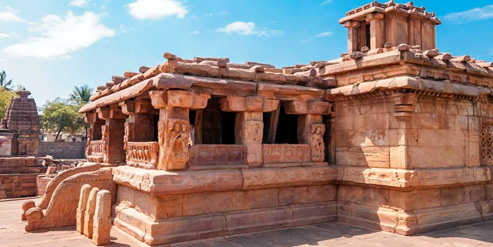
3. Based on geographical location and architectural style, Hindu temples can be characterized under two broad categories—Nāgara, and Drāvida. A third style of temple architecture – Vesara is also found. This is a hybrid style with adaptations from both Nāgara and Drāvida style.
The distinction between the 3 styles can be made by comparing the elevation of the temple, forms of the spire and the plan of the temple.
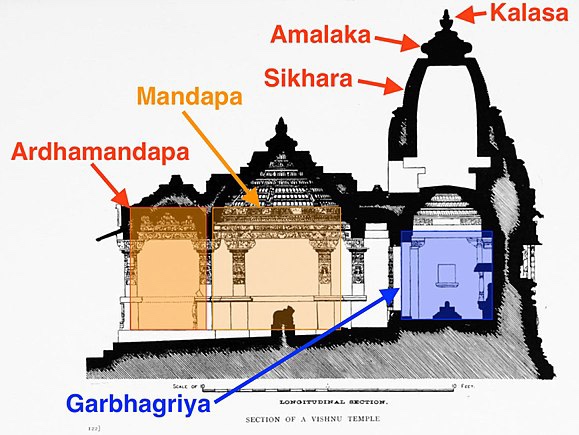
- Garbhagriha or the sanctum where the main idol of the deity is housed
- Mandapa or the portico which leads to the garbhagriha, where the worshipers assemble
- Shikhara that is the spire above the sanctum
- Vaahan which is the mount or vehicle of the main deity of the temple
4. A Nāgara temple generally rests on a high platform- jagati over which is constructed a small platform called pitha. Rising above this is a smaller platform- adhisthana, which forms the base for the construction of superstructure of the temple. Among the other components of a Nāgara temple are – bhadra, sirsa, amalaka, bijapuraka, rathika.

5. Drāvida temples are marked by six major angas, namely:
- Adhisthana: the base of the structure on which the superstructure of the temple stands
- Pada: the walls which enclose the garbhagriha, with stambhas (pillars) in between
- Prastara: the beam or the architrave that denotes the end of the garbhagriha walls and the beginning of the spire
- Griva: the clerestory or rows of windows on the bottom of the spire and above the garbhagriha
- Shikhara: the spire rising above the griva
- Stupi: the finial in the shape of a stupa or kalasa that crowns the shikhara
- Dvajha-sthambha or main flagstaff

5. While the Nāgara and Drāvida types of temples have distinctive features of their own, Vesara type adopted from both in variety of ways.
6. Whatever be the architectural style adopted , a Hindu temple layout plan however must provide for the various “devata sthaanam” (locus of divinities) that must find a place around the main sanctum. The various lesser gods and demigods also have to necessarily undergo “praana pratishta” around the main sanctum precincts. These “sthaanams” are pictorially represented below :
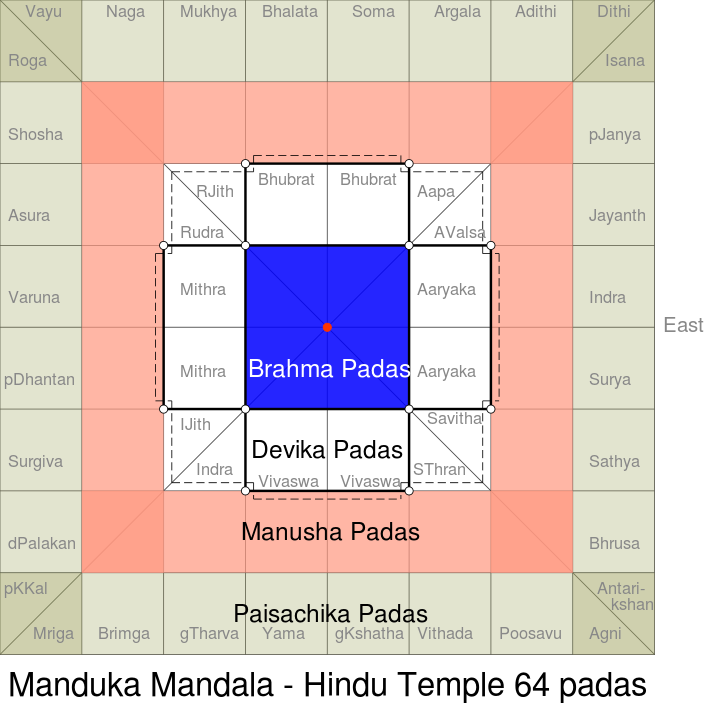
7. In a Hindu temple’s structure of symmetry and concentric squares, each concentric layer has significance. The outermost layer, Paisachika padas, signify aspects of Asuras and evil; the next inner concentric layer is Manusha padas signifying human life; while Devika padas signify aspects of Devas and good. The Manusha padas typically houses the ambulatory concourse. The devotees, as they walk around in clockwise fashion through this ambulatory to complete Parikrama (or Pradakshina), walk between good on inner side and evil on the outer side. In smaller temples, the Paisachika pada is not part of the temple superstructure, but may be on the boundary of the temple or just symbolically represented.
The Paisachika padas, Manusha padas and Devika padas surround Brahma padas, which signifies creative energy and serves as the location for temple’s primary idol for darsana. Finally at the very centre of Brahma padas is Garbhagruha (Garbha– Centre, gruha– house; literally the centre of the house) (Purusa Space), signifying Universal Principle present in everything and everyone. The spire of a Hindu temple, called Shikhara in north India and Vimana in south India, is perfectly aligned above the Brahma pada(s).
Beneath the mandala’s central square(s) is the space for the formless shapeless all pervasive all connecting Universal Spirit, the Purusha. This space is sometimes referred to as garbha-griya (literally womb house) – a small, perfect square, windowless, enclosed space without ornamentation that represents universal essence.In or near this space is typically a murti. This is the main deity — moola archa murti .
The dhvajastambha (ध्वजस्तम्भ) refers to the flagstaff erected in front of the mukhamaṇḍapa (front pavilion) of a Hindu temple. The dhvajastambha is usually built within the temple walls (prākāra). They are traditionally built of wood and stone, where the wooden variety is often finished with a metal covering (kavaca). The dhvajastambha is a common feature in the Dravidian styled temples.
*************
Praana Pratishta ritual is considered to infuse life into the Hindu temple, and bring to it the numinous presence of divinity and spirituality.
The ceremony marks the recognition of the image of god to represent “a particle of the divine whole, the divine perceived not in man’s image as a separate entity but as a formless, indescribable omnipresent whole“, with the divine presence being a reminder of its transcendence and to be beheld in one’s inner thoughts during darśana in the temple.
**********
Now considering all the above facts, what again rises in the mind of an ordinary Hindu ( an Unknown Sri Vaishnava) are the following :
1. If the Sankaracharyas aver that the Ramajanmabhoomi Temple at Ayodhya is an incomplete piece of temple architecture — and hence unready for “pratishta” — which particular structure or sub-structural component of the overall temple work-in-progress are they referring to?
2. For the specific purposes of duly solemnising the set of rituals which is now going to be adopted for the consecration of the temple ( as per the guidance already given by the Kanchi Sankaracharya) , which structures or sub-structures of the half-complete temple are absolutely essential? And which would render the rituals either infructuous, utterly invalid or “a–sastraic” only by reason of the fact that some components of the overall architecture remain incomplete?
Instead of endlessly debating and discoursing in open public upon the matter , why can’t all the 4+1 Sankaracharyas convene a conclave amongst themselves , thrash the matter out reasonably and come to an amicable and workable consensus ?
Won’t all we millions of ordinary, lay Hindus be happy if Their Holiness did that ?
Jai Shree Ram !
Sudarshan Madabushi