

PART-4
(d) The Conundrum of Relativism Vs Absolutism:
The most morally disturbing parts of IP’s novel are in those scenes where Krishna’s general weltanschauung — his general outlook on the life and world – gets revealed through his utterances.
Throughout the novel, one can see that Krishna’s world-view was deeply grim and one of dark pessimism, greatly influenced by the ceaseless violence and malevolence he encountered everywhere he went. It finally ended in the great War of Kurukshetra in which Yadavas, Kauravas and Pandavas all perished. Hastinapur, Indraprastha and Dwaraka became in the end ghost-cities, their old grandeur and glory disappearing away into the ruins and desert-sands of time.
To Krishna the sum of all human existence was thus nothing else but futile struggle between good and evil … an endless strife to gain wealth and power by arrogant men with vaulting ambitions and hubris.
As he lay dying in Dwarka, Krishna’s final words to Jara, the hunter, were deeply self-introspective and gloomy when he spoke about how the clans of Yadavas much like the Pandavas and Kauravas too destroyed themselves:
“They waged a destructive war, or shall we say, committed “collective suicide”, mindlessly killing one another in a frenzy… Power and wealth corrupted us, made us arrogant and we deserved to die; you may call it destiny or give it any name you like. The combination of the arrogance of power, the greed to amass wealth and the dissipation of wealth has always the cause of the disintegration of society. That is what history teaches us….”
The zeitgeist of the Mahabharatha era was unmistakably one of moral decay, decadence, corruption and cynicism. Krishna was not immune from being afflicted by the melancholia of his times. Which is perhaps why the needle of his moral compass tended to flicker and veer more towards relativism rather than to absolutism. He was never shy of openly admitting it himself:
- “I’m an anarchist, a rebel. I do not believe that there is any absolute code of conduct which is valid for all time….
- “According to the law of the jungle, the strongest have all the privileges”.
- “Life is a game. There are certain rules to be followed. You either follow them or violate them. …
- “Dharma is a path. The path you choose in accordance with your circumstances is dharma. …The interest of the game depends upon the choice you make. It is this (moral) contradiction that makes the game interesting.
- “The ideological and emotional conflicts within us (which we grapple with as we make our choices) provide meaning and relevance to our lives. These are the rules of the game of life; we have to play according to set rules. There is no exit….”
At the very end of the war, a distraught Gandhari castigates Krishna for being the principal cause of the complete devastation and death of the Kaurava empire. She finds his moral relativism downright abhorrent.
“You play with words, Krishna. What a game is this in which so many have died for nothing? Do you think it is interesting? The noblest of men … have all died. All because of you. Do you mean to say all this is part of a game! The whole country has become a graveyard. How does it matter anymore who rules it? Take this from me – I have performed innumerable penances and if they are worth anything, I curse you with all the power I have: thirty-six years from today, the Yadava tribe too will be eliminated and then you’ll know whether life is a game or full of suffering”.
“Krishna smiled and said, “I understand your anger, Mother. Any tribe or community which considers itself superior and becomes arrogant is bound to destroy itself. You have only made my job easier. I thank you for your curse”.
**************
Nowhere more starkly is revealed Krishna’s moral relativism than in the scene in IP’s novel where Duryodhana and Arjuna, both approach Krishna in Dwaraka just as the war is about to begin. Both of them go to meet Krishna at the same time to try and enlist support in the war for his own respective side.
Krishna plays a game with both of them.
He offers them a choice. Since he has resolved not to take up arms himself in the war — neither for the Kaurava nor Pandava forces – Arjuna and Duryodhana, he tells them, can take their pick. They can either take all of Krishna’ own armies under their command or, they can enlist Krishna as a non-combatant – a mere charioteer.
Arjuna promptly chooses; he wants Krishna to be by side in the war. Duryodhana then gleefully takes command and control of all of Krishna’s large armies and goes home happy thinking Arjuna to be a fool.
Krishna goes thus to the side of the Pandavas while giving marching orders to thousands of his Dwarakan soldiers in his own army to join and serve under the command of the Kauravas.
Krishna’s action poses a moral question.
Did not Krishna by his action send his armies to certain death? How could a supreme commander of an armed force decide to go and ally himself personally with one side in a war but then command his own men to fight for the other enemy side?!
What kind of morality is that? How relative can moral relativism be?
***************
The final twenty-second chapter in IP’s novel is not from the original epics. It is from his very own imagination… and it ends the story of Krishna on a sad and poignant note.
The war is over. The people have perished. The land is devastated. Krishna himself must find his life ebbing away slowly…
At the fag end of his life, having lost everyone and everything around him, Krishna is beset with dark nostalgia. He wants to desperately clutch one last time at a straw in life before he sinks… He wants to go and visit again his old love, Radha… the girl with whom he had spent the happiest moments in life.
He travels all the way to Vrindavan hoping he will see her once again for one last time. As Krishna nears the village, his mind is full of old, beautiful and tender memories of Radha. He makes his way slowly to the house he remembers once belonged to Radha… What happens next must be told in IP’s own words in the final page of the novel:

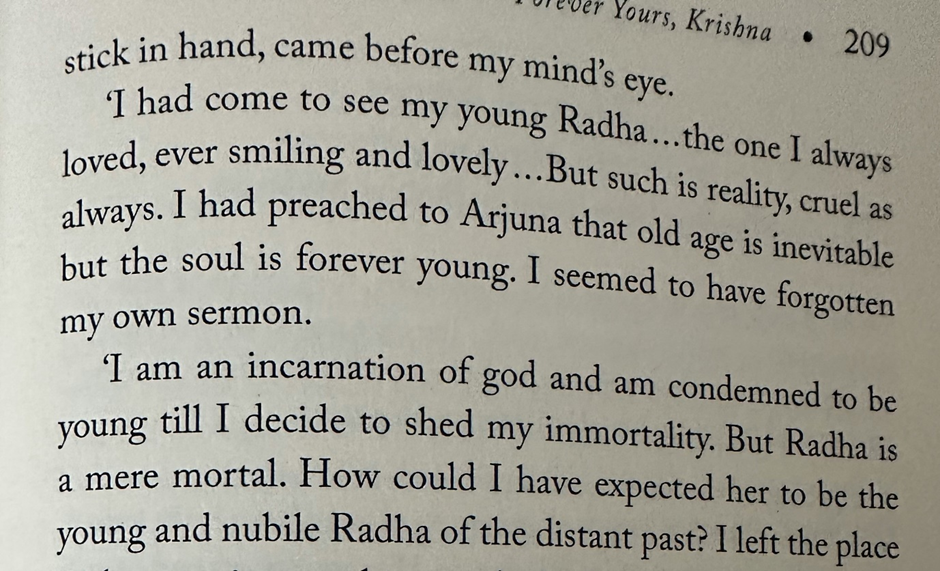
Krishna the wily, invincible politician had at last met his match… an adversary even he, God Almighty, never could hope to outwit or overcome: Time….
CONCLUDED
Sudarshan Madabushi