PART-3
(c) Commentary on the morals of sexuality:
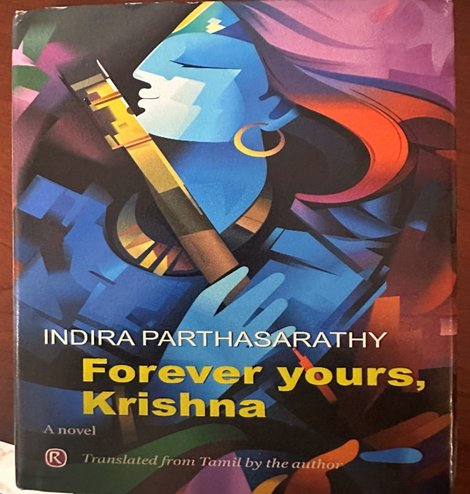
In IP’s novel, explorations of the theme of Love and Sexuality are sensitively explored through the portrayal of the many dalliances of Krishna.
The explorations cover the entire spectrum of Love in all its human manifestations. The romance between Krishna and his several paramours at different stages in his life was always a complex affair. Often it was not a matter of pure personal life-choice but of political expediency too. Love and Romance played a central part in the subtle games of political machination and manipulation of which Krishna was a master non pareil.
IP’s novel narrates the story of the Krishna’s amorous adventures in “50 different shades of pink” … one might say by borrowing a modern cliché that describes the full, wide spectrum of the most fascinating of human emotions called Love. It is an emotion whose depths Man relentlessly seeks to plumb. Never in time has he ever succeeded in that quest.
Krishna had eight wives and perhaps a thousand female cloying admirers in Gokulam who were besotted with love for his person as much for his melodious flute play.
There was no denying that Krishna was a gallant ladies’ man… a real charmer who understood the feminine heart, instinct and its most intimate longings and aspiration.
In his previous avatar as Rama he had been an uncompromising monogamist. But as Krishna in a later avatar, he told Jara, the hunter, “I was fed up with treading a one-way path which I did as Rama avatara, setting an example for people to follow. Now I have a totally different role to play….”
So, Krishna married eight wives all of whom he loved dearly: Rukmini, Sathyabhama, Kalindi, Mitravindai, Sakti, Pathirai, Lakshumanai and Jambavathi… ! And he had several soul-mates too with whom he cultivated intensely personal relationships: they were the simple gopikas, cow-maidens of Gokulam with whom he frolicked and happily went gallivanting …. “Krishna had immense concern for women. He respected them and was kind (to them) in several ways”.
IN IP’s novel, women couldn’t help falling deeply in love in many different sorts of strange ways with Krishna even when they knew he could never be theirs to own or possess. As a mere stripling cowherd, with Radha, who was seven years older than him, he had the most intense and idyllic of all personal relationships … more intensely passionate perhaps than even that with any of his eight wives.
Bhanumathi, Duryodhana’s wife — she loved him dearly but then proudly claimed that she was Krishna’s adopted sister.
Bhanumathi’s sister was Jalandara who loved Bheema and wanted to marry him. Krishna helped her consummate that marriage.
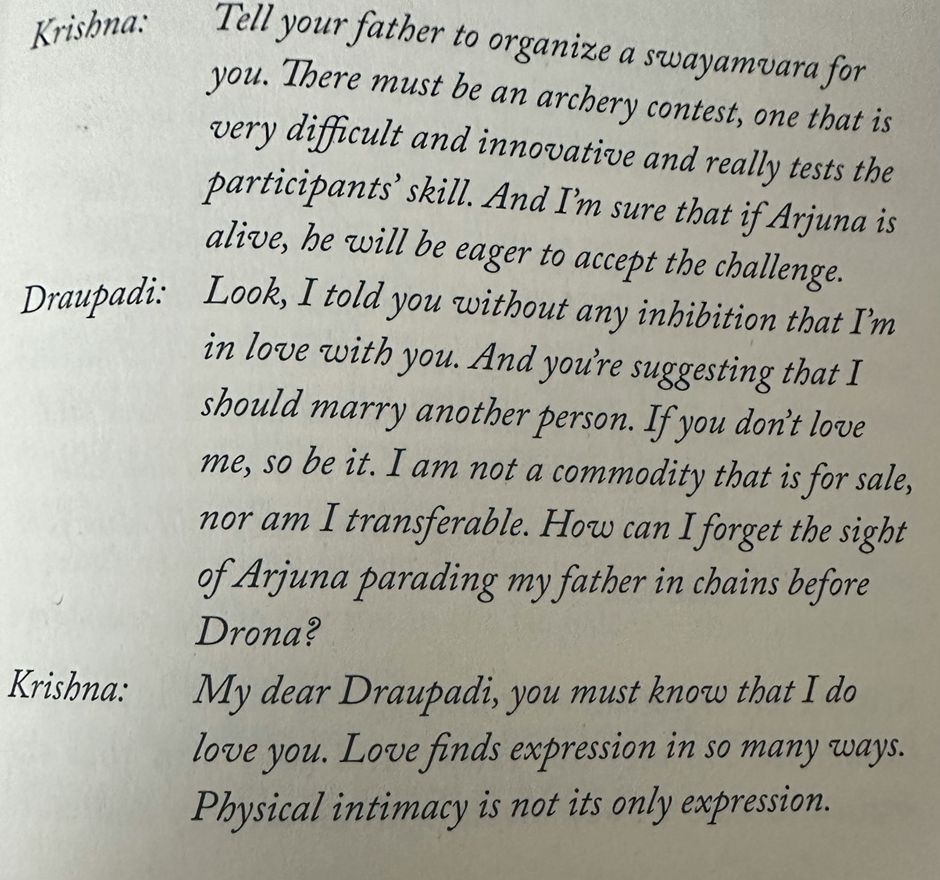
Then there was Draupadi herself who did not hide her deepest feelings of love for Krishna. IP depicts the romantic affair between the two in a discreet and private heart-to-heart chat they both had:
Then there was also the feisty girl called Shaibya who had a very complex love-hate sort of relationship with Krishna. She too openly expressed her amorous feelings for Krishna who however did not reciprocate it in the same manner. Instead he arranged for her a match he thought was best – with his protégé Shvetaketu. The discreet conversation between the beautiful Shaibya and Krishna too is worth reproducing below:
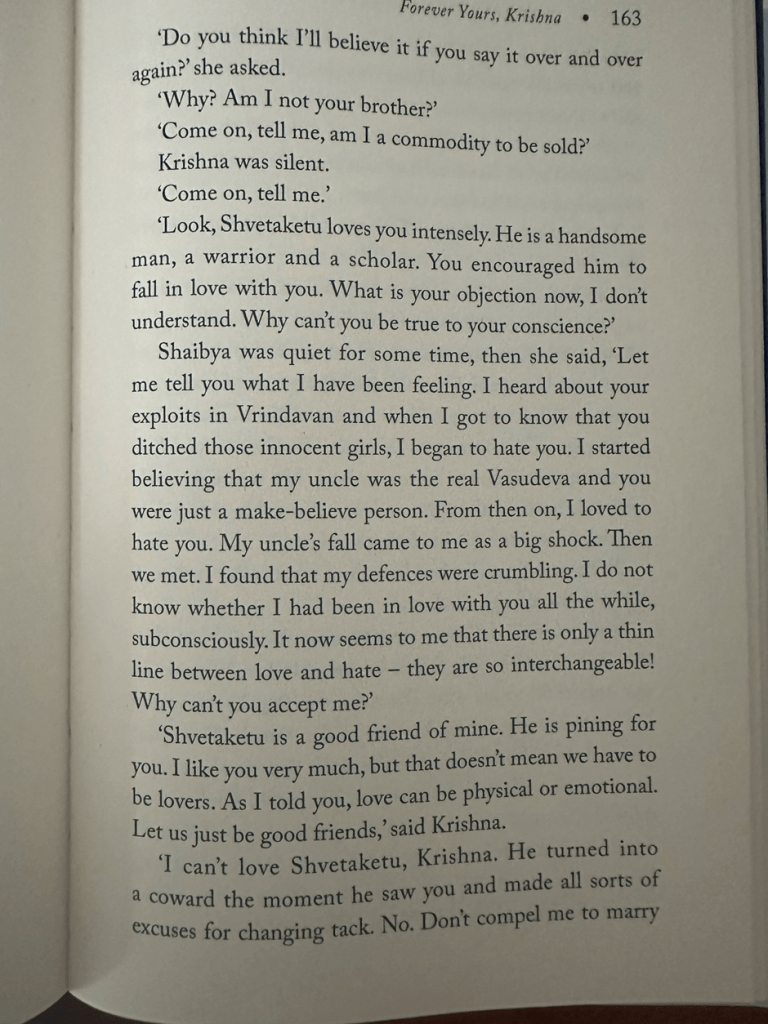
Finally, there was also a rather strange, delicate relationship of love between Krishna and Kuntidevi that seemed to have embedded deeply in it some element of maternalism — mildly Oedipal even.
Krishna had three mother-figures in his life – Devaki to whom he was born; and Yashodha, who was his foster mother. He spent hardly any time at all with his natural mother. With Yashoda he spent only his childhood years in Vrindavan and Gokulam. He left his native roots very early in life to go out into the wide, wicked world. There was no strong maternal influence in his life. Kuntidevi perhaps, came the closest to a mother-figure in his life… He spent years and years with her. Her destiny and Krishna’s own were intertwined in many ways… He was deeply protective of her. And she in turn loved him deeply in ways that she alone in the world might have understood….
Kunti’s darkest secrets that she kept to herself all her life were known only to Krishna. That she had had a pre-marital affair was never known to the Pandava family nor the fact that she had given birth to an illegitimate child. She lived all her years as a queen with the pain of guilt and shame suppurating inside her heart right until the end of the Kurukshetra war when the truth finally tumbled out of her. It caused her entire family great distress. But Krishna was ever protective of her, as he always was of every especial bond that ties man and woman….
******************
In the sexual mores of Krishna’s and Kunti’s times, polygamy and polyandry were both not uncommon. Today both are taboo in modern society. Both are thematically explored by IP in the novel in starkly bold and candid terms. But IP does not go far enough to push the boundaries of his explorations of a sexual ethic which, in the time of the Mahabharatha, might have prevailed only by exception amongst ruling or wealthy classes but was never normative amongst commoners.
IP wades only knee-deep and that too very gingerly into dangerous waters. Ethical bromides are offered to explain away blithely the strong overtones of sexual promiscuity in the characterization of Krishna, the gopika damsels, of Draupadi and Kunti.
“Each gopika saw her dream vision of an ideal lover in the cowherd who played melodious love songs on his flute and danced ecstatically with her.
“Perhaps these romantic visions of the gopikas were actual occurrences, perhaps mere illusions. Who could censor the imagination of the happy girls in Vrindavan? Every man had several wives those days. If an unfortunate father had six daughters, he would marry off the first daughter and gift the other five girls as a bonus to the same man.
“Do you know how many wives Vasudeva, Krishna’s father had? Seven! Pauravi, Rohini, Bhadra, Madira, Rochana, Ila and Devaki. When men were allowed as many wives as they desired, was it wrong on the part of women to let their imagination run wild and visualise a platonic relationship with that handsome and ebullient boy of Vrindavan? The ever-youthful and handsome Krishna was an object of wish-fulfilment for them, offering them a chance to love him and frolic with him”.
***************
In IP’s novel the delicate subject of Polygamy does get squarely addressed — yes of course — but then quite understandably only with strait-jacketed reticence. IP suggests that Polygamy was exceptional but not unethical sexist custom in the times of the Mahabharatha. However, the more disturbing question about whether Polyandry, which was imposed upon Draupadi by sheer unfortunate accident, could technically fall under the definition of Incest is deftly avoided.
Reading the chapters that deal with Draupadi’s “svayamvara”, Arjuna winning the archery contest and her hand as his prize, Yudhishtara’s terrible malapropism and Kunti’s bizarre rationale for the consent she gave the polyandrous arrangement for her five Pandava sons with Draupadi, raises many quirky and unsettling questions in one’s mind:
- If polygamy is consensual, does it make it any less morally questionable?
- And if polyandry is consensual, does it make it more morally reprehensible or less?
- If in a polyandrous marriage, the wife gave birth to children – as many children as Draupadi did herself in the Mahabharatha — how did paternity get established?
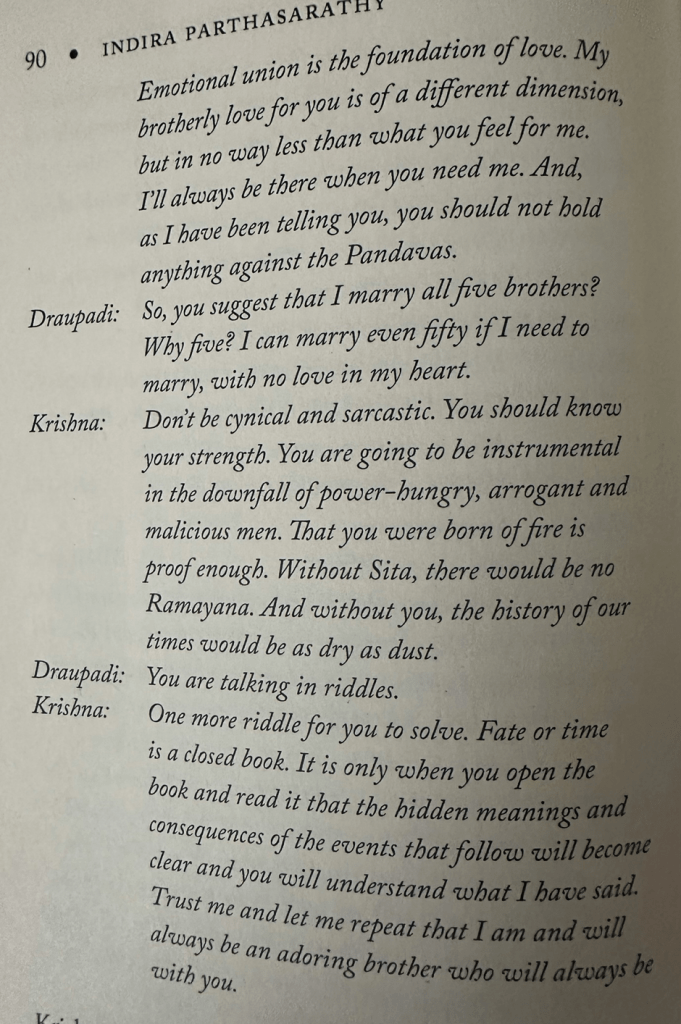
A reader of IP’s novel might want to ask such searching questions while reading the following pages too where the marriage of Draupadi to the Pandava princes is talked about between Kunti, Krishna and Jara:
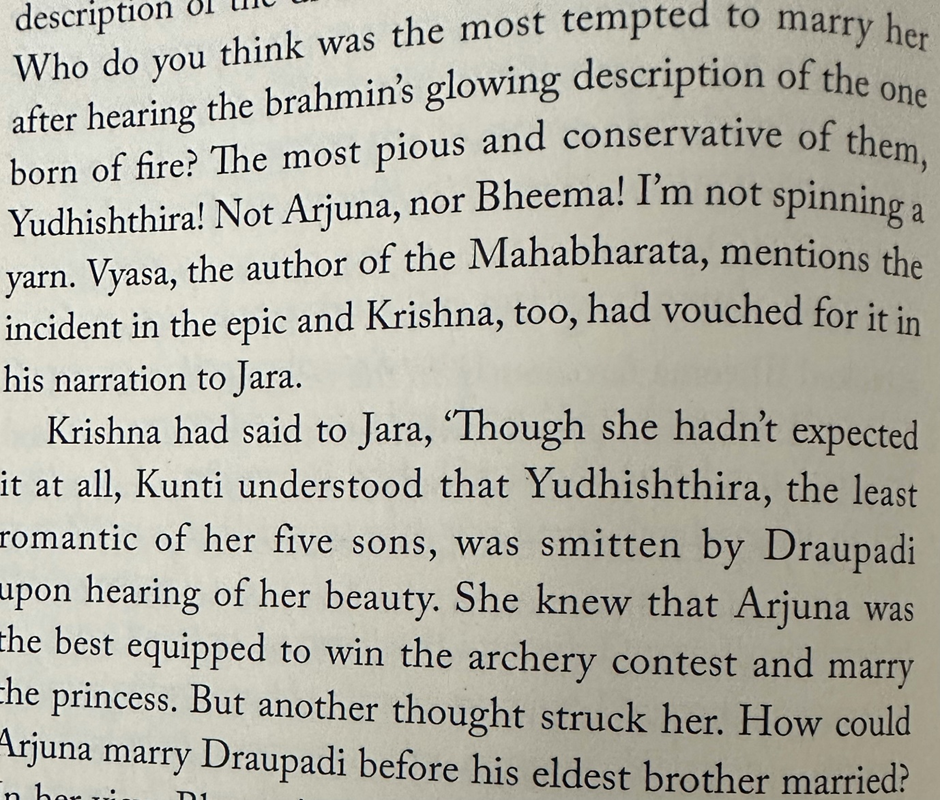
How did the polyandrous marriage of Draupadi to the five Pandava princes then come about? The passage below reveals it:
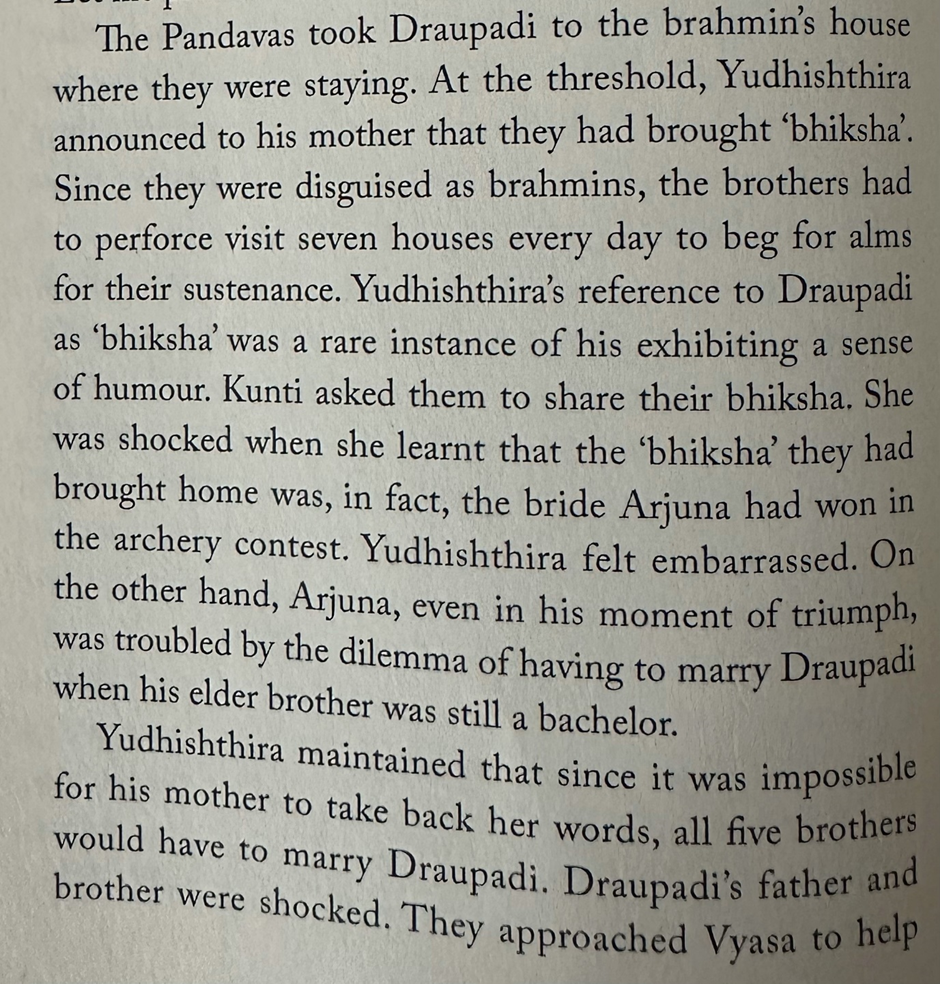
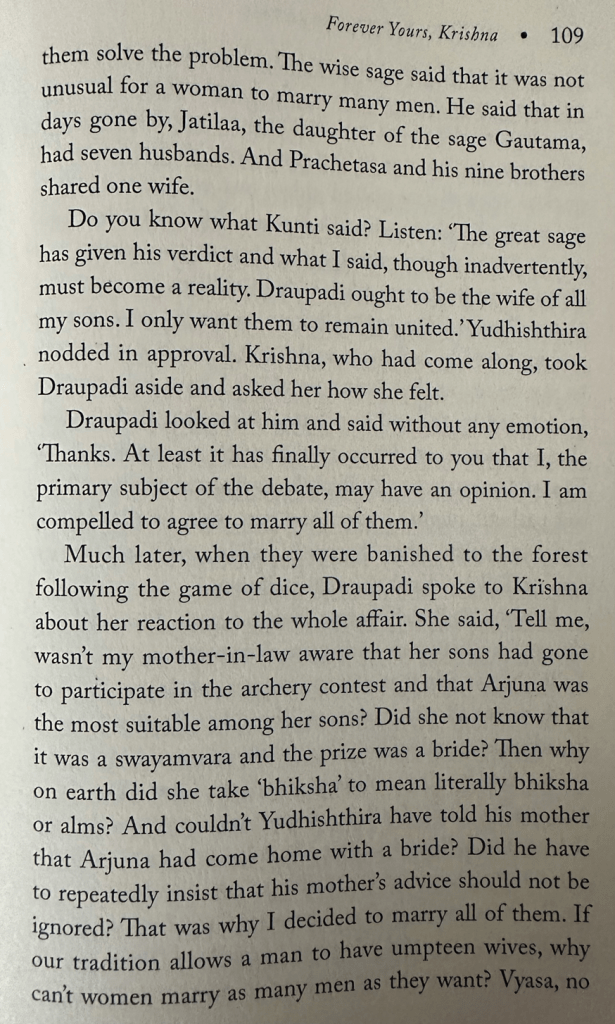
Draupadi’s outraged poser to Krishna above perhaps best expresses the very core of the feminine search for a sexual identity transcending gender: “If our tradition allows a man to have umpteen wives, why can’t women marry as many men as they want?” is Draupadi’s thunderous question.
In IP’s portrait of Draupadi caught as she in her terrible ethical predicament, one is able to see vague likeness to what the modern psychologist, Carl Jung, theorised to be the “gender polarisation” stunting the archetypal feminine identity. https://theconversation.com/what-would-carl-jung-tell-you-to-do-with-your-spreadsheet-of-life-goals-throw-it-away-and-embrace-the-feminine-220544
Societal norms tend to focus on narrowly defining “man” or “woman”, rather than considering archetypal underpinnings of the feminine and masculine. For psychiatrist and psychoanalyst Carl Jung and post-Jungian thinkers, these concepts are crucial to understanding gender and wider cultural dynamics.
A Jungian perspective considers the feminine and masculine as concepts that are not specific to man or woman but germane to people of all genders. They are embedded in thousands of years of history, folklore and myth and their characteristics are remarkably similar across time and cultures. In Jung’s theory – later expanded on by others of his school — he relates the feminine to mythical and spiritual dimensions such as the moon, soul, creativity, inwardness, darkness, chaos, intuition and (active) receptivity. A masculine energy is often associated with the sun, spirit, light, (immediate) action, aspiration and outwardness. And in his view, the feminine is neglected in patriarchal, neoliberal cultures that value rationality, action and ambition.
If in truth God is a genderless ontological entity, then Krishna, the divine avatar of God, was only affirming the fact through Love.
***********
Love was thus truly very central to the life of Krishna as divine avatar.
Women gravitated towards him like fireflies to a flame. Why? Because he exuded the sort of love that only the “unpolarized Jungian” feminine heart is capable of fully understanding.
“He grew up in the cowherd community, a naughty boy full of mischief. The cowherds had led a dull and weary life before the arrival of Krishna. Suddenly their lives changed; it was like the onset of spring. Beautiful, sweet-smelling flowers bloomed everywhere and life acquired a new meaning… With Krishna’s arrival, the old dreary rituals, customs and lifestyle became a thing of the past. Women gained freedom; they sang, danced and celebrated their newfound freedom with gay abandon… Krishna thus gave the cowherd community a new collective identity”
Krishna knew and understood that “All women, irrespective of age, dislike social restrictions such as caste or status and love to live in a society where the mind is free of inhibitions.
“Krishna looked at human life as an aesthetic experience. He lived by the dictum that men and women should mix freely with each other, without any gender barrier. During his discourses, he would always assert, “Friendship and love between man and woman does not necessarily have a sexual connotation”.
“He told Jara, “The cowherd girls of Vrindavan were close friends of mine because the awareness of gender was absent in our relationship. Every girl experienced unbounded freedom and joy in my company, and gthat is what made all of us happy”.
“…. Love transcends age. A physical relationship is just one of the expressions of love. And let me ask you a question: do all married couples who have sex really love each other? … Do you know what I consider true love? The spontaneous joy that overwhelms a lover, not necessarily when he sees his beloved but when he feels her presence no matter where she is. That is the reason why Krishna told his dear friend Arjuna, “I have eight wives and one love”. Your guess is right — the one he loved was Radha.”
****************
Love in Krishna’s life is a tantalising mystery, just as pretty much everything else about him was during the time he spent on earth. It is extremely difficult to fathom the true nature of the romantic disposition of God incarnate. IP of course alludes in this regard to the mystic saint Nammazhwar who in his Tamil paasurams revealed how he broke through the gender-barrier to finally experience the ecstasy of Love-union with God. But then ordinary souls cannot all be Nammazhwars… for them questions about Krishna’s Love remain unanswered:
Was it carnal? Erotic? Was is it sentimental? Was it passionate Emotion? Was it platonic? Was it Oedipal (as IP too suggests in his novel)? Was it transcendent?
It is truly very difficult to figure out exactly which one of the above it really was because each of Krishna’s relationships with the opposite sex had a certain indefinable, fluid or indeterminate quality about it.
The only way one perhaps could feebly attempt to grasp and understand Krishna’s romance is to take the help of the Greek categories of Love.
The Greek philosophers of Love classified it into the following grades: Philia, Pragma, Storge, Eros, Ludus, Mania, Philautia, Agape and Meraki. https://www.greecehighdefinition.com/blog/9-different-types-of-love-according-to-the-ancient-greeks . Each is said to be a successive sublimated state of one or more of the other.
Eros was sexual desire; Philia was soul connection; Storge was devoted love; Pragma was mature love; Ludus was playful love; Mania was obsessive love; Meraki (in modern Greek language) was the love found in creative endeavour; Philautia was self-love; Agape was unconditional love.
So then, was Radha’s love for Krishna Ludus or Pragma? Was it eros or philia? Was Krishna’s love for Draupadi Philia or Storge? Was Shaibya’s love for Krishna eros or Philautia? Was Krishna;s love for Kunti agape?
Who can really tell for sure? …. How can one plumb the depths of the soul of an avatar of the paramatma?… If reading the Mahabharatha or Bhagavatham cannot reveal to us much about the matter, how can it be expected that a modern novel such as “Forever Yours, Krishna” could enlighten us any better?
Love is often more complicated than any words can describe — be it in Sanskrit, Tamil or English. However the way IP’s biographical profile of Krishna has been etched in the novel, what it tells us is that, evidently, there was no one way in which Krishna nurtured and cultivated relationships with the many women in his life. But the love he gave his paramours and admirers certainly resulted in them leading happier lives and having healthier, more fulfilling connections with the world.
(to be continued)
Sudarshan Madabushi