In response to my blogpost of yesterday here at this link : https://mksudarshans.blog/2024/05/26/is-indian-electoral-system-designed-to-put-into-power-only-minority-governments/ , retired Judge of the Madras High Court, Justice T.C.A. Rangarajan ( https://tshc.gov.in/retjudges/tncrj.html) sent me an email proposing what I consider is a truly wholesome and innovative although radical and challenging agenda for large-scale Reform of India’s voting system.
To read Judge Rangarajan’s set of “disruptive”ideas and concepts you may please scroll all the way down below. Let me warn you his proposals might strike some of you — depending on what your ideological leanings and prejudices are — as being, in varying degrees, a paradigm shift or seismic fissure …. or, ambitious naïveté if not utopian idealism.
Nonetheless, I for one believe the ideas and suggestions put forth by the Judge deserve the serious attention of the public and hence this follow-up blog of mine coming in the heels of yesterday’s titled “Is the Indian Election System designed to put into power only Minority Governments?”.
Judge Rangarajan’s truly “novel idea” is exactly the kind of “out-of-box” or “lateral thinking” required to reform India’s voting system . I do hope many such innovative ways of thinking are submitted by right-thinking and well-intentioned intellectuals like the Judge to the Law Commission, Supreme Court Court Judges , Constitutional lawyers, Civil society think-tanks and even the President of India and get the process gain momentum .
Even if the process takes more than a couple of years to gain traction and eventually culminate in the next term of the Parliaments as an epochal Constitution Amendment Bill in Parliament , it would be worth all the labour pains and social strife .
I especially like the Judge’s truly creative concept that elections will be fought on the basis that
— the whole of India will be one constituency,
— only registered and qualifying political parties will enter the electoral fray in their own name and not field the candidates to whom they give “tickets”
— seats in Parliament will be allotted to Parties in proportion to the votes they polled actually and relative to the grand total
— the parties will nominate MPs to the seats in parliament that get allotted to them . Such nominations will be from out of a prior list of candidates they prepare before leading up to the polls.
In my view the above system (once it is further debated upon and refined and made politically and constitutionally feasible) besides ushering in truly broad-based representation for the Indian voting public in Parliament will also considerably minimise many of the banes that afflict our present electoral and parliamentarian life-styles: e.g.
— eliminate the complexities and divisive conflicts arising from periodic delimitation exercises
— eliminate personality-centric (or cult-figure centric) high-voltage, high-decibel, bitterly emotive and frenzied election campaigning
— eliminate wasteful colossal campaign expenditure and black-money; enable the fixation of realistic limits on political parties’ spending on campaigns; make it possible also to enforce regulatory limits on spending through stricter scrutiny and greater accountability
— enable the implementation of the sensible one-nation-one-votetimetable once in 5 years, duly staggered for national and assembly/local body elections.
— considerably reduce the possibility of legislative process ever becoming dysfunctional (as seen often today) and become instead more responsible , efficient and productive … and yes, more dignified too.
— considerably increase the chances of engendering consensus consistently in passing Parliament bills and resolutions …. No walkouts, no gerrymandering, no filibustering….
To all those who might fear these proposals as paradigm or seismic shifts in politics in India and rather treacherous waters to wade and navigate through while reforming the Electoral system, I can only ask “So what… ?! In the churning of a “Samudra Manthan” , the roiling sea might throw up deadly foaming toxins but so long as the pristine fount of “Amrutham” too springs from it in the end, there’s nothing to fear, really, is there ?
Sudarshan Madabushi
***************
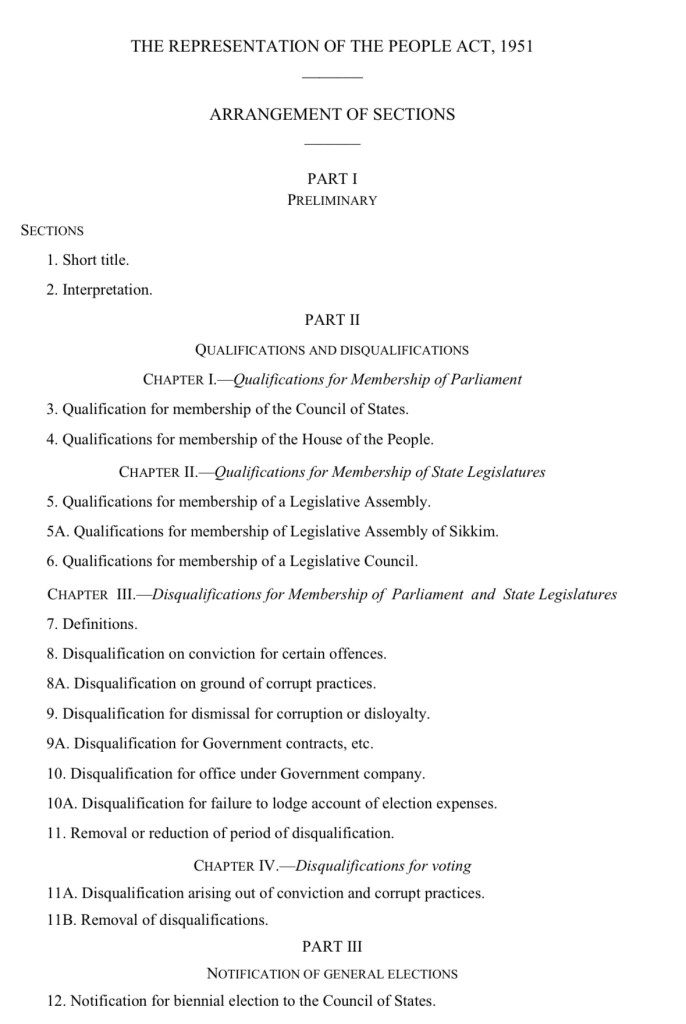
Here below is reproduced Judge Rangarajan’s full email text:
Here is a novel idea for electoral reform to set the ball rolling:
1. The ‘first past the post’ rule does not give a truly proportionate representation to the people in the Parliament. Therefore, the contest should be only among parties registered with a minimum number of at least 10% of registered voters as members of that party.
2. No individual will be allowed to stand for election. All seats in Lok Sabha will be filled only with men and all seats in Rajya Sabha will be filled with only women thus giving equal share in the representation.
3. Each party should declare its vision and mission and a list of members who will be nominated to fill the seats won.
4. There will be no need for delimitation as the entire nation will be a single constituency.
5. Seats will be allotted to the parties in proportion to the votes polled.
6. A joint session of both houses of the Parliament thus constituted will act as an electoral college to elect one among themselves as the Prime Minister and he will chose his cabinet to accommodate the various parties, in proportion to their strength, thus forming a national government.
7. There will be no opposition gallery in the Parliament as everyone will be entitled to give his views on every subject discussed; but the parties will be allowed to have whips to ensure that their manifestos. If any member disobeys the whip he will be replaced by the party to which he belonged by the next person in the declared panel of nominees.
8. Thus there is no need for any anti-defection law. There will be no need for any bye-election at all.
9. If the Prime Minister loses a motion of confidence, he will be replaced by electing another person as PM. The Parliament will not be dissolved in midterm at all.
10. The Prime Minister can fill his cabinet with members from either house in proportion to the vote share of the parties.
The decisions of the Parliament will thus be by consensus and truly represent the wishes of the people.
—— end ——