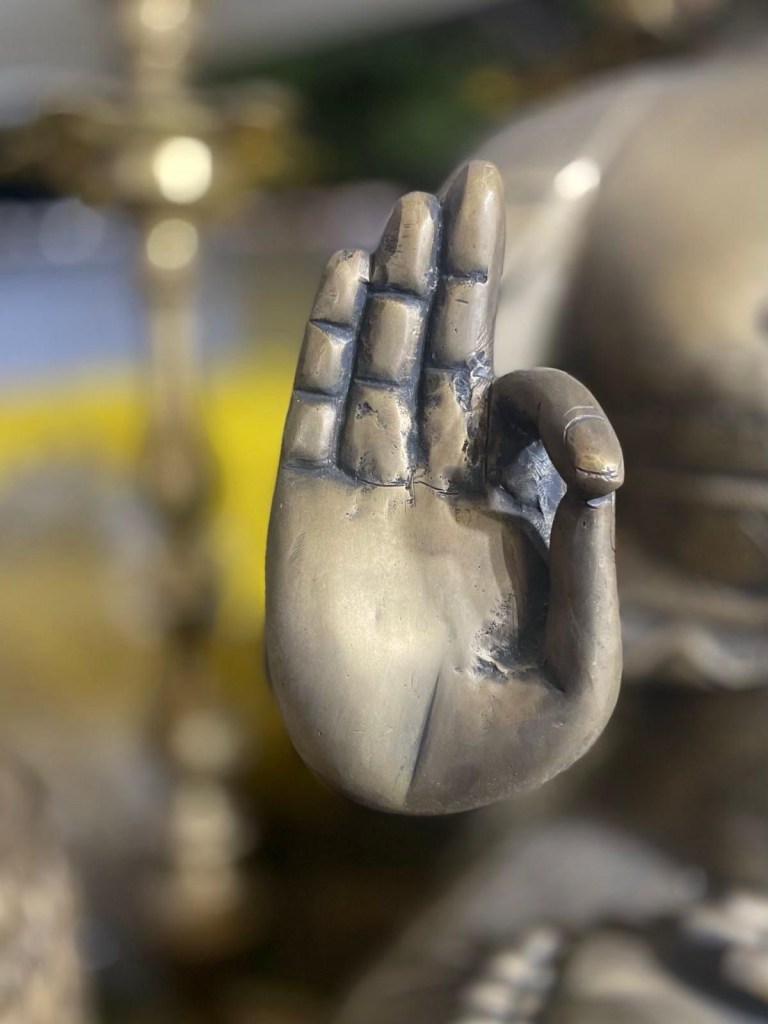
The picture above is of a beautifully crafted metal sculpture of the palm of the Buddha depicted in some ancient icon kept in some unknown Buddhist “vihara” perhaps …
The graceful pose in which Buddha’s palm is seen… in Sanskrit language … it’s called a “mudra” …
A “mudra” in Vedic cultures — and more especially in Yogic practices — has profound significance of many nuanced kinds — aesthetics, for one, as in dance forms such as Bharathanatyam or Kathakali; occultism, is the other, as in Tantra and other sacerdotal practices; and there is also spiritualism, as it pervades all Vedantic thought.
It is through the lens of the third “spiritual” kind of significance i.e. Vedantic symbolism, that I myself, more often than not, tend to view the beautiful mudra captured in the photo above.
If you gaze long enough at the photo of the mudra, it’s more than likely that you will get the strong impression that the mudra, by itself, at once evokes in our mind ineffable feelings of calm, contemplation and contentment.
Why is it so ? It’s because inhered into the mudra, there is a strange power of symbolism from which radiates out extra-sensory meaning and purpose. It is important to unlock that symbol if we hope to get at least a glimpse of the meaning and truth that lie beneath it.
There are many kinds of keys believed to be able to unlock the symbol for us. For instance , I myself came upon the below interesting chart on the Internet which purports to show what the “chinn mudra” signifies . It’s a simple chart and it’s quite self-explanatory:
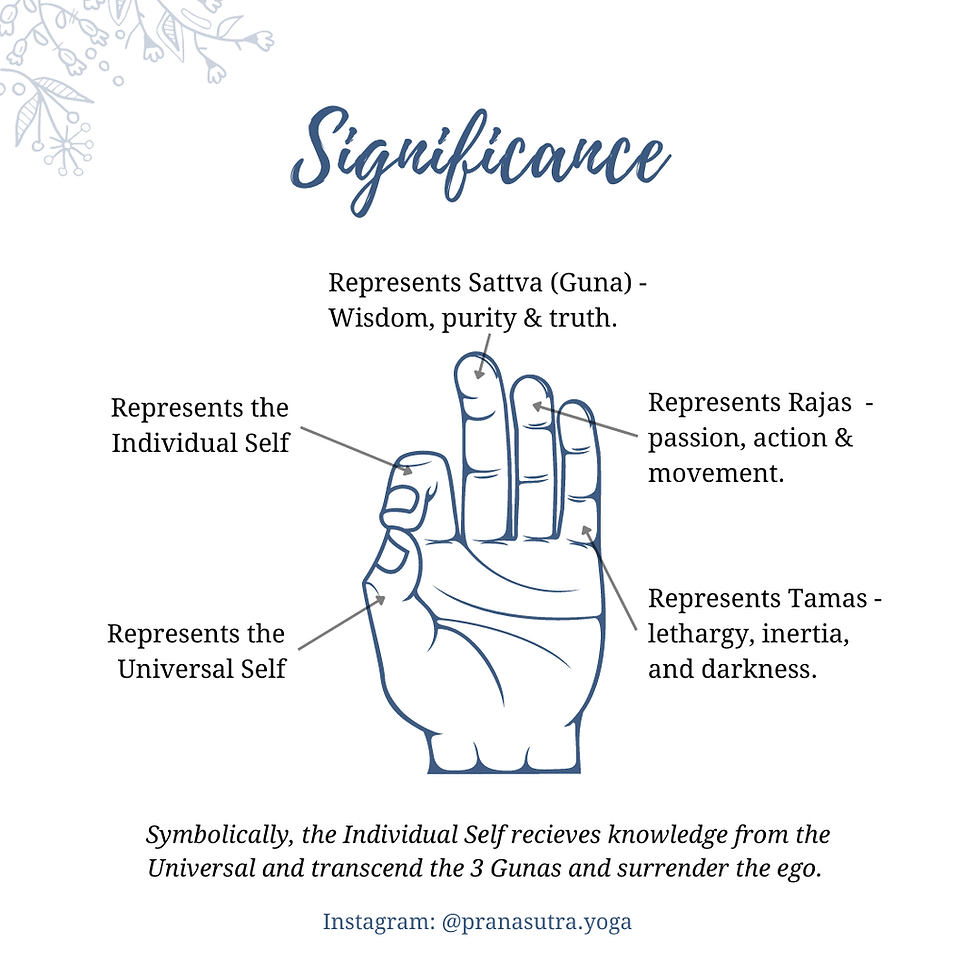
I do not claim to be a spiritualist or Yogic practitioner who can provide further “expert” explanations to the above chart. So, I shall leave the above chart alone. The reader can ruminate upon it privately at will.
However, what I do wish to share here below is a little knowledge which I have been able to gather about the spiritual significance of this beautiful mudra from listening to what a few eminent Acharyas, belonging to the Sri Vaishnava school of Visishtaadvaita Vedanta, have spoken about in many a public discourse…. “pravachanam“.
Below is a brief paraphrased summary of such elaborate explications as I am able to recall today to the best of my ability:
1. The 5 fingers symbolise significant Vedantic postulates (in Visishtadvaita they are referred to as “Tattva”).
2. The middle, ring and small fingers represent the Tattva-Traya postulate of 3 ontological realities : Cit (sentient being), Acit (insentient being), and Ishwara (the Supreme Absolute Being I.e., the Overlord of both Cit and Acit)
3. How to gain the knowledge of the 3 metaphysical tattvas?
4. It is possible indeed but then only through acquiring the knowledge relating again to what we may call as the “3 Pillars of Vedantic Wisdom” viz. Tattva (Principle) Hita (Practice) and Purushartha (Purpose)
5. How then is one to go seeking those 3 Pillars ? The answer given is that it is by using 2 God-given gifts to Man : Manas and Buddhi i.e. the Mind and the Intellect. In the mudra, the two are represented by the Index finger and the Thumb respectively .
6. It is very significant that Buddhi is symbolised by the Thumb … for we know that without the Thumb all the other 4 fingers cannot fully or efficiently function . Likewise, without the intellect , the mind cannot function as it should. If the Mind malfunctions, knowledge of the 3 tattvas (‘gnyaana‘) too then cannot be gained .
7. When Mind and Intellect, on the other hand, come together , gnyaana becomes accessible and realisable. So long as they remain un-conjoined or un-coupled, they remain out of synch with each other. In other words, they each function independently but without spiritual synergy or purpose. To clasp an object properly, one needs to put to use both the index finger and thumb together to pick it up first; it is then that the other 3 fingers too come together … and all 5 fingers then bunch together to gather up and hold the object in the palm. Such is the case with “gnyaana” too… the mind and the intellect must work in tandem to be able to grasp what the Pillars of Vedantic Wisdom — tattva, hita and purushartha — are all about.
8. There remains now one further problem : Who but a “gnyaani” himself can help us to go beyond mere symbolism? Who can show us the practical ways to actualise the realisation of the 3 metaphysical truths by using the power of the Mind and Intellect ?
9. The answer given to the question is that it is only an Acharya ( a spiritual adept) who can help us in that experience of that process… the Acharya catalyses what is called “gnyaana praapti” — the acquisition of hard-earned spiritual insights.
10. In Sri Vaishnava philosophy, such “gnyaana” is explained analogously in terms of a long journey of spiritual discovery and insight. And again incidentally, that long journey is said to be marked by 3 main milestones : they are (1) “atma svarupa gnyaana”, (2) “Paramatma svarupa gnyaana” and (3) “upaaya gnyaana praapti”.
11. The first 2 above are self-explanatory Sanskrit terms. It is redudant to explain them. But it is important to know that they, in fact, denote the Cit and Ishwara i.e. 2 among the 3 tattvas of the “Tattva-traya” triad.
12. The third spiritual insight or discovery described by the term “upaaya gnyaana praapti” bears direction relation to what is Hita — viz. the second of the 3 Pillars of Vedantic Wisdom. Hita is the roadmap for the journey. It shows the routing and the direction to take. The greatest work of Hita in Vedanta is the Srimadh Bhagavath Gita in which are expounded the 4 great “yoga upaaya” (or “yogopaaya“) — Sankhya-yoga, Karma-yoga, Bhakti-Yoga and Saranagathi.
13. On this voyage of spiritual discovery, there 2 other similar milestones along the way. They are known as (4) “upaaya virodhi ” and (5) “Parama Purushaartha”. Spiritual insight dawns only when one has learnt not only how to walk steadily and purposefully upon the journey’s road (i.e. the upaaya ) but also — and perhaps more importantly — how to avoid treacherous pitfalls and road-bumps (virodhi) among the way that leads up finally to the desired destination called “Parama purushartha“.
14. Finally, there is one last problem to be solved. To be able to patiently and thoroughly teach or train the disciple all the theory and practice underlying everything described above as Vedantic tattvas, one needs a Guru or Acharya, who is adept in the subject. The Guru must be willing to exert himself to the utmost to educate and enlighten the disciple. Such effort can be borne only out of a heart brimming with compassion. To impart “gnyaana” to a disciple, what is required uppermost, and far more than deep knowledge itself, is Compassion… a guru’s compassion. This rare kind of compassion is known as “daya“.
15. The various methods of imparting knowledge to a disciple by a guru are collectively known in Vedanta as “Acharya Upadesa”.
16. The symbolic representation of “upadesa” is what the beautiful mudra depicted in the above photograph is all about.
17. Which is precisely why in Sri Vaishnava tradition, it is far more common to describe the popularly known “chinn mudra” more accurately as “upadesa mudra”. It symbolises both “gnyaana” of Tattva, Hita and Purushartha … but above all, it signifies “daya” … the great compassion of the Guru.
18. This mudra thus is a powerful symbol signifying Knowledge, Truth and Compassion and that is the reason why when we gaze long and hard at it, a feeling of calm, contemplation and contentment descends upon and envelops us at once.
**************
The graceful and beatific “upadesa mudra” is what the iconic figure of the great Visishtaadvaita preceptor, Sri Ramanujacharya is always seen with today by all Sri Vaishnavas:
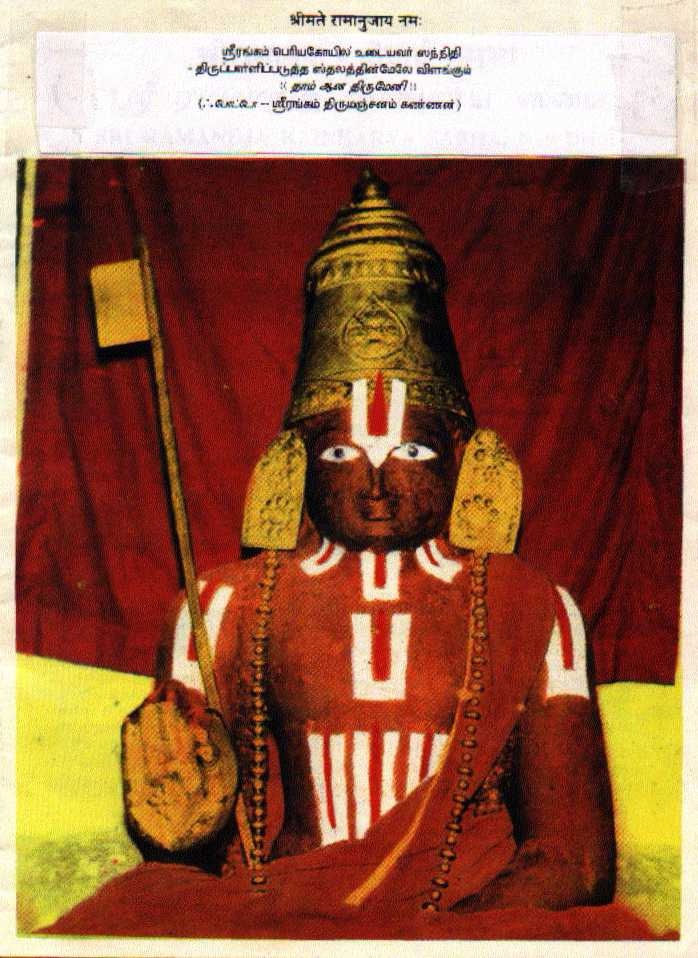
“Yonithyamachutha padambuja yugma rugma
vyamohatha sthathirani thrunayamene
asmathguroh Bhagavathosya dayaika sindho
Ramanujasya charanow sharanam prapadye”
Shrimathe Ramanujaya Namaha
In the above honorific sung in his praise by all Sri Vaishnavas, the phrase “dayaika sindho” stands out. His “upadesa” all sprang from a “daya sindhu“, veritably, a sea of compassion for his disciples.
***************
Sudarshan Madabushi