Post-1947, it was the Anglicised-Hindu Class that became the chosen people upon whom all the dreams and hopes of Jawaharlal Nehru for a “modern India” rested. Nirad C. Chaudhury described them — “….as a separate ethnic entity with its own collective psychology. It is constituted by the Hindus of the Anglicized upper middle-class, and is thus an offshoot or rather variety of the Hindu species. The class is a psychological and cultural breed, but it has not been hybridized by those ardent and successful improvers of equíne, canine, or bovine races — the British. The Anglicized Hindu breed of India is self-hybridized, like white peas from an adjacent bed of reds”.
The population of these Hindu Anglophiles, Nirad Babu pointed out, was infinitesmal compared to the rest of Independent India’s: “Their number is small, and in relation to the rest of the population almost negligible. I doubt if they are even one-fortieth of that neglected minority, the Muslims, and they might well be just half-a million. But there is no contesting the fact that they are the dominant minority. They are in the front rank in every field of human activity, political, economic, cultural, so far as anything can be called activity in present-day India”.
*************
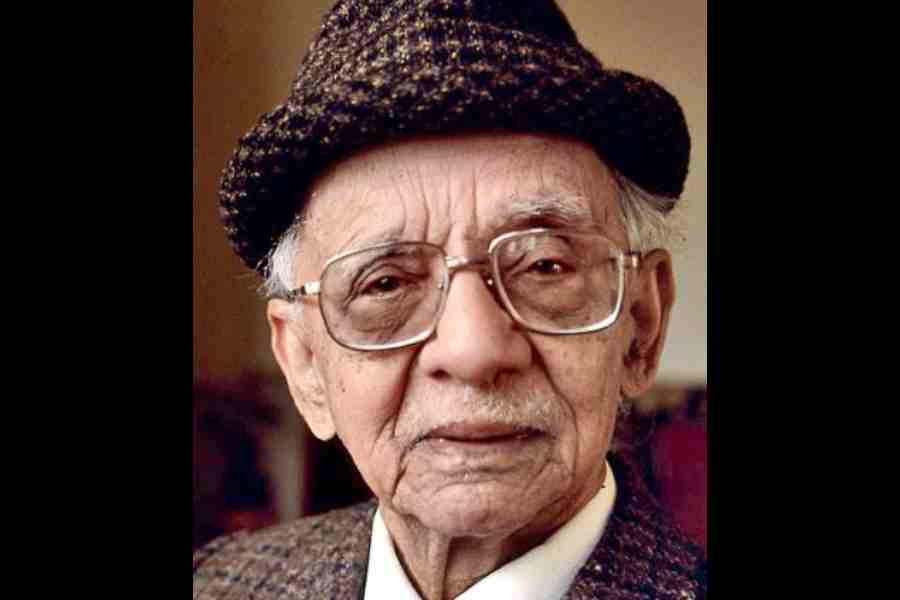
Nirad C Chaudhury (1897-1999 CE)
Nirad Chaudhury’s essay then went on further to explain this unique but miniscule class of Indians who came to rule the roost under the grand arch and sway of Nehruvium for nearly two decades after 1947 and continued to still exert and exercise enormous influence later upon the political thinking, social engineering and cultural churning during the following three more decades in India…. which was when the green shoots of Hindu Nationalism (today called Hindutva) began first sprouting all across the northern landscape and heartland of the country. It was truly a historic marvel indeed how nearly a 300-million large mass of people came to be ruled by a barely half-a-million strong minority of Anglicised Hindus.
Nirad Babu explained it this way:
“I shall have to deal with the class … in my essay … and in this one, I am concerned only with that aspect of this group’s personality which bears on the question how far this class can be depended on to maintain and complete the modernization of India which really means its Westernization. In other words, I shall discuss the class only as the agents of that transformative process.
“The makers of policies in the two great Western countries, the United States and Great Britain, look to these men, and even more to the women of this class, for the success of their policies. This small order is seen by them to be as well-fruiting in geniuses as an espalier of apple trees. It is indeed the rising hope of the West in India. The whole of the Western ‘Aid India Club’ in the most comprehensive sense, thinks that these Anglicized Hindus are the only people who matter in the country, and that they are going to reshape and remake Hindu society in the image of the Western”.
************
According to Nirad Chaudhury, this powerful “dominant minority” class of India — an elite, ruling aristocracy that Nehru assiduously cultivated during his regime as Prime Minister as the very apple of his eye — consisted of 4 four principal sub-groups whose dominance over Nehru’s India resulted in the spread of its tentacles of influence far and wide in the country:
(1) The officers of the Armed Forces;
(2) The Government Bureaucracy, Managerial and Professional Elite (in the private sector);
(3) The Technicians (or rather technocracy);
(4) the Youth in (academia) Schools and Colleges (and Universities of higher learning).
Nirad Babu had very trenchant if not pungent things to say about each one of the above.
************
ARMED FORCES:
“Let me begin with the officer corps. They are a new order in Hindu society. They were the last to join the Anglicized upper middle-class, and did not exist before the first World War. But they are the most Anglicized Hindus today in their behaviour and manner of living. They are also the Hindus who know least about Hindu ways and traditions and are the most indifferent to all things Hindu so far as these can be present in the consciousness. This transformation and the attendant sterilization were brought about by the very special and strict system of education devised for them by the British military authorities in India, which is being continued by the present Hindu ruling class.“
“To make my point of view clear I have to give the background. Though the question of giving commissions to Indians in the British Indian army was discussed as far back as the eighties of the last century, no Indian was actually given one till towards the end of the first World War. After that it was decided, as a matter of policy, to begin the Indianization of the leadership of the Indian Army by admitting Indians to the officer corps as a matter of regular practice. In accordance with this policy, at first a very small number of Indians of good education and social position were hand-picked and sent to Sandhurst, and so far as it was possible for Indians to become typical Sandhurst products, they became that. This system was continued during the twenties. Then it was found necessary to reconsider the policy, in order to give the Indian officers military education in their own country. … The sun rose, and the same sun is now at the zenith. But it is a very moonish sun, palely reflecting the light from Sandhurst. A completely exotic military college was set up, as indeed it could be expected to be”.
*************
BUREAUCRACY, MANAGERIAL AND PROFESSIONAL CLASS
Of this sub-group of Anglicised Hindus, Nirad Chaudhury was savagely critical. In hindsight and on reading the below passages, one gets the impression that the author of “The Continent of Circe” sixy years ago had already anticipated one of PM Narendra Modi’s own Parliamentary broadsides against the Lutyens and Khan Market gangs of today.
“From the point of view of Westerization, political, economic, or cultural, nine-tenths of the Hindu middle-class persons who have received education in English in schools or universities can be left out of the reckoning. Their Westernization is purely technical, and it is relevant only to their method of earning a livelihood or making a career, and it leaves their character and outlook untouched. These men in their Westernization conform to the minimum specifications of vocational Westernization laid down formerly by the British rulers and now continued by their Brown heirs.
“It is only the well-to-do core and elite of this class which can be said to have been Westernized in any effective manner, and it is for this reason that I have estimated the numerical strength of the order at such a low figure. Even of this small class not all have been educated or trained in Western countries. In fact, formerly, those who had received some sort of education or training in Europe or America were only a fraction of the whole body of Westernized Hindus. Nowadays, on the contrary, they certainly are in a majority. However, the women who have been abroad still form a minority of the Hindu women who have taken to Western ways, but their number, too, is growing.
“There is some ill-feeling between the two wings of the Anglicized Hindus, that is to say, between those who have been abroad and those who have not been, and even more exclusive ill-feeling between those who have been at Oxford or Cambridge and those who have not been at these two universities, wherever else they might have been. The country-bred Anglicized persons consider those who have come back from the West as swell-headed, and the other side reciprocates by regarding the ‘natives’ as jackdaws in borrowed plumes. But in respect of fundamental attitudes and cultural complexion, there is no very great difference between the two sections. In fact, I do not meet more Hindus with a Westernized mind among those who have been educated in the West than I do among those who have remained in India. The stay in the West seems to be more obvious in the finish of the order than in its substance.
“The regional distinctions between Anglicized Hindus are far more important. All of them can be recognized province-wise by the specific quality of Westernization; that is to say, the general body of the Anglicized Hindus falls into provincial types. Those from the Punjab tend to be different from those from Bengal or Madras, and even the Bengali and the Tamil Anglicism are not the same. But these differences, important as they are if one is considering the specific shade of the Westemization, are not significant if the transformation is considered simply as passing over to a way of life modelled on that of the West and recognizably alienated from the traditional Hindu way.
Even more important are the distinctions which have been created within the Anglicized upper middle-class by the social function or, in simple words, by the means of livelihood and vocations.
***************
Nirad Chaudhury back in 1965 also accurately predicted the fall of the Anglicised Brown Sahibs of the Indian Government Bureaucracy (IAS, IPS and IA &AS babudom) and correctly, but in extremely harsh terms, assessed their progressive enfeeblement and enslavement.
“But the weakness of the Westernization of this class of men lies in the very length and protraction of the assimilation. Their reaction to Western influences has now become a routine affair, and the influences themselves have ceased to be stimulating. On the other hand, with each succeeding generation, the men themselves are becoming more and more enfeebled and less and less absorbent. It would seem that their saturation point was reached long ago. So they are now something like leached soil for the growth of continuous Western crops, and in strength of character, varying the metaphor, one might describe them as wine which is very much madérisé.
“Those … who are only seeing them today in their day of worldly power and prestige will have great difficulty in believing this. To all appearance, their Anglicism is not only assertive, but even insolent. They do not behave politely to any Indian who does not belong to their class. They are strident in their contempt for Hinduism and Hindu ways, and voluble in repeating any Western credo, however trite. In every respect they appear to be a self-confident caste, and it is natural to assume that the self-assurance springs from a sense of inner strength and a living faith in new values.
“Indeed, there are perhaps few people on our pullulating Mother Earth of today who hold a higher opinion of themselves, of their own intelligence, knowledge, and culture. When these Hindus cannot treat a particular individual rudely for any reason, but find him holding opinions opposed to theirs, they sport an oily smile which is more maddening than any outright discourtesy could be. They are pontifical and unshakable in their assumption of omniscience. All these men combine the Hindu pride of caste with the English pride of class, and they can be very unpleasant.
“If that be so, you will ask— where is the weakness? Such arrogance, offensive as it is, can hardly exist without some awareness of a superior culture, combined with an assertive devotion to it.
“That precisely is what is not there, and the worst part of this egregious snobbery is that it is unaccompanied by the substance which could be assumed to have inspired it. It has no ideological or cultural foundation, and is wholly a matter of worldly position and power, which they think are unassailable and will therefore remain permanent. They are incapable of realizing that their present status is dependent on a temporary and very exceptional personal factor. To make no mystery of it, the dominant position of the Anglicized Hindu upper iniddle-class is due to the presence of Nehru, first as the Prime Minister of India, next as the supreme national leader, and, over and above all, as the object of the Hindu personality cult which has even now made a divinity of him, to be worshipped in a temple, like the Roman emperors.
***********
Chaudhury was exceptionally perspicacious in further pointing out that even while Nehru often disavowed Hindu Nationalism (or what today many know to be Hindutva), he nonetheless depended upon that section of the non-Anglicised, native society of India.
“Personally, that is, in his ideas and character, Nehru is the leader of the Anglicized upper middle-class of India, but it is not this which has made him the absolute dictator that he is politically, mulgré lui. He holds that position and gets his power from a wholly dissimilar source, a source which he dislikes and disapproves of, which yet has made him what he is politically. It is the personality cult in the religion of the Hindus, which was transferred to the political sphere with the advent of Mahatma Gandhi. It was that typical prophet of the Hindu masses who built up this kind of leadership for Nehru, and transmitted the quasi-religious primacy to him in apostolic succession by what was equivalent to a laying on the hands*. But since in fact Nehru does exercise the esoteric leadership, he can and has put its power and sanction behind his own social order. However alien the personalities and ideas of this order might be to the Hindu masses, the masses will give their support to it through the nexus that Nehru is, and so long as he lives and maintains the nexus, the Anglicized Hindu order will also remain in the saddle. But as soon as he goes it will quite naturally be overthrown. That is what the class as a whole cannot realize — hence the blind and confident arrogance.
(My Note: * “laying on the hands” is a Biblical phrase referring to when a believer places hands on another person to release the power of God for one of three purposes: to handpick an individual for a special work of the Church; to receive the Holy Spirit; and to administer healing).
Chaudhury further predicted:
“One might, however, admit the possibility of their being ousted from political and administrative power without accepting as a corollary that their Westernizing cultural role will also come to an end. A cultural function has no necessary relationship with political and administrative power, and therefore the loss of the one need not always bring in its wake a loss of the other.
“These, however, are precisely the things which can no longer be expected from the Anglicized Hindus of India. To whatever province they might belong, they are marked by the common lack of faith, energy, and courage. The whole order seems to be in a state of premature debility. It contains no men capable of putting passion in the pursuit of Western ideals and fighting for them against opposition and obloquy, as the Westernizing Hindus did in the nineteenth century. The class, which now forms the executive element in the ruling order, is sunk in an easy-going and affluent materialism. The Westernization supported by these caryatids is only a façade. Behind it lies hidden a dangerous void of faith, ideas, courage, and, of course, energy.
“This is rubbing it in, though. Almost all Anglicized Hindus admit that the Westernization which impinged on the higher regions of their mind is now at the point of exhaustion, and what survives of it is even more dilute than the proverbial milk and water. The only influence and prestige which makes it still possible for those who retain this out-of-date Westernization to earn a second rate livelihood in contemporary India is due to the presence either at the prow or the helm of the Indian ship of State of men like Dr. Radhakrishnan and Mr Nehru.
***********
Being an unapolegetic Anglo or Europhile himself — of the intrepid not the hypocritical sort, though — Nirad Chaudhuri did not mince any words to describe the Anglicised Hindu ruling-class of the Nehruvian Order as a craven, spineless lot that when asked, by the Nehru regime, to bend no more than a little to bigoted Hindu Nationalists’ views or demands on occasions, often chose however to crawl.
“What is most significant and deplorable from the point of view of the continuation of the Westernizing process in India is the timidity of the Anglicized upper middle-class. If there is willingness and determination to introduce Western ways the knowledge may follow, but there is hardly any incentive to know because the desire itself is so sheepish and apologetic. The whole Anglicized order is mortally afraid of Hindu prejudices. They give up things they cherished at the hint of slightest trouble. I do not think that the men of the Anglicized class loved anything more devotedly that their English clothes, especially the tie. But one day a hint came from very exalted quarters that these were taking the class away from the people, and they threw their Western wardrobe overboard overnight, and went into a costume which was formerly the livery of their servants. Men in general, I have always thought, are very conservative in their external habits. But the Anglicized Hindus are very revolutionary, though in the reverse-gear.
“At the slightest clamour from some Hindu bigot or ignoramus, they proscribe books on India written by honest writers, and among the proscribed works is a book by Arthur Koestler. When the Catholic Church puts a book on the Index or when the Communists ban a book, each party can be said to be acting in the interest of ideas which it holds. The Anglicized Hindus always act in the interest of ideas they themselves condemn. There is no principle behind their behaviour…
************
Chaudhury thus in criticising the Hindu Anglophile — the Lutyen Elite Corps of Nehruvium — exposed their weaknesses to be in fact a weakness of Nehru’s own deep Janus-faced character… a weakness that stemmed from not so much from lack of ideals as the hypocrisy they exhibited in espousing their ideals.
“This timidity about the English language, and all things Western, gains more significance if it is considered along with the outstanding trait of the Anglicized Hindu’s character— which is weakness. This weakness has deprived the class as a whole of moral courage and fighting spirit. Almost all their evil propensities spring from weakness, and not from any inherent viciousness. It is only after seeing them that I have realized the full truth of La Rochefoucauld’s saying that ‘la faiblesse est le seul defaut que l’on ne saurait corriger (i.e. “weakness is the only defect that cannot be corrected“). They play for small stakes in a small way, and remain satisfied with their small gains. The result is that their whole existence is utterly trivial, and this triviality has become a permanent quality of their personality. Perhaps the best proof of this is that they do not participate in the Hindu sorrow, do not feel the weight of the secular curse on the head of that unfortunate people.
**********
Regarding the 3rd and 4th sub-group of Anglicised Hindus of India too — viz. Technocracy and the Youth of India —Nirad Chaudhury had some pretty provocative but precient predictions to offer in his essay. They will be discussed in the next and final instalment.
Sudarshan Madabushi