At Terezhundur, the Perumal temple which is of the Sri Vaishnava Vadakalai sampradaya (to which I may add that I proudly belong), is apparently supported by Sri Ahobila Mutt). This I could recognize easily in the distinctive (Sri Sannidhi) shape of the “tirumann” forms that adorned the temple walls and concourses all around the precincts.
The temple of Terezhundur Sri Varadaraja Perumal is a sprawling structure … an air of divine serenity fills this beautiful temple. From the outward looks of the Kovil however it seems like it badly needs improved maintenance . As a sishya of the Ahobila Mutt, through this blogpost, I humbly make an appeal to the Sri Karyam of Sri Sannidhi to please take effective steps and arrangements for carrying out repairs and renovation of this wonderful temple and perform its “samprokshanam” as early as possible.
Inside the sanctum itself , the idol of Sri Varadaraja Perumal is imposing , almost gigantic with the archa-murthy having a visage that is so full of beatitude and divine geniality. A mesmerizing idol, idol indeed! Accompanying the deity also are the other icons of Garuda Azhwar , Prahlada Azhwar , Markandeya Maharishi … and with the Thaayaars …
A magnificent sanctum indeed … one that tugs at the heart of every devotee who can imagine and evoke in his or her mind the picture of the “utsava murthy” as Gosakan, the divine cowherd who descended upon earth in his avatar as Krishna.
********************
Apart from the “vadakalai tirumann urdhva pundhram or chinnam”, what took me by equally great surprise were the etchings on the temple wall. They were of several verses taken from the Kamba Ramayana (“ramaavataaram“) !! Usually one is used to seeing on Divya Desam Perumal Kovil walls only the mangalaasaasanam paasurams of the Azhwars . But here in Therezhundur, the pride of place on the temple walls has been given to the great Tamil poet Kamban!

The reason was not too difficult to fathom, since, the village of Therezhundhur was the birthplace and native hearth of Kamban in the 11th century CE.
It is also being said here in this temple that the poet got his name Kamban as derived from Sthamban… which denotes the avataric deity, Sri Narasimhan …
Kamban’s nativity in Therazhundur, a rich temple-village, had a significant influence on his writings. He was born into a family of temple workers (Uvachars), with his father performing puja at the local Kali temple, and his family were worshippers of Lord Narasimha. This upbringing immersed him in temple culture, rituals, and devotional practices from an early age, shaping his deep spiritual outlook and mastery of both Tamil and Sanskrit.
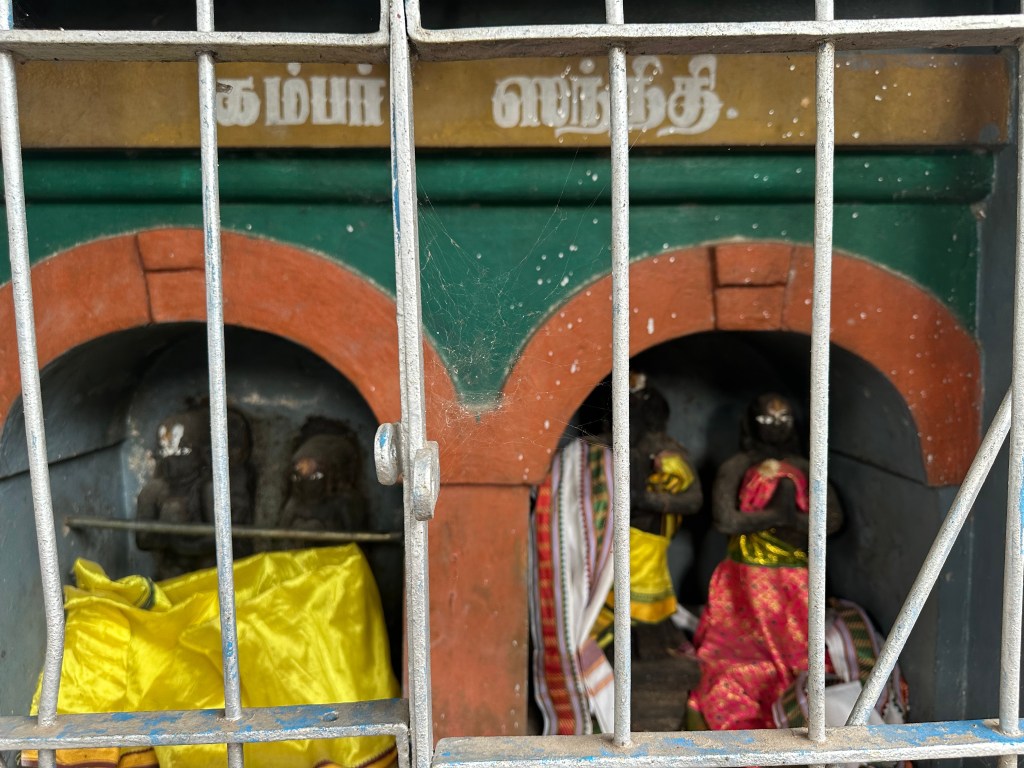
The presence of idols of Kamban and his wife inside the Therazhundur temple, and the rare idol of young Prahladha beside Perumal, reflect the temple’s lasting connection to his legacy. Kamban’s works, especially the Kamba Ramayanam, are infused with spiritual, ethical, and cultural themes rooted in temple traditions, and he often adapted stories to suit Tamil devotional sensibilities. Thus, his nativity and upbringing in the Therazhundur temple environment profoundly shaped both the content and style of his literary contributions.
This fact adds credence to the belief that Kamban’s monumental Tamil poetic work is no less a religious work as it is a literary masterpiece .
The association of the Sri Ahobila Mutt with both the Terezhundhur Kovil and Kamban thus became much clearer to me .
Kamban’s family deity, Lord Narasimha, had a profound influence on his literary themes. Unlike Valmiki’s Ramayana, Kamban devoted a significant section of his Kamba Ramayanam to the Narasimha avatar, inserting the entire story of Narasimha’s slaying of Hiranyakashipu as a major episode. This addition highlights themes central to Narasimha’s legend: the triumph of good over evil, divine protection of devotees, and the upholding of dharma (righteousness).
Kamban’s portrayal of Rama as a divine protector and restorer of dharma echoes the qualities of Narasimha, reinforcing the importance of faith, compassion, and the ultimate victory of righteousness-core messages associated with his family deity. This influence helped Kamban infuse his epic with deep spiritual and philosophical resonance, making it distinctively Tamil and devotional in character.
Kamban thus has a special place in the heart of Sri Vaishnavas.
(to be continued)
Sudarshan Madabushi