Early next day from my base-camp at Mayiladuthurai, my pilgrimage continued on to the holy temple town of Tirukannapuram.
This visit of mine to this sacred Divya Desam was of very special significance to me personally, since it was precisely where the 5th and very last destination in a customary pilgrimage known in Sri Vaishnava tradition as the “Pancha Krishnaararanya Kshetrams” culminates.
During earlier years — since 2018 — along with my wife, I had already sojourned through three divya desams in an exclusive cluster amongst these five others — (1) Thiruvikrama Perumal Temple in Thirukkovalur, (2) Loganatha Perumal Temple in Thirukkannagudi, (3) Gajendra Varadhan Temple in Thirukapisthalam and (4) Bhakthavatsala Perumal temple in Tirukannamangai Kovil … And now, I stood before Sri Neelamegha Perumal Temple in Thirukannapuram —- my fourth.
To me personally, it felt like I had reached one more milestone in the Pilgrim’s Progress in life. After Tirukannapuram, there remained now for me only one more temple left in the Pancha Krishnaaranya Kshetrams to visit. Mentally, I prayed to the Deity of Tirukannamangai to bless me again with his darshan there at some time very soon in the very near future, now that I had worshipped him here at Tirukannapuram.
Meanwhile, now at Tirukannapuram, I turned to walk into the temple precincts with a heart skipping with excited expectations of joyous darshan. Here are some headline features of this great temple:
| Moolavar : Sowriraja Perumal | Posture : Standing Pose Facing East With Varada Hastham and Prayog Chakra | |
| Thayar : Kannapura Nayagi | Utsava Perumal : Sowrirajan | Utsava Thayar : Padmasini Thayar |
| Vimanam : Uthpalavataka Vimanam | Theertham : Nithya Pushkarini, Ananda Saras | Puranam : Padma Puranam |
It was here in Tirukannapuram that the Deity here himself initiated Thirumangai Azhwar into the sacred esotericism of “Thiru Manthira Upadhesam“…. the 8 syllabled “ashtaakshara mantram” so dear to all Sri Vaishnavas.
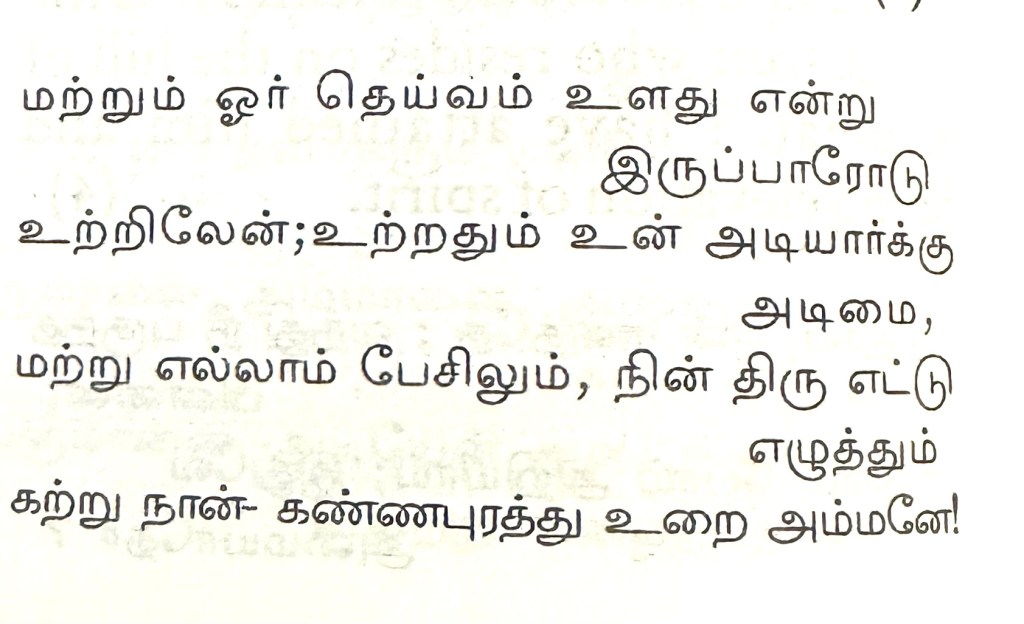
“O Lord of Kannapuram! I shall have nothing to do with those who take to other gods. Having learnt (from you) your eight-syllable Mantra and meditating on it constantly, and out of all the meanings gleaned and interpreted from it, the only one I chose to embrace is this: lifelong dedication to the service of your devotees.”
The Legend for the Name – “Sowrirajan“
Sowrirajan is the name of the “utsava” (processional) Deity in this kovil. It means Artificial Coiffured Hair! The “sthala purana” tells an interesting tale of how this endearing “naama” got stuck to the Almighty here!
Once there was a devoted priest named Ranga Bhattar who was a priestly servitor of the Almighty here in Thirukannapuram. In the days of yore, there was a custom that, every day the local royal viceroy would dutifully send a large garland to the temple which the priest would then use to adorn the Deity in the sanctum. Later, the local viceroy would come for darshan at the temple to be honoured when the priest would return to him the same garland earlier offered to and adorning the Deity.
One day, due to some unknown reasons, the customary garland from the viceroy’s palace gardens did not reach the temple on time. The priest got frustrated and began fretting since the time of viceroy’s Darshan was nearing and he feared the temple service that day would get delayed. The delay would certainly displease the viceroy.
To save himself from the ire of the local viceroy, the priest in very great haste rushed to his home, took away the flowers collected there meant for his own wife’s use, and ran back with them to the temple to weave them all quickly into a garland for the Almighty.
The viceroy duly arrived and the customary service in the sanctum was held, after which the garland of the Deity was ceremoniously removed and offered as “maala maryaadai” to the high and mighty dignitary.
However, on returning to his palace, the viceroy, as he removed the garland from his neck, noticed that a long strand of human hair was entwined in the garland! To him it looked exactly like that of a strand of hair taken from a woman’s tresses. The big man fumed!
The priest was at once summoned from the temple and questioned about the garland.
Fearing severe punishment at the hands of the viceroy, the priest to save his skin, began blatantly lying. He told the viceroy the long strand of hair pulled out of the garland must be that from Lord Vishnu’s own head!
The viceroy was incredulous! He thought the priest was lying through his teeth. But then the priest vigorously insisted that daily he himself had seen the Deity in the sanctum actually wore his lustrous hair very long!
The viceroy remained unconvinced. After all, he too had been visiting the sanctum every day and knew exactly how the Deity’s idol looked. He had never seen the Almighty sporting long hair…
“Priest, I will come tomorrow to the sanctum to verify myself if you are speaking the truth or fibbing. You may go now!”, said the viceroy sternly.
The panic-stricken priest rushed back to the temple and trembling with fear, he prostrated before the Deity and desperately pleaded for the Lord to rescue him from the dire punishment that surely awaited him the next morning—- the Day of Judgment.
The next day, the viceroy arrived to verify the claims of the priest at the sanctum and asked the priest to show him the Lord’s long tresses.
The craven priest reached behind the Lord’s idol. Miraculously, the Almighty gave Darshan to both the priest and the viceroy in a pose that sported a beautiful, silken long-haired “sowri” … an artificial coiffure!
Since then, the Deity of Tirukannapuram has always been known to his devotees as Sri Sowriraja Perumal!
**************
The deity rooted inside the sanctum is the Moolavar Murthy of this Perumal. The idol can seen to be in a very elegant posture indeed symbolising divine blessings being showers on his devotees with eagerly outstretched hands.
The Almighty’s hands appear to be holding the “receiving mudra‘” (receiving posture in contrast to the usual iconic posture one will find on idols in other Vishnu temples where the Lord would be in “Abhaya mudra” or “daana mudra”, the giving posture) symbolising that He accepts all the sorrows and burdens of the devotees who come to Thirukannapuram seeking his grace for relief and solace.
Unlike other Sri Vaishnava temples elsewhere , where one of the several large and overarching portals inside the temple is designated specially to be the “svarga vaasal” (or the Doorway to Heaven), in Tirukannapuram, there is no such Svarga Vaasal ! Why? Because it is believed that one can reach Sri Vaikuntam, the eternal abode of Lord Narayana, if one were to merely step onto the soil inside this great Divya Desam and prostrate upon it in true devotion. No entry through “svarga vaasal” is needed here for the true devotee !
With that happy and hope-filled thought lodged inside my mind, I ambled out of the Tirukannapuram — a merry and fulfilled Pilgrim.
(to be continued)
Sudarshan Madabushi