In the minds of many Sri Vaishnavas exists still a very deep-rooted conception or consciousness of the Dravidian origins of their ageold history which broadly is imagined to be divided into (a) the Azhwar Era and (b) the post-Ramanuja era.
In the Azhwar era, again it is believed by them, that Vaishnavism took roots in South India as an anti-Saivite theology that preceded it chronologically — i.e. since the pre- 5th century CE. Saivism in the eyes of these Sri Vaishnavas was indeed the most dominant popular faith also in the post-Ramanuja era — i.e. after the 11th century CE. Thus, the most common historical narrative is that the two theological schools of Saivism and Vaishnavism in Tamil country (Chola and Pandya provinces) remained diametrically and bitterly opposed rival sectarian faiths.
This popular impression amongst many Sri Vaishnavas is a simplistic “black and white” theory. The nuanced facts of history show that while Saivism and Vaishnavism were indeed distinct schools of theocentric faith, they both overlapped and blended together harmoniously through several of their common religious interaction and cultural intercourse.
Both theologies, for example, were essentially rooted in the Vedas (“marai“); both were theosophic and theophanic; both embraced Bhakthi as a pathway to spiritual liberation; both accepted Agamic forms of idol-worship in their respective temples; both celebrated their respective pantheon of saints as mystics: 63 Nayanmars in the case of the Saivites and 12 Azhwars in the case of the Vaishnavites.
While these commonalities of the two sectarian faiths are well-known, there is one other little-known fact yet about them that often gets overlooked by both sides. It is that both the Saivite and Vaishnavite temples of the Azhwar Era have had very intimate inter-sectarian affiliations and mutual intra-faith accommodations between each other.
Such affilations and accommodations sprung truly from the respect and tolerance each had for the other. And that fact is precisely what inspired an old and very famous Tamil aphorism quoted even today by the discerning and very learned Saivites and Vaishnavites of Tamil Nadu :
“ஹரியும் சிவனும் ஒன்று, அதை அறியாதவன் வாயில் மண்”
“Hariyum Sivanum onru, adhai ariyadhavan vaayil mannu“… is a very old maxim common to both sects . It echoes the integral voice of Tamil spiritual and philosophical discourse over past centuries that emphasized the unity of Vishnu (Hari) and Shiva (Sivan) as manifestations of the same supreme reality. It also suggested that denying or being ignorant of this unity is as foolish as filling one’s mouth with mud (மண்) — a metaphor for self-inflicted ignorance or foolishness.
Such mutual affiliation and accommodations were found to be evident in several Siva and Vishnu temples even of those bygone eras.
For example, in the famous Rameshwaram Temple of Siva, there is to be found even today alongside the sanctum on a corner of the inner ‘praakaara‘ a separate sannidhi for Vishnu consecrated there as “Bindhu Madhava Perumal“. Saivites to this temple thus worshipped both Siva and Vishnu under the roof of the same abode of the Almighty One.
Similarly in the famous Nellai Appan Siva temple in Tirunelveli, there is right next to the main Sivalinga sanctum, a large “sannidhi” of Sri Govindaraja Perumal... Again, Saivites devotees offer worship to both Siva and Vishnu.
Conversely, near Trichy, one can see in the Divya Desam temple of “Uttamar Kovil” (Tirukkarambanoor Sri Purushottaman Perumal Temple) also houses within the same premises, a Sivalinga sannidhi dedicated to “Bhikshadanar Iswara“. So, Vaishnavites here offer obeisance to both Vishnu and Siva.
**************
When I visited the Divya Desam kshetra at Tiru Sirupuliyur Perumal kovil, I was pleasantly surprised to come across again yet another egregious example of the ancient Saiva-Vaishnava spirit of mutual accommodative spirit inside a temple being manifested in a form other than in the form separate ‘sannidhis‘ or shrines for the two deities. What I saw was what I believe I stumbled upon as being both an affirmation as well as a truer clarification of the hoary Tamil aphorism of “ஹரியும் சிவனும் ஒன்று..” than what has for so long been its most popular interpretation.
However, before I proceed to explain the clarificatory truth of the Tamil aphorism, first let me pen a few striking impressions of this temple at Tirupuliyur which I was able to gather during my visit to this divya desam for the very first time in life.
| The Vishnu deith here is referred to as | Arulmaakadal, Krpasamudra Perumal |
| Lakshmi here is referred to as | Tirumamagal Nachiar, Dayanayaki |
| The cupola Vimana is called | Nandavardhana |
| The temple pond, Pushkarni is called | Maanasa Pushkarni |
| The Divya Prabhandham Hymns sung | Ten |
| Location | 3 kms on Mayavaram-Kollumangudi route; 3 kms from Thiru Velliangudi – Komal |
Structure
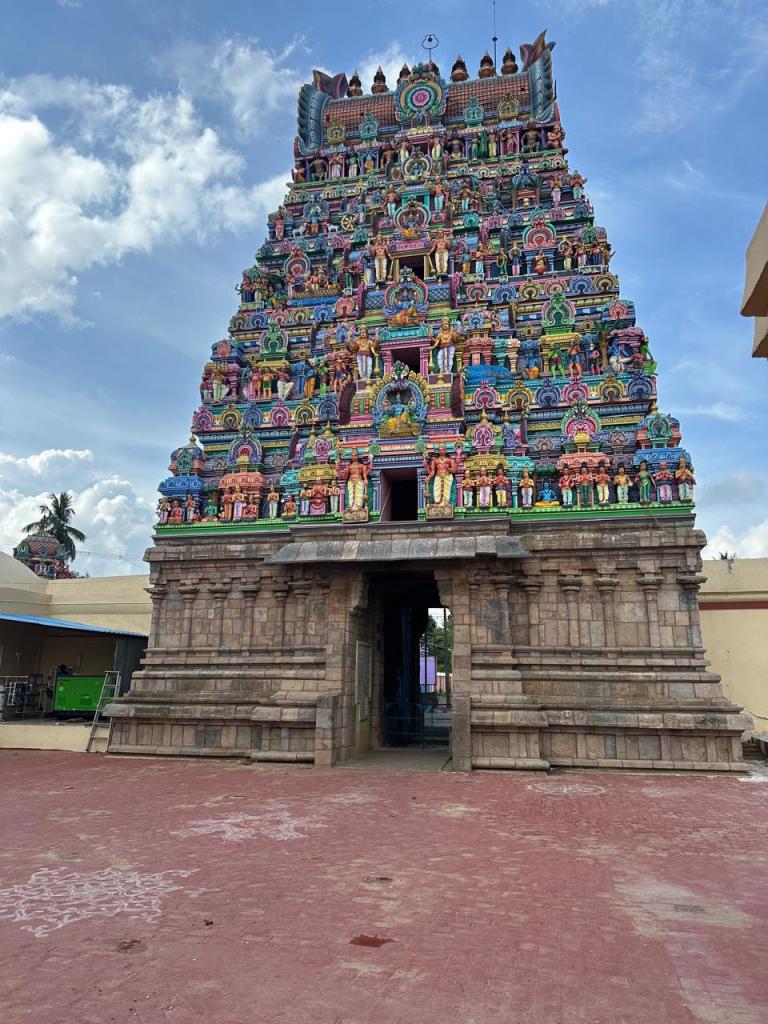
The front of the temple is decorated with ornamental figures and symmetrical designs. The temple has carved on it animals like elephants, horses, monkeys, so also peacocks, trees, warriors, flying figures, deities and celestial beings as well as some narratives from the puranas. The temple architecture is a bold synthesis of architectural forms and features of several dynasties that has resulted in a strong local traditional form.
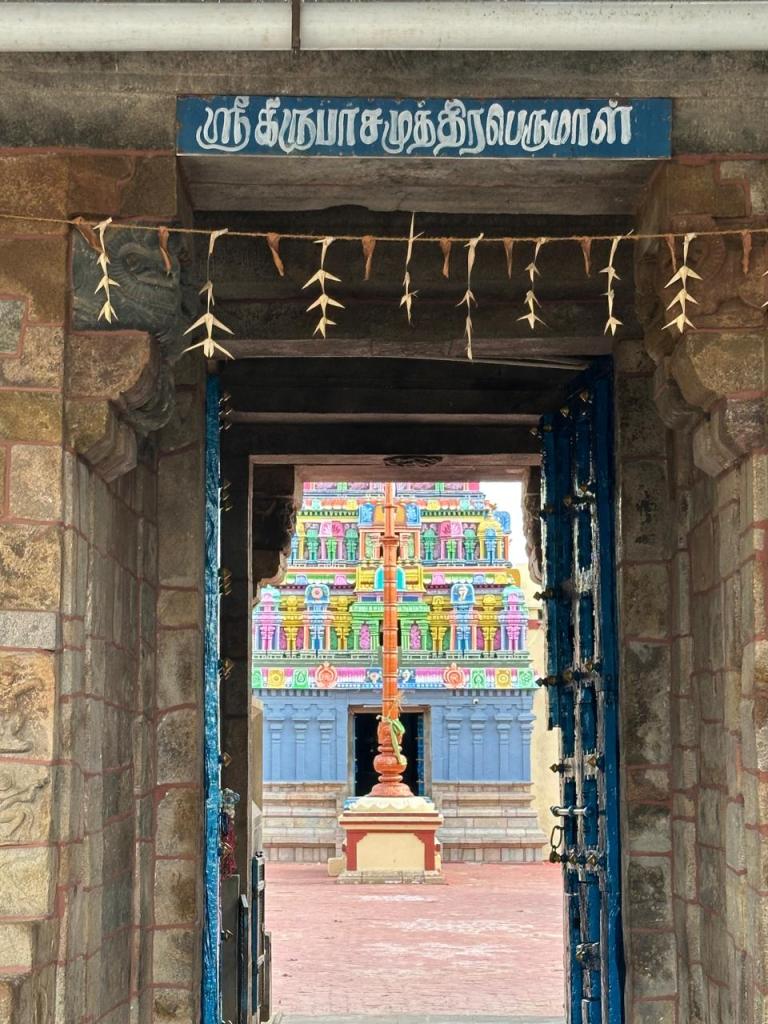
The temple is on an elevation and has two towers, one of five tiers and the other of three tiers with a magnificent Shikara perched over the east.
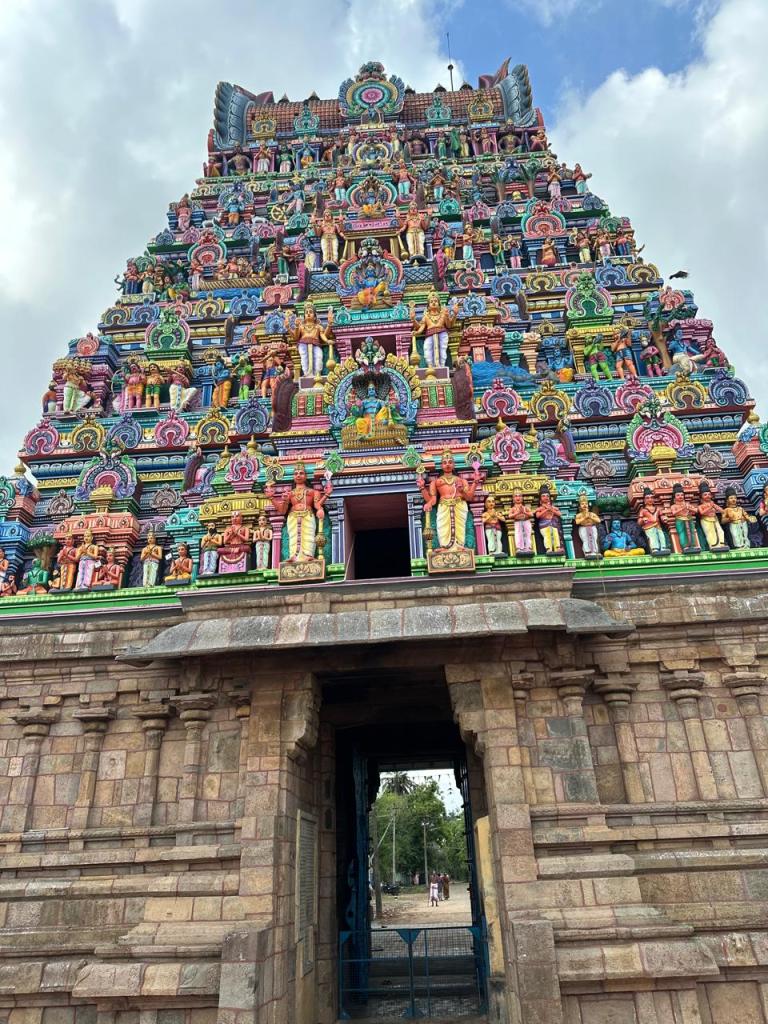
Mahavishnu here is seen in Bala sayana and the temple has separate shrines for Manavala Mamuni, Andal, Srinivasa, Nammalvar, Ramanuja and Anjaneya.
Legends
Garuda purana and Brahmanda purana are said to contain many descriptions of this ancient temple. Rich both in history and legend, the sthalapurana also mentions that many eminent sages, rishis performed penance and worshipped Mahavishnu in his glory here.
While the sage Pulikkal Munivar is known to have done penance in this temple during Puranic times, Bhrgu Maharishi was also at once blessed by the supreme Lord at this very shrine.
Another legend goes thus:
Several centuries ago, during the period of Bhakthi renaissance, there lived a monk, a muni who was a Mahavishnu upaasakar. He aspired for realisation of the self.
He prayed to Lord Shiva to bestow upon him with the energetic limbs and sharp night-vision eyes of a tiger (“puli” in Tamil), enabling him thereby to travel vast distances, day and night, nonstop to all parts of the country.
Siva asked him what else he desired and the muni said he was seeking moksha, eternal salvation.
Siva was greatly pleased and granted the rishi “tiger limbs and vision“. However, for for the boon of “moksha” he directed the muni to travel to this kshetra in Sirupuliyur where by worshipping Arulmakadal perumal in bhujanga sayana, the blessing of “moksha” could be attained.
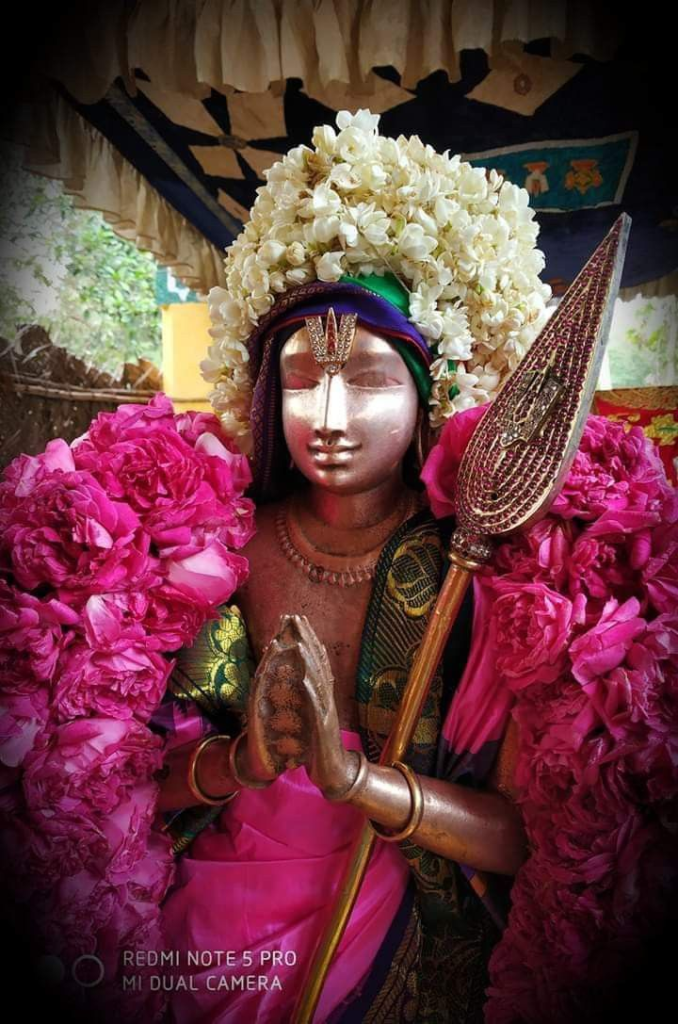
This muni was none other than Pulikkal Munivar or Rishi Vyaghrapada.
In remembrance of this puranic legend, a lovely icon of Vyaghrapada muni (Pulikaal munivar) is enshrined inside the sanctum.
The sanctum also has the icon of another famous rishi, Kanvamuni of the Rg Vedic times.
According to one legend, Vyaghrapada was entrusted with the task of plucking fresh flowers from a grove, untouched even by honeybees, for offering to Shiva in his aspect as Nataraja in the temple complex of Chidambaram. While plucking the flowers, Vyaghrapada was wounded on account of thorns and sharp stones. Shiva conferred on him thus the feet of tigers to relieve him of his pain and to go about his religious tasks with vigour.
Now bearing tiger’s (puli) feet, the sage easily moved from place to place, including climbing rough trees to pluck fresh flowers untouched even by the honeybees.
Both the sages Patanjali and Vyaghrapada once together venerated Shiva, and in response, the pleased deity performed for their eyes only the magnificent “ananda tandava”, his dance of bliss which to this day, one can see in the glorious pose of Nataraja at Chidambaram temple.
An astronomical work attributed to Rishi Vyaghrapada
According to local traditions in distant Kerala, Vyagrapada’s footprints are also to be found in that state.
The authorship of a treatise on astrology called Aṅkaṇaśāstra (also called Grahasamaya and Navagrahasamaya) has been attributed to sage Vyaghrapada. The work consists of 389 verses and has been divided into four chapters. In the book, each of the lagna-rāśi-s has been divided into nine aṅkaṇa-s (navāṃśa-s) and each aṅkaṇa is presided over by a graha having individual characteristics. (Wikipedia)
************
After darshan inside the sanctum, I walked out on to the outer ‘praakaara‘ of the temple and performed the customary “pradakshinam“, the slow circumambulation around the “garba gruha”. It is in fact the time during which a pilgrim concentrates his mind in meditative contemplation upon the deity and the temple legends as well.
My mind began to dwell upon the the old Tamil proverb: “ஹரியும் சிவனும் ஒன்று, அதை அறியாதவன் வாயில் மண்” …. and for some mysterious reason I could hardly fathom, I found myself asking this question:
“Rishi Vyagrapada had prayed to Siva and asked for not only “puli kaal” and vision. He had also told Siva that he was seeking “moksha”, did he not? Siva then granted him the first two wishes. But for “moksha”, Siva directed Pulikaal Muni to travel to Sirupuliyur and beseech Vishnu presiding there for the bliss of eternal salvation. Why? If Siva and Vishnu are both one and and had possessed the same divinity …. i.e. “ஹரியும் சிவனும் ஒன்று” …. why couldn’t Siva himself have granted the boon of “moksha” to Rishi Vyagradapada? Why send him all the way to Tiru Sirupuliyur divya desam to seek “moksha” from the Perumal there?
The answer to the question buzzing inside my mind, while I was absorbed in performing the “garbha-gruha pradakshinam“, came to me when suddenly I was able to recall a “paasuram” from the Naalaayira Divya Prabhandham.
Tirumangai Azhwar performed mangalaasaasanam for the Deity at this divya desam in ten beatiful hymnal stanzas in Tamil …. (Periya Tirumozhi 7.8.4). The most captivating and revealing of those “paasurams” is this one — and which, incidentally at once, also clarified to me the question roiling my mind about Vishnu and Siva being one:
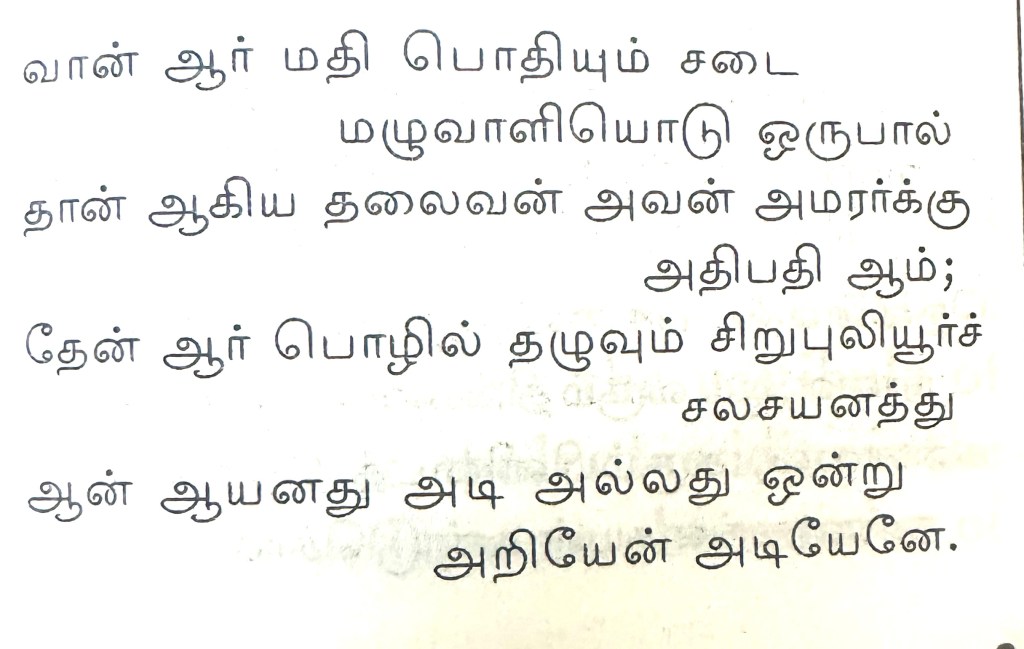

In the above ‘paasuram‘, there are three significant Tamil phrases which reveal and clarify the true import of the Tamil maxim of “hariyum sivanum onru… etc.”
There is the phrase describing Siva as “the moon-bearing” deity (sadai mazhuvaali); and then there is the phrase describing Indra as the “leader of the demigods” (amararkku adipathi). Then there is the phrase describing Kripasamudra Perumal as the Supreme One …. “thaan aagiya thalaivan“... on either side of whom both Siva and Indra stand merely looking on as the Azhwar prostrates at the feet of the Deity of Sirupuliyur, acknowledging that “Other than his lotus feet, I know no refuge …. “sirupuliyur salasayannathu aanaayanathu adi alladhu onru ariyen….”
What the Tirumangai Azhwar verse thus establishes is the cardinal theological truth which he came to know; which Siva and Indra too were cognizant of; and which is precisely why the Lord of Kailasa directed the Rishi Vyagrapada to go and pray at Sirupuliyur to the Supreme Duty Vishnu who alone could confer on him the grace of “moksha“.
The Tamil maxim “ஹரியும் சிவனும் ஒன்று… ” is therefore true and yet inaccurate.
It is true in so far as the power to grant moksha is excluded from the divine powers other deities are capable of bestowing. If a devotee remained ignorant, however, even after getting acquainted with the legend of Siva and Rishi Vyagrapada, of the truth that Vishnu or Supreme Naryana alone can bestow “moksha“, then it is such a devotee who must be said to have metaphorical “mud” in his mouth…. அதை அறியாதவன் வாயில் மண்”
In traditions such as those founded by Madhvacharya (Dvaita) and Sri Ramanuja (Vishishtadvaita), Vishnu (Narayana) is regarded as the supreme being and the sole granter of moksha. Devotion and surrender to Vishnu are seen as the only way to attain liberation, and even the grace to do so is believed to come exclusively from him. The Bhakti movement within Vaishnavism also clearly emphasizes that only Vishnu or his avatars (like Krishna or Rama) can grant moksha. Other deities, such as Siva, as in the case of Rishi Vyagrapada, can at best only intercede on behalf of the devotee or else recommend or direct him to Vishnu but they do not by themselves possess power to grant eternal liberation.
(to be continued)
Sudarshan Madabushi