This is the last and 15th instalment in this series of essays on my 3-day pilgrimage to 6 Divya Desam temples in and around the town of Mayiladuthurai in Tanjore and to the Tharangambadi-taluka village of Vilanagar where the grand Mahasamprokshanam of a c.900-year old temple of Sridevi Perundevi Thayar sametha Sri Varadaraja Perumal was celebrated over three full days, all filled with the joyous religious fervour of nearly five thousand devotees who had thronged there on the final day of April 30, 2025.
***************
The day dawned auspiciously. It was warm, sunny and a morning breeze wafted into the temple precincts. The village wore a vividly festive look. festoons, colourful pandals. The sound of chants and devotional songs was everywhere. An unending stream of villagers — women, children, men, young and old, all excited and eager — was flowing in from the neighbouring hamlets.
Earlier that morning, the Deity’s idols were carried around the village streets in a grand ceremonial procession accompanied by a lot of fanfare, music and nagagawaram pipers and drummers leading the “utsava purappaadu”. And even earlier, the village womenfolk, all dressed in their fine silks, were coming into the temple in droves, holding plates in their hands carrying various offerings of fruits, flowers, ‘saamagris‘, nuts, grains, spices, condiments etc… for the occasion.

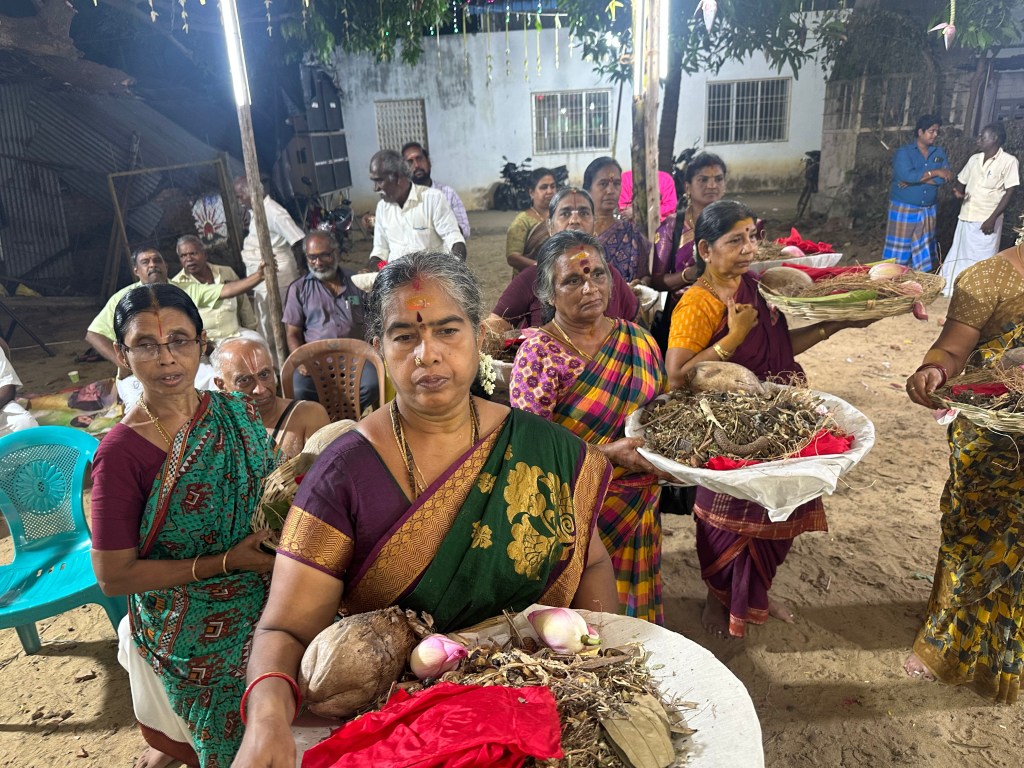
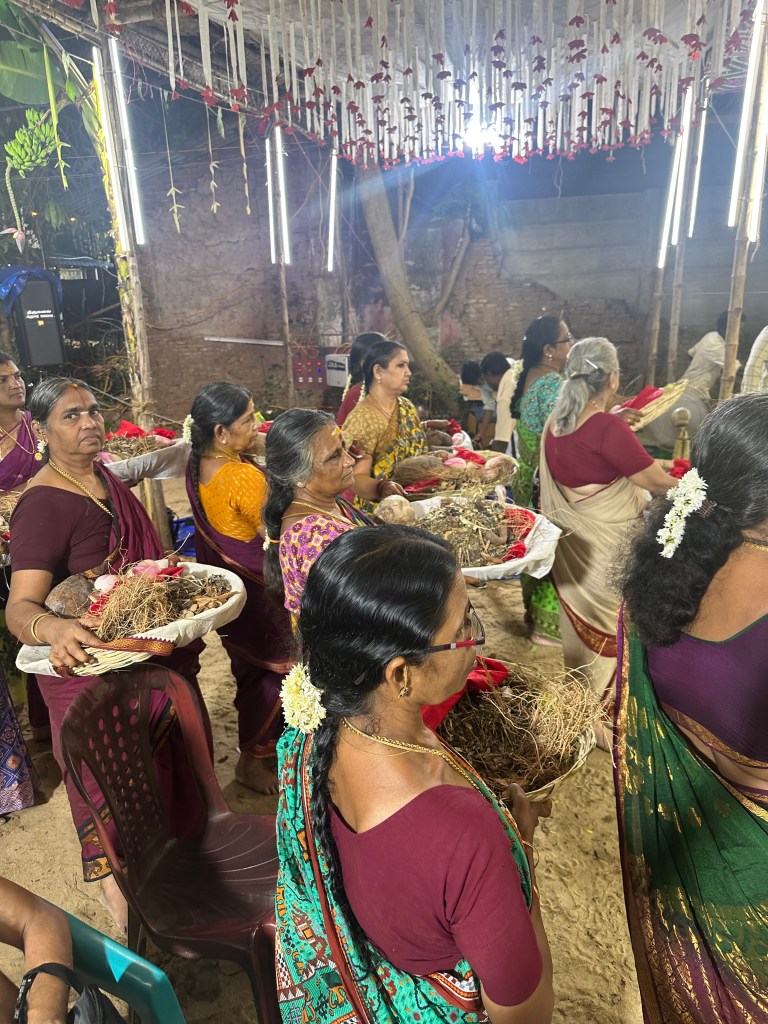
The “purappaadu” procession filled the morning air with merriment and surcharged it with tremendous spiritual energy and expectation.
************
Once the Deity’s idols were carried aloft reverentially into the temple interior, they were duly restored into the sanctum, the inner “sannidhis“.
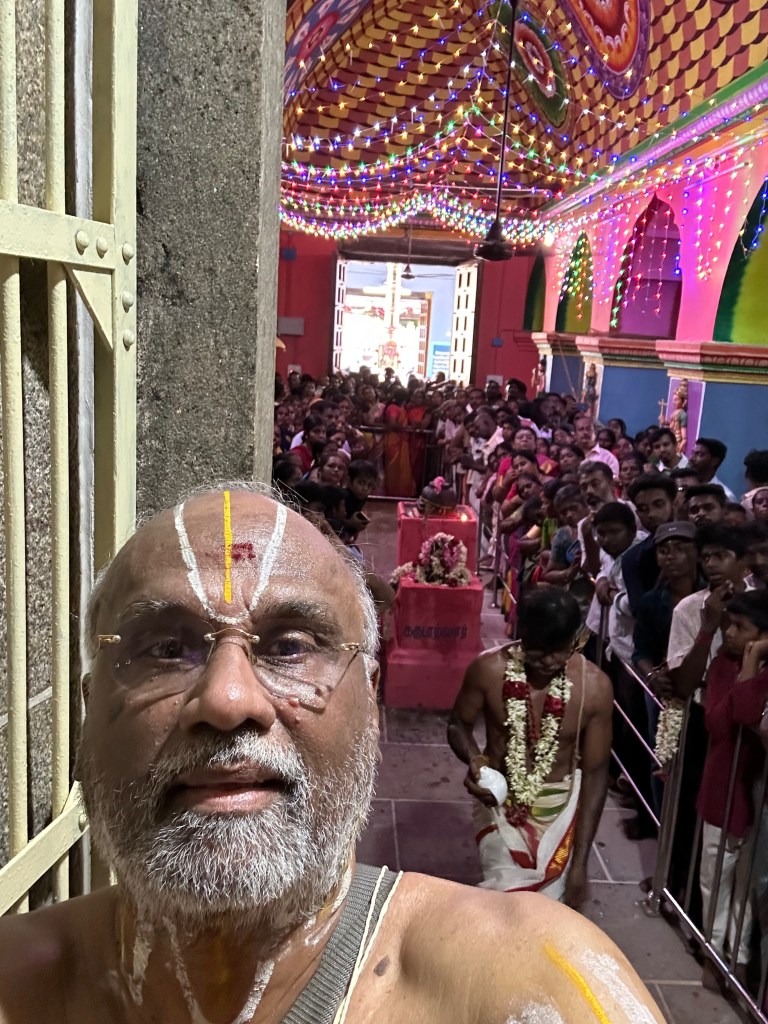
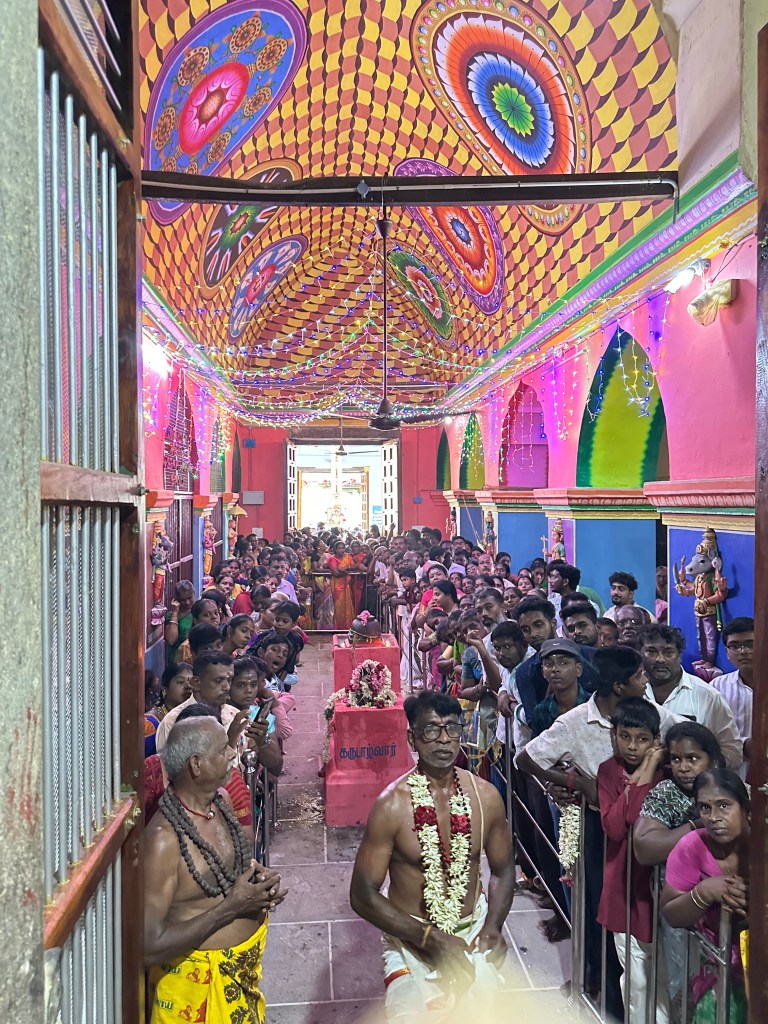
The crowds of devotees now surged into the temple antechambers and outer ‘mantapams‘ to have darshan of the Almighty’s new archa form, all bedecked now with new and fine silk raiments (pattu-pithaambara vastra), jewellery (aabharana) and bright, fresh floral garlands (pushpa, tiruthuzhaai malai) …. All in all, a truly breathtakingly beautiful sight! Of course, as I stood in the sanctum, I was allowed to feast my eyes upon the idols but forbidden to take any photos of the “garba-griha“.
*****************
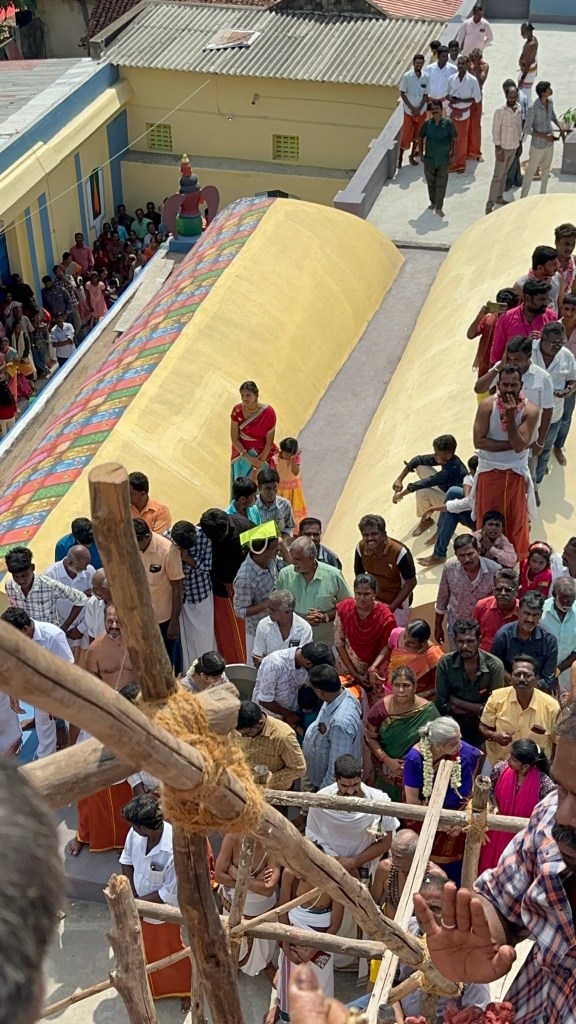
However, the event that hundreds of villagers had come to witness with great expectation … and many hundreds more were all slowly assembling too to witness that morning … was the grand climactic event of the Mahasamprokshanam which was the Vimana Kalasha Tirumanjanam! It was the glorious event that signified the culmination of the 3-day “yagnya” (fire rituals) and all Vedic rites. The crowds of worshippers were keen to watch the ceremonial bathing of the kalashas (finials) that were erected upon the summit of the kovil cupola (vimana). When the sacred water then cascaded down the tower onto the ground, they would all rush forward to catch a few sprinklings of the same upon their heads. It is Hindu belief that such consecrated water contains divine and cosmic energy that gets recharged into the garbha-griha (the sanctum) and into the “archa-murthy” (the idols of the Deity) now re-sanctified therein already by the samprokshanam rituals.
**************
Earlier that morning, I had seen a makeshift scaffolded ladder already erected. It led from the ground up to the very summit of the “gopura vimaana” of the temple. It was quite a steep ladder. The priests would all be soon climbing up its gradient to perform the grand finale of the samprokshanam while the great gathering of crowds standing below watched in awe and “bhakthi“.
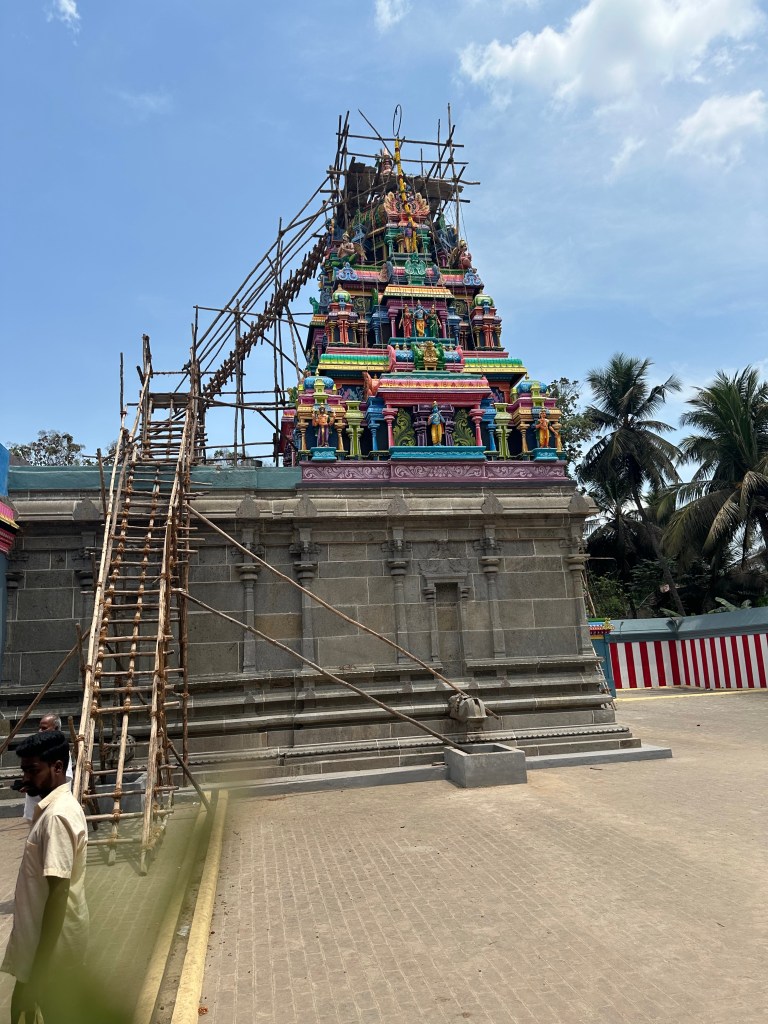
To me personally, the experience of climbing up along with the Vedic priests right to the very top of the cupola and to be present along with them when they duly performed the “kalasha tirumanjana” ritual was going to be a most thrilling, first-time-in-life ever religious experience.
Thanks to my good friend and the event “yajamaanar” and principal “ubayakarta“, Sri.Kothandaraman, I too was permitted by the priests to ascend by scrambling over the scaffolding that had been fastened, rather precariously, to the ‘gopuram‘ and to reach the sacred “kalashasa-s” atop the “vimaana“.
I seated myself on the makeshift ledge at the top and watched the priests begin the “kalasha tirumanjanam”. It was truly a unique experience for me to be seated beside the sacred vimaanam at the very moment of its “samprokshanam“.
As the ritual ended, and the sacred waters poured down the cupola, down the sides of the temple ‘gopuram‘ and fell in a cascade of sprinklings upon the surging, roaring crowd of devotees below on the ground, it seemed as though, through some inexplicable mysterious and mystic event of the cosmos, the heavens and earth had, momentarily, merged together.
For the very first time in life, I too was a participating witness to the sacred, auspicious ritual of “kalashaabhishekam” from the closest possible quarters. For me, it was a rare moment when absolute, sheer exhilaration of spirit at once coursed almost electrically, as it were, through body and mind! I felt I was in a daze caught in the middle of a whirlwind of spiritual wonder….
*************
Indeed, it was a whirlwind of spiritual wonder.
Although I was no total stranger to the temple rite of “mahasamproshanam“, having witnessed quite a few of them from afar …… and also gathered many impressions about them from news reports, TV channel reportage and word of mouth, still there were so many unanswered questions about this Agama-centric ritual that still kept me wondering about its significance, symbolism and esotericism. And some of those niggling questions roiling my mind were:
Why the use of water as a medium of sanctification? Why the “Kumbha”? Why the “kalashas”? Why at all the “vimaana”? And the crowds of devotees! What makes them all so eagerly and excitedly throng, hustle and jostle to catch the sprinklings of the “abisheka” water from the vimaana top? Was it blind faith? Do they know why they do it?….
Later, I was able to gain much needed clarity on all the above questions from a brief but very informative conversation I had with Sri. Ranganatha Bhattar, the chief officiating priest, and from a little bit of follow-up reading on my part independently . Let me share below a paraphrase of what the Bhattar explained to me and what I supplemented with a bit of of my own reasearching on the subject.
*************
- The Kalasha Abhishekam ritual, particularly when performed on the temple Vimana (tower above the sanctum), holds profound significance in Agamic traditions. This ceremony marks the grand culmination of Maha Samprokshanam, symbolizing the infusion of divine energy into the sacred structure.
- Significance of Kalasha Abhishekam in Agama:
- Divine Invocation and Purification: The ritual involves pouring sanctified water from 1,008 Kalashas (sacred pots) over the Vimana. Each Kalasha is filled with water infused with Vedic mantras, herbs, and offerings, representing the essence of holy rivers and cosmic energies. This act symbolizes the purification of the temple’s spiritual infrastructure and the reawakening of the deity’s presence (Prana Prathishta).
- Union of Cosmic Energies: The Kalashas embody Purna Kumbha (the “complete vessel”), symbolizing the union of divine energies. The water’s flow during Abhishekam represents the descent of divine blessings into the physical world.
- Renewal of Temple Power: Agamic texts prescribe this ritual to rejuvenate the temple’s spiritual potency, ensuring it remains a vibrant center for worship. The ceremony is believed to neutralize negative energies and restore cosmic balance.
There are rituals uniquely Vishnu-centric within the Pancharatra tradition.
• Pancharatra Puja Vidhi: The entire structure of worship, including specific mantras, mudras, and iconography, is centered on Vishnu and his manifestations durng the entire “samprokshanam” event. It is the “mantra shakthi” that is central to the entire ritual procedure as it generates the desired spiritual energies and vortices.
• Vyuha worship: The worship of Vishnu in his fourfold emanations (Vasudeva, Sankarshana, Pradyumna, Aniruddha) is a hallmark of Pancharatra, not found in Shaiva or other Agamic systems.
• Sahasra Kalasha Abhishekam: While abhishekam is common in many traditions, the Pancharatra’s detailed prescriptions for Vishnu’s abhishekam—especially involving the Vyuha deities—are unique in their theological context. These rituals and theological emphases set Pancharatra apart as a distinct, Vishnu-focused tradition within the Agamic corpus.
Why the Vimana is Central to the Ritual?
1. Architectural and Cosmic Symbolism: The Vimana is not merely a tower but a cosmic axis (Axis Mundi) linking the earthly realm to the celestial. Its intricate design mirrors the universe’s structure, with the Kalasha at its apex symbolizing the pinnacle of spiritual attainment.
2. Abode of the Deity: In Agama, the Vimana is considered the deity’s celestial residence. Consecrating it through Abhishekam reinforces the divine presence, ensuring the temple remains a conduit for blessings.
3. Energetic Circuit: The Vimana acts as a “spiritual antenna,” channeling energy downward to the sanctum and devotees. Pouring sanctified water over it completes the circuit, allowing divine energy (shakti) to circulate throughout the temple.
Agamic Foundations: The ritual aligns with Agamic injunctions that prioritize the temple as a microcosm of the universe. The Kriya Sakanda section of Agamas details the use of Kalashas to invoke deities, purify spaces, and amplify rituals.
• The Vimana’s sanctification ensures the temple’s alignment with cosmic laws (rita), making it a perpetual source of spiritual nourishment for devotees.
In essence, Kalasha Abhishekam on the Vimana is both a metaphysical reset and a celebration of the temple’s role as a bridge between humanity and the divine.
***************
Temple iconography and architecture in the Pancharatra tradition are meticulously designed to reflect Vishnu’s cosmic supremacy and theological centrality. These elements are governed by Agamic prescriptions, transforming the temple into a microcosm of divine order and a conduit for devotion.
1. Architectural Symbolism of Vishnu’s Cosmic Role
• Vimana as Cosmic Axis: The Vimana (temple tower) symbolizes Mount Meru, the axis mundi connecting earthly and celestial realms. In Vishnu temples, its design often incorporates three sanctums representing Vishnu’s three postures: seated (Vasudeva), reclining (Anantasayana), and standing (Trivikrama).
• Mandala-Based Layout: The temple’s ground plan follows a mandala (sacred geometric diagram), mirroring the unfolding of Vishnu’s energy from a central Bindu (point). This design, rooted in Pancharatra Agamas, positions the Garbhagriha (sanctum) as the cosmic womb from which divine power radiates .
• Vertical Hierarchy: The temple’s tiers symbolize Vishnu’s transcendence. The lower sanctum represents his earthly presence (leela vibhuthi), while upper levels signify celestial realms (nithya vibhuthi), culminating in the Kalasha (finial), embodying his ultimate sovereignty .
2. Iconography Embodying Pancharatra Theology
• Vyuhas and Divine Emanations: Sculptures and reliefs depict Vishnu’s four Vyuhas (emanations)—Vasudeva, Sankarshana, Pradyumna, and Aniruddha—arranged directionally to reflect their cosmic functions. For example, Vasudeva faces west (earth), Sankarshana north (human life), and Aniruddha south (ancestral realm) .
• Narrative Panels: Walls feature scenes from the Ramayana, Mahabharata, and Vishnu’s avatars, reinforcing his role as sustainer and protector. These carvings serve as visual theology, guiding devotees through his leelas (divine plays) .
• Symbolic Attributes: Vishnu’s icons hold the Shankha (conch) and Chakra (discus), representing cosmic sound and divine order. His reclining form on Ananthasesha signifies the dissolution and renewal of creation .
3. Ritual Integration with Architecture
• Kalasha Abhishekam: The Vimana is bathed with sanctified water during Maha Samprokshanam, a ritual prescribed in Pancharatra texts to rejuvenate Vishnu’s presence. The Sahasra Kalasha (1,008 pots) ritual underscores his all-pervading nature .
• Garbhagriha as Divine Body: The sanctum is designed as Vishnu’s physical form, with the Sukanasi (antechamber) as his nose and the Shikhara (spire) as his crown. This anthropomorphic symbolism aligns with Agamic analogies of the temple as a “body of God” .
• Pancharatra Puja: Daily worship follows Agamic protocols, including specific mudras (gestures) and mantras invoking Vishnu’s Vyuhas. The temple’s orientation (often eastward) and proportional design ensure alignment with cosmic principles (rita) .
4. Distinctive Pancharatra Features
• Temple as Visual Theology: The Vishnu temple exemplifies Pancharatra’s “visual theology,” where sculptural arrangements encode doctrines like the Chatur-Vyuha (fourfold emanations) and Dvadasa-Namas (twelve names of Vishnu) .
• Integration of Human and Cosmic: The temple’s corridors and mandapas (halls) symbolize the journey from mortal existence (samsara) to liberation (moksha), guided by Vishnu’s iconography .
In essence, Pancharatra temple architecture and iconography are not merely aesthetic but deeply doctrinal, embedding Vishnu’s centrality into every stone and ritual. The structures serve as both a map of the cosmos and a medium for devotees to commune with the divine.
***************
The curtains on the grand finale and climax of the Mahasamprokshanam of Sri Perundevi Thaayaar sametha Sri Varadaraja Perumal at Vilanagar Kovil came down at last at around noon that day after an elaborate “saatrumarai” service (plenary, valedictory ritual of chanting select breviaries from Vedic, Vedantic and puranic scriptures and select litanies in praise of “sampradaaya acharyas lineage“).
It was time for me to leave Mayiladuthurai, catch a train and return home to Chennai after what truly had been a memorable “yaathra“.

*************
There was however one more last stop on my yaathra which I felt I must not miss since I did not know when again I might have the chance to pass by these southern provinces of Tamil Nadu again.
It was my desire to visit the nearby the great temple-town of Thiruvarur, one of the most well-known Shivasthala-s in Tamil Nadu, presided over by the Deity worshipped as Sri Thyagaraja Iswara.
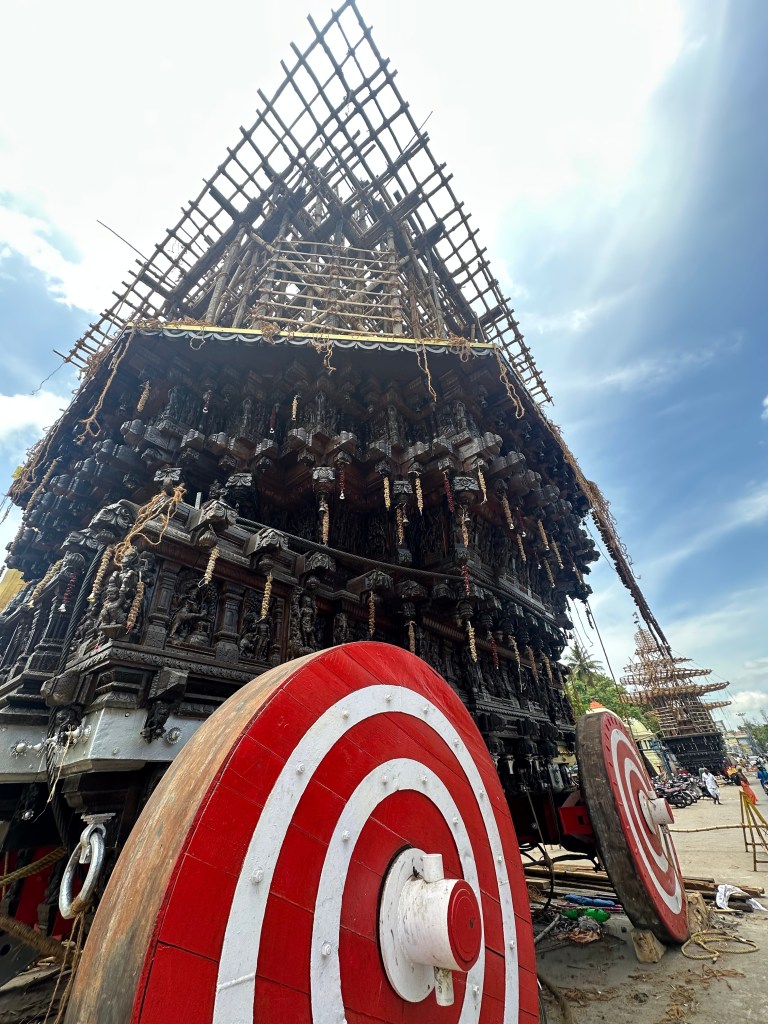
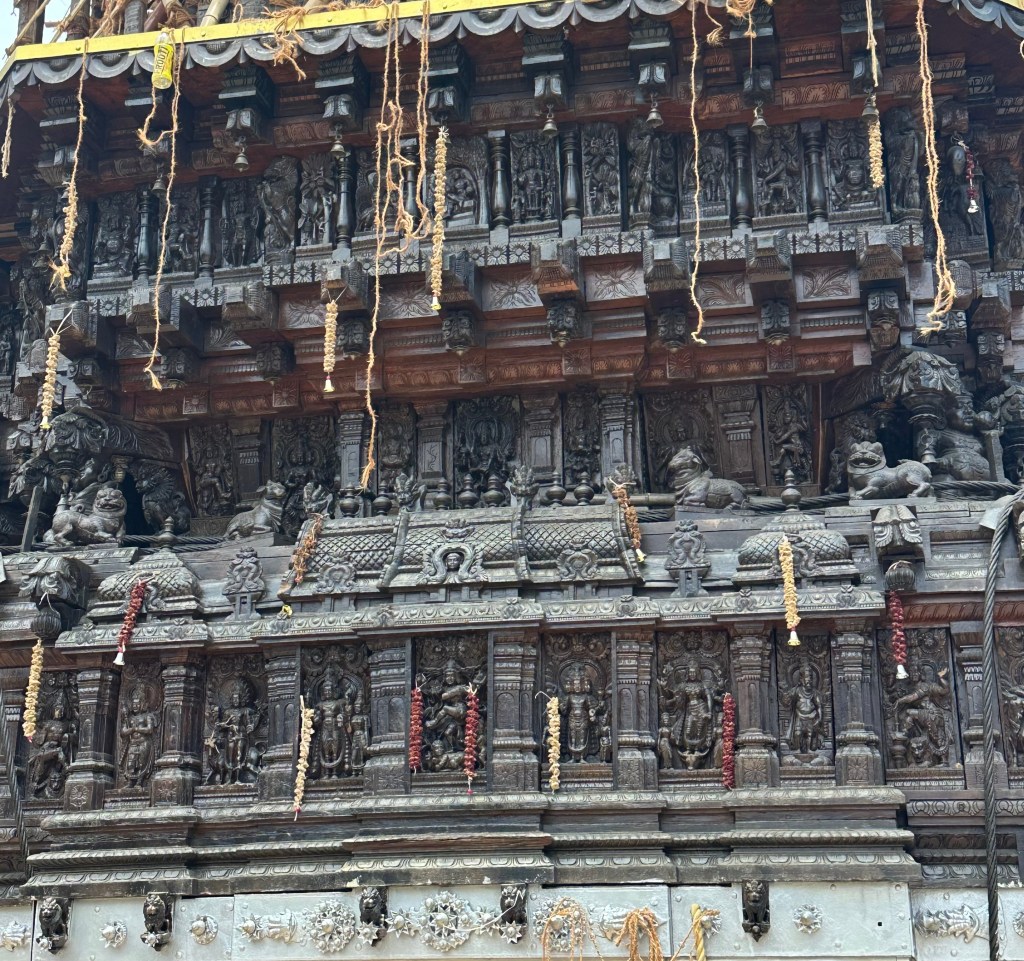
Since I was racing against time to catch my train to Chennai, I decided I would postpone the temple visit to a later date sometime in the future but then I would stop by just to get a good look at the famous Thiruvarur Temple chariot, a magnificent temple “vaahana“, the mighty vehicle of the Deity carved in wood… truly a masterpiece and enduring classic of traditional temple craftmanship and carpentry artisanship. I had read so much about the magnificence of this chariot that it was my desire to set eyes upon it at least once in my lifetime.
The temple chariot of the Thyagaraja Temple in Tiruvarur, the largest temple chariot of its kind in India and Asia. It weighs around 300 to 360 tonnes and stands about 90 to 96 feet tall. This massive chariot, known as “Aazhi Ther,” is pulled through the four main streets surrounding the temple during the annual chariot festival held in April–May. It is renowned for its size, intricate wood carvings, and the grandeur of the procession, attracting lakhs of devotees every year. The chariot stands out as the largest traditional temple chariot in India, weighing about 300–360 tonnes and reaching a height of 90–96 feet.
In comparison to other Major Temple Chariots: the Tiruvannamalai (Annamalaiyar Temple) is significantly smaller. So is Chidambaram Natarajar Temple chariot. The Udupi Krishna Temple (Brahma Ratha) is notably large but is much lighter and shorter than Tiruvarur’s. The tallest Chariot is the Thottuva Sri Bharanikavu & Kannambillil Devi Temple, Kerala—150 feet tall, but it is said to be lighter and not as massive as Tiruvarur’s chariot.
I was so very keen to see this chariot because I had read that it was an engineering marvel!
The construction of this massive temple chariots at Tiruvarur — 300–360-tonne, 90–96-foot-tall “Aazhi Ther” — involved overcoming significant engineering challenges, particularly in structural design, material durability, mobility, and cultural preservation. It also demanded interdisciplinary solutions—from structural innovations inspired by skyscrapers to modular designs and crowd management—all the while honoring centuries-old traditions of native craftsmanship about which so little is known or appreciated today.
I would not pass up an opportunity to go and take a look at this chariot. I drove into Thiruvarur and there it stood…. the magnificent “vaahana” of Sri Thyagaraja Ishwarar! What an awesome sight indeed! What a aesthetic treat to the senses and spirit!



************
Chariots are such a central cultural feature of the temples of both Vishnu and Shiva in Tamil Nadu. A great temple will always boast of itself as possessing a great chariot for its great Deity.
On the train journey back from Mayiladuthurai to Chennai, my mind dwelt upon two beautiful verses of the Tamil saints of yore who had sung praises to the Almighty with references to their “ther vaahana”.
The hymn known as “Tiruttontattokai” (Hymn 39) was sung by Appar while he was living at Thiruvarur:
“ஆரூரில் அப்பனென் றடியேன் அடைந்தேன்
ஈரூரும் பைங்கழல் ஏத்தி யிருந்தேன்
சீரூரும் செந்தேர் திருவாரூர் எங்கள்
சீரூரும் செல்வச் சிவனே யவனே”
“In Arur (Thiruvarur), I sought refuge at the feet of the Lord;
I praised and worshipped His golden ankleted feet with devotion.
In glorious Thiruvarur, where the grand chariot rolls,
He is our Lord Shiva, the embodiment of all prosperity and glory.”
Then there is the beautiful verse Periya Thirumozhi (7.11.9) of Thirumangai Azhwar who also sang in praise of the great chariot of Sri Ranganathar of Sri Rangam Temple.
சங்கம் உடையான் திருவரங்கன் தன்னை
அங்கம் அழகாகத் தேரோட்டும் அணி
பொங்க அரங்கத்து எம்பெருமான் தன்னை
எங்கும் எளியேன் வணங்கும் இடம்
“The Lord of Srirangam, adorned with conch, who rides the beautiful chariot with grace,
That glorious Arangan, my Lord, is the One whom I, the humble one, worship everywhere.”
As the train sped past many cities on my way to Chennai, I thought to myself, “Maybe, some day in the future, sooner than later, a great Chariot may get constructed for Sri Varadaraja Perumal at Vilanagar temple too?!”
****** Shubhamasthu*******
Sudarshan Madabushi