My mother, Sangitha Kalananidhi & Padma Shree Awardee, Dr. Smt.Mani Krishnaswami was born on February 3, 1930 in Vellore, North Arcot District of Tamil Nadu.
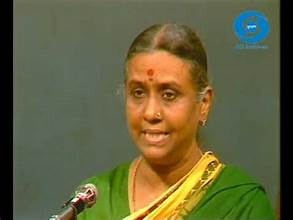
Mani, as she came to be popularly known later in life, was the eldest of 11 other siblings — six daughters and five brothers, age —born to her parents, Candadai Sri Lakshminarasimhachariar and Smt. Margathavalli between 1930 and 1948. It was one large happy and close-knit family headed by my ‘thaatha‘ who was a landowning wealthy and respected elder citizen of Vellore.
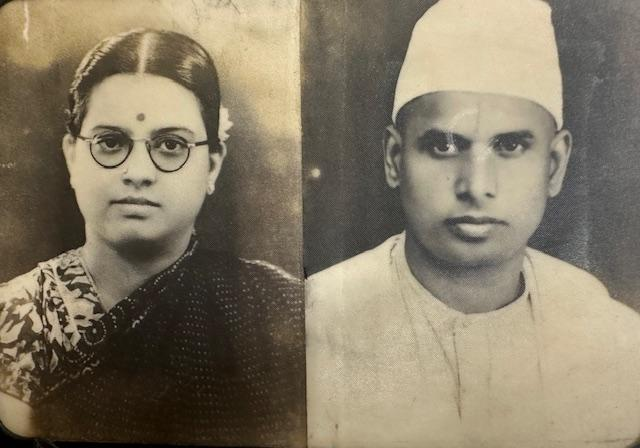
All siblings lived under one roof in a sprawling farmhouse in the little village of Kangayenellore about 10 kms. from Vellore. The village would have remained utterly nondescript if not were the fact that the famous Saivite scholar and religious “pravachana” preacher, Sri Krupananda Vaariaar also hailed from there.
While all their twelve children were born in Vellore and grew up in Kangeyanellore Village, my ‘thaata‘ by the late 1940s realized that all his children had to be given modern education in the schools and colleges in the then flourishing city of Madras. He decided to buy a large house in the sylvan neighborhood of Adyar Gandhinagar and into which the entire family moved in circa 1960.
The quiet, lush Adyar neighborhood in those days boasted also of being host to the famous Besant Theosophical Society school and the Kalakshetra. Nearby, there was also the Roman Catholic Irish missionary St. Patrick’s High School and the Rani Meyammai High School too. Not too far from Adyar, there was also the Rosary Matriculation School. All of these institutions easily gave admission to one or more of all my grandfather’s dozen children. My mother and a few of her sisters and brothers went to the Besant School; a few sons and daughters went to the other schools. All children were provided ample opportunities to gain excellent schooling right upto the higher secondary level.
Although Lakshminarasimhachari moved all his children into the new family home in Adyar, Madras, he still had to remain back in Vellore and Kangayenellore to oversee his large farming landholdings that fetched him his only large source of income that was needed to raise such a large family. He and Margathavalli decided that they would have to shuttle between Vellore and Madras but leave all the children in Adyar under the care of their eldest daughter, my mother Mani… who then was hardly out of her teens.
Mani Krishnaswami, after finishing SSLC in the Besant School, was by then just starting pursuit of an education in Arts and Music at the famous school, Kalakshetra, headed by the redoubtable art diva, Smt. Rukmini Arundale. But her father, my ‘thaata‘ however made it clear to her that while she continued her education at Kalakshetra, the care of all his other children at the Adyar family house, would have to be undertaken by her, while he himself could only shuttle between his Vellore farmhouse and Madras. The health of the mother, i.e. my “paatti“, Margathavalli, after so many childbirths, by now had begun to deteriorate and since her condition required expert medical attention at the Vellore Christian Medical College Hospital (CMC), ‘thaatha‘ could neither risk moving her to Madras nor himself get away from his farming livelihood in Kangayenellore.
The long and short of the story is that in the end, Mani Krishnaswami, who was no more than around 20 years old by then was saddled by her father with the burden of doing matronly (in loco parentis) duties for all her siblings — about nine or ten them who were all aged then ranging variously from 15 years of age to 2 years!
So very early in life, my mother Mani thus had to be bear the burden of running a large household of siblings that was made up of a couple of toddlers and several school-going children, all on behalf of her own near-absentee parents.
My helpless ‘thaatha‘ came to depend solely upon my mother to fulfill the role he had been compelled by family circumstances to thrust upon her young shoulders. From his farmhouse in Kangeyanellore, he had no other choice left but to remote-control the running of the Adyar home, a task he had all but completely delegated to my mother. Yet, he knew he had to keep in constant touch with her and keep communications with her on a weekly if not daily basis just to ensure that his family was well attended to and provided for under my mother’s overall supervision though assisted as it was by a couple of loyal and very efficient household domestic servants and maids.
In those days soon after Indian Independence, it seemed like long distance communication was impossible without the use of the Indian Postal Mail service. The use of the good old Postcard was virtually universally prevalent amongst the people of India. It was cheap, efficient and very timely mode of communication… all it needed was a postal stamp of one-half anna, or 3-paisa to be affixed on the card!
My grandfather kept insisting that between my mother in the Adyar home in Madras and himself in Vellore, there must be constant postal mail flow of weekly postcard communication to ensure that he was kept abreast almost on a realtime basis by my mother, Mani K, of how she was doing her household duties as a caretaker, matron and a sort of surrogate mother to her little siblings. The post-card exchange between the father and his eldest daughter in effect thus contained a virtual annal of family history!
My ‘thaatha‘ had a very fine handwriting. He also had a very refined style of writing in English with a lovely turn of phrase and use of apt idioms and proverbs. He was also a very parsimonious man, given his farmer mentality. There was such brevity in his thought and word. There was also frugality in the way he used his resources. So, when he wrote a postcard letter to my mother, he made sure that, in his fine handwriting, he packed into the small, cramped rectangular 7″X4″ mail-writing space of the post-card, every little matter that he could sqeeze into it and which otherwise might have taken all of the writing space available on an A4 paper stationery today!
My mother’s two immediate sibling sisters were named Smt. Vasantha and Smt. Shanti (sadly, both deceased now). They were both, in fact, in their younger years, students of Carnatic music too and in fact used to sing along with my mother in their practice sessions. In the photograph below, my mother Mani Krishnaswami can be seen singing along with her two sisters, Vasantha and Shanti (the former seated on the chair due to physical ailment; the latter seated on the floor between she and my mother… The lady behind them is the youngest of all the seven sisters).
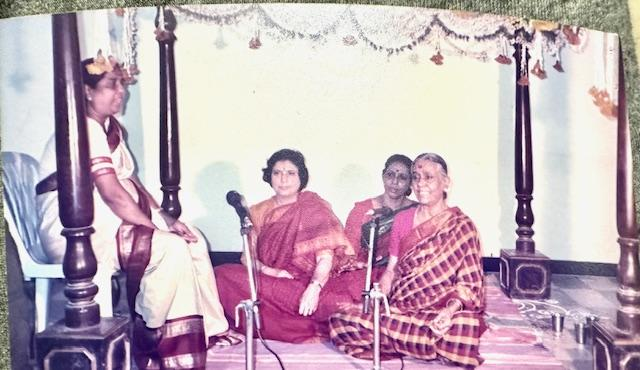
In the postcard letter below dt. July 15, 1947 written by my ‘thaatha‘ to my mother, it is the names of these two sibling sisters, Vasantha and Shanti, that get mentioned. In the postcard, he tells my mother through detailed, meticulous instructions, that she should apply a “Z A B solution” to the two sisters to relieve them of an eye-infection. In 1947, I guess, medical advancements in India had not progressed that much as they are today…. And medications were plain and homemade!
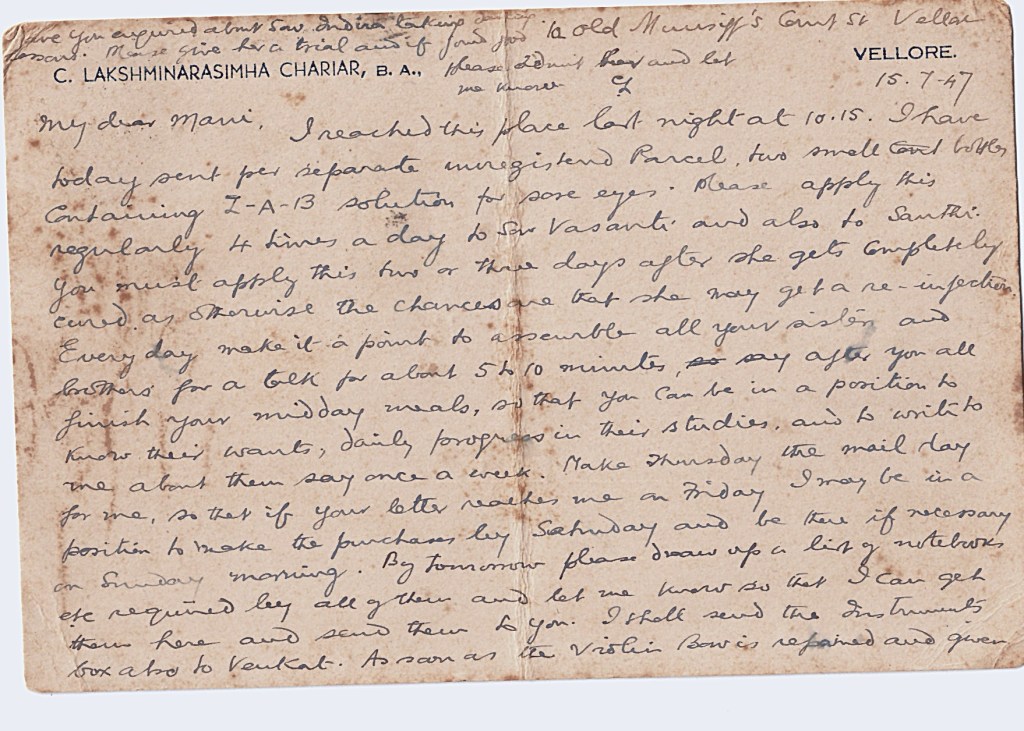
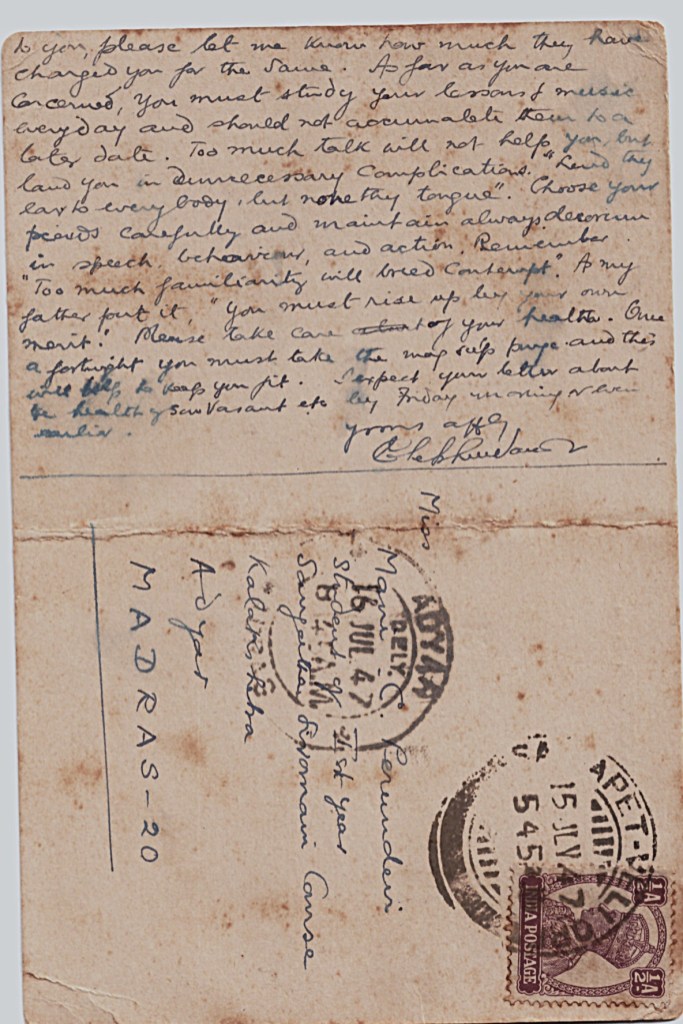
Next, my poor mother is also given a fatherly but stern harangue on a postcard, telling her how she must use management skills to ensure that all her siblings fall in line with her command and obey her without demur! She is their sergeant-major, as it were, and she better act the part!
Then there are further detailed instructions given to Mani about her reporting duties and that he expects her to write file a postcard report that should reach him without fail every Thursday or Friday!
Then follows another strict instruction about how she must go about optimizing the provision of school notebooks to her school-going siblings for the upcoming new academic year! Obviously, in 1947, the schools unlike those of today, did not insist on students buying cartloads of notebook stationery for the inagural new academic year! And there is also a line ‘thaatha‘ inserts in which there is something said about some violin that would have undergone some repair…. I rememember now that for a few years at Kalakshetra, my mother Mani Krishnaswami of versatile musical skills, had also been learning to play the violin!
The most remarkable of instructions, however, that is given on the postcard by my ‘thaatha‘ to my mother is about how she must diligently pursue her own studies without getting unduly distracted by trivial talk!
There is a tone of parental censure in Lakshminarasimhachariar’s lines when he chides my mother about “talking too much”! He even quotes to her a stylish English maxim to drive home his sermon: “Lend thy ear to everybody but none thy tongue”!
Reading the postcard today, I can’t help wondering what did my poor darling mother do that it made her father want to severely counsel her on the virtues of maintaining reticence in her social intercourse?!
As far as I know my mother was always a lady of very restrained and gracious speech…. Nobody ever said they thought she was a bit of a jabberwoky… So, what had made my ‘thaatha‘ want to issue such a rude warning to her about loosening her tongue?!
Looking back upon my very own memories of my dear mother, I feel so very sorry for her indeed…. At such a young age, not only had she been saddled with the burden of upbringing her young siblings at home even while sedulously pursuing her own education but also that the youthful sprightfulness of her insouciant spirit had been reined in or dampened by her father’s strict homilies…
*************
In the next postcard dt. March 3, 1948 seen below, my ‘thaatha‘ shows to my mother the softer, a little more affectionate side of his personality.
In this postcard letter, “thaatha” recalls to his mind the death of Mahatma Gandhi that had happened tragically hardly a couple of months earlier on January 28, 1948. The tone of his words is sombre and wistful… It is quite obvious that like millions of his countryment at that time, he too had been deeply saddened by Gandhi’s death and, evidently, it had been still haunting his mind:
“Mahatma Gandhi as a physical entity is dead and gone… But as an angel and celestial being he is watching over our country’s welfare and is now in a position to watch over everyone of us since his memory is entombed in our hearts”.
But immediately after writing the above poignant lines, ‘thaatha‘ switches from the sublime to the quotidian… He invokes the spirit of Mahatma Gandhi himself in a fresh new homily to my mother and intended to let her know that he does not appreciate her enjoying even the occasional visits she evidently was making to the matinee in cinemas — most likely a harmless, frivolous entertainment my mother might have indulged herself.
The lines below he wrote reflects his frowning displeasure:
“He (Gandhi) has particularly thought that the films as exhibited in cinemas nowadays are never of the best and do not elevate the mind but degenerate it into, at best, very poor and harmful agencies”…
So, that is why, ‘thaatha’s‘ postcard letter continues in the same severe vain, and exhorts my mother Mani Krishnaswami with these grave warnings:
“… students of Kalakshetra — girl students — must observe decorum and propriety of manners and not be knocking about in the cinemas of the city without proper chaperones at all times and sundry…”

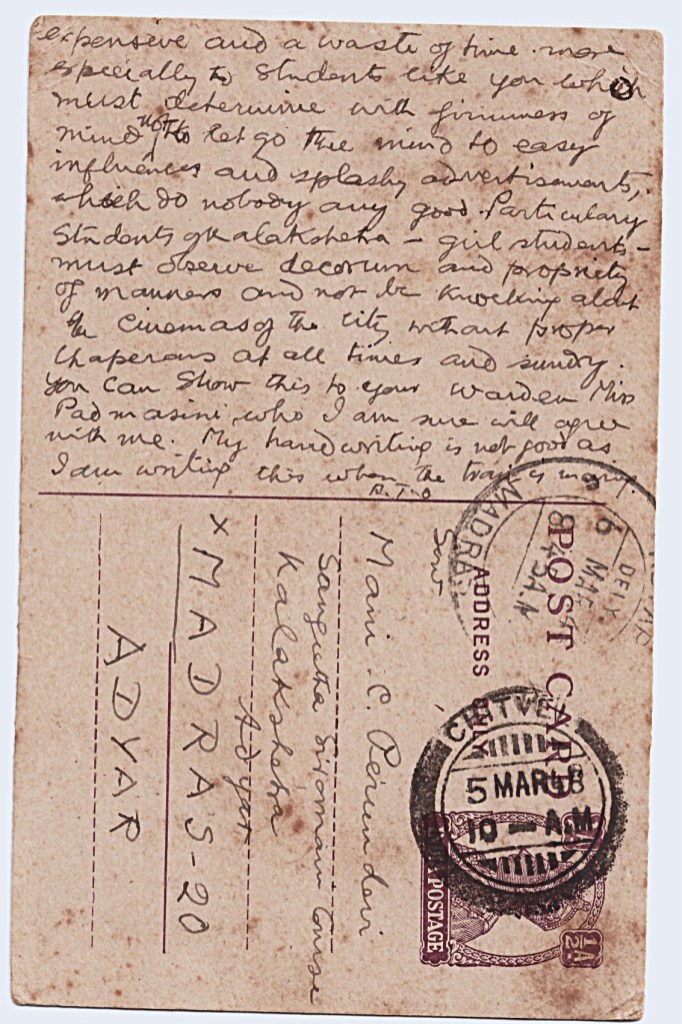
Again, after reading ‘thaatha’s‘ gravely intoned sermon in his postcard letter above, I cannot help feeling more than a pang of sympathy that tugs at my heart for my beloved, departed mother.
Mani Perundevi, who my mother then was, she was really no more than a young lass, 18 years of age… A visit to a cinema for a matinee show had, who knows, probably been her only source of relief and a bit of rest and recreation away from her daily matronly chores of looking after her little siblings. Yet there he was, her strict yet well-intentioned, protective father, Kandadai Lakshminarasimhachariar, telling her that she must curb her harmless adolescent proclivity for cinema… and quoting, to boot, the great Mahatma Gandhi himself in support of his view!
Not however having enough writing space on a postcard to express a sudden surge of feelings of warm feelings for his eldest daughter, and fearing that his letter might have sounded a tad too severe and hurtful, the father at the end did have the goodness of heart to slip in and add an affectionate postcript to Mani, his daughter on whom he had been depending so completely to keep his family flock together:
“Yours affly…. this is an advice, and not a censure…”
**************
Sudarshan Madabushi