The Sastri College in Durban, South Africa is a co-educational, multi-racial, multi-cultural state secondary school with learners from grade 8 to grade 12. The founding of Sastri College was the vision of the (Late) Rt. Hon’ble V.S Srinivasa Sastri (1869-1946 CE). The official opening of the school took place on Monday, 14th October, 1929 when the Earl of Athlone, Governor-General of South Africa inaugurated it https://sastricollege.co.za/about-us/. The College represented the the vision of Sri. Srinivasa Sastri – who was then the Agent General of the Government of India in South Africa — to realise which the Indian Community in South Africa collected and contributed the handsome amount of 18,000 pounds. The school is today located on the periphery of the central business district of the City of Durban. It is a school rich in tradition and respected for its high academic achievement. The website of the Sastri College says this proudly: “These have been handed down to us through the dedication and vision of our predecessors which continues to inspire us today”.
On October 10, 2029, the Sastri College, Durban will celebrate its Centenary Year.
My very dear and long-time friend and fellow Chartered Accountant, Sri. G.Karthikeyan’s is the maternal great-grandson of Rt. Hon’ble Srinivasa Sastri. Yesterday, Karthik (as I have always called him) proudly informed me that the Administration of the Sastri College, Durban, had been so very gracious to send in a full three years in advance (!) a formal invitation to his mother, Sri. Srinivasa Sastri’s grand-daughter, to attend the Centenary Year Celebrations of the college in October 2029! Karthik’s message to me was: “Sudarshan, as an aside, the Ambassador of South Africa to India Mr. Anil Sooklal contacted my mother to inform her that they are planning the centenary celebration of Sastri College in 2029 at Durban. He wanted to invite the Sastri family to Durban for the Centenary celebration...”
“How ever so gracious of the Sastri College, Durban!“, I thought! And how grateful they must be to the memory of Srinivasa Sastri that the institution has not forgotten him or his surviving family in India today… even a 100 years after it was founded! I replied to Karthik immediately, expressing my fulsome praise for the South African college, to his mother and to the entire family of Rt. Hon’ble Srinivasa Sastri. I told him I hoped that come October, 2029, he will travel to Durban to attend the Centenary festivities of the Sastri College as a mark of respect to the memory of his great-grandfather.
The above exchange of correspondence with Karthik reminded of my own great admiration for Sri. Srinivasa Sastry. Although I am a student of Indian history during the period of India’s freedom struggle, I had not acquainted myself to well or deeply with Srinivasa Sastri’s own role in it. Everything I knew about Sastri was from what is out there in the public domain that anyone, of course, can easily access:
Srinivasa Sastri was born to a poor temple priest in the village of Valangaiman near Kumbakonam, India. He completed his education at Kumbakonam and worked as a school teacher and later, headmaster in Triplicane, Madras. He entered politics in 1905 when he joined the Servants of India Society. Sastri served as a member of the Indian National Congress from 1908 to 1922, but later resigned in protest against the non-cooperation movement. Sastri was one of the founding members of the Indian Liberal Party. In his later days, he was strongly opposed to the partition of India.
Srinivasa Sastri served as a member of the Madras Legislative Council from 1913 to 1916, Imperial Legislative Council of India from 1916 to 1919 and the Council of State from 1920 to 1925. Sastri also functioned as India’s delegate to the League of Nations, as member of the Privy Council of the United Kingdom and agent to the Union of South Africa.
************
However, my admiration for Srinivasa Sastry did not stem from what little I knew of his work in Indian politics in the Pre-Independence era.
When I was a young man in my early 30s I had grown to admire him greatly when I had first read a book, a compilation of Srinivasa Sastry’s famous “Lectures on the Ramayana”, delivered over several months (April through November 1944) at the Madras Sanskrit College.
Reading that book (https://a.co/d/1wvVj6u) was my very first introduction to not only the “itihaasa’s” magnificence as an ancient epic but also to the exquisiteness of Maharishi Valmiki’s Sanskrit language. More importantly, the lectures of Srinivasa Sastry opened my eyes for the very first time in life to the immense possibilities of ways of understanding and creatively appreciating the Ramayana’s literary and scriptural profundity with the aid of English cadence of which Sastri was an unequalled master. For someone like me who had no more than a mere smattering knowledge of the Sanskrit language, Valmiki Ramayana was brought vividly alive indeed thanks to the sheer brilliance of Sri. Srinivasa Sastri’s Lectures.
Many years later, I myself authored and published a book of essays titled “The Unusual Essays of an Unknown Sri Vaishnava” (2025 edition: https://amzn.in/d/awRFQuB. The couple of essays on the Ramayana that I had penned therein, I must acknowledge, did borrow quite a lot and also did quote profusely from Sastri’s own “Lectures“. So great was the spell of inspiration that Rt. Hon’ble Srinivasa Sastri always had cast upon me, indeed, in my own humble literary forays!
***********
Upon receiving such wonderful, glad news from my friend Karthik about the upcoming 2029 Sastri College Centenary Celebrations in Durban, my mind also turned a little sombre when I began to wistfully recall the history of India’s freedom struggle and Srinivasa Sastri’s own distinguished albeit chequred and, sadly, under-appreciated role in it. It is in that mood that I feel compelled to boldly say too here that I feel, back here in India, especially in Tamil Nadu whose illustrious son of the soil he truly was, the memory of the Rt. Hon’ble Srinivasa Sastry, for some unfathomable reason, has not received half the reverence and celebration that the Sastri College in faraway Durban has deemed it fit to accord him in during the centenary year it will celebrate in 2029.
To fathom and to try to understand the reasons might perhaps force me to revisit and dig into — a little bit at least — into India’s pre-Independence history when Sastri has been made a part of it by none other than the Father of the Nation, Mahatma Gandhi. In fact, the best place from which to start digging a bit into history, I would say, is to discover an intimate correspondence that took place between Gandhi and Sastri … a letter in which the Mahatma virtually hustled a reluctant Sastri to undertake a very important and historic political assignment in South Africa.
My friend Karthik yesterday fished out that letter dated in April 1927 which the Mahatma wrote to his great-grandfather and sent it across to me:
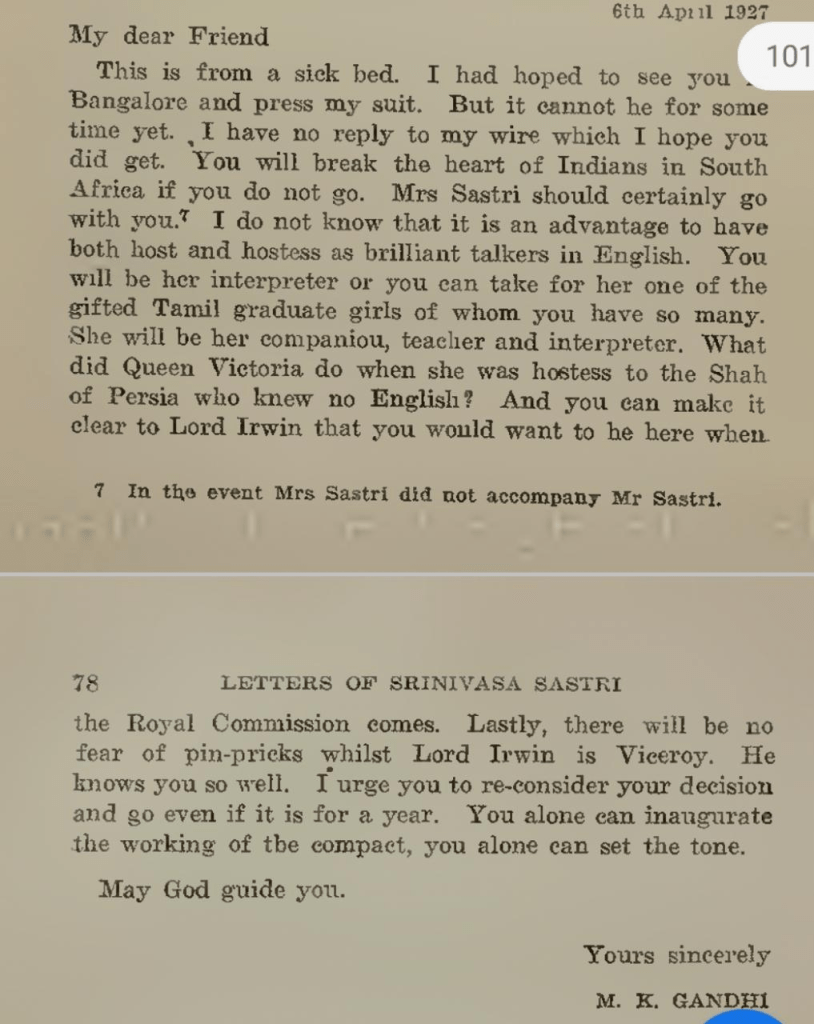
This correspondence, written by Mahatma Gandhi to V. S. Srinivasa Sastri on 6th April 1927, centers around Gandhi urging Sastri to reconsider his decision about not going to South Africa to represent Indian interests. Gandhi expresses personal disappointment at not being able to meet Sastri due to illness but strongly emphasizes the importance of Sastri’s visit for the morale and well-being of Indians in South Africa.
Gandhi is persuasive, mentioning that Sastri’s absence would deeply disappoint the Indian community there. He discusses logistical details, such as the presence of Mrs. Sastri or a suitable interpreter, reflecting the complexities of diplomatic responsibilities abroad. Gandhi draws on historical references (such as Queen Victoria hosting the Shah of Persia!) to argue that language barriers could be overcome and should not deter Sastri from making the trip.
Further, Gandhi addresses the broader political context: he refers to the upcoming Royal Commission and the political climate under Lord Irwin, indicating that Sastri’s leadership would help set the right tone and inaugurate the ‘working of the compact’ between India and South Africa. Gandhi earnestly urges Sastri to reconsider his decision, even if only for a year, stating, “You alone can inaugurate the working of the compact, you alone can set the tone.” He concludes with a blessing for divine guidance.
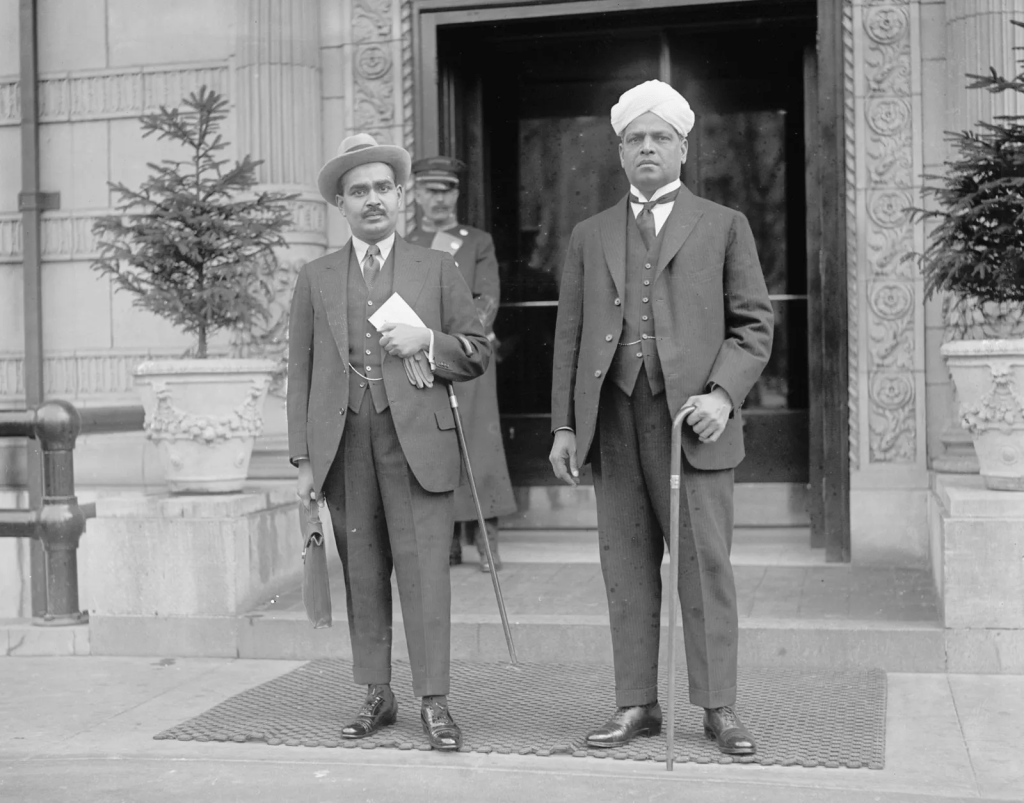
From a careful reading of the above letter of Gandhi, we can easily conclude that Srinivasa Sastri’s influence on Gandhi’s political strategies was very strong in several nuanced ways, especially during the 1920s when Indian nationalist leaders like Gandhi, Gokhale and Nehru were negotiating the complex terrain of colonial politics and international diplomacy.
***********
(to be continued)
Sudarshan Madabushi
The calibre of people in public life in those times is something which we cannot gloss over, while lamenting about the current state of affairs. There is no dearth of people with fancy degrees in public life today, but there is a complete erosion of even basic values in them, people like Sri Sastri are the epitome of values, unfortunately the loss of such people left vacuums which were never ever filled