The Tamil literary doyen Sri Indira Parthasarathy — popularly known as Eepa the novelist and playwright who is the only one who won both the Sahitya and Sangitha Nataka Akademi Awards — suddenly asked me this question via a WhatsApp message the following intriguing question. It momentarily baffled me .
When Hanuman meets Ram in the forest for the first time introduces himself in such a way that Ram feeling amazed by Hanuman’s vocabulary exclaims ‘யார் கொலோ இச்சொல்லின்
செல்வன்?’ What language Hanuman could have spoken?
Eepa is a formidable Tamil scholar and my knowledge of the language is so limited that I could never hold a candle to his . Yet , the question was so intellectually fascinating to me that i tried to delve a bit into Valmiki Ramayana and revisit the episode in Kishkinda Kandam wherein Sri Rama first encounters Hanuman and is enchanted by the latter’s speech.
Eepa’s reference was obviously to Hanuman, when he first met Rama in the forest, spoke in such an eloquent and refined language that Rama was amazed by his vocabulary and the sweetness of his speech, leading to the famous Tamil phrase “யார் கொலோ இச்சொல்லின் செல்வன்?” (“Who is this prince of words?”). In Valmiki’s Ramayana, Hanuman is described as speaking in a language that is both sweet and perfect, with mastery over Vedic knowledge, grammar, and syllabic precision.
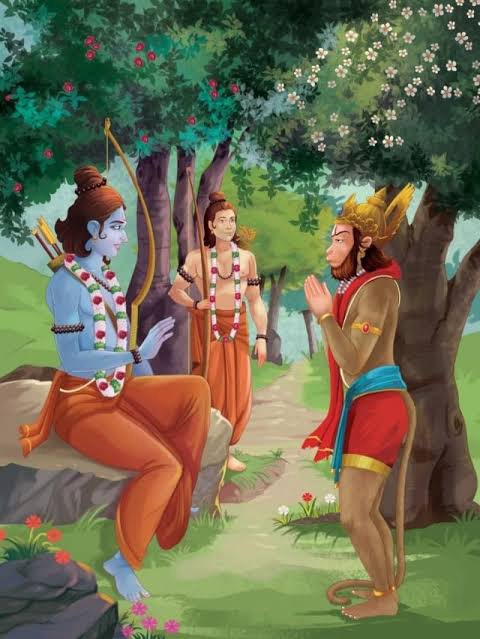
The Ramayana describes Hanuman as speaking in a “sweet human language” (मधुरं मानवाक्यम्, madhuram manusham vakyam), meaning language of the people, not of elite pundits or archaic Sanskrit. While Valmiki’s text itself does not name the language, the context and repeated use of the word “madhuram” suggest Hanuman’s flawless command of a literary “desiya” (indigenous) language.
Based on my above understanding of the Kishkinda episode, my off-the-cuff and “shoot-from-the-hip” response to Eepa was as follows :
Sir, I know there are many linguistic theories about this question . My personal view is that Hanuman spoke in some old dialect of “Sundara Telugu” language . In the Ramayana , Valmiki says Rama found the language used by Hanuman to be “Maadhuryam” … sweet and sonorous .
Rama and Hanuman first met each other in Kishkinda … which today is somewhere in the triangulated border areas of Andhra Pradesh and Karnataka . So , the local dialect there may have been pre-historic mix of Telugu and Kannada .. both of which languages are derived from Sanskrit .
Secondly , even Mahakavi Bharatiyar , a great Tamil poet , characterised Telugu as “sundara Telugu” .
So, we may be allowed to reason that Hanuman spoke in some predated version of Telugu .
Of course, I know Tamil scholars of Kamba Ramayanam will not agree with my view.
*****
Eepa did not quite agree with me. He replied :
“Telugu and Kannada are basically Dravidian languages highly sanskritized”.
Eepa however went on to make another intriguing observation offering a very different perspective :
Hanuman approaches Ram not only to inform him about who he is but more importantly he was keen to also convey in a subtle manner that he (as Sugriva’s chief-of-staff) may be also needing Ram’s favour (a military alliance, as it were) in regard to some domestic political issue of Kishkinda state … And Hanuman did so in the choicest most carefully chosen words reflecting an intellect and wisdom of the highest order. That is precisely the reason why Ram who was quick to understand what Hanuman was broaching him for is thoroughly impressed and exclaims ‘யார்கொலோ இச்சொல்லின் செல்வன் ‘?
Eepa’s insight into the Kamban lines were penetratingly brilliant indeed and it left me thinking suddenly about what a waste of scholarly energy and research had been expended on this question by other run-of-the-mill Tamil and Kamba Ramayana scholars, past and present, on the hotly disputed question about in which language Hanuman could possibly have spoken to Sri Rama if it was not Sanskrit?
Eepa was saying that the real question is not one of linguistics at all because it was not the literary form or quality of Hanuman’s speech that impressed him so much as the deft, delicate and diplomatic subterranean content in his speech. Which meant that the unending scholarly debate of many years over what language was spoken by Hanuman is rather inconsequential if not wholly irrelevant.
Eepa further emphasised his point:
“I believe Kamban or Valmiki did not really bother much at all about the medium of conversation or the quality of the language used between all the characters in question for that matter…. Because Ram travelled all the way from Ayodhya to Lanka not to appreciate language but in search of someone who could help him find his lost Sita. It is thus not the language but the hard content of what they spoke which really matters. So I feel Ram was amazed at the way in which Hanuman spoke so subtly with choicest idioms to test the waters for forging some kind of an alliance between Sri Rama and Sugreeva.
Thus, Eepa’s whole argument was that the Kamban phrase — “யார் கொலோ இச்சொல்லின் செல்வன்?” (“Who is this prince of words?”) — really refers to Rama’s admiration for Hanuman sense of adroit realpolitik as reflected in his speech rather than for its purely literary or semantic elegance.
Eepa’s perspective was truly an absolutely blinder of an eye-opener for me!
******
Eepa’s perspective still did not stop me from persisting in the other more pedestrian question for which too I pressed him for an answer: What could have been the language in which Hanuman spoke so impressively that it absolutely captivated Sri Rama ?
(To be continued)
Sudarshan Madabushi