By M.K.Sudarshan
16 August 2026: Chennai, India

“The Indian diaspora built a protective financial shield around India, using software wealth to bankroll domestic consumption and stabilize the national treasury.
The Chinese diaspora, by contrast, acted as a technological spearhead, injecting Silicon Valley capital and IP directly into China’s veins to build a domestic industrial superpower that could eventually challenge the West.”
Yesterday, my Op-Ed on the “Soft Power of India and America” — https://mksudarshans.blog/2026/08/14/india-independence-day-special-the-dynamic-use-of-soft-power-how-america-and-india-in-their-own-ways-have-enlarged-joseph-nyes-theory/— triggered a tempest of heated debates in the private social media space.
Many readers, unfortunately, missed the primary thesis: the real story isn’t about which country holds a more appealing cultural brand of “soft power”, but rather the economic and strategic purpose to which that soft power is deployed.
The discussion quickly degenerated into a defensive argument over whether the Indian diaspora has contributed as much to its homeland as its Chinese counterpart.
To move past emotional rhetoric, it was felt by more than one respondent, that we must look at the hard data to tell us the true story of the structural divergence between how India and China utilized their overseas talent over the last thirty years. It turns out, in fact, to be one of the most fascinating economic case studies of the modern era.
It is easy to assume that Chinese graduates returned home because their system was perfectly welcoming, while Indian elites stayed in the West purely out of patriotism-destroying frustration. The truth is far more complex. While Western-trained intellectuals in both nations faced near-identical walls of nepotism, academic corruption, and institutional gatekeeping, China successfully built an industrial escape hatch. By creating a high-stakes corporate tech machine, Beijing managed to weaponize the very irritation of its returnees, driving them to bypass local bureaucracy and conquer advanced industries.
Meanwhile, India’s laissez-faire approach left its brilliant minds stranded from its heavy industries, leaving them to watch global innovation from the comfort of the Western C-Suite while the homeland relied on a financial safety net of family remittances.
This is the untold story of numbers, systemic friction, and mismatched playbooks—and why that long-standing balance is finally beginning to shatter.
Part 1: The Great Campus Demographics Shift
For over a decade, Western higher education was fueled by an economic engine stamped Made in China. However, a quiet revolution has completely rewritten campus demographics in both the United States and the United Kingdom.
According to data from the Institute of International Education (IIE) Open Doors Reports, China was the undisputed leading sender of international students to the US from 2009 onward. But the lines on the graph have officially crossed.
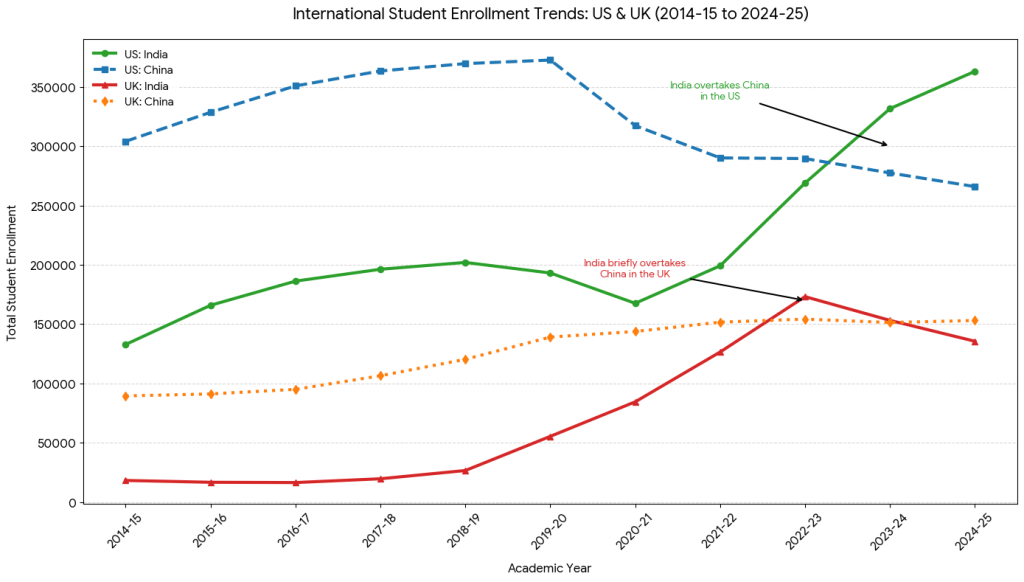
In the 2023–2024 academic year, India overtook China, reaching an all-time high of 331,602 students compared to China’s 277,398. By the 2024–2025 academic year, the gap widened aggressively, with Indian enrollment climbing to 363,019 while China steadily declined to 265,919. A similar phenomenon played out in the UK, where visa issuances to Indian students spiked by 273% following the reintroduction of post-study work routes in 2021.
However, the raw numbers mask a critical structural disparity in what these students study:
- The Indian Footprint: Indian students are heavily clustered in graduate programs, specifically STEM-focused Master’s degrees. They view Western education as a high-ROI professional stepping stone.
- The Chinese Footprint: Chinese students maintain a much stronger balance at the undergraduate level, alongside specialized PhD research.
Part 2: The Returnees — Carrots, Sticks, and “Sea Turtles”
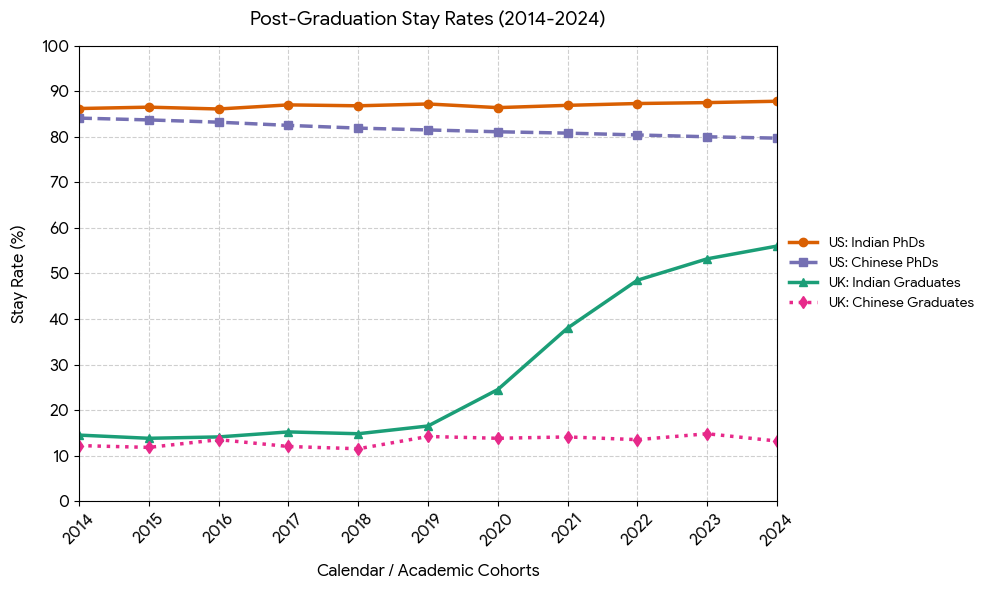
What happens after graduation day reveals the first major divergence. When looking at macro trends over the last three decades, China engineered a massive, cyclical “brain gain,” while India experienced a prolonged, compounding “brain drain.”
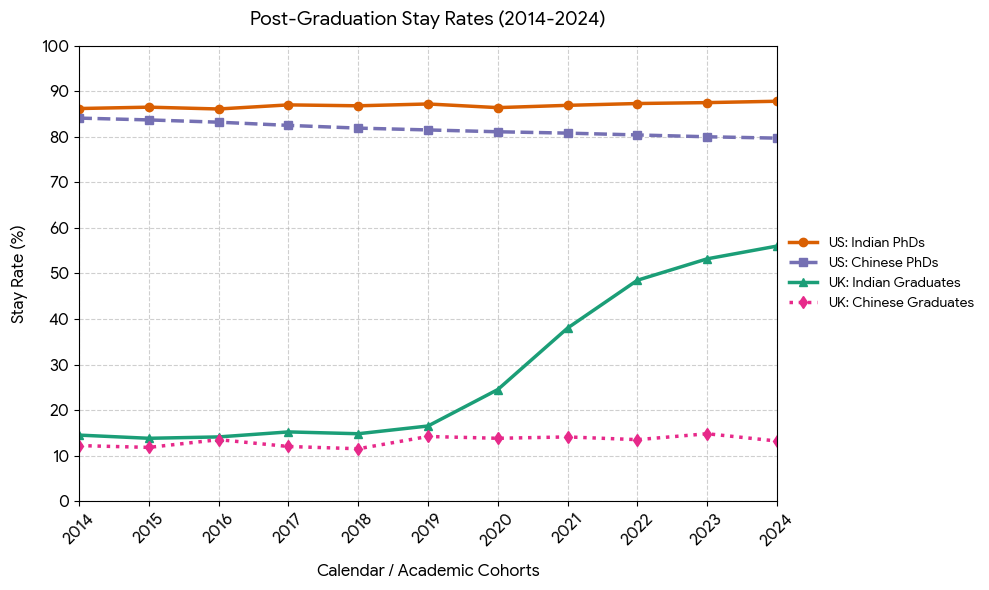
How did Beijing achieve an overall cumulative return rate where official state data estimates that nearly 80% to 87% of all Chinese students who studied abroad since the late 1970s eventually went home? It was a masterful deployment of a “carrot-and-stick” policy framework:
- The Contractual Stick: For students funded by the state-run China Scholarship Council (CSC), the rules were ironclad. Scholars signed contracts requiring two domestic financial guarantors (usually parents). Staying abroad meant the state could legally freeze family assets, alongside imposing a mandatory 20% to 30% financial fine on top of tuition clawbacks.
- The Golden Carrot: For the vast majority of self-funded students, Beijing realized physical coercion would fail. Instead, they built an economic magnet. They offered instant, fast-tracked Hukou (residency permits) in elite cities like Shanghai and Beijing for graduates of top-50 global universities. Returning entrepreneurs, colloquially dubbed “Hai Gui” (Sea Turtles), were gifted multi-year tax exemptions, duty-free imports, and free office space across 260+ dedicated Tech Parks.
India, operating as a laissez-faire democracy, lacked both the bureaucratic mechanisms to penalize those who left and the capital-intensive infrastructure to lure them back. Elite graduates from the IITs and IISc left with the state’s blessing, but they largely stayed away.
Part 3: The “Stay Diaspora” — Systemic Griping and the Deep-Tech Gap
Whenever the diaspora debate happens in Indian elite circles, a defensive refrain invariably emerges: India is simply not a welcoming or conducive environment for highly qualified returnees.
One prominent Indian author recently summarized this sentiment to me with a sharp historical edge:
“China has no varnashrama dharma. Dr. S. Chandrasekhar, the astrophysicist, came back to India and found he couldn’t get a job in any university. So did Nobel laureate Dr. Har Gobind Khorana. This is India for you.”
While these egregious historical examples of institutional rejection are deeply painful, the assumption that this griping is unique to India is factually incorrect. The exact same systemic frustration, nepotism, and bureaucratic friction plague China.
The Universal Grievance: “Guanxi” vs. Meritocracy
In China, returning Western-trained PhDs face a brutal corporate and academic rivalry against the “Tu Bie” (Ground Beetles)—local graduates who never left. Local faculties, built on years of insular political alliances and interpersonal networking (Guanxi), routinely freeze out returning Hai Gui.
Returnees frequently gripe about the suffocating, top-down hierarchy of Chinese institutions, where challenging a senior dean’s flawed data is a career-ending move. Furthermore, returning scientists heavily critique China’s academic “paper factories,” which mandate a exhausting volume of low-quality, plagiarized, or rushed publications over slow, breakthrough research.
The Differentiating Factor: Brute Industrial Scale
If the griping and systemic flaws are identical in both countries, why did the data yield such a disappointing result for India compared to China over the last 30 years?
The answer comes down to sovereign industrial capacity.
When a Chinese returnee or stay-diaspora member grew frustrated with academia, China had a hyper-capitalized, state-backed corporate engine waiting to absorb them. The Chinese diaspora did not just send money home; they transferred tacit hardware knowledge and venture capital. They cloned Silicon Valley. Returnees founded Baidu, built the infrastructure for Alibaba and Tencent, and established SMIC (China’s chip giant) using expertise harvested from Intel and Nvidia.
Across every critical sector, China stole a march on India:
- Avant-Garde Tech: China dominates India in AI compute and semiconductor fabrication.
- Heavy Industry: China used diaspora-led supply chains to become the global leader in commercial shipbuilding, high-speed rail fabrication, industrial robotics, precision machine tools, and commercial aeronautics (such as COMAC’s C919 airliner).
India’s stay diaspora, by contrast, achieved unprecedented heights in corporate management, leading global giants like Microsoft, Alphabet, and IBM. But back home, their contribution was locked into the services sector and private financial transfers.
Remittances build beautiful family homes and fund retail spending—pumping a historic $115+ billion annually into India to stabilize the rupee—but private remittances cannot build a $10 billion semiconductor cleanroom, a deep-water shipyard, or an aerospace testbed. India lacked the physical sandboxes for its diaspora to play in.
Part 4: The Resurgence — India’s Hard-Learned Pivot
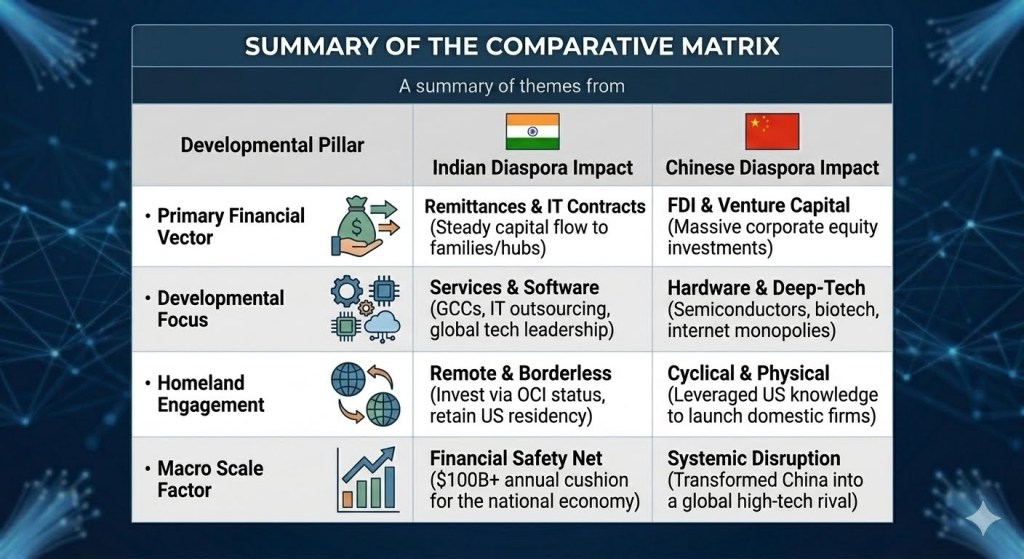
The data leaves no room for ambiguity: India and China have approached global education through two entirely different economic playbooks. Neither strategy is inherently superior, but each has fundamentally reshaped the global talent landscape over the last three decades.
The Chinese Model: Targeted Brain Gain
China played a masterful internal game. By combining Western-educated “Hai Gui” (Sea Turtles) with aggressive state subsidies, tax breaks, and high-tech start-up parks, Beijing successfully engineered a massive “brain gain.” Returning graduates acted as tech translators, importing the Silicon Valley blueprint to build autonomous, domestic digital giants like Baidu, Tencent, and Alibaba. For China, sending students abroad was a cyclical investment meant to fuel internal innovation and rapid GDP growth.
The Indian Model: The Borderless Diaspora
India, by contrast, leveraged the power of a borderless network. Facing limited high-tech infrastructure at home in the 1990s and 2000s, India’s brightest minds stayed abroad. They smashed corporate glass ceilings to lead the world’s most powerful tech conglomerates—from Microsoft to Alphabet—while simultaneously building an unmatched global lobbying and investment apparatus. Instead of returning physically, this diaspora fuels India externally, making the nation the world’s undisputed leader in foreign remittances, pumping over $100 billion annually back into the domestic economy.
The Road Ahead
As we look at current campus shifts—with Indian student enrollment skyrocketing past a declining Chinese footprint in the US—the mechanics are shifting once again. With India’s domestic tech ecosystem now maturing into a powerhouse of its own, we may see the lines on our charts cross yet again.
For global universities, policymakers, and corporate recruiters, understanding this structural divergence is no longer optional. It is the key to tracking where the world’s next generation of innovation will be built.
However, concluding the story here would be a historical mistake. The disappointment of the last three decades has triggered a profound, aggressive policy overhaul in New Delhi. India has realized it cannot remain a global superpower on software code and remittances alone.
Today, we are witnessing sure signs of a structural resurgence, driven by an ecosystem that is finally building the physical sandboxes India long lacked:
- The Semiconductor Awakening: Through the $10 billion India Semiconductor Mission (ISM), the government is bypassing private remittance models. By offering heavy capital subsidies, India is successfully drawing global chip assembly, testing, and fabrication units to states like Gujarat and Assam.
- The Heavy Manufacturing Push: Backed by the Production Linked Incentive (PLI) schemes, India is aggressively capturing supply chains in electronics, defense manufacturing, drone robotics, and advanced chemistry cells.
- Global Capability Centres (GCCs): The software pipeline has evolved. Over 1,600 GCCs now exist in India. These are no longer basic call centers; they are complex R&D hubs where diaspora networks are redirecting core engineering, AI architecture, and product design ownership straight to Bangalore, Hyderabad, and Pune.
- A Maturing Startup Ecosystem: With over 100 tech unicorns, India’s domestic venture capital landscape is now sophisticated enough to allow a frustrated Silicon Valley engineer to return home and instantly find world-class institutional funding, bypassing traditional bureaucratic red tape.
The Final Verdict
Yesterday’s debate missed the forest for the trees. The Indian diaspora is not “less patriotic” than the Chinese diaspora, nor is Indian talent inherently less capable.
The data simply reveals that China built a state-driven industrial engine capable of absorbing hardware expertise, while India built a borderless service network. As India finally constructs its own heavy industrial and deep-tech foundations, the lines on the charts are poised to shift once more. The diaspora is no longer just sending money home—they are finally coming back to build.
(Concluded)
