by M.K.Sudarshan
August 15, 2026 : Chennai, India
This Op-Ed is dedicated to India on its Independence Day, 15 August 2026.
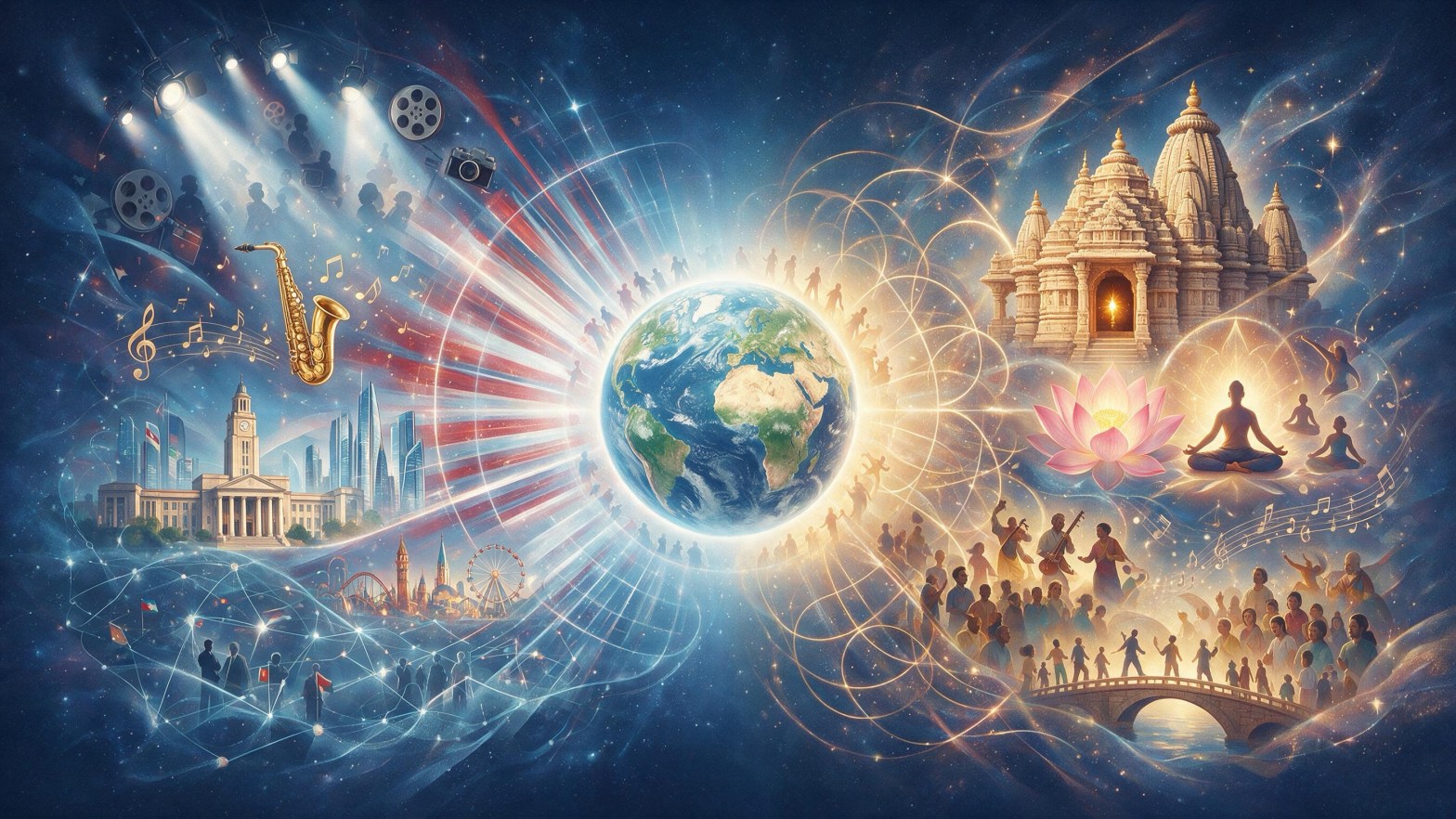
America and India possess immense “soft power”, but they deploy it toward different ends.
America has often used cultural attraction, political ideals, and diplomacy to legitimise global leadership and sustain a hegemonic order.
India, drawing upon its civilisational inheritance and the ideal of Vasudhaiva Kutumbakam—“the world is one family”—has more often used “soft power” to preserve strategic autonomy, build bridges, and maintain cordial relations across political and ideological divides.
India does not disprove Joseph Nye’s theory of soft power; it enlarges it by showing that attraction can serve not only hegemony, but also pluralism, autonomy, and relationship-building.
The power of attraction
In 1990, the American political scientist Joseph S. Nye introduced the concept of “soft power” into international-relations theory. He defined it as the ability to obtain desired outcomes through attraction and persuasion rather than coercion or payment.
Whereas hard power operates through military force, economic pressure, or inducements, soft power works by shaping what others want and persuading them that cooperation with the powerful actor is desirable.[1][2]
Nye identified three principal sources of a country’s soft power: its culture, its political values, and its foreign policy.
Culture generates attraction when it is admired by others; political values generate attraction when a country lives up to them at home and abroad; and foreign policy generates attraction when it is regarded as legitimate and morally authoritative.[1][3]
The concept was initially developed largely with the United States in mind. Yet the subsequent history of America and India shows that soft power can be used for very different purposes. America has often employed it to support global leadership and hegemony. India has more often used it to preserve strategic autonomy, cultivate cordial relationships, and maintain diplomatic access across ideological and geopolitical divides.
The contrast between the two countries does not disprove Nye’s theory. It enlarges it.
America’s cultural empire
For much of the twentieth century, America possessed an extraordinary reservoir of soft power. Hollywood, jazz, Coca-Cola, Disneyland, American universities, popular music, technology, and consumer culture projected an image of a dynamic, prosperous, open, and self-confident society.
American cultural products did more than entertain. They disseminated an entire way of life. They associated freedom with individual choice, prosperity with capitalism, and modernity with American innovation. The world was not merely consuming American films, music, food, and brands; it was being introduced to an American conception of what a desirable future might look like.
America’s political values added a second dimension to this cultural attraction. John F. Kennedy personified youth, idealism, eloquence, and public service. Martin Luther King Jr. gave the American promise of equality a universal moral language. The civil-rights movement, despite exposing the deep contradictions of American society, also demonstrated the capacity of the United States to criticise and reform itself.
This capacity for self-correction was an important source of American attraction. America’s claim to leadership was persuasive not because it was free of injustice, but because its institutions and citizens could publicly challenge injustice and demand reform.
The third element was foreign policy. The post-Second World War United States created alliances and institutions that were not based solely on force. The Marshall Plan, NATO, the United Nations system, educational exchange, international trade, and scientific cooperation helped make American leadership appear beneficial to much of the non-communist world.
American soft power was therefore not merely a decorative cultural asset. It helped establish a world order in which the United States occupied the central position.
Exceptionalism and hegemony
American soft power, however, was never politically neutral. It was closely connected with the idea of American exceptionalism: the belief that the United States possessed a distinctive historical mission and was uniquely qualified to lead the free world.
This gave American soft power both universal appeal and hegemonic purpose.
American ideals were presented as universal values, but they were also embodied in American institutions, American alliances, and American strategic interests. The United States did not merely invite other nations to admire its culture; it often asked them to accept an American-led political and economic order.
This was not always cynical. Many countries genuinely benefited from American security guarantees, investment, technology, education, and trade. Yet the distinction between universal values and American interests was often blurred. Washington’s interests could be represented as the interests of freedom itself.
The Reagan years illustrated this duality. Ronald Reagan greatly expanded American military power and adopted a confrontational policy toward the Soviet Union. Yet his language of freedom, democracy, and resistance to the “evil empire” gave American hard power an attractive ideological frame. The eventual collapse of the Soviet Union appeared to many people not merely as a military or economic defeat for Moscow but as the triumph of an entire social and political model.
In Reagan’s policy, hard power and soft power were not opposites. Military strength was made more effective by the appeal of the values in whose name it was exercised.
The erosion of American attraction
The decline of American soft power was not caused by a single president. It resulted from a growing gap between America’s professed values and its conduct.
The Vietnam War had already damaged American credibility. But the invasion of Iraq, Guantánamo Bay, torture, Abu Ghraib, extraordinary rendition, and the doctrine of preventive war produced a far deeper crisis.
The United States claimed to be spreading democracy and human rights while appearing to disregard international legitimacy and the rights of those under its control. The ongoing Iran War is the latest example of such a doctrine effectively camouflaging the exercise of hard power with the deceptive sheen of soft power ( i.e. making the world safe from a nuclear Iran, an “evil regional bully”).
The Iraq War demonstrated the limitations of hard power with particular clarity. American military force could remove Saddam Hussein’s regime, but it could not create political legitimacy, social trust, or a stable regional order. The war weakened the attraction of American leadership and intensified anti-Americanism.[4][5]
The problem was not simply that the war was unpopular. It was that American conduct seemed to contradict American rhetoric. When a country claims to represent liberty and lawful government, its own deviations from those standards carry an especially high reputational cost.
The Trump era today has only further deepened several of these weaknesses. A transactional approach to alliances, hostility toward multilateral institutions, admiration for authoritarian leaders, attacks on democratic norms, and the frequent use of threats and economic pressure has made American influence appear less principled and less predictable.
American culture did not disappear. Hollywood, technology, universities, music, entrepreneurship, and the English language continued to attract millions. What has significantly weakened is the ability of the American state to convert cultural admiration into diplomatic trust.
America may still be admired, but admiration for American society no longer automatically produces confidence in the American government.
India’s older civilisational attraction
India represents a different historical form of soft power.
Its cultural influence is not primarily the product of a modern nation-state. It draws upon a civilisational inheritance that includes Hindu philosophical traditions, Buddhism, Sanskrit literature, yoga, Ayurveda, mathematics, astronomy, temple culture, music, dance, textiles, cuisine, and systems of learning.
Indian ideas travelled across Asia through religious teachers, merchants, pilgrims, scholars, artists, and ruling elites. The spread of Indian religious and cultural forms into Southeast Asia occurred substantially without the direct political incorporation of those territories into an Indian empire. The idea of “Greater India” therefore refers less to territorial conquest than to the diffusion of cultural forms, intellectual traditions, religious practices, languages, and political symbols.[6]
Travellers such as Xuanzang, Ibn Battuta, and Marco Polo encountered a civilisation of immense diversity and intellectual vitality. They did not all travel to India for the same reason. Xuanzang was primarily a Buddhist pilgrim and scholar; Ibn Battuta was a jurist, diplomat, and traveller; Marco Polo belonged to the world of commerce and travel literature. Their accounts nevertheless testify to India’s importance as a centre of religion, scholarship, wealth, and cultural exchange.
India’s attraction should not be romanticised. Its history includes caste exclusion, social hierarchy, sectarian conflict, political violence, and discrimination. Yet Indian civilisation displayed a remarkable capacity to absorb, translate, and localise external influences. It did not merely preserve a fixed culture; it repeatedly transformed encounters with foreign peoples and ideas into new Indian forms.
Colonial fascination and exploitation
The British were fascinated by India’s antiquity, religious traditions, languages, arts, philosophical systems, and social diversity. But British admiration coexisted with conquest, extraction, racial hierarchy, and political domination.
This is an important distinction. A colonial power may admire the civilisation it rules while denying equality to its people. British Orientalism therefore cannot be treated simply as evidence of India’s soft power. It also functioned as an instrument of classification and imperial knowledge.
The British admired India and exploited India at the same time. They studied Indian texts while presenting Indians as incapable of self-government. They celebrated Indian diversity while governing through divisions. They praised Indian wealth while reorganising the economy for imperial benefit.
The episode demonstrates that cultural attraction does not automatically translate into political power. India could fascinate the British, yes, but without being able to prevent British domination.
Gandhi and the moral power of weakness
Post-colonial India inherited poverty, partition, communal trauma, economic weakness, and the institutional scars of colonial rule. It possessed little of the military or economic power associated with great-power status.
Yet India generated international influence through a distinctive combination of moral and political resources.
Mahatma Gandhi’s experiments with truth, non-violence, self-discipline, and resistance to injustice gave India a universal moral vocabulary. Gandhi’s influence extended far beyond India because he presented political struggle as an ethical act rather than merely a contest for power.
The Indian Constitution provided another source of attraction. In conditions of poverty and extraordinary diversity, India attempted to build a democratic republic based on universal citizenship, elections, fundamental rights, and pluralism. The success of this experiment was never complete, but the attempt itself commanded international respect.
India’s soft power during the early decades of independence therefore derived partly from the contrast between its material poverty and its normative ambition. A newly independent and impoverished country sought to build a democratic nation without abandoning its civilisational identity.
Nehru and non-alignment
Jawaharlal Nehru’s foreign policy translated this moral and civilisational capital into international diplomacy. Non-alignment allowed India to avoid subordination to either the American or Soviet bloc during the Cold War.
Non-alignment was not passive neutrality. It was a political doctrine of sovereignty, anti-colonialism, peaceful coexistence, and strategic independence. India sought to ensure that newly independent countries would not merely exchange European colonial rule for dependence on one of the two superpowers.
At the height of Cold War rivalry, the creation of a non-aligned bloc represented a significant normative contribution to international politics. India’s leadership gave smaller and newly decolonised countries a collective voice and a language with which to resist bloc politics.[7]
India’s influence was therefore not based on the ability to command. It rested upon the ability to articulate concerns that many other countries shared.
India today
Contemporary India continues to possess substantial soft-power resources. Yoga, Ayurveda, Indian cinema, Carnatic and Hindustani music, cuisine, spirituality, literature, the diaspora, technological achievement, democratic elections, and civilisational confidence all contribute to India’s global attraction.
India also uses soft power through diplomatic flexibility. It can cooperate with the United States while retaining defence ties with Russia; engage Israel and the Arab world simultaneously; participate in the Quad while maintaining relations with Iran; and speak to both the Global North and the Global South.
This is the contemporary form of strategic autonomy. India does not ask every country to share its ideology before establishing a relationship. It seeks diplomatic space across political systems and geopolitical camps.
The phrase Vasudhaiva Kutumbakam—“the world is one family”—provides the philosophical expression of this outlook. The principle comes from the Mahā Upaniṣad and has been invoked by Indian leaders, including Nehru and Narendra Modi, to describe India’s approach to the world. It was also reflected in the G20 formulation, “One Earth, One Family, One Future.”[8][9]
The phrase is not merely a pious slogan. It expresses a different conception of international influence. India’s ideal is not necessarily to make the world Indian, but to make the world more receptive to India as a civilisational, plural, and independent actor.
Hard power and defensive power
India’s soft power should not be confused with the absence of hard power. India possesses a large military, nuclear capability, economic weight, strategic geography, and an expanding technological base.
Nor should India’s military history be equated with America’s wars of global intervention. India’s conflicts with China and Pakistan have overwhelmingly been connected with territorial defence, border disputes, or immediate security concerns. They have not formed part of a worldwide project to remake foreign societies or establish Indian hegemony across distant regions.
The 1971 intervention in East Pakistan involved humanitarian, refugee, and strategic considerations, and its history contains complexities. But it was not comparable to America’s discretionary wars of intervention in Vietnam, Iraq, or other theatres where military action was undertaken to reshape political orders far beyond the United States’ immediate territorial security.
India has used hard power, but its hard power has generally been geographically limited and strategically defensive. Its soft power, by contrast, has operated globally.
Two uses of attraction
The contrast between America and India can now be stated more precisely.
American soft power has usually been instrumental and order-building. It has helped attract countries into an American-led system and legitimise America’s position at its centre.
Indian soft power has usually been relational and autonomy-preserving. It has helped India maintain ties with countries of different ideologies, political systems, and levels of power.
America’s dominant political narrative has been exceptionalism: America is uniquely qualified to lead.
India’s corresponding civilisational narrative is Vasudhaiva Kutumbakam: the world is one family, and India can engage with many worlds without becoming subordinate to any one of them.
This contrast should not be made absolute. American soft power has also facilitated genuine cooperation and supplied international public goods. Indian soft power also serves national interests, including status, influence, economic opportunity, and diplomatic support.
Every successful foreign-policy ideal operates at two levels. It expresses values while also serving interests. The difference lies in the political purpose toward which attraction is directed.
Enlarging Nye’s theory
Joseph Nye’s theory explains the mechanism of soft power: influence through attraction, legitimacy, persuasion, and the shaping of preferences. The American and Indian experiences add a further question: what kind of international relationship does soft power seek to create?
In the American case, attraction has often helped organise a hierarchical order under American leadership. In the Indian case, attraction has more often helped preserve strategic autonomy and maintain relationships without demanding ideological conformity.
This distinction modifies the conventional understanding of soft power. Soft power need not always be an instrument of hegemony. It can also be a civilisational mode of relationship-building.
India therefore does not disprove Nye. It reveals that soft power can operate through a different moral and diplomatic grammar. It can draw upon civilisational memory, philosophical universalism, cultural plurality, and diplomatic restraint.
The most useful conclusion is not that India represents the triumph of soft power over hard power. Rather, India demonstrates that a civilisation may possess such deep and durable soft-power resources that they compensate, at least partly, for the limited hard power of the state.
America and India have therefore enlarged Nye’s theory in two different directions.
America showed how soft power could become the cultural and moral foundation of hegemony. India shows how soft power can become the basis of diplomatic autonomy, civilisational confidence, and relationship-building across political divides.
Hard power can compel obedience. Soft power can create willingness. But the purpose for which willingness is cultivated determines the character of the power itself.
In America, attraction has often been used to lead the world. In India, attraction has more often been used to remain open to the world.
That is the dynamic use of soft power.
(Concluded)
Sources
[1] Unclear Attraction: A Critical Examination of Soft Power as an … https://academic.oup.com/cjip/article/3/2/189/344483
[2] Soft power: Not just winning hearts and minds, but saving … https://www.hks.harvard.edu/faculty-research/policy-topics/international-relations-security/soft-power-not-just-winning-hearts
[3] ANNALS311699.qxd https://study.sagepub.com/sites/default/files/The%20ANNALS%20of%20the%20American%20Academy%20of%20Political%20and%20Social%20Science-2008-Nye-94-109.pdf
[4] Soft Power and American Foreign Policy https://link.springer.com/chapter/10.1007/978-981-99-0714-4_7
[5] The Decline of America’s Soft Power https://ciaotest.cc.columbia.edu/olj/fa/fa_mayjun04/fa_mayjun04c.html
[6] Narrating India in/and the World: Colonial Origins and Postcolonial Contestations https://academic.oup.com/book/45723/chapter/398171564?guestAccessKey=
[7] From non-alignment to multi-alignment: assessing India’s foreign policy shift https://www.tandfonline.com/doi/full/10.1080/00358533.2023.2165367
[8] ‘Vasudhaiva kutumbakam’ for the 21st century https://www.brookings.edu/articles/vasudhaiva-kutumbakam-for-the-21st-century__trashed/
[9] Vasudhaiva Kutumbakam: India’s G20 presidency in shaping the global … https://www.journalofpoliticalscience.com/uploads/archives/7-1-42-133.pdf
[10] India rising: Soft power and the world’s largest democracy https://www.brookings.edu/articles/india-rising-soft-power-and-the-worlds-largest-democracy/
[11] A Decadal Snapshot of India’s Soft Power Strategies (2014-2024) https://www.orfonline.org/research/a-decadal-snapshot-of-india-s-soft-power-strategies-2014-2024
[12] [PDF] Rising Soft Powers: India – USC Center on Public Diplomacy | https://uscpublicdiplomacy.org/sites/uscpublicdiplomacy.org/files/useruploads/u20150/India%20soft%20power_0.pdf
[13] [PDF] Soft Power – Wilson Center https://www.wilsoncenter.org/sites/default/files/media/documents/page/joseph_nye_soft_power_journal.pdf
[14] NYE, J. Soft power (2004) https://www.scribd.com/document/873007229/NYE-J-Soft-power-2004
[15] India-Us relations : assessing India’s soft power https://scispace.com/pdf/india-us-relations-assessing-india-s-soft-power-3qpdu7cl9b.pdf
[16] [PDF] Sowing the seeds of soft power: the United States and India in the … https://upload.wikimedia.org/wikipedia/commons/f/f1/Sowing_the_seeds_of_soft_power-the_United_States_and_India_in_the_next_great_game(IA_sowingseedsofsof1094547906).pdf
[17] Making the Case for Soft Power https://muse.jhu.edu/article/197628/summary
[18] Soft power – Wikipedia https://en.wikipedia.org/wiki/Soft_power
[19] Soft Power by Joseph Nye – DiploFoundation https://www.diplomacy.edu/resource/soft-power-the-means-to-success-in-world-politics/
[20] [PDF] Soft Power: What it is, Why it’s Important, and the Conditions Under … https://moodle2.units.it/pluginfile.php/217337/mod_forum/attachment/13369/Soft%20power%20-%20usi%20e%20definizioni-2011.pdf
[21] [PDF] the evolution of a concept – Soft Power Club https://www.softpowerclub.org/wp-content/uploads/2021/03/Nye-Soft-power-the-evolution-of-a-concept-1.pdf

One thought on “INDIA INDEPENDENCE DAY SPECIAL: The Dynamic Use of “Soft Power”: How America and India, in Their Own Ways, Have Enlarged Joseph Nye’s Theory”