
by M. K. Sudarshan
21 August , 2026: Chennai, India
“…Today, we are going to look past the superficial headlines of Washington’s balance sheet to explore a timeless mathematical reality.
Long before Western economists drew up the rules of leverage, a 4th-century BCE master strategist named Kautilya (aka Chanakya) laid down the ultimate law of state survival in the Arthashastra: a state that destroys its economy to fund its government will lose both.
Welcome to The Chanakya Paradox: Why the Printing Press Eats the Empire and Private Banks Wag the Dog.”
🎬 Introduction: The Great Illusion of the Ledger
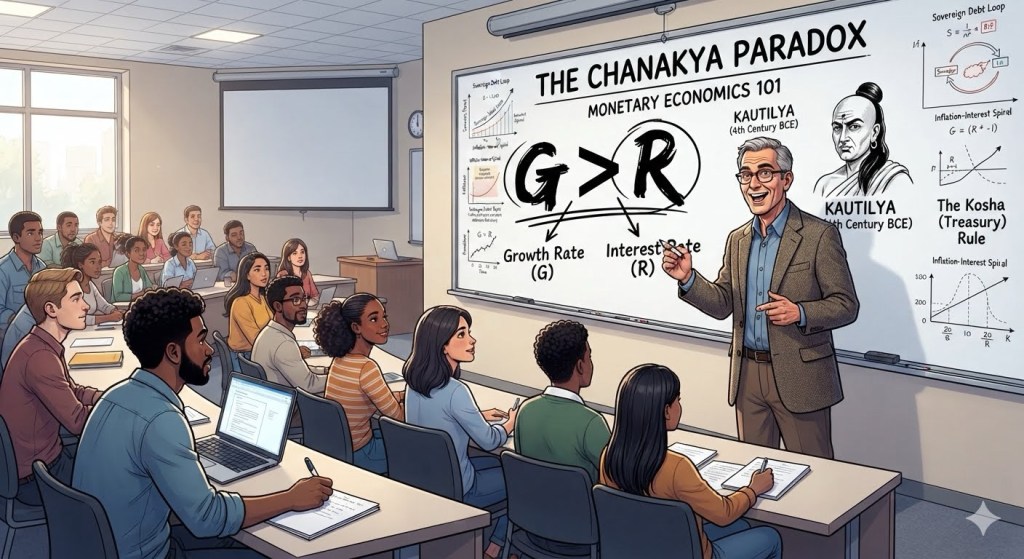
Good morning, everyone. Welcome to Monetary Economics.
If you open any standard undergraduate textbook, you will be told that economics is the study of scarce resources. But if you look at the real world, you will find that the most powerful force in human history isn’t scarcity—it is an illusion etched into an accounting ledger.
Today, we cross a historic milestone. The national debt of the United States has officially crossed $40 trillion [𝖯𝖡𝖲 𝖭𝖾𝗐𝗌𝗁𝗈𝗎𝗋]. The alarms are blaring in Washington. Pundits are predicting the immediate collapse of the American empire.
But as graduate students, your job is to look past the sensational headlines and understand the underlying mathematics of power. Today, we are going to look past the superficial headlines of Washington’s balance sheet to explore a timeless mathematical reality. Long before Western economists drew up the rules of leverage, a 4th-century BCE master strategist named Kautilya laid down the ultimate law of state survival in the Arthashastra: a state that destroys its economy to fund its government will lose both.
Welcome to The Chanakya Paradox: Why the Printing Press Eats the Empire and Private Banks Wag the Dog.
📉 Part 1: The Myth of the Number—Why the Size of Debt Does Not Matter
Let’s start with a foundational truth that confuses almost every politician on earth: The absolute size of a nation’s debt does not matter.
If I told you that a man owes $10 million, you might think he is ruined. But if I tell you that man is a multi-billionaire tech mogul, you realize $10 million is pocket change. Debt is completely meaningless without context. In sovereign economics, that context is defined by a simple, elegant race between two variables: g and r.
- g is the nominal growth rate of the economy (GDP + Inflation). It represents how fast the economic pie is expanding.
- r is the effective interest rate the government pays to borrow money. It represents how fast the debt is compounding.
If a country has $40 trillion in debt, but its economic engine (g) is expanding at 10% while its borrowing cost (r) is locked at 2%, that nation is completely safe. The rising tide of economic productivity naturally dilutes the debt over time.
The absolute number on the ledger is just a ghost. The only thing that is real is the structural relationship between your growth and your interest rate.
The Professor: (Pausing, scanning the room for maximum dramatic effect)
“Now, let’s look at the United States today through this exact mathematical lens. The headline data tells us that the U.S. economy is growing at a seemingly resilient real GDP rate of 2.0%. Against a sovereign borrowing cost of around 4.5%, that’s a tough position to be in—it means r > g, and the debt is technically compounding faster than the pie is growing.
But it gets much worse. As graduate students, you must learn to dissect headline indicators.
If we look under the hood of that 2.0% GDP growth and strip away the massive, hyper-concentrated capital expenditure of a single sector—the Artificial Intelligence tech boom—do you know what the real underlying growth rate of the U.S. economy actually is?
(Writing the number on the whiteboard)
It is a near-stagnant 0.66%.
Think about what that means. Nearly two-thirds of all economic growth in the United States today is driven by tech giants spending hundreds of billions of dollars constructing data centers and buying advanced computer hardware. The consumer-facing economy—the main street shops, the factories, the everyday services—is crawling at less than one percent under the crushing weight of sticky inflation and high interest rates.
This is the ultimate modern manifestation of our thesis. The United States is relying entirely on a localized tech capital wave to artificially inflate its growth engine (g), desperate to prevent the wider r > g death spiral from swallowing its $40 trillion balance sheet. If that AI infrastructure spending slows down before it can organically boost the productivity of traditional industries, the illusion shatters, and the empire slides directly into structural stagflation.
(Pausing, the Professor lets the gravity of the number sink in)
So, keeping this fragile 0.66% core in mind, let’s look back at history to see what happens when the illusions fade and the debt loop truly takes hold…”
⏳ Part 2: The Correlation of Debt and Decline
When that mathematical relationship flips—when r permanently overtakes g—empires begin to crumble. Let us walk through the cemetery of history to see how this played out across four great civilizations.
🇬🇧 The British Empire: The Fiscal Exhaustion
Following World War II, Great Britain sat on the winning side of history, but its balance sheet was completely broken. Its debt-to-GDP ratio had plummeted past 250% [𝖴𝖪 𝖯𝖺𝗋𝗅𝗂𝖺𝗆𝖾𝗇𝗍]. Britain didn’t lose its empire to a military invasion; it lost it to a spreadsheet. The cost of maintaining military garrisons across the globe (r) vastly outstripped its stagnant post-war domestic growth (g). Bankrupt and entirely dependent on foreign concessional loans [𝖴𝖪 𝖯𝖺𝗋𝗅𝗂𝖺𝗆𝖾𝗇𝗍], Britain was forced by its creditors to liquidate its imperial holdings, leading directly to Indian Independence in 1947.
🇹🇷 The Ottoman Empire: The Debt Colony
By 1875, the Ottoman Empire was trapped. Decades of borrowing from European banks to fund lavish palaces and modernization projects left them with £214.5 million in foreign debt. Annual debt servicing alone consumed 80% of total state revenues. The empire officially declared bankruptcy via the Decree of Ramazan (1875). To protect their investments, European creditors forced the Sultan to sign away one-third of his tax revenues directly to the Ottoman Public Debt Administration. Long before the empire physically dissolved after WWI, it had ceased to be a sovereign state; it was merely a debt-collection territory for European banks.
🇲🇳 The Mongol Empire: The Paper Catastrophe
The Mongols did not have a bond market, but they pioneered a different monetary trap. During the Yuan Dynasty in China, the Mongol rulers ran massive deficits to fund court extravagances and foreign wars. To pay for it, they printed paper fiat currency (Chao) with zero silver backing. The market quickly realized the money was empty paper. Trust evaporated, hyperinflation took hold, and the entire commercial economy collapsed, triggering the domestic rebellions that violently chased the Mongols out of China.
🏛️ The Roman Empire: The Shrinking Coin
Rome did not have a national debt, but it faced a brutal cash-flow deficit. As imperial expansion halted, the influx of war plunder dried up, but the fixed costs of maintaining a massive standing army and administration kept rising. To bridge the gap, Roman Emperors began systematically debasing the currency. They melted down the silver Denarius and mixed it with cheap copper. Over two centuries, the silver content of Roman coins dropped from 95% to less than 0.5%. The result? Severe hyperinflation, the complete destruction of internal trade, and an empire so financially hollowed out it could no longer afford to pay the legions guarding its borders.
👑 Part 3: The Fatal Trap of Regime Survival—Why Rulers Cannot Help It
Looking back, we might wonder: Why were these rulers so foolish? Why didn’t they just cut spending?
The answer is that governments do not mismanage their treasuries because they are stupid. They do it because they are trying to survive the next ten minutes.
Imagine you are a Roman Emperor. If you do not pay the legions their bonuses tomorrow morning, they will assassinate you and replace you with a general who will. You know that debasing the currency will cause inflation in ten years, but if you don’t do it today, you won’t survive the week.
Governments consistently prioritize short-term institutional survival over long-term structural health. As an empire expands, its bureaucratic machinery grows massive, self-serving, and inflexible. To buy social peace, fund welfare, and appease elite factions, the state must spend more than it extracts.
The fatal economic error these regimes make is confusing currency with wealth. Real wealth is the productive capacity of your people—their farms, factories, and trade. When a government over-taxes, inflates, or over-borrows, it is actively cannibalizing the productive base of its own economy to sustain a bloated, unproductive state apparatus. They destroy the house to keep the furnace burning for one more night.
📈 Part 4: The Birth of the Bond Market—Accelerating Global Leverage
For centuries, an empire’s ability to mismanage its finances was limited by the physical amount of gold and silver it could squeeze out of its population. But then came the greatest financial innovation in human history: The Institutional Bond Market.
Invented in the Italian city-states and perfected by the Dutch and the British, the bond market allowed governments to trade future tax revenues for immediate cash. Instead of stealing gold today, a king could issue an IOU promising to pay investors back over the next thirty years.
Suddenly, global debt was completely decoupled from physical constraints. It became an engine driven by three distinct gears:
If an empire had a powerful economic growth engine (g), global investors would happily buy its bonds at very low interest rates (r). This created a massive accelerant. The bond market allowed the British Empire to fund global wars and the United States to fund the Industrial Revolution by borrowing against their future prosperity.
But this engine has a dark side. The bond market functions as an unyielding, cold machine. The moment an empire’s growth begins to slow down, or its debt becomes too heavy, the gears reverse. Investors demand a higher risk premium, driving up the yield (r). Suddenly, the bond market transforms from a financial turbocharger into an inescapable debt trap.
🖨️ Part 5: The Forbidden Fruit—The Pitfalls and Temptations of Printing Money
This brings us to the ultimate temptation of the modern era. When the bond market demands higher yields and the debt becomes unsustainable, modern governments look at their printing presses and ask a seductive question:
“Since we borrow in our own currency, why don’t we just print the money to pay off the debt?”
This is the core illusion of modern political discourse. Let’s map out exactly what happens when a government prints money specifically to fund its largest line item: Interest on its borrowing.
Every single month, the U.S. Treasury must pay billions of dollars in interest to bondholders. If the Federal Reserve creates new dollars out of thin air to cover these checks, it does not bypass the real economy. That newly printed cash enters the banking system immediately .
Because you have flooded the market with paper money without increasing the actual production of food, energy, or housing, the value of each dollar drops. You get immediate domestic inflation.
But the story doesn’t end there. Bond investors are highly rational actors. If a pension fund or a foreign central bank realizes the government is paying them interest in depreciating, printed currency, they will protect themselves. The next time the government tries to borrow money, investors will refuse to buy the bonds unless they receive a significantly higher interest rate—an inflation premium.
Yields spike. Because the government has to constantly roll over trillions of dollars of old debt into new bonds, a 1% or 2% jump in interest rates instantly adds hundreds of billions of dollars to the annual budget deficit. The government is forced to print even more money next month just to cover the newly inflated interest cost. You have entered the terminal Inflation-Interest Spiral.
📜 Part 6: Chanakya’s Defense—The Anti-Debt Philosophy of the Arthashastra
Long before Western economists began tracking g > r, an ancient Indian polymath named Kautilya (also known as Chanakya) identified this exact systemic vulnerability. In the 4th Century BCE, he wrote the Arthashastra, the world’s first comprehensive treatise on statecraft and political economy.
Kautilya’s philosophy was explicitly and fiercely anti-debt.
In his Saptanga (seven-limb) theory of the state, Kautilya positioned Kosha (the Treasury) as explicitly more important than Danda (the Army) [𝖯𝗈𝗅𝖲𝖼𝗂 𝖨𝗇𝗌𝗍𝗂𝗍𝗎𝗍𝖾]. He簡 argued that a standing army is completely useless without a well-filled treasury to sustain it [𝖯𝗈𝗅𝖲𝖼𝗂 𝖨𝗇𝗌𝗍𝗂𝗍𝗎𝗍𝖾].
Kautilya warned that running a state on borrowed money or structural debt was a critical weakness that directly compromised a nation’s sovereignty. If a king faces an extraordinary emergency (Apatkala)—such as an invasion or a famine—Kautilya did not prescribe borrowing money. Instead, he outlined a highly strategic system of temporary emergency resource extraction:
- Benevolences (Pranaya): Demanding one-time financial contributions from the wealthiest merchants and landowners based strictly on their capacity to pay.
- State Monopolies: Temporarily taking direct control over high-yield commercial sectors like mining, salt, and liquor to immediately refill the state’s coffers.
- The Rule of the Bee: Kautilya issued a stern warning to rulers: “A king must collect taxes from his economy as a bee sucks honey from a flower—taking just enough to sustain the state without damaging the underlying petals.”
Kautilya understood that a treasury built on debt makes the king a hostage to lenders. For ancient Indian dynasties, financial survival was achieved by boosting internal productivity and maintaining real, physical surpluses, never by building a mountain of structural liability.
🐕 Part 7: The Tail Wags the Dog—Who Really Rules the World?
This brings us to the final, unsettling conclusion of our story.
Most people grow up believing that the government is the supreme authority—the “dog”—and the central bank and the commercial banking empire are merely the technocratic “tail.”
But when a nation crosses the tipping point into systemic debt, the financial system completely inverts. The tail begins to violently wag the dog.
When a government owes $40 trillion, it is no longer an independent sovereign ruler. It is a captive patient on permanent financial life support. Every single week, the government must go back to the banking system to roll over its expiring debt and borrow billions more just to keep its offices open.
At that stage, power shifts entirely to the Primary Dealers—the massive global commercial banks and institutional investors who control the bond auctions. If the banking empire decides a government’s policies are unfavorable, they don’t need to deploy an army. They simply stop buying the government’s bonds. Yields spike, the national budget fractures, and the government is forced to capitulate.
The central bank is pulled into this trap via Fiscal Dominance. It can no longer raise interest rates to protect the currency because doing so would instantly bankrupt its own government. The central bank’s primary mission shifts from maintaining economic stability to ensuring government liquidity.
Politicians sit in parliaments, sign decrees, and give speeches about war and peace. But behind the scenes, the elite banking apparatus decides what is possible. They decide if a nation can afford to wage a war, if it can fund infrastructure, or if it must implement austerity. The government becomes a glorified debt-collection agency, extracting taxes from its citizens and routing that wealth straight back into the banking system to service compounding interest.
🎓 Conclusion: Your Challenge as Economists
As you step into the world of graduate-level monetary economics, I want you to remember this framework.
Do not get distracted by the raw numbers. Don’t look at $40 trillion and assume immediate collapse [𝖯𝖡𝖲 𝖭𝖾𝗐𝗌𝗁𝗈𝗎𝗋]. Instead, look at the structural relationship. Look at whether a nation’s organic economic growth engine (g) is outpacing its systemic cost of capital (r).
The moment that inequality flips, the clock begins to tick. The state survival loop activates, the printing presses start running, and the banking tail begins to wag the political dog.
Throughout this semester, we are going to unpack the mathematical models behind this power dynamic. Your goal is to understand how this machine works—because those who understand the relationship between g and r are the ones who can predict the rise and fall of modern empires.
Thank you. Let’s open the floor for questions.
🎬 Scene: After the Applause Clears
Setting: The lecture hall of the university. The hum of industrial air conditioners fills the room as first-year graduate students chatter, pack their bags, and shuffle toward the exit doors. The professor is at the podium, shutting down the laptop and neatly piling up lecture notes.
A sharp, inquisitive student steps out of the dispersing crowd. He holds a tablet displaying a copy of the Reserve Bank of India’s State Finances Report. He hails from Chennai, Tamil Nadu.
The Student: (Politely, waiting for the professor to look up)
“Professor? Do you have two minutes? That lecture was absolutely fascinating, especially the framework on how the banking tail completely wags the political dog when r > g flips.”
The Professor: (Smiling, closing the laptop case)
“Of course. That’s why we’re here. Go ahead. What’s on your mind?”
The Student:
“So, I was applying your model to India while you were talking. I look at my home state, Tamil Nadu. According to the latest data, Tamil Nadu holds the largest absolute debt volume among all Indian states—nearly ₹9.6 Lakh Crore. When you see that number in the local newspapers back home, political opposition parties use it to scream about an impending economic apocalypse. But looking at your framework… the absolute size of the debt shouldn’t matter, right? What is Tamil Nadu’s actual g > r dynamic?”
The Professor: (Leaning back against the podium, impressed)
“Excellent connection. You’ve bypassed the political theater and looked straight at the plumbing. You are completely right: the absolute number of ₹9.6 Lakh Crore is just a ghost headline. To understand Tamil Nadu’s health, we have to look at its Gross State Domestic Product (GSDP) and its borrowing costs.”
The Student: (Nodding, pulling up a chart on his tablet)
“Right. Because Indian states can’t print currency like the U.S. Federal Reserve does. They issue State Development Loans (SDLs).”
The Professor:
“Exactly. They have no printing press to hide behind. Now, let’s run the math for Tamil Nadu. The market yield on its 10-year SDLs—your r—is tightly managed by the RBI and hovers around 7.4% to 7.7%. But look at Tamil Nadu’s nominal growth rate, your g. Driven by its massive automotive hubs, electronic manufacturing, and deep industrial diversification, the state’s nominal growth is surging at roughly 11.5%.”
The Professor: (Continuing)
“Do you see the spread? That is a highly healthy +3.8% positive gap. Because the underlying economic engine is expanding significantly faster than the debt is compounding, Tamil Nadu’s debt-to-GSDP ratio remains entirely manageable at around 29%. It’s using leverage correctly—borrowing to fund high-value capital expenditure and infrastructure, which in turn expands the future tax base. It is structurally secure.”
The Student: (Contemplating)
“So the alarmists back home are treating it like a household budget instead of a sovereign-adjacent economy. But Professor, does that mean every heavily indebted state in India is safe?”
The Professor:
“Far from it. Turn your eyes northwest to Punjab. Punjab doesn’t have Tamil Nadu’s absolute volume of debt, but it is in a classic Chanakya structural trap. Its debt-to-GSDP ratio is nearing 47%—the highest among all major non-hilly states. Its nominal growth (g) has slowed down to around 8.5%, while its borrowing cost (r) sits at that same 7.6%market rate.”
The Professor: (Tapping the student’s tablet)
“Look at that razor-thin spread of just 0.9%. Punjab isn’t using its debt for capital investments or industrial corridors like Tamil Nadu is. It is trapped in the ‘Survival Loop’ we discussed in class. It is borrowing money to pay for power subsidies, committed legacy pensions, and day-to-day administrative survival. Over 20% of Punjab’s entire revenue receipts are swallowed up just to pay the interest on its past debt.”
The Student:
“Ah! So because Punjab can’t print rupees, it can’t inflate its way out of that trap. What happens when a subnational state hits a wall like that?”
The Professor:
“The tail wags the dog, but on a federal scale. The central government in New Delhi steps in under the FRBM Act, clamps down on the state’s borrowing ceilings, and effectively takes over its fiscal policy. The state loses its political autonomy.”
The Student: (Smiling, locking his tablet)
“So Kautilya’s rule of the bee applies perfectly even to modern Indian states. Collect taxes like a bee taking honey to invest in the flower’s growth… otherwise, you become a hostage to your creditors.”
The Professor: (Picking up his laptop bag, smiling)
“Spoken like a true monetary economist. Write this down as a short postscript case study for your mid-term paper. I’ll see you in seminar on Thursday.”
The Student:
“I will, Professor. Thank you so much!” (Turns and walks out of the empty lecture hall)
(Concluded)

Really a wonderful blog enlightening ordinary citizens very much.Thank you 😀😀😀