
By M.K.Sudarshan
August 21, 2026: Chennai, India
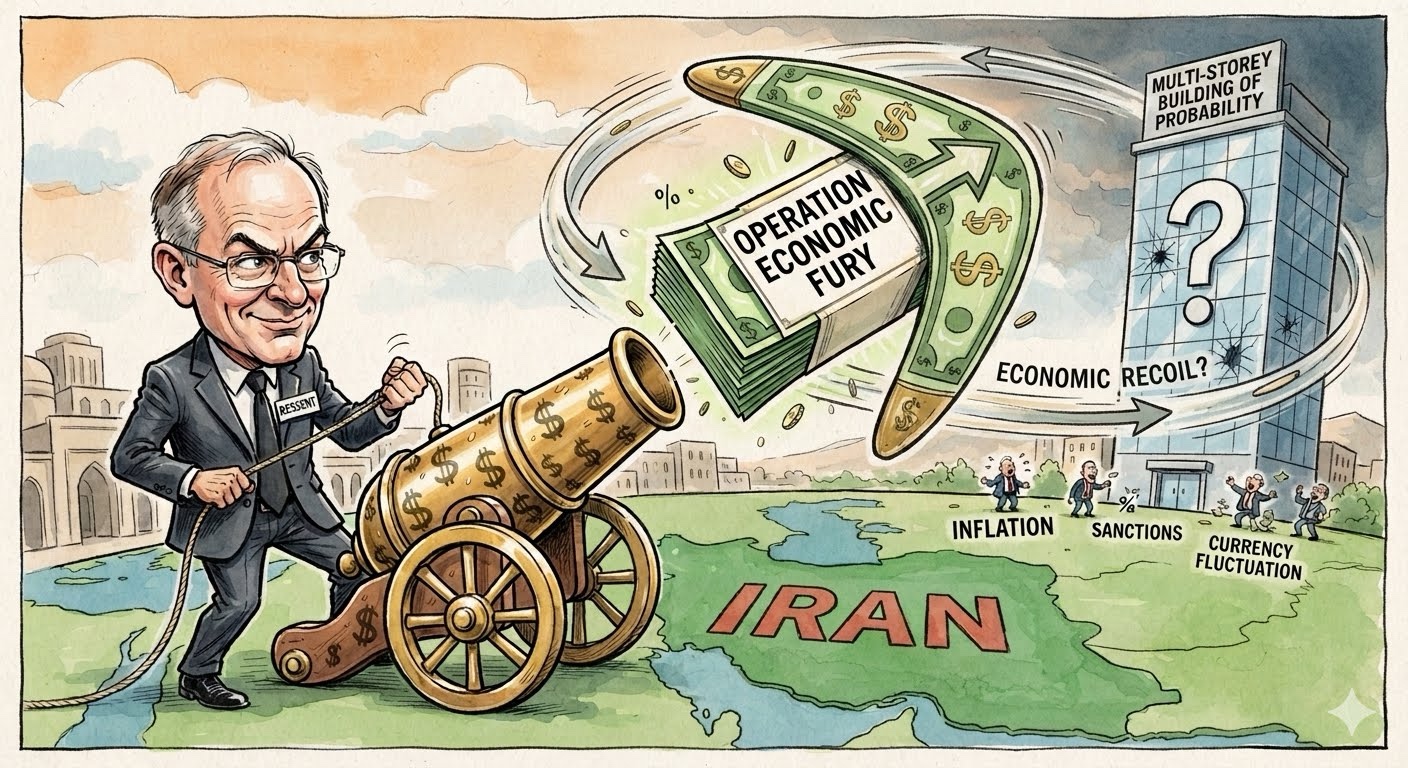
The United States Treasury has officially pulled the pin on what it describes as the most aggressive financial campaign in modern history. Dubbed “Operation Economic Fury,” the strategy outlined by Treasury Secretary Scott Bessent aims to push the Islamic Republic of Iran past the baseline economic misery it has endured for decades and force a total collapse of the regime. By combining an absolute squeeze on remaining oil channels with aggressive secondary tariffs, Washington is attempting to execute a financial blueprint of total state isolation.
Yet, as the smoke clears over the global financial map, a stark disconnect emerges between macroeconomic cruelty and geopolitical reality. While the strategy is a masterpiece of economic warfare, prominent realist scholars and military analysts—such as Professor John Mearsheimer, Lieutenant Colonel Daniel Davis, and Alastair Crooke—warn that Washington is confusing tactical economic cruelty with achievable geopolitical victory. In their view, the campaign risks becoming another chapter of strategic sound and fury, yielding high-voltage regional chaos rather than a clean political transition.
Part 1: The Case for Absolute Strangulation
To understand why Washington believes this campaign will succeed where thirty years of previous sanctions failed, one must look at the unprecedented structural seals applied to Iran’s economic escape valves. Historically, the regime survived through a combination of dark-tanker oil smuggling to China and informal financial clearinghouses in the United Arab Emirates. Operation Economic Fury has methodically dismantled this architecture.
First, the baseline has shifted due to physical and geopolitical shocks. Following the intense military escalations that began on February 28, 2026, Iran’s maritime trade has been subjected to a highly restrictive naval framework, effectively choking oil exports to zero. Simultaneously, the United Arab Emirates completely severed its financial and logistics ties with Tehran, closing Iran’s largest gateway to the global economy.
Second, Washington has weaponized the global tariff system. By threatening an immediate 25% secondary tariff on any nation continuing to trade with Iran, the United States has forced a brutal mathematical choice upon major economies like China and India: access to the multi-trillion-dollar American market, or heavily discounted Iranian crude oil. Even Iran’s traditional partners, China and Russia, are calibrating their responses purely out of strategic opportunism rather than altruism. While Beijing publicly condemns the sanctions, it is quietly treading carefully to avoid a total trade collapse with the West, opting to lock up Iranian oil revenues inside Chinese bank accounts to prevent Tehran from accessing cash. Moscow, heavily constrained by its own military commitments, provides electronic warfare data and localized arms sales to fuel a US distraction but refuses to offer a mutual defense clause or risk its lucrative ties with the broader Arab Gulf. With Iran’s foreign currency reserves frozen abroad and annual food inflation hovering near 90%, the macroeconomic metrics suggest a state staring down the barrel of total financial bankruptcy. On paper, the blueprint for state collapse appears absolute.
Part 2: The Mirage of Financial Attrition
The fundamental flaw of Operation Economic Fury, however, lies in the assumption that macroeconomic devastation automatically translates into military incapacitation or democratic revolution. Realist assessments emphasize that this logic misunderstands both the cheap economics of asymmetric warfare and the brutal survival mechanics of an entrenched autocracy.
Asymmetric warfare does not require a thriving, high-functioning economy. A long-range Shahed drone costs roughly $20,000 to manufacture—a mere fraction of the multi-million-dollar Western interceptor missiles (such as the SM-2 or Patriot) required to shoot them down. As Lt. Col. Daniel Davis points out, this creates a severe attrition deficit for the West, burning through finite US precision-guided munition stockpiles at a rate that Western factories cannot replace for years. Because Iran possesses highly decentralized, underground manufacturing lines insulated from financial systems, it can sustain a high-frequency asymmetric defense grid on a shoe-string budget.
Furthermore, historical precedents like Cuba and North Korea demonstrate that severe economic degradation rarely translates to a loss of military capability or a change in governance. North Korea has been economically destitute and entirely isolated for decades, yet it successfully developed thermonuclear weapons and intercontinental ballistic missiles. When resources become scarce, an authoritarian regime does not cut its military budget; it strips food, health care, and civilian infrastructure from its people to shield its security core.
The “threshold of pain” theory—the idea that popular misery will inevitably spark a successful domestic revolution—chronically fails because hyperinflation destroys the middle class, leaving citizens entirely consumed by the exhausting daily struggle for food and water rather than organized political resistance. Paradoxically, as private industries collapse, the population becomes entirely dependent on state-rationed survival supplies, increasing the government’s leverage over the public.
Crucially, powerful neighbors like Turkey and Pakistan view an unstable, fracturing Iran as an unmitigated national security nightmare rather than an opportunity. A collapse of the Iranian state would push millions of starving refugees across Turkey’s fortified eastern border, threatening its economy and potentially creating a power vacuum for autonomous Kurdish militant factions. For Pakistan, an imploding Iran threatens to trigger a reverse flow of refugees and spill volatile Baloch insurgencies directly into its unstable Balochistan province, while risking catastrophic domestic sectarian conflicts. To protect their own sovereign borders, Ankara and Islamabad have a direct national interest in keeping the central government in Tehran functional enough to police its own territory, creating a natural regional wall against US-led regime change.
Conclusion: The Multi-Storey of Risks
The ultimate trajectory of Operation Economic Fury can be visualized through a clear metric of probability, mapped out as a three-story strategic building where the chance of success drops precipitously with each higher floor:
[THE STRATEGIC OUTCOME PROBABILITY MATRIX]
Floor 3: Stable Regime Change ──► [ 30% Success Probability ] (Requires popular revolt to defeat an insulated security apparatus)
▲ │ Floor 2: Halting the Military ──► [ 40% Success Probability ] (Stalled by cheap $20k asymmetric weapons & underground factories)
▲ │ Floor 1: Breaking the Economy ──► [ 90% Success Probability ] (Achieved: Bankrupted state, hyperinflation, frozen assets)
The fatal hazard of this strategy is that by successfully locking Iran onto Floor 1 while demanding it climb to Floor 3, the United States leaves a highly armed, cornered regime with absolutely nothing left to lose. Stripped of conventional economic alternatives, Tehran’s strategic incentive shifts entirely toward weaponizing regional chaos. As Mearsheimer warns, Iran’s path to victory does not require defeating the US military conventions; it merely requires surviving and making the Persian Gulf unsafe for maritime shipping. By mining the Strait of Hormuz and driving global oil prices past $100 a barrel, a desperate Iranian regime can inflict an immediate, catastrophic financial tax on Western voters and global supply chains.
Ultimately, Operation Economic Fury achieves immense tactical pain but lacks a viable strategic exit. By ignoring the structural realities of asymmetric warfare and the defensive interests of regional neighbors, Washington may find that it has not engineered a democratic transition, but rather ignited a catastrophic regional fire that burns the entire building down.
(Concluded)
