by M.K.Sudarshan
September 22, 2026: Chennai, India
Welcome to advanced semantic engineering.
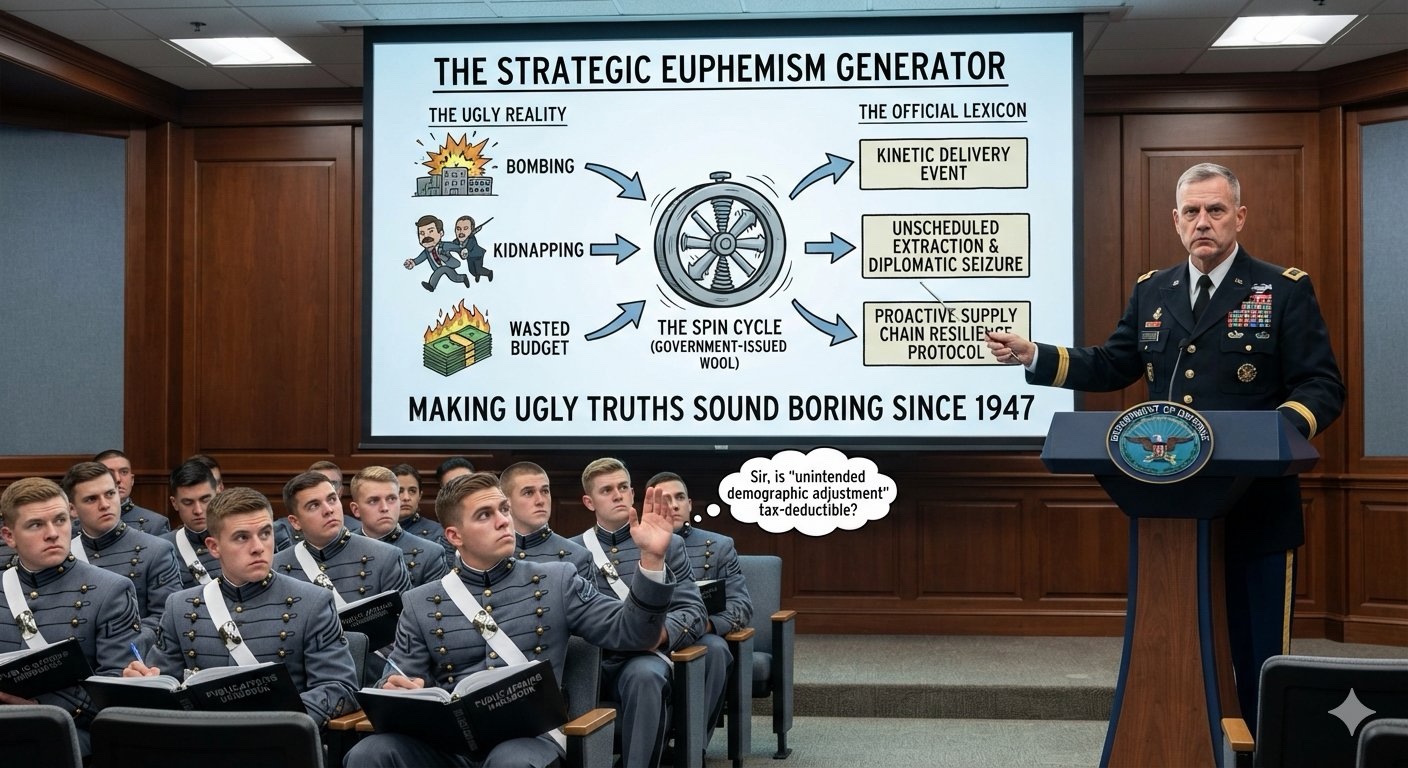
An elite military instructor pulls back the curtain on how governments transform raw violence, operational failures, and trillion-dollar budgets into sterile, high-end science experiments using the ultimate weapon: a dictionary.
The fluorescent lights of the lecture hall at the Elite Military Academy hummed. At the lectern stood Colonel Alistair Vance, a veteran of three decades of bureaucratic theater. He adjusted his glasses, looked at the eager, freshly pressed cadets, and cleared his throat.
“Good morning, future managers of global friction. Seat yourselves.
Today, we are skipping the tactical drills. We are not talking about logistics, and we are certainly not talking about physics—well, not the kind of physics that involves actual science. Today, we are discussing the most powerful weapon in your arsenal, one that requires no maintenance, never jams, and costs absolutely nothing to manufacture.
I am talking, of course, about Linguistic Smokescreens.
Now, I see some of you bright-eyed cadets looking confused. You think wars are won with stealth drones and hypersonic missiles. Nonsense. Wars are won by ensuring the folks back home think you’re conducting a sterile, high-end science experiment.
1. The Core Principle: Micro-Level Softening
Let’s start with a basic rule: Never use a verb when a multi-syllabic noun will do.
If you order a missile to detonate a building, what have you done? To a civilian, you’ve ‘bombed’ it. Terrible word. Sounds loud. Implies fire, shattered glass, and a budget deficit. Instead, you have engaged in a ‘kinetic delivery event.’ See how beautiful that is? It sounds like FedEx dropped off a package, just with a slightly higher velocity. Kinetic energy is just mass times velocity, cadets! You aren’t destroying a target; you are merely introducing a rapid atomic reallocation.
If the package accidentally hits the apartment block next door, you haven’t ‘killed bystanders.’ Do not let me catch you using that word in a press briefing. You have caused ‘collateral degradation of non-organic assets’ or, if pressed, ‘unintended demographic adjustment.’ It’s a statistic, not a tragedy.
Mastering this micro-level lexicon transforms grim actions into an orderly, manageable, and highly controlled technocratic process:
- “Surgical strike” borrows from medicine to imply a clean, life-saving incision that only removes the “disease,” ignoring the collateral destruction.
- “Theater of operations” turns a literal battleground of human suffering into a detached, staged drama.
- “Neutralize” is used to substitute for the destruction of an enemy target, asset, or personnel.
- “Ordnance” is a general classification used for military supplies including weapons, ammunition, and explosives, which categorizes items collectively rather than individually by specific function.
2. The Macro Level: Ideological Camouflage
Now, let’s look at the grand strategic level. Suppose you want to take a piece of land that belongs to someone else. History books written by civilians call this ‘invasion’ or ‘annexation.’ But we are professionals.
If you are a rising superpower and you want to swallow an island democracy that your party has never actually ruled, you don’t say you’re stealing it. You invoke Irredentism—asserting a claim based on shared ethnicity, history, or culture. You tell the media that the people on that island share your DNA, your cultural fondness for dumplings, and therefore, you are merely facilitating a ‘romantic, long-overdue family reunification.’You’re not invading; you’re just the ultimate long-lost relative showing up on their doorstep with an aircraft carrier to say hello.
If you lost a border skirmish eighty years ago, you lean into Revanchism—the motivating desire to reverse a past military or political defeat and reclaim lost national pride. You don’t tell your public you’re starting a bloody war for a piece of mountain terrain; you tell them you are ‘righting a historical asymmetry.’
Look at our friends in South Asia wrestling over Kashmir. One side uses demographic irredentism to claim a valley because of who lives there, calling it a ‘liberation movement’. The other side uses legalistic revanchism because of a piece of paper signed in 1947, calling it administrative ‘reintegration’. Both sides are trying to ‘reintegrate’ the exact same plot of land! It’s brilliant. If you say ‘reintegration’ enough times, the public forgets that ‘integration’ involves artillery.
3. Catastrophe Rebranding (When Things Go Sideways)
At this point, Cadet Jenkins raised his hand. “Sir, how do we deploy this linguistic toolkit if the entire deployment goes completely sideways? What happens when a ‘stabilization initiative’ turns into a total operational failure, and the politicians start ad-libbing their own smokescreens?”
Colonel Vance smiled—a thin, chilling line. “Excellent question. Sit. You are hitting on the advanced seminar: Catastrophe Rebranding.
When an operation falls apart, the civilian leadership will immediately panic and begin generating what we call ‘Vapor Rhetoric.’ Let’s look at the current theater—Iran.
Suppose we’ve sent three carrier strike groups into the Persian Gulf, the sky is glowing orange, and the oil markets are in cardiac arrest. The media is screaming the ‘W-word.’ War. As officers, you must never let that word escape your lips, and you must firmly guide your civilian leaders to do the same.
Take a page out of the playbook of Vice President JD Vance. If the press corps corners him at a podium, asking why we are trading missile salvos with Tehran, his response won’t be tactical—it will be ontological. Imagine him looking into the cameras with that practiced, folksy earnestness:
“Look, folks, let’s be entirely clear here. To call what is happening in Iran a ‘war’ is not only irresponsible, it’s fundamentally inaccurate. A war requires two competing sovereign wills engaged in a formal, systemic struggle. What we are witnessing right now is simply a highly synchronized, cross-domain regional recalibration. We are merely correcting market and security anomalies in the Gulf. It’s an interactive containment strategy, not hostilities.”
See the beauty there? He hasn’t denied that things are exploding; he has simply redefined the explosion as an ‘anomaly correction’.
But then, cadets, you have the Commander-in-Chief himself. Donald Trump doesn’t do technocratic jargon. He doesn’t care about ‘cross-domain recalibration.’ He uses the Lexicon of Minimization. While the Pentagon is sweating through their dress whites because four divisions are pinned down, he will take to the microphone and call the entire multi-billion-dollar quagmire a ‘military excursion.’
“We sent our beautiful, tremendous boys on a little military excursion. A very short, very successful excursion. They went in, they did a fantastic job—nobody’s ever seen an excursion like it—and they’re just tidying things up. It’s a beautiful outing. Not a war. The fake news wants to call it a war, but it’s a very orderly, high-energy excursion.”
As future commanders, you must learn to love the word ‘excursion.’ An excursion is what a middle school class does to a museum. It implies a picnic lunch, a clear itinerary, and a scheduled bus ride home. By downgrading a massive, multi-theater logistical failure to a ‘minor outing,’ the administration reframes a bloody stalemate as a temporary delay on a scenic route.
So, Cadet Jenkins, if your brigade gets cut off, your communications go dark, and you are forced to abandon millions of dollars of hardware in the desert, what do you write in the after-action report? You do not write ‘rout.’ You do not write ‘failure.’
You write: ‘The unit successfully executed a non-linear, retrograde excursion to optimize resource conservation.’ You didn’t retreat because you were losing. You simply took an unprompted vacation to a more defensible position.
4. Fiscal Camouflage: Rebranding the Exorbitant Budget
Alright, let’s talk about the lifeblood of the entire enterprise: The Budget.
Suppose the administration has just requested a breathtaking, eye-watering $1.1 trillionfor the next fiscal year. The economy is tight, the public is wondering why they’re paying six dollars for a loaf of bread, and the opposition party is demanding to know why the Pentagon needs an extra eighty billion dollars just to upgrade the software on drones we haven’t even built yet.
How do we sell this to a skeptical public without sounding like we are hoarding wealth for a sci-fi movie?
First rule of fiscal camouflage: Never call it a spending increase. ‘Spending’ sounds like a teenager with a credit card at a shopping mall. It implies indulgence. Instead, we call it a ‘Strategic Readiness Investment.’ You see, cadets, ‘investment’ implies that the taxpayers will eventually get a dividend, even if that dividend is just the abstract privilege of not being vaporized.
Let’s break down the three pillars of financial smokescreens you will use to justify these numbers to a congressional committee:
A. The Inflationary Redirection
When the public complains about a bloated defense budget, you immediately pivot the blame to the cosmos. You don’t say, ‘We are buying more bombs.’ You say:
“We are merely absorbing systemic, macroeconomic headwinds to maintain baseline operational parity.”
Translation? ‘Everything is expensive these days, folks. If milk costs more, so do Tomahawk missiles. We’re the victims here.’ By framing the increase as a passive defense against inflation rather than an active expansion, you magically disarm the fiscal hawks.
B. The Deterrence Premium
If a reporter asks why we need a new generation of stealth bombers when the current ones work just fine, you look them dead in the eye and introduce The Deterrence Premium. You say:
“This is a non-escalatory, preventative asset architecture designed to optimize peace stability.”
You aren’t buying weapons to fight a war; you are buying weapons so the other guy decides today is a bad day to start one. It’s insurance! And who argues against insurance? If the budget goes up by 15%, you tell the public that the ‘Price of Peace’ has simply experienced a minor market adjustment.
C. The Supply Chain Resilience Protocol
This is my absolute favorite, cadets. When we spend nine hundred million dollars on a warehouse that stays completely empty, or three billion dollars on spare parts that don’t fit any existing airframe, that is not ‘waste.’ If an auditor calls it waste, you court-martial their vocabulary.
You explain to the press that this is a ‘Proactive Supply Chain Resilience Protocol.’
“We are strategically pre-positioning material redundancies to mitigate future logistical friction points.”
We didn’t overspend on junk we don’t need. We intentionally bought extra things to make sure our supply lines feel ‘resilient.’ It sounds so forward-thinking, so corporate, that the committee members will nod along just to look like they understand what you’re talking about.
Conclusion
Remember, future leaders of the military-industrial complex: your job isn’t to save money, and it isn’t just to apply physical force. Your job at the microphone is to apply vocabulary. Turn raw, ugly violence and massive expenditure into a corporate synergy report.
If you drop a bomb, it’s a ‘surgical incision.’
If you lose a city, it’s a ‘tactical retrograde reallocation of forces.’
If a budget expands, it’s a ‘readiness correction.’
If a project runs 400% over budget, it’s a ‘technological leap-ahead refinement phase.’
And if you start a war, it is always, always a ‘stabilization initiative.’
Master the language, and the public will keep their eyes firmly wool-covered, leaving you free to manage the kinetics.
Class dismissed. Go practice your passive voice.”
(END of CLASS)