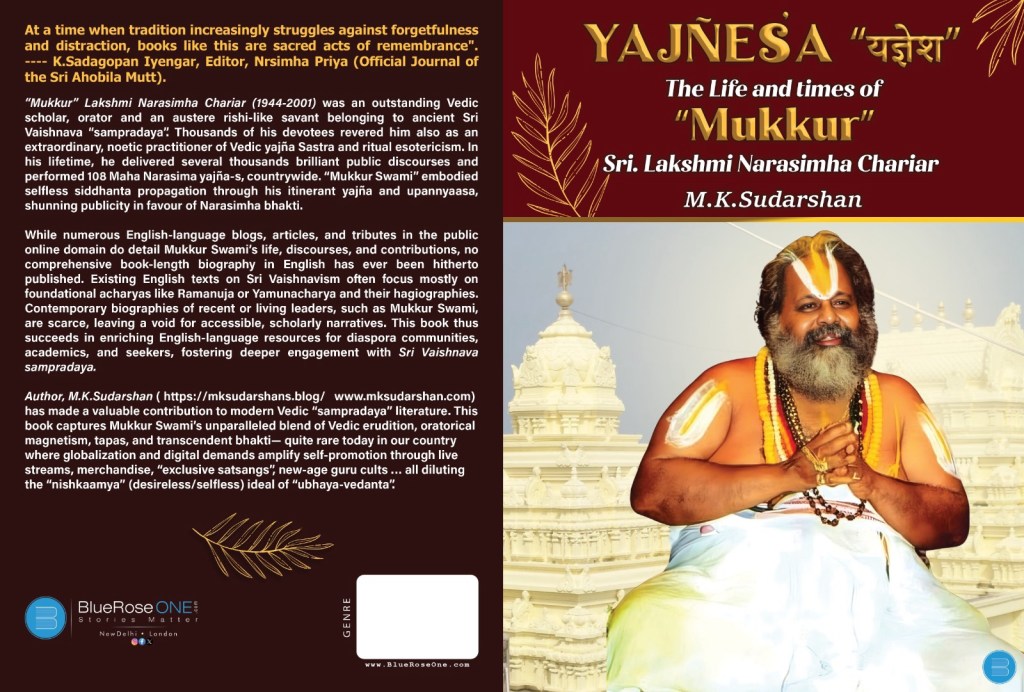
For two decades, devotees and admirers have preserved the memory of Mukkur Swami through Tamil tributes, reminiscences, articles, and personal recollections.
Yet the English-speaking world has had very little access to a comprehensive account of his life and work.
This book seeks to fill that important gap.
It brings together the story of an extraordinary Vedavith, yajna-karta, upanyasaka, and devotee of Sri Narasimha for readers across India and the global Hindu community.
A life remembered.
A legacy made accessible.
Please find the links below where you can easily place your order for the book :
BLUEROSE STORE: https://blueroseone.com/store/product/yajnesa-yajaniasha-the-life-and-times-of-mukkur-sri-lakshmi-narasimha-chariar
AMAZON: https://www.amazon.in/dp/9378259014
FLIPKART: https://www.flipkart.com/yajea-life-times-mukkur-sri-lakshmi-narasimha-chariar/p/itm8c07f6de73af5?pid=9789378259012
*वेदम् परम प्रमाणम् – Vedam Parama Pramaanam
This happened for real on the banks of the Godavari, in Rajahmundry. Adiyen is not telling a lie. This is a true incident.
There was a person named Jagannatha Ghanapaathi. He was a Salakshana Ghanapaathi. When he started chanting a mantra, it will be like ‘Kamsukandam‘, his voice would resonate like pure bronze..! It would sound as powerful as a hundred people chanting together. He would chant alone. Such was the sheer majesty of his recitation.
He was an examiner. A person came to him and asked, I have a desire to learn Ghanam from you. You must teach me. He agreed. He taught him and the student learned. He mastered almost every part flawlessly. Finally, a spot in the seventh Kaandam. That is…
“_Vrushaavaam vaam vrushaa vrushaavaagum retho thaaretho vaam …. thuth thadhaathu thadhaathu thskyo thskyo thadhaathu thuth thadhaa thutha thadhaathu thskyo oho… thskyo thuthu thskyo ghrutham ghruthagum thskyo thuthu thskyo ghrutham…_”
In this place, sounds like is, itthu, ikku are all densely intertwined. ‘_Thskyo thuthu thskyo ghrutham ghruthagum thskyo thuthu thskyo ghrutham_’
The student could not grasp this spot. He taught him for fifteen days. No matter how many times he said it, the student was saying something else instead of ‘Thskyo thuthu thskyo ghrutham ghruthagum thskyo thuthu thskyo...’ It just wouldn’t come. He saw this and said, I cannot teach you anymore. Please do not torture me further. You may leave..!
He burst into tears. He had chanted everything else perfectly. Why didn’t this one spot come? What sin did we commit in our past lives? He was very worried that this sound wasn’t grasped. What did he do, the teacher said it’s impossible anymore. He got up and was about to go inside. He used to come on a cycle daily. He started pushing the cycle to leave.
The Acharya who was going inside, that Jagannatha Ghanapaathi, called him.
Come here like this, he said. Is there full air in this cycle? There is, he said. Sit like this, he said. See that place where air is filled in the rear wheel, he opened that spot slightly. It went ‘_Sssss_’. You have to say it like this, he said. He let the air out like that twice. He got it…!! When the air was released, that resonance came out perfectly for ‘_Thskyo thuthu thskyo thskyo thuthu thskyo_’.
He got it immediately. He started chanting beautifully. He was so happy. Immediately he fell down again and again and did namaskaram to Jagannatha Ghanapaathi. Don’t do it to me, do it to the cycle..!!. I taught you and you didn’t get it. This insentient cycle taught you and you got it. Prostrate to the cycle, he said..!!
See, we humans think we can pronounce every sound. But insentient objects lower than us, bird species, all these speak much more distinctly than us. They pronounce sounds much more beautifully than us. When an insentient object, a sound coming from a cycle tire raises a Vedic dhwani, hearing that he understood. He didn’t get it when taught until now. This happened visibly like that.
Therefore, because Vedic pronunciation is very difficult, because pronouncing that sound is a state that requires a lot of hard work to earn, one must go to that Gurukula and struggle to learn it. ‘_*Aadau Vedaah Pramaanam. Akshara raasi grahanam.*_’
That is why when the Veda says ‘_Nathapanijanitha naattiya kanta moolatho bhaaga aabhyanthara samngnaka samvaaranatha alpapraana prayathna arthamaathrika paraangabhootha arka devathaaka braahmana jaathi akaara_’ – the Veda assigns a jaathi to every single aksharam here.
‘A’ and these are Brahmana jaathi. ‘Ja, Ksha’ are Kshatriya jaathi. The ‘Na’ varga are Vaishya jaathi. The ‘Tha’ varga are the Chaturtha varna, the fourth varna.
Thus, syllables appropriate to the four jaathis combine to form a padam. Many padams combine to form a vaakyam, many vaakyams combine to form a panchaasat, many panchaasats combine to form an anvaakam, many anvaakams combine to form a prasnam, many prasnams combine to form a kaandam, and many kaandams combine to complete a Samhitai..!!
If we look at the Veda aksharam by aksharam like this, some sounds must be chanted from the naabhi.
‘_Yattharathi tharathi yathyattharathi thatthaththarathi yathyattharathi thath_’
This must be chanted only from the naabhi. A person was saying ‘Yattharathi tharathi yat…’. If said like that there is no use. The sound ‘_Yattharathi tharathi yathyattharathi_’ comes from the naabhi. There is a dhwani sthaanam and karanam for it. Where that dhwani should be said from is all a determined matter. Therefore, it must be held and chanted from the naabhi.
Some sounds don’t need to be said from the naabhi. They come right from the kantam, that is, the throat. Some are like that, look at this:
‘_Chandramasayasi chandram chandramasi mama maasi chandram chandramasi mama asi mama mama aasyasi mama bhogaaya bhogaaya mama aasyasi mama bhogaaya bhogaaya mama mama bhogaaya bhava bhava bhogaaya mama mama bhogaaya bhava_’
This comes right from the kantam. It doesn’t need to be brought down to the naabhi. Some padams are like that.
Some come right from the mouth, called thaalu madhyam. Without going up to the kantam, from the mouth:
‘_Thaam vaava vaava thaam thaam vaava dhevaa dhevaa vaava thaam thaam vaava dhevaa dhevaa vaava vaava dhevaa_’
See, it comes right from here, it doesn’t go down.
Some sounds come right from the lips.
‘_The huve huve the the huve sava sava huve the the huve sava huve sava sava huve huve savaah mahagum sava huve huve savaham_’
It comes right from the lips.
Therefore, the sthaanam for Vedic chanting is from the naabhi to the lips. Therefore, if a person sits and chants the Veda…
‘_Thriyasthrigum shathvai devathaahaa_’
In his divine body, in his body from the naabhi to the lips, in those respective places, all thirty-three crore Devatas are seated. That is why ‘_Veda vidhyaa braahmanebhya: veda vidhye dhive dhive namaskuryaath_‘. We must daily bow down and worship those Veda-viths who chant the Veda. The Veda itself commands that we must fall down and worship the Mahans who carry it, telling us to see that and do it.
Therefore, the sthaanam is like that from the naabhi to the lips. It must be chanted like that. Some in these specific dhwanis:
‘_Idaa idopahoothae daa idaa_’ – It must be chanted like a goat bleating. It must be said like a goat bleating in that place.
‘_Hingaaraaya svaahaa hingk hi hi iheva keva hi hi_‘ – That means it must be said like a horse neighing.–!! ‘_Hi hi hee…_‘ means that sound must be said like the horse neighing.
‘_Thathkrouncha dhwani veethayaa sumangalaa_‘ If you strike a bell and let it be, how the reengaaram remains for some time, some sounds must be chanted like that.
Therefore, there is a kramam established for that Veda to say it exactly without changing that pronunciation.
*Such an immense wealth of the Veda, Aadau Vedaa Pramaanam. Such a Veda is the Parama Pramaanam*
(Reproduced in English translation by Mukkur Sri Srinivasachariar (MLS Swami, ‘Tiru Kumarar’ of Mukkur Sri Lakshminarasimhachariar).
Sudarshan Madabushi