
M.K.Sudarshan
November 13, 2026: Chennai, India
Abstract
The Philosopher’s Blind Spot asks why history’s most celebrated thinkers—Socrates, Plato, Aristotle, Marcus Aurelius, and the Upanishadic sages—could possess extraordinary intellectual insight while accepting, justifying, or failing to challenge profound human unfreedom.
The essay examines ancient slavery in Greece and Rome, the varied forms of bondage in ancient India, and the distinction between slavery and caste.
It argues that philosophical brilliance does not guarantee moral imagination: a thinker may reason brilliantly within the assumptions of their age while leaving slavery, caste, patriarchy, or imperial domination untouched.
The essay then turns the question toward the present: what hierarchies, sufferings, and excluded beings might modern philosophy be failing to recognize?
It suggests that industrial animal suffering, ecological destruction, global inequality, harm to future generations, and possibly the treatment of sentient digital minds may be among our own blind spots.
The central claim is that wisdom is not merely the ability to construct powerful arguments; it is the willingness to ask who has been left outside the circle of one’s moral concern.
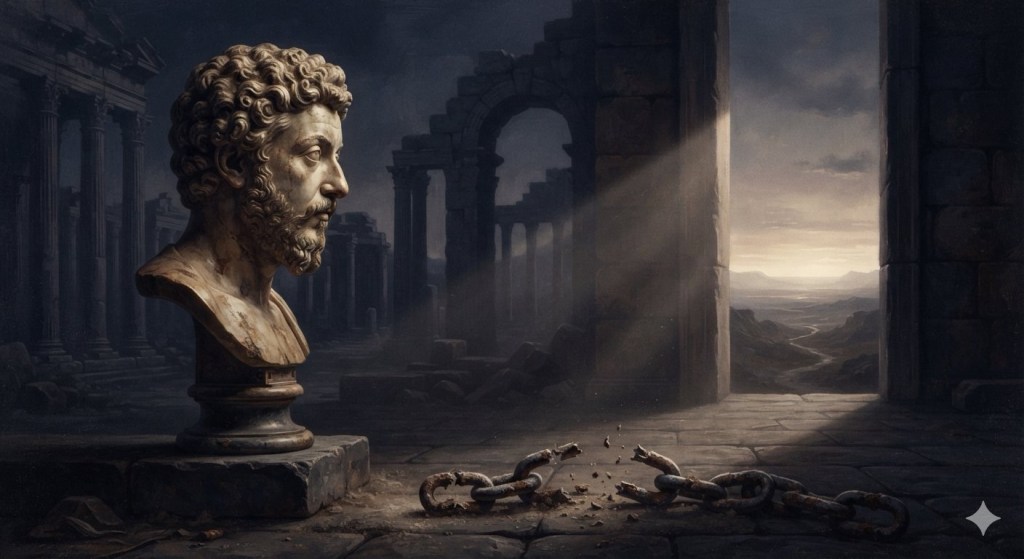
The greatest philosophers were not always morally wise in the fullest sense.
They could reason with extraordinary power about virtue, justice, the soul, and the good life, yet fail to see—or refuse to see—the humanity of people placed outside their social order. Slavery is the clearest example.
Socrates, Plato, Aristotle, and Marcus Aurelius lived in societies where slavery was ordinary; yet none mounted the sustained, public condemnation of the institution that their own moral principles might seem to demand.[1][2]
This is not a reason to dismiss philosophy. It is a reason to read philosophers critically. Their genius does not make them morally infallible, and their blindness can teach us as much as their insight.
The scale of the failure
In classical Athens, slavery was not a marginal institution. It was woven into households, agriculture, craft production, mining, and public life. At the time of Socrates, Plato, and Aristotle, many Athenian households owned at least one enslaved person.
Against that background, the silence of the great philosophers can feel startling. Socrates left no writings of his own, so we cannot know with certainty what he privately believed. But Plato, in the Republic, opposed the enslavement of fellow Greeks while leaving non-Greeks outside that protection. His moral concern was real, but it stopped at a boundary drawn by ethnicity and political belonging.
Aristotle went further. In Politics I, he argued that some people were “slaves by nature”: people who, he claimed, lacked the rational capacity to govern themselves and were therefore suited to be ruled by others. He described the natural slave as a human being who belonged to another, an “article of property” and an instrument for action.[3][4]
That was not mere silence. It was an intellectual defense of domination.
Aristotle’s dangerous logic
Aristotle’s argument is especially troubling because it is not careless. He recognizes that slavery raises a question of justice; he knows that some thinkers regard it as unnatural because it rests on force. But instead of accepting the implication, he tries to defeat the objection by dividing humanity into those fitted to rule and those fitted to be ruled.[1]
His reasoning turns human difference into a hierarchy. The slave is compared, in effect, to the body in relation to the soul, and even to animals in relation to human beings. The conclusion is that slavery can be “expedient and just” for those deemed naturally inferior.[4][5][3]
This is the philosopher’s blind spot in its sharpest form: a brilliant mind using its intelligence not to question an injustice, but to give it a respectable philosophical foundation.
Marcus Aurelius and Stoic limits
Marcus Aurelius presents a different kind of failure.
As a Stoic, he affirmed that human beings share reason and belong to a common human community. His Meditations repeatedly urges self-command, humility, and concern for the welfare of humanity.
Yet he did not turn that universalism into a public attack on slavery. His private reflections were not a political programme, so we should not expect a systematic abolitionist manifesto from them. But the absence remains morally significant: a philosophy that recognizes universal human kinship did not, in his hands, become a demand that the enslaved be freed.
Marcus did help some enslaved people obtain freedom through his legal decisions. That matters. But humane treatment and individual acts of emancipation are not the same as recognizing that no human being should ever be another person’s property.
The Indian comparison
It is tempting to contrast this with ancient India, where the epics, Puranas, and philosophical texts do not foreground a large-scale commercial slave trade in the manner of Greece or Rome. That observation has some truth. Ancient Indian society contained varied forms of servitude—war captivity, debt bondage, household service, purchase, and hereditary status—rather than one uniform, market-centered slave economy.
But it would be a mistake to conclude that India was free of unfreedom.
The Arthashastra regulates the sale, pledge, and redemption of enslaved people; the Manusmriti recognizes multiple categories of slaves; and the Mahabharata depicts enslavement as a catastrophic loss of freedom and dignity.
The Buddhist tradition adds another layer. The Buddha’s teaching against trade in living beings directly bears on the trafficking of human beings, while Buddhist texts also call for considerate treatment of slaves and workers. These are real ethical restrictions, though not equivalent to a full social programme for abolition.
Caste is not simply “Indian slavery,” and it should not be treated as such. Caste concerns inherited social rank, occupational restriction, ritual status, and group exclusion; slavery concerns the ownership and transfer of individual persons. The two systems could overlap, but they are not identical.
The Upanishadic tension
The Upanishads contain one of the world’s most powerful visions of spiritual equality: the inner self, ātman, is ultimately one with Brahman. This vision can challenge every external marker of rank, birth, and status.
Yet spiritual equality is not automatically social equality.
The Chandogya Upanishad contains the story of Satyakama Jabala, whose uncertain parentage does not prevent his acceptance as a student—an important affirmation that character can matter more than lineage. But the same text also treats good and bad births in hierarchical terms, associating Brahmin, Kshatriya, and Vaishya birth with good conduct and Chandala birth with evil conduct.
The Upanishads therefore contain both a universalizing spiritual vision and assumptions that can reinforce inherited hierarchy. Their moral insight was profound, but it did not consistently become a demand to dismantle caste-based social subordination.
The first clear voices
The history of anti-slavery thought is not simply a story of later modern enlightenment. Some ancient voices did see further.
The Greek sophist Alcidamas, in the late fifth or early fourth century BCE, preserved the striking claim: “God has left all people free; nature has made no one a slave.” It is a direct rejection of the idea that slavery is natural, and it predates Aristotle’s defence of natural slavery.
But Alcidamas’s statement survives only as a fragment from a political speech. It may express a principle of natural freedom without amounting to a developed programme for abolishing slavery everywhere.
The strongest surviving ancient condemnation belongs to Gregory of Nyssa, a fourth-century Christian bishop. In his fourth homily on Ecclesiastes, Gregory argues that human beings, made in God’s image and endowed with freedom, cannot rightly be owned, bought, or sold. Slavery, for him, is not merely a misuse of power; it is a sinful usurpation of God’s authority over human beings.[6]
Scholars describe Gregory’s homily as uniquely fierce and unequivocal among surviving ancient texts. He condemns slavery not merely as abused or excessive, but as intrinsically sinful and incompatible with the Gospel.[2][7]
The modern mirror
The question this history forces upon us is not only, “What did past philosophers fail to see?” It is also, “What are we failing to see now?” The likely answer is that our blind spots will not be the ones future people find obvious only because they are unfamiliar to us; they will be the ones built into our ordinary institutions, comforts, and assumptions.[8][9]
A moral blind spot is a limitation that prevents individuals or societies from recognizing flaws in their own moral judgments and practices. The historical pattern is consistent: people rarely see themselves as cruel; they see themselves as reasonable within the categories their society has made normal.[8]
Aristotle did not think he was defending arbitrary cruelty; he believed he was describing a natural hierarchy. Marcus Aurelius did not think Stoic universalism required him to dismantle Roman slavery. Likewise, modern philosophers may be reasoning carefully within assumptions that future generations will regard as morally inadequate.[9][3]
Our own blind spots
Several modern blind spots seem especially likely.
Industrial animal suffering may be the most immediate. The routine confinement, breeding, transport, and slaughter of billions of sentient animals for food may one day appear as morally unintelligible as slavery appears to us today. The issue is not whether animals possess human rights; it is whether their capacity to suffer gives them a claim that our convenience cannot simply override.[10][8]
Ecological destruction may be another. We are damaging ecosystems, extinguishing species, destabilizing the climate, and consuming resources in ways that will constrain the lives of people not yet born. Future generations may see this not as an unfortunate side effect of progress, but as a systematic transfer of costs from the powerful present to the powerless future.[11]
Global inequality may reveal a third failure. Extreme poverty, preventable disease, and early death persist alongside extraordinary affluence. A moral philosophy that can explain why a person in another country matters less because they are distant may one day look as morally cramped as Aristotle’s distinction between citizen and slave.[10]
The treatment of future generations may be the deepest blind spot of all. We routinely discount the interests of people who cannot vote, bargain, protest, or even exist yet. But moral status should not depend on proximity in time any more than it should depend on proximity in space.[11]
A further possibility is digital minds. If future artificial systems possess—or may possess—sentience, consciousness, or interests, our treatment of them as tools, property, or experimental objects may come to look like another case of moral status denied because a being does not fit familiar categories.[9]
The deepest failure
The deepest moral failure may not be cruelty itself. It is the ability to normalize cruelty once it is organized into institutions, markets, laws, and routines.
Slavery became acceptable when it was embedded in war, property law, and economic necessity. Caste became acceptable when it was embedded in ritual, kinship, and social order. Industrial animal farming, ecological destruction, and global inequality may become acceptable for similar reasons: they are dispersed, legally sanctioned, economically useful, and psychologically distant.[8][9]
The modern philosopher’s danger is therefore not ignorance of logic. It is the temptation to treat a morally convenient arrangement as inevitable.
What moral sense may be missing
Several capacities seem to be missing in every era:
- Moral imagination: the ability to see the inner life of beings unlike oneself.
- Temporal imagination: the ability to take seriously people who do not yet exist.
- Spatial imagination: the ability to feel the reality of suffering beyond one’s own society.
- Institutional imagination: the ability to see how ordinary systems produce extraordinary harm.
- Epistemic humility: the willingness to admit that one’s own moral certainties may be the next generation’s blind spots.[9]
The uncomfortable possibility
Future generations may judge us not mainly for lacking compassion, but for possessing compassion in a narrow, selective form. We may care intensely about those close to us, while treating animals, distant strangers, future people, and possible artificial minds as outside the circle of serious moral concern.[9]
That would make us not so different from the philosophers we criticize. Their failure was not that they lacked intelligence; it was that their moral imagination stopped at the boundary their society had drawn. Ours may stop at the boundary drawn by species, nationality, wealth, time, or substrate.[9]
The necessary discipline
The discipline required is not merely to adopt fashionable causes. It is to cultivate a habit of asking, whenever an institution feels natural or necessary:
- Who benefits from this arrangement?
- Who bears its costs?
- Whose suffering is being made invisible?
- Which beings or generations have no voice in the decision?
- What would this practice look like if its victims could speak?
That is the question the ancient philosophers often failed to ask. It is also the question our descendants may one day ask of us.[8][9]
What the blind spot teaches
The lesson is not that Socrates, Plato, Aristotle, Marcus Aurelius, or the Upanishadic sages were worthless. It is that their wisdom was partial.
They could see deeply into human nature, yet fail to extend that insight to those excluded from their social world. They could speak of justice, yet leave slavery, caste, gender hierarchy, or imperial domination untouched. They could praise virtue, yet accept institutions that denied basic freedom to others.
This is the philosopher’s blind spot: the ability to reason brilliantly without seeing the full moral consequences of one’s assumptions.
A necessary humility
We should not congratulate ourselves too quickly.
Every age has its own accepted hierarchies, its own invisible exclusions, and its own injustices that future generations may find impossible to understand.
The proper response to the great philosophers is neither uncritical reverence nor dismissive contempt. It is critical gratitude: receive what is true and humane in their thought, while refusing to let their prestige silence the moral questions they failed to ask.
The measure of wisdom is not only the ability to construct a beautiful argument. It is the willingness to ask: Who has been left outside the circle of my concern—and why?
(Concluded)
Sources
[1] Ancient Political Philosophy https://plato.stanford.edu/archives/Win2023/entries/ancient-political/
[2] The ‘Whole Humanity’: Gregory of Nyssa’s Critique of Slavery … https://www.cambridge.org/core/journals/scottish-journal-of-theology/article/abs/whole-humanity-gregory-of-nyssas-critique-of-slavery-in-light-of-his-eschatology/529FB6E4046BDA4BBC9D0F5154115720
[3] 24.01S16 Three Philosophers on Slavery https://mitocw.ups.edu.ec/courses/linguistics-and-philosophy/24-01-classics-of-western-philosophy-spring-2016/lecture-notes/MIT24_01S16_SES23.pdf
[4] Did Stoicism Condemn Slavery? – Donald J. Robertson https://donaldrobertson.name/2017/11/05/did-stoicism-condemn-slavery/
[5] Aristotle, Politics, Book 1 https://www.perseus.tufts.edu/hopper/text?doc=Perseus:text:1999.01.0058:book=1
[6] Aristotle, Politics (350 BCE) – House Divided – Dickinson College https://housedivided.dickinson.edu/sites/teagle/texts/aristotle-politics-350-bce/
[7] Animalizing the Slave: the Truth of Fiction* | The Journal of … https://www.cambridge.org/core/journals/journal-of-roman-studies/article/abs/animalizing-the-slave-the-truth-of-fiction/BF1848E76276723DA302F5734CED5F43
[8] Marcus Aurelius https://plato.stanford.edu/archives/FALL2017/Entries/marcus-aurelius/index.html
[9] Slavery and Post Slavery in the Indian Ocean World https://hal.science/hal-02556369/document
[10] Labour and Bondage in Andhra Pradesh | Olsen/Murthy https://www.yorku.ca/jspot/2/wkolsenrvramana.htm
[11] http://www.wisdomlib.org › hinduism › bookManusmriti Verse 8.415 – Wisdom Library https://www.wisdomlib.org/hinduism/book/manusmriti-with-the-commentary-of-medhatithi/d/doc201350.html&lang=en
[12] http://www.wisdomlib.org · hinduism · bookChapter 13 – Rules regarding Slaves and Labourers https://www.wisdomlib.org/hinduism/book/kautilya-arthashastra/d/doc366096.html
[13] B.A._H__Eng_Sem-I_Paper-1_Unit-1 https://uod.ac.in/uploads/new-web/04012023_Appendix-100.pdf
[14] AN 5.177: Vaṇijjāsutta—Bhikkhu Sujato – SuttaCentral https://suttacentral.net/an5.177/en/sujato?lang=en&layout=plain&reference=none¬es=asterisk&highlight=false&script=latin
[15] Early Buddhism, Slaves, Outcasts, and the Lowest Social Classes https://www.academia.edu/43285945/Early_Buddhism_Slaves_Outcasts_and_the_Lowest_Social_Classes
[16] Slavery in South Asia https://link.springer.com/chapter/10.1007/978-3-031-13260-5_29
[17] Chapter 2 The Hindu Social Order—Its Eseential Principles – Page 120 https://baws.in/books/baws/EN/Volume_03/pdf/120
[18] Renaming Caste, Retaining Privilege https://www.theindiaforum.in/caste/renaming-caste-retaining-privilege
[19] The Vedas don’t seem to support the Caste system at all, so where exactly does it come from? https://www.reddit.com/r/hinduism/comments/s79l3x/the_vedas_dont_seem_to_support_the_caste_system/
[20] chandogya-upanishad https://mouseia.org/api/works/chandogya-upanishad
[21] Chāndogya Upaniṣad 5.10.7 – Brhat https://www.brhat.in/openlibrary/special/chandogya-upanishad/5-10-7
[22] Alcidamas – Early Greek Political Thought from Homer to … https://www.cambridge.org/core/books/abs/early-greek-political-thought-from-homer-to-the-sophists/alcidamas/516DEF685CB842EA3A854099015CF3D7
[23] Alcidamas – Wikipedia https://en.wikipedia.org/wiki/Alcidamas
[24] The Cappadocian fathers on slave management https://scielo.org.za/scielo.php?script=sci_arttext&pid=S1017-04992013000100017
[25] Likeness and Difference in Gregory of Nyssa’s Social Ethics https://www.cambridge.org/core/services/aop-cambridge-core/content/view/90D1D13CE71F87526908098BE1B648A4/S002842892400012Xa.pdf/mirrors_of_death_images_of_god_likeness_and_difference_in_gregory_of_nyssas_social_ethics.pdf
[26] Scottish Journal of Theology: Volume 54 – Issue 1 | Cambridge Core https://www.cambridge.org/core/journals/scottish-journal-of-theology/issue/E54AA40B6C6AC58E7D614233A308F8FF
[27] Moral Blind Spots | Issue 128 https://philosophynow.org/issues/128/Moral_Blind_Spots
[28] Moral Circle Explosion – Jeff Sebo https://jeffsebo.net/wp-content/uploads/2022/09/jeff-sebo-moral-circle-explosion.pdf
[29] Beyond the Expanding Circle: Towards a Pluralist Account of Moral Progress – Ethical Theory and Moral Practice http://www.link.springer.com/article/10.1007/s10677-026-10576-6
[30] Angling for equality of consideration – Times Higher Education (THE) https://www.timeshighereducation.com/features/angling-for-equality-of-consideration/101823.article
[31] Definition, Examples, Fields, Applied vs. Normative Ethics … https://www.britannica.com/topic/applied-ethics
[32] On blinding future generations: a neglected site of environmental injustice https://research-portal.st-andrews.ac.uk/en/publications/on-blinding-future-generations-a-neglected-site-of-environmental-/
[33] What we owe each other: Intergenerational and … https://ethics.org.au/what-we-owe-each-other-intergenerational-and-intertemporal-justice/
[34] A Philosophical Perspective on Intergenerational Justice https://link.springer.com/chapter/10.1007/978-3-032-03345-1_3
[35] Our Perspective – Sentience Institute https://www.sentienceinstitute.org/perspective