M.K.Sudarshan
November 18, 2026: Chennai, India
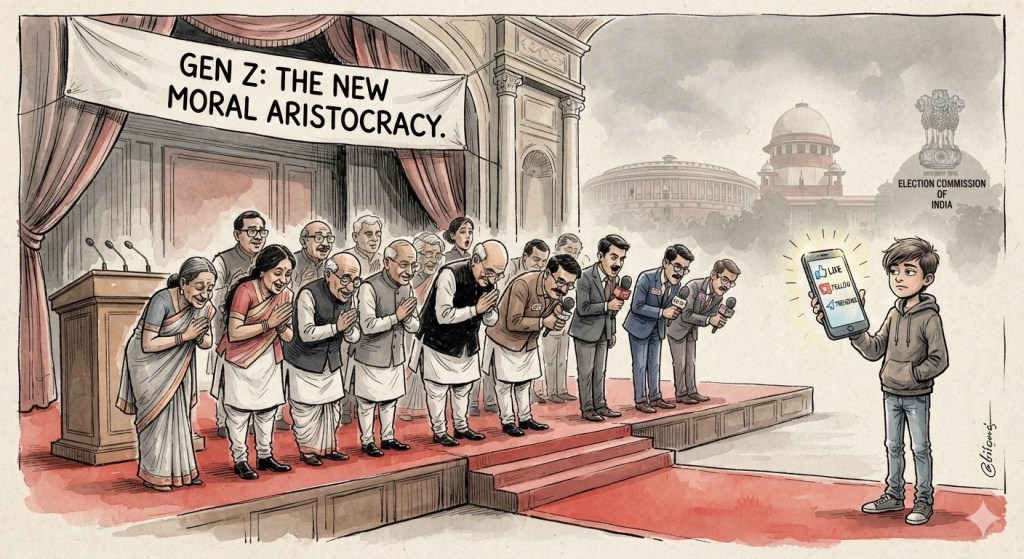
Youthful idealism deserves a hearing—but not political worship, moral exemption, or the power to dictate to democratic institutions.
India’s political class has discovered a new object of devotion: Gen Z. Ministers, Opposition leaders, celebrities, editors and television anchors now compete to praise the “energy,” “idealism” and “digital courage” of the young. Some of this is welcome. Much of it is flattery. And a portion of it risks becoming something more troubling: the conversion of legitimate youth grievances into a politics of street pressure, moral blackmail and institutional intimidation.
The question is not whether young Indians have the right to protest. They do. The question is whether political parties, media commentators and protest entrepreneurs are helping young citizens use that right responsibly—or teaching them that democratic institutions may be bullied into submission by the loudest crowd.
A real grievance, not a manufactured one
The present unrest did not arise from nothing. The immediate trigger was anger over examination failures, including the alleged leak of the NEET-UG question paper, and demands for accountability from those responsible for a system on which millions of young Indians stake their futures. The protests were largely peaceful, and their early demands centred on examination reform, transparency and ministerial accountability.[1]
These are not frivolous demands. A young person who prepares for years, faces fierce competition, and then finds the examination system compromised has every reason to be angry. Nor is it illegitimate to ask whether public institutions are responsive, credible and fair.
But a genuine grievance does not automatically validate every demand made in its name. Nor does it justify converting a policy failure into a claim that an entire generation has been uniquely oppressed, disenfranchised, or entitled to a new category of “fundamental rights.”
From accountability to ultimatum
The Cockroach Janta Party began with a focused demand: accountability for examination failures and the resignation of the then education minister. That demand was met. But the movement then widened into demands for the resignation of the Chief Election Commissioner, criminal proceedings against him, a halt to electoral-revision processes, and broader changes to the electoral framework.
Here lies the problem. Citizens may certainly demand that a minister resign; ministers serve at the pleasure of political accountability. But the Chief Election Commissioner occupies a constitutionally protected office. Under Article 324 of the Constitution, the CEC can be removed only in the same manner, and on the same grounds, as a Supreme Court judge—through a parliamentary process involving specified majorities, an inquiry, and ultimately a presidential order.[2]
A 48-hour ultimatum followed by the threat of nationwide agitation may be effective politics. It is not constitutional politics. If allegations of misconduct are serious, they should be investigated and adjudicated through lawful channels. If they are not, no amount of street mobilisation should be allowed to decide the matter.
The difference between protest and coercion
Peaceful protest is not anarchy. Article 19 of the Constitution protects freedom of speech and the right to assemble peaceably and without arms. But those rights are subject to reasonable restrictions in the interests of public order, and any restriction must be lawful, necessary and proportionate.[3]
The distinction is straightforward:
- Citizens may assemble, argue, petition, litigate, campaign and vote.
- They may criticise ministers, judges, election commissioners and prime ministers.
- They may not use violence, intimidate fellow citizens, damage property, obstruct ordinary life, or seek to force constitutional authorities to resign through mob pressure.
- They may not treat every police restriction as fascism, nor every judicial refusal as betrayal.
A democracy needs protest. It also needs limits. When protest becomes a veto over institutions, it ceases to be democratic participation and becomes coercive politics.
The parties’ convenient embrace
The INDIA alliance has been quick to embrace the youth movement. Congress and allied parties have joined protests, mobilised cadres, endorsed demands for the CEC’s resignation, and presented the agitation as the voice of India’s youth, women, farmers and workers.
There is nothing inherently improper in parties responding to public anger. That is what opposition politics is for. But there is a difference between supporting a citizen’s right to peaceful protest and lending legitimacy to ultimatums, abusive rhetoric, or pressure on constitutional institutions.
When established parties applaud every escalation, they encourage a dangerous lesson: that moral indignation can substitute for evidence, and that street theatre can substitute for parliamentary argument. That is not empowerment. It is a recipe for a politics in which every grievance becomes a siege and every institution becomes a target.
The media’s role
The media has not been an innocent bystander. Some commentators have framed the protests in grand terms: youth liberation, resistance to authoritarianism, a democratic awakening. Such language may be emotionally satisfying, but it can obscure the harder questions: What exactly is being demanded? By whom? Through what constitutional means? And at what cost to citizens who are not part of the protest?
At the same time, it would be equally wrong to dismiss all youth dissent as orchestrated anarchy. The protests began with real concerns, and many participants were peaceful. A mature media should report both facts: the legitimacy of some grievances, and the danger of some methods.
The media’s duty is not to choose between flattering the young and defending power. It is to insist on evidence, proportion and constitutional limits.
What Rajaji and Sastri would ask
Srinivasa Sastri and C. Rajagopalachari were not enemies of freedom. They were men who understood, from the independence struggle, that agitation can be necessary when ordinary constitutional channels are closed. But they also understood that the habits of struggle can become dangerous in a free republic.
Rajaji himself acknowledged that the non-cooperation movement had left less desirable legacies, including habits of disregarding law and authority. His warning after Independence was that discipline could no longer rest on fear; it had to rest on voluntary acceptance of democratic norms.
Their likely question today would not be, “Why are young people angry?” It would be, “What are you asking for, and through what means?” A demand for examination reform is democratic. A demand that constitutional officers resign because a crowd has gathered is not.
A better politics for youth
India does not need Gen Z worship. It needs intergenerational seriousness.
Elders should listen to young people on employment, education, examinations, housing, mobility, digital life and public integrity. Young people should also recognise that governance is difficult, that institutions exist precisely to prevent power from becoming the property of the loudest group, and that democratic victories achieved through coercion are often short-lived.
Political parties should compete for youth votes through credible policies: better schools, credible examinations, job creation, administrative reform, transparent elections and accountable institutions. They should not compete to see who can praise youth outrage most loudly.
The real test
The real test of this moment is not whether Gen Z can mobilise. It plainly can. The test is whether India’s political class can channel that energy into constitutional politics rather than mob politics.
A government with a popular mandate must still be accountable. An Opposition has a duty to challenge power. Citizens have a right to protest. But none of these truths cancels the others.
India will remain a democracy not because its streets are always full, but because its institutions remain strong enough to hear dissent without surrendering to it—and because its citizens, young and old alike, are mature enough to demand justice without mistaking coercion for freedom.
The future of Indian democracy will not be decided by who can shout loudest, march furthest, or trend fastest. It will be decided by whether we can still distinguish the right to be heard from the power to dictate.
(Concluded)
Sources:
[1] Student Protests in Delhi and India 2026: Gen-Z’s Frustration and Fight for Reforms – PRIF BLOG https://blog.prif.org/2026/08/05/student-protests-in-delhi-and-india-2026-gen-zs-frustration-and-fight-for-reforms/
[2] CEC Impeachment Process Explained: How Can India Remove an … https://indianexpress.com/article/explained/explained-law/cec-impeachment-process-removal-election-commissioner-explained-10944874/
[3] Delhi protest restrictions: Can police stop peaceful protests … https://indianexpress.com/article/explained/explained-law/delhi-protest-restrictions-supreme-court-rights-10917775/
[4] Meeting of CJP, Union ministers underway after Dharmendra Pradhan’s resignation – The Economic Times http://economictimes.indiatimes.com/news/politics-and-nation/meeting-of-cjp-union-ministers-underway-after-dharmendra-pradhans-resignation/printarticle/132624617.cms
[5] March fest in October: Opposition & ‘cockroaches’ to hit streets over EC row, Gyanesh Kumar’s resignation – The Economic Times http://www.economictimes.indiatimes.com/news/politics-and-nation/protests-escalate-opposition-and-cockroach-janta-party-to-challenge-election-commission-over-gyanesh-kumars-resignation-sir/printarticle/134611750.cms
[6] Why India’s Cockroach movement wants the election chief … https://www.dw.com/en/india-cockroach-movement-targets-election-chief-over-voter-roll-dispute/a-79462036
[7] CJP, student groups unite against CEC Gyanesh Kumar, call for nationwide mobilisation https://www.economictimes.indiatimes.com/news/politics-and-nation/cjp-student-groups-unite-against-cec-gyanesh-kumar-call-for-nationwide-mobilisation/articleshow/134761869.cms
[8] Can the Chief Election Commissioner be removed? What the law says https://www.theweek.in/news/india/2026/10/28/can-the-chief-election-commissioner-be-removed-what-the-law-says.html
[9] The Chief Election Commissioner and Other Election Commissioners … https://prsindia.org/billtrack/the-chief-election-commissioner-and-other-election-commissioners-appointment-conditions-of-service-and-term-of-office-bill-2023
[10] Peaceful Protest And Public Order https://www.livelaw.in/articles/peaceful-protest-public-order-554688
[11] India’s opposition parties stage new protest against … https://apnews.com/article/india-opposition-protests-voters-elections-cockroach-party-cb532b4811eea64c51f61cd4199fb64e
[12] Angry youth | The rage of Gen Z https://www.indiatoday.in/amp/magazine/cover-story/story/20260803-angry-youth-the-rage-of-gen-z-cjp-protests-jantar-mantar-protests-2955213-2026-07-25
[13] CJP, or Cockroach Janta Party, calls for protests against … https://www.bbc.com/news/articles/ck62mped4rz9o
[14] Rahul Gandhi: India’s opposition rallies against voter roll revision exercise https://www.bbc.com/news/articles/c60qk92dvlwgo
[15] Ashok Swain on the Mounting Opposition to Modi’s Authoritarian Rule https://thediplomat.com/2026/11/ashok-swain-on-the-mounting-opposition-to-modis-authoritarian-rule/
[16] researchonline.lse.ac.uk › id › eprintIndia’s Gen Z are making accountability a condition of … https://researchonline.lse.ac.uk/id/eprint/141112/1/inequalities_2026_8_26_india-gen-z-protests-citizenship-accountability.pdf
[17] Full text of “Speeches Of C. Rajagopalachari (jan1948-jan1950)” https://archive.org/stream/in.ernet.dli.2015.206564/2015.206564.Speeches-Of_djvu.txt