M.K.Sudarshan
November 20, 2026: Chennai, India
In a striking demographic twist, India today is home to more English speakers than the entire population of England. According to the 2011 Census, over 129 million Indians—roughly 10.6 percent of the population, a figure that contemporary estimates place closer to 250 million—speak English as a first, second, or third language. That single statistic makes English the second-most widely spoken language in the country, trailing only Hindi and outnumbering every single regional tongue from Bengali and Marathi to Telugu and Tamil.
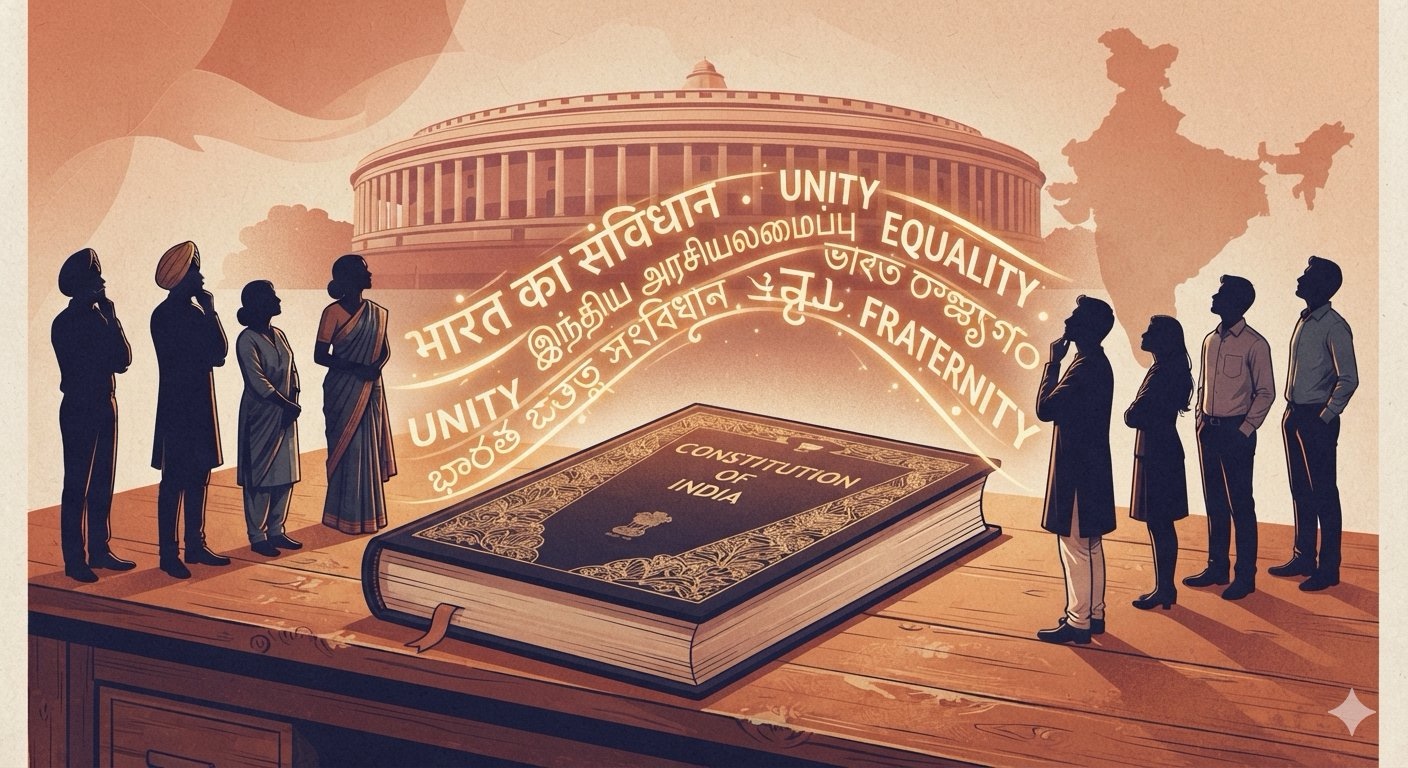
Yet, in the grand architecture of the Indian Constitution, English occupies a bizarre twilight zone. It is everywhere in practice, yet treated as an outsider in principle.
By virtue of Article 343 and the Official Languages Act of 1963, English is the Associate Official Language of the Union. It is the sole official language of states like Nagaland and Meghalaya. It is the language of the Supreme Court, the High Courts, higher education, scientific research, and the corporate engine that powers India’s global rise. And yet, when one turns to the Eighth Schedule of the Constitution—the solemn list of India’s recognized languages—English is conspicuous by its absence.
English, a so-called “elitist language”, thus, is an Eighth Schedule pariah.
This exclusion exposes a deep, unresolved paradox at the heart of Indian democracy: a language that serves as the indispensable federal bridge for hundreds of millions of citizens is routinely stigmatized in political rhetoric as an elitist, colonial relic that must be uprooted in the name of national pride.
To understand this contradiction, one must look at the competing arguments that shape India’s linguistic politics. On one side stands the argument for decolonization and linguistic equity. Proponents of this view—most visibly within the current political establishment—contend that because nearly 85 to 90 percent of Indians do not speak English fluently, conducting governance, higher education, and judicial proceedings primarily in English creates a form of linguistic apartheid. To them, English is not a victim of discrimination; it is the ultimate gatekeeper of elite privilege. From this vantage point, the Eighth Schedule was conceived to nurture and protect indigenous heritage languages, not to shelter the world’s most dominant global tongue, which requires no state life support to survive.
On the other side, however, lies a sobering federal and democratic reality. For millions of citizens, particularly across southern and northeastern India, English is neither a colonial badge nor an instrument of elitism—it is an essential shield against majoritarian linguistic hegemony. When political leaders attack English-speaking Indians as culturally unmoored or urge citizens to feel ashamed of speaking the language, they are not dismantling elitism; they are alienating a vast, productive Indian demographic and undermining the very bridge that holds a diverse federation together.
Worse still, the Eighth Schedule’s gatekeeping does not stop at English. More than three dozen indigenous languages and dialects—including Bhojpuri, spoken by over 50 million people, Rajasthani, spoken by nearly 26 million, alongside Tulu, Gondi, and Garhwali—have languished for decades in constitutional limbo.
When pressed on why these languages remain excluded, the state often falls back on bureaucratic excuses: the absence of objective criteria, or the administrative and financial burden on the Treasury to translate parliamentary debates and conduct civil service exams in dozens of additional tongues. In an era where India leads the world in digital public infrastructure and artificial intelligence translation initiatives like Bhashini, pleading financial or logistical helplessness is a remarkably flimsy justification for linguistic exclusion.
The real barrier is not the Treasury; it is political convenience. Recognizing Bhojpuri or Rajasthani threatens to carve tens of millions of speakers out of the Census’s “Hindi” umbrella, diluting the statistical dominance of the country’s largest language. Meanwhile, keeping English out of the Eighth Schedule allows politicians to score easy ideological points against “colonialism” while quietly relying on English to run the courts, draft laws, and educate their own children.
There is an innate hypocrisy in this arrangement. Inclusivity is a political virtue to which every party in India pays enthusiastic lip service, yet our constitutional framework continues to treat both homegrown dialects and our largest link language as second-class citizens.
International precedents—from South Africa and Zimbabwe to New Zealand, Kenya, and the Philippines—demonstrate that young democracies can constitutionally recognize English alongside indigenous languages without surrendering their cultural soul. India does not need to choose between its heritage and its modernity.
A pragmatic, forward-looking constitutional reform could easily end this stalemate. Rather than an expensive, all-or-nothing bureaucratic model, India can adopt a tiered framework for the Eighth Schedule: granting immediate, dignified constitutional recognition and cultural patronage to every qualifying indigenous language, while deploying modern AI translation and on-demand thresholds for administrative and parliamentary services.
At the same time, formally inducting English into the Eighth Schedule would consummate a marriage that history and geography have already solemnized—acknowledging that English, as spoken, written, and enriched by over 129 million citizens, is no longer the property of a former colonizer. It is an Indian language.
True national pride does not require manufacturing enemies out of the tongues our citizens speak. A confident republic embraces all its voices—whether born in the villages of Bihar and Karnataka or forged in the classrooms and courts of modern India.
(Concluded)