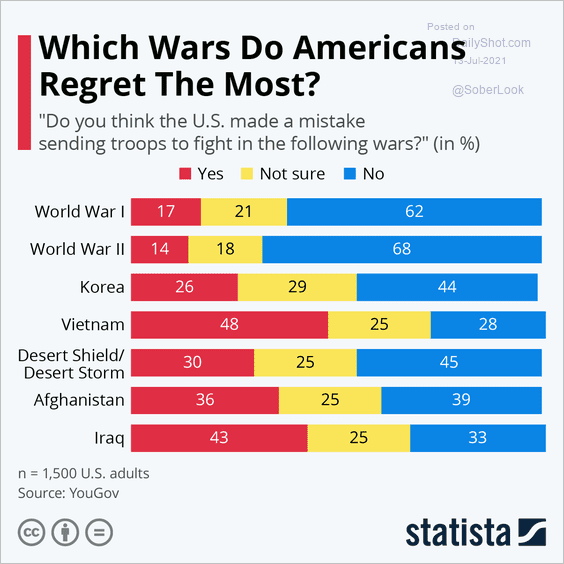
This is such a revealing and insightful chart indeed!
America, make no mistake about it, has had a hand in either instigating, leading or orchestrating almost all wars fought in the world in both the 20th and 21st century so far … And given so many of the present potentially tinderbox-hotspots of geopolitical tension that exist between China and Russia, each with America (in Europe and the South China Sea and Indian Ocean), future wars in the 21st century too are certainly going to see America embroiled and deeply entangled in them.
Already, non-military wars between America and its two formidable enemies, as we know, are being relentlessly waged today — as bitter “trade and currency wars”, “cyber-space and outer-space wars”, “culture and propaganda wars”. So, I have no doubt in my mind at all that, given the trajectory of where relations and affairs are slowly heading between these three super-powers inter alia, it’s only a question of time before a proper military war breaks out at some point in future that engages all three of them in this century.
From the Chart above, one gets quite a few interesting insights indeed:
1. The battlegrounds of all wars fought by America were all located overseas … i.e. in the Asian-European hemisphere of our planet… none of them in the American corner of the world (excepting of course the minor and sporadic ones in just a few Latin and South American theatres). The scars of most wars that America fought are thus even today to be seen only in the rest of the world … not in America.
2. All the wars which America waded into were impelled by two simple and clear objectives : gain of territory or dominance over territory .
3. The objective of “gain of territory” or “dominance over territory” was however in all cases effectively camouflaged or garbed by America as being virtuous and titanic ideological battles against “evil” empires or regimes. The definition of Evil, of course, was always a purely American one… and that definition became in good time the very sum and substance of what America began proudly claiming was “American Exceptional-ism”.
4. America’s destruction of enemy territory in the wars in all cases crippled the economy of the defeated country. And the job of “Reconstruction” and “nation building” in the immediate aftermath of war, America made it known to the world, was its “exceptional” moral duty as a world power.
5. America’s “exceptional-ism” it was that then inspired its pious motives to always step forward and volunteer to administer a “helping hand and healing touch” upon the broken defeated country in its struggles to restore its broken economy and society. And to do precisely that, America proselytised its so-called “American way of life” and encouraged the defeated country to embrace the ideals of “life, liberty and the pursuit of happiness”.
5.2. For America Reconstruction meant, in reality, worldwide control and dominance over levers of economic, financial and cultural (“soft”) power encompassing and institutionalising cross-continental Markets through an overarching multinational and multilateral architecture of an imperium of governance functioning from out of Washington DC. The blueprint for such a grand architecture was what was conceived, laid and rolled out as the famous Breton Woods System of 1944, the Supreme Command of Allied Powers (SCAP) of 1945 and then through the Marshall Plan of 1948 …. through which America came to exercise global dominance over most of the world’s trade and commercial markets, capital and financial markets (multilateral, multinational development and commercial banking systems and networks) and, of course, the largest marketplace of all : the marketplace of ideas, dreams and aspirations of global populations at large.
5.3. Dominating the “marketplace of ideas” meant America wielding global influence through the strategy of Acculturation. It is a very profound and powerful weapon more difficult to develop then military hardware or arsenal. To explain it in the most simplistic yet not entirely inaccurate terms, acculturation refers to an effective “carpet-bombing strategy” of “capturing the hearts and minds” of the peoples in the defeated countries with “soft-power” arsenal such as Coco-Cola, MacDonald fast-food, Hollywood box-office “smash-hits”, faded Levi blue-jeans, the jingle-jangle medley of “hard-rock”, jazz, blue and country music and then, last but not the least, “fast and furious” Ford Mustangs and Chevys.
5.1 It must be noted that “acculturation” means essentially the transfer of values and customs from one nation to another… i.e. from the victor to the defeated nation resulting in the modification of the culture of the latter as a result of deep, subliminally subservient cultural contacts with the former. There are four different and insidious “acculturation strategies” that America skilfully employs to gradually infiltrate and enslave the “hearts and minds” of the people that it defeats in military wars as mentioned in the Chart above viz.: assimilation, separation, integration, and marginalisation.
Given all the above insights that even someone like me, a very ordinary spectator and mere bystander, with only limited knowledge and understanding of the history of American engagements in the modern world-history of Wars, is able to glean from the above Chart, I do wonder what probably could be the range, depth and relevance of criteria and considerations upon which the 1500 All-American sample-group of enlightened citizens who were randomly surveyed did actually base their answers in the category of “YES”, NOT SURE” or “NO”.
What exactly did they have in mind when they chose to say that they either regret or don’t , or else are unsure, whether they should or not be regretful of America’s great wars abroad listed above? I wish I knew so that I could better understand how the collective mind of America — the most belligerent society and warlike nation on earth today — truly looks within itself its soul, how that mind works and why…
Now, letting all the above as it may, what I found so very strange and so very monumentally and singularly ironic about the above Chart is that while it does provide insight into America’s several wars, it is absolutely silent on one great unasked question … and whether deliberately or not, I cannot guess, it does seem to conceal, ignore and forget! That one question is this:
“Does America regret the mother of all Wars it has fought since?
I mean the War it fought for well over a 100-odd years all over the vast expanses of the magnificently virgin, continental land upon which the Pilgrim Fathers stepped on the soil they at once called the “New World”, and the one they discovered looking out from on board their the ship, the Mayflower, on which they had set sail from the shores of Europe as desperate, fleeing immigrants.
Does America even remember … let alone regret … the wars it fought against the native Indians of the land it went about conquering ?
Does America regret the mass-slaughter of a large part of the whole race of the brave, aboriginal people of America?
How many of the 1500 Americans who were surveyed, and whose classified responses are charted vividly in the info-graph above , know that today only some 2 million “American Indians” inhabit the United States, less than 1% of the nation’s population?
How many of the respondents probably knew that the origins of the native aboriginal Indians in America have always been viewed by all Americans only through the narrow prism of no more than a 500-year perspective i.e. from the point of view of the Europeans who “discovered” the New World? And yet that the true story of American Indians begins some 17,000 years ago?!
Americans today cannot be expected to give any sort of informed or meaningful responses to either express “regret”, or the lack of it, over a War that has long been forgotten. Therefore, it does not and should not, in fact, matter that the memory of that war has been all but extinguished from the collective consciousness of ordinary Americans. After all, the native aboriginals themselves have been so very properly and thoroughly “acculturated” by America today, haven’t they? So wheres is the need to express “regret” for a people that America has, over two centuries, already successfully rendered duly “separated, assimilated, integrated or marginalised”?
Of all the sad lessons to be learned by us from human affairs and condition, the saddest one is certainly this : Long before forgotten Memories get dumped into the dustbin of History, make no mistake about it, Regrets have have already vanished into it without a trace.
Sudarshan Madabushi