____ by M.K.Sudarshan
Yesterday, 12 March 2022, the Committee Members of the Sri Ahobila Mutt, Mysore had kindly invited me to be the Chief Guest at an hour-long Online event which they organize and conduct regularly every Saturday of the week. (please see attached Flyer). It was attended by more than 35+ online participants.
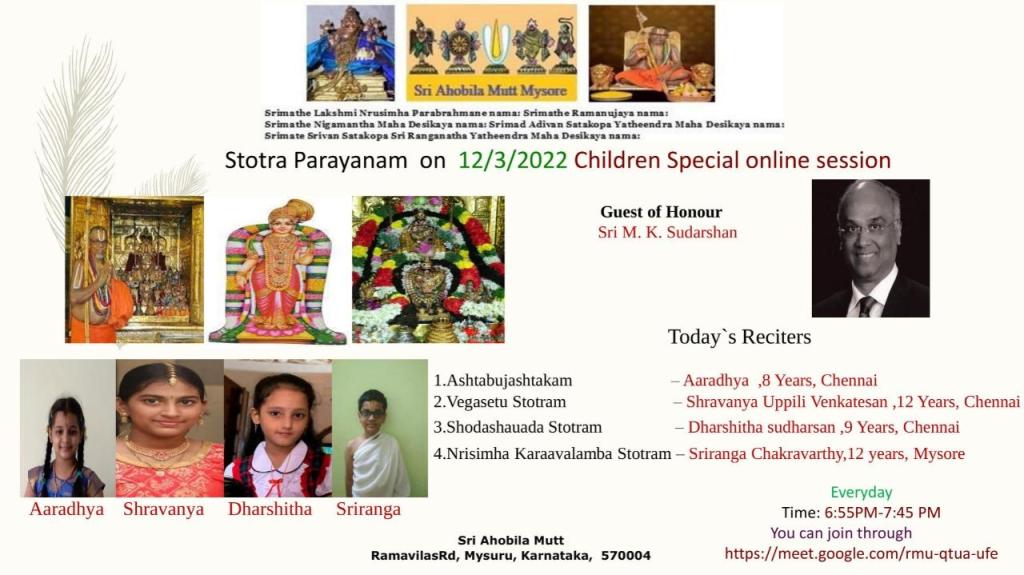
The event features little children from Sri Vaishnava families and homes in the region, taking the online stage and reciting for the audience a few select Sanskrit hymns (Stotra-s) composed by the great Sri Vaishnava Acharya, Swami Vedanta Desikan (1268-1368) that they had learned from a teacher in the past several weeks. Four little children (aged perhaps no more than 10 or 12 years!) last evening appeared on the online show and each gave a sterling, flawless performance. There were excellent recitations of “ashtabhujaashtakam”, “vega-sethu stotra”, “shodhashaayudha stotram” and “lakshminarasimha karaavalamba stotram”.
As Chief Guest on the occasion, I was expected to give a brief talk by way of encouraging all the assembled children to learn and participate in even larger numbers in the Mutt’s future online-classes as well as to recognize the great service (“kainkaryam”) being rendered by the teacher/s who, while remaining in the background, were still patiently and silently dedicating themselves to coaching all the children in their efforts.
My talk lasted 10 minutes and my first task was to congratulate all the children who had put up a most delightful and competent performance to regale the hearts of everyone in the audience. It is not very easy to learn Sanskrit Stotras since it demands proper pronunciation and clear articulation. And to recite Desika Stotras properly, one has got to adhere to certain strict rules of poesy, diction, “uccharippu”, “cchandas”, “kaala pramaanam” and, above all, the striking the right mental attitude of “bhakthi bhaava” (spirit of devotion). All that was exhibited in ample measure by all the children and it was a treat indeed to listen to their recitals of the evening.
Next, in my talk to the children, I tried to explain to them briefly and as simply as it was possible for me, the importance of reciting/chanting Desika Stotras within our respective family homesteads, at temples and in community gatherings. Many parents at home, I know from my own personal experience, are often found to sternly command their children or wards to learn and recite daily Desika Stotras as part of a rigid, daily regime. Of course, obedient as our children are, they nonetheless do perhaps silently ask themselves: “Why am I being forced to recite these Sanskrit litanies daily?! It sometimes seems like an imposition! What purpose does it serve?”
To disabuse the tender minds of our young children of quite such understandably natural feelings and misgivings, I tried explaining to them about what I myself believed are the main reasons why reciting the Stotra-paata-s of Swami Desikan has come to be the hallmark of a true Sri Vaishnava (“Sri Vaishnava lakshanam”) and also as a long-standing tradition of our community. I tried to explain to them that stotra reciting is beneficial to body, mind and soul, and that they would all surely realize the truth of the fact as they grew older and matured in life.
Below is a transcript of my brief talk to the children which I thought it would be useful to share amongst a larger audience within the Sri Vaishnava community via my own online website: unknownsrivaishnava.wordpress.com
****************************
Namaskaaram to all!
In the 10 minutes time given to me to deliver my talk I propose to share with you all a few personal thoughts and views on the importance of learning Divya Stotras of our paramaachaaryan Swami Sri Vedanta Desikan.
I learn that the Mysore Ahobila Mutt has now for more than a year been organizing online classes for children and young people to learn Desika Stotras. The classes are conducted through the traditional “sandhai” method. I also learn that this program has been very successful and many members of this group have greatly benefited from these online “sandhai” classes. Please accept my congratulations, all those who have helped to organize and participate in such classes.
Let me now briefly talk about the importance of learning Desika Stotram and embracing it in our lives and homes as a traditional mode of worship.
***************************
The importance of learning and reciting Desikan Stotras can hardly be overemphasized for all Sri Vaishnavas and Bhaagavathaas. Chanting of Desikan stotras in our homes while performing the Tiruvaaraadanam to our “aathu perumaal” (household shrine) is both a religious ritual as well as a long unbroken cultural tradition in Sri Vaishnava homes. In fact, it is Sri Vaishnava “lakshanam”.
Many young boys and girls in our community often ask me the question: “Why is the chanting of Stotras important?”
I tell them that there are 5 principal reasons
The First reason is that chanting stotras is bhagavath preetyartham… It is to please and delight perumal and thaayaar. Chanting the stotra-s of Swami Desikan – e.g. Daya Satakam, Bhagavath Dhyaana Sopaanam, Sri Stuthi, Kaamaasikaashtakam or Sudarshanaashtakam etc. — is pleasing to Perumal and Thayaar.
How do we know that?
Well, we know that fact from the Sri Vishnu Sahasranaamam which through a very eloquent shloka attests to its truth that Bhagavan is:
“stavyaḥ stavapriyaḥ stōtraṁ stutiḥ stōtā raṇapriyaḥ | pūrṇaḥ pūrayitā puṇyaḥ puṇyakīrtiranāmayaḥ || 73 ||.
- Stavyaḥ: is the one who is the object of the laudations of everyone in the world and he is the Perumal who himself never has the need to praises any other being. Vishnu or Bhagavaan has none superior to himself and hence does not need to laud anyone else.
- Stotraṁ: A Stotra means a hymn proclaiming the glory, attributes and names of Perumal.
- Stutiḥ: means a poem of praise.
- Stava-priyaḥ: is Perumal who is always pleased by hymns.
The Second reason is this:
When we chant a stotra, we are actually following the example of Perumal himself! Like him, we too become a “stota”. We are in effect following Perumal’s own footsteps or, in other words, imitating him!
Stōtā means one who sings a hymn of praise.
Perumal himself did very much like to chant stotra and we know that to be a fact since it was Sri Rama himself in his avatar as Rama in this world, who sang a stotra in praise of Sri Lakshmi Narasimha at Ahobilam: “Sri Panchaamruta Stotram”.
Thus, by following the example of Perumal himself, we in chanting stotras, we become “stota”!
Furthermore, we must also understand that being a stota makes us confers upon us the eligibility to receive Perumal’s “poorna anugraham” — i.e. his fulsome grace and blessings.
Why?
Because, the very act of a stota singing stuthi in praise of Perumal who is a “stavya-priyan” is an act of very high virtue known as “punya”. In other words, “stotra” fetches for the “stota” extraordinary “punya”!
How do we know that to be true? We know it because it is attested too in the same shloka of the Sahasranaamam:
pūrṇaḥ pūrayitā puṇyaḥ puṇyakīrtiranāmayaḥ ||
The naama “punyah” tells us that chanting “stotram” in itself is a virtuous act – it fetches us all good and auspicious benefits ie. Punyah. “Purna purayita Punyah” also means that “stotra” which by even only hearing enables one to remove and erase all sins and obtain “punya”.
The Third Reason:
“ Yo maam naama sahasrena stotum ichchati pandava
Soham ekena shlokena stuta eva na samshayaha”
That Bhagavaan is an avid lover of “stotra” is denoted by his name “stava priya:” And the confirmation of the fact that he really does crave for the delight of hearing the sweet sound of his own “naama” is revealed by his very own confession in the above Shloka spoken as “bhagavaan uvaacba” in the “phala Sruthi” passage found towards the end of the Vishnu Sahasranamam.
These are his very words:
“If someone wants to worship me by reciting the Sahasranamam but is unable to utter no more than only one Shloka (out of the hundred and seven), I still delight in that single chant which to me is the equivalent to the recital of the entire Vishnu Sahasranamam.”
Bhagavaan thus is so very easy to date and please! All it takes is just any one random Shloka in the 1000-versed Sahasranamam-Stotra, and consisting of no more than a few “naamaa-s” to be recited by us, to whet Bhagavaan’s divine, voracious appetite for worship. When such a facile and wholly effortless way to please Bhagavaan has been revealed to us, why miss the opportunity to grab it eagerly with both hands and with all hearts brimming with adoration for him? Wouldn’t it be very foolish of us if we were to ignore it?
The Fourth reason:
We find that Swami Desikan’s stotras are embedded with sacred Vedic mantras… When we chant his divya-stotrams, we actually end up chanting also the equivalent of Vedic mantrams.
Normally, it is very difficult for ordinary people like us to learn Vedas which takes intense study under a guru for more than 12 to 15 years. In learning Veda manthrams, there are many rules and discipline to follow faithfully. Vedic manthrams when chanted correctly and with utmost faith, protect the chanter from all sins, dangers and diseases in life… ‘Mananaat traayate iti manthrah ‘is how Manthra is defined in Sanskrit. It means that by constant repetition (mananaat) of which, you overcome/protected (traayate) [overcoming or protection from bondage/troubles/cycles of birth and death] is (iti) called Manthra.
Since, it is not given to all to learn Veda manthrams in the proper and formal way, Swami Desikan out of his compassion for all of us his disciples, composed his Sanskrit Stotrams by embedding them with sacred syllables and certain secret and select beejaakshara-s and phonemes derived from various Vedic passages. So, even when ordinary persons like us recite those stotrams, we are able to obtain all the benefits of chanting Veda manthrams without having to study the Vedas themselves. By doing so we too are able to easily earn the benefit of all-round protection in life that has been attested to and mentioned in the statement … ‘ Mananaat traayate iti mantrah’… e.g. in Desikan’s Garuda Dandakam, there is the beejaksharam “pakshi”…. which is in fact a phoneme from the sacred Garuda manthra. Similarly, in Sudarshanaashtakam, the incantation of “Jaya Jaya Sri Sudarshana …”. Etc. is known to have great manthra significance.
The Fifth reason:
When we have learnt fully to recite “stotra”, committed it to memory, and can chant it anytime too at will flawlessly and effortlessly, it means that we have internalized it within ourselves in the depths of our mind. Once, that process of internalization is complete, we can be sure that the “stotra”, which is really another less formalized mode of repeating sacred Vedic “manthra”, will start working its magic, as it were, inside our mind. What is that “magic”?
The magic lies in the potency of the stotra to bring the light of spiritual knowledge (“gnyaanodayam”) into the mind; slowly, new spiritual insights we will be able to discover ourselves in life; truths and doctrines that hitherto we did not understand will suddenly being to unfold inside our mind; all the events in our life will begin to assume a glow of “sattvam” (i.e. truthfulness and purity); and we will begin then to feel much closer than ever before to the presence of Perumal who resides within our heart …. Our mind will slowly start thereafter getting more and more engrossed in “bhagavath chinthanai” (divine contemplation).
So, we must all not fail to understand that if our minds are to be filled with the light and glow of “bhagavath chintanai”, it must be ensured first that our tongues are trained properly to articulate and chant the praise of Perumal through “stuthi:” and “stotra”.
This very important truth has been revealed to us, in fact, by the beautiful line in the 5th verse of Andal’s “Tiruppaavai” (“maayanai mannu vada Madurai maidhanai…. Etc”):
“Vaayinaal paadi, manathinaal sindikka….”
Which is to say, precisely, that you “first have to learn to recite the stotra” (vaayinaal paadi) before you can enable your mind begin contemplating God (manathinaal sindikka).
************************************
The above are the 5 main reasons why every Sri Vaishnava must learn to memorize, recite and regularly chant Swami Desikan’s stotram-s. Of course, you can go, and you must also go and learn from other learned Vidwaans and religious Sri Vaishnava scholars about several other reasons there are which also underline the importance of nithya paaraaayanam of Desika Stotrams.
I conclude my talk now with a sincere request to many more Sri Vaishnavas of the Mysore region and also elsewhere to come forward and participate enthusiastically in the future online learning programs of the Ahobila Mutt. I pray to Perumal and Thaayaar and to our Acharyan Sri Nigamaantha Desikan to bless us all with all goodness and auspiciousness in our lives.
****************************
“Shubhamasthu”