“SrIranga-mangaLa-nidhim karuNAnivAsam
SrIvenkaTAdri-SikharAlaya-kAlamegham |
SrIhastiSaila-Sikharojjvala-pArijAtam
SrISam-namAmi SirasA yaduSaila-dIpam ||
It is an observable fact of history that at three of the above four great capital temple-towns of Sri Vaishnavas the above shloka names — viz. Tirumala, Sri Rangam and Melkote –Sri Ramanujacharya, personally undertook the responsibility for reforming the then prevailing and later institutionalizing a permanent new system of succession in the matter of appointment of temple custodians and priestly functionaries who were to be given hereditary rights and privileges to act effectively for all times to come as servitors and administrators of the temple. By doing so he ensured a unique continuity of tradition the hallmark of which was standardization of modes of worship in all Sri Vaishnava temples according to a set system of theism which was a sacred blend of the timeless Vedic, Agamic and Prabhandhic practices that had survived from pre-historic, historic and medieval times. It was a system which in his world-view would ensure that Visishtaadvaita as a “siddhaantham“, and as a “darsana” called “ubaya vedaanta“, would withstand the test and passage of time, outlast all vagaries of human affairs, serve the deepest spiritual needs of people of all ages, caste and creed and endure forever.
There are volumes and volumes of history and legends relating to the three temples that have been recorded in and around them in hundreds of epigraphical stone-inscriptions from Chola, Hoysala and Pallava times. Much historical information is also found in hagiography authored by several dozens of scholars and theologians of the medieval Sri Vaishnava community itself (such as for instance, “bhutha-puri mahaatmyam”, “prappanaamritam”, “divyasuri charita“, “yathiraaja vaibhavam“, “guru paramapara prabhaavam”, “raamanuja champu” etc.). All these were bequeathed to posterity from historic times and came to be later preserved, curated and published by British colonial administrators, historians, archivists and curators in official gazettes, government historical and archaeological surveys, travelogues, monographs etc. There is therefore a lot of historical evidence that exists about the outstanding work of remarkable foresight carried out by Sri Ramanuja at Tirumala, Sri Rangam and Melkote.
A very comprehensive history of the Tirumala Temple was published by the Tirumala-Tirupati Devasthanam, “The Tirumala Temple” (1981 edition) which devotes many pages describing the religious reformist and institution-building programs Sri Ramanuja undertook at the Tirumala Temple and upon which the temple even today is modelled and functions. Below are a few extracts from the book reproduced to highlight the particular interest that Sri Ramanuja took to institute a system of ritualism and priestly-custodial succession at Tirumala:

Sri Ramanuja’s intimate connection with and influence over the organization-structure and style of management of the Tirumala temple is broadly summarized as follows:

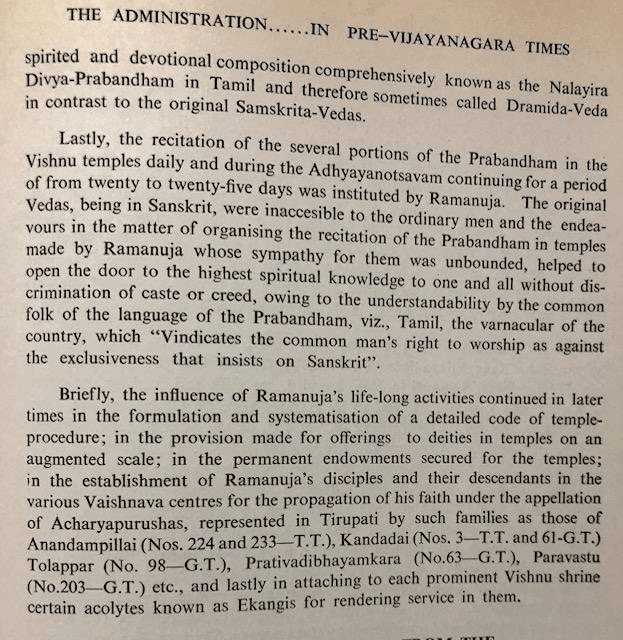
Thus, there can be no doubt, going by the above historical accounts, that as far as the Tirumala Temple was concerned, it was the religious systems — i.e. operating procedures of ritual and Agama — ordained and authorized by Sri Ramanuja himself that became institutionalized after him. After him, they were faithfully implemented by a core-group of Jeeyars, chief-priests and “ekaangis“ whose rights to run and oversee the affairs of the temple sanctum and shrines were not only asserted through and by unbroken hereditary lineage but whose Legitimacy to exercise such rights was beyond challenge.
The Jeeyars and “ekaangis” and “miraasidars” of the Tirumala Temple were all adherents of the “sampradaaya” of the “southern” or Tenkalai achaaryas and laity who were the principal religious constituencies of Sri Ramanuja’s ministry at the great Sri Rangam temple of which he was the moving revolutionary and inspirational spirit all through his lifetime.
It was thus, why and how the Tirumala Temple, although geographically located far north away from Sri Rangam in the south, however to this day belongs to the “southern” or Tenkalai “sampradaaya” embraced and upheld by the Tirumala Temple Jeeyars…. the “sanyaasi” descendants of the first “Satakopa-yathi-s” who were ordained by none other than Sri Ramanuja himself.
*******************************
The templates of religious and sacerdotal reforms and institutions Sri Ramanuja conceived, introduced and implemented at Tirumala temple were all mostly replicates of what he had similarly used in the many years while living and working in Sri Rangam, the temple which is primus inter pares, the first amongst equals among the 4 great Sri Vaishnava “divya-desams“.
The very same templates were also used by him later at the Melkote where again he personally set about instituting ecumenical and sacerdotal systems and traditional modes of worship in the Vishnu temple there which too, again, was geographically far north of Sri Rangam.
The reformist and institutional-building agenda of Sri Ramanuja at all the three temples was codified and articulated in clear, detailed, all-comprehensive and well-documented temple-manuals called “NITHYAM” and details of which are found in historically authentic documents called “Sri Rangam Ozhukku” and modified version of which is also the “Tirumala Ozhukku”; and the one relating to the Melkote Temple is called “udayavar niyamanappati”.
(Important Note to readers: The word “ecumenical” being used here should not be misunderstood to be any kind of reference to the Christian Church. It is only being used as a convenient “neutral term of reference” to religious rites and services conducted generally within any place of worship).
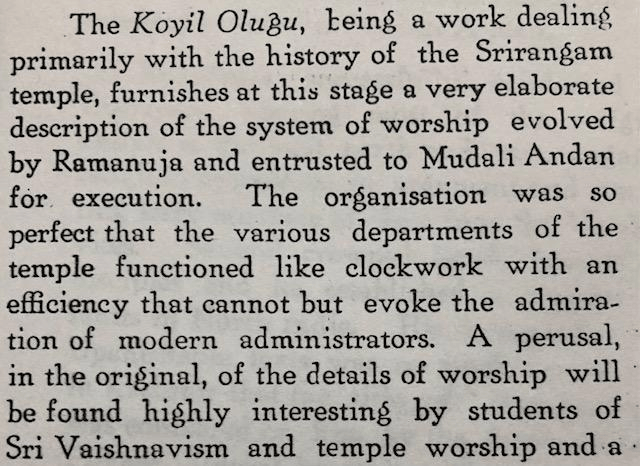
I reproduce below now only a very few samples of extracts from the Koil Ozhukku texts that have been translated into English by notable modern Sri Vaishnava scholars such as Sri. T.S.Parthasarathy and Smt. Prema Nandakumar. My purpose of quoting from their respective books is two-fold:
One is to highlight how intimately and personally connected Sri Ramanujacharya was to the establishment of ecumenical/sacerdotal traditions, systems and processes that were to be followed in these two other temple-capitals of Sri Vaishnavas besides Tirumala. As in Tirumala temple so in the Sri Rangam and Melkote temples too, we find that the whole institutional edifice Sri Ramanuja erected and left behind became truly the “gold standard” of best practices, so to say, that all Vishnu temples were enjoined to emulate and abide by — especially the divya-desams that the holy Azhwaars had sanctified by visiting them in the distant past and including them in the hymns of the Dravida Veda, the “4000 naalaayira divya-prabhandhams” . In a sense, the Sri Rangam Temple traditions effectively not only defined but also legitimized through sacral sanction the essential character of Sri Vaishnavite temples. All temples of the community wherever located had to comply with the Sri Rangam model since it was the seminal one instituted by Sri Ramanuja himself personally.
And secondly, I reproduce the extracts below only to urge readers…. young Sri Vaishnavas of the modern generation today…. who remain either ignorant of, or indifferent to their cultural roots and religious heritage to please take the trouble to read these English language sources of contemporary literature. It will help to greatly expand their awareness of the noble ancestry, identity and hoary traditions to which they belong.
Here is an extract that relates to what Sri Ramanuja accomplished at the Sri Rangam Temple:
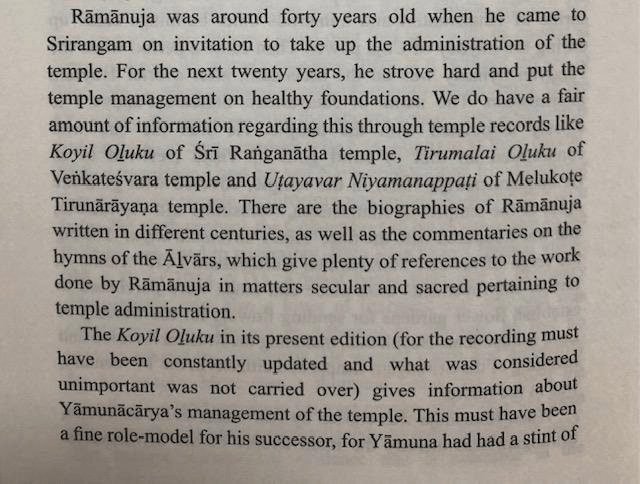
Here below is another interesting and relevant extract:
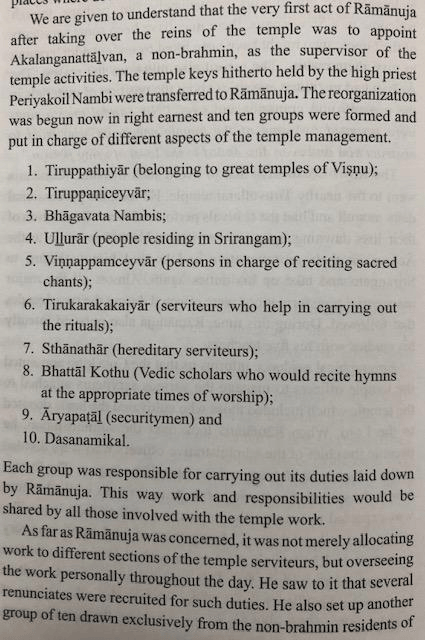

The extract below, likewise, relates to the reformist and revolutionary work Sri Ramanuja undertook at the Melkote temple where he lived for about 20 years. With the support of the then Jain Hoysala king, Bittideva, (who later converted to Sri Vaishnavism and as King Vishnuvardhan became an ardent disciple of Sri Ramanuja), he succeeded in developing Melkote into the 4th most famous and important temple-capitals of Sri Vaishnavism.


************************************
Sri Ramanuja spent the first 40 years of his life in youth (brahmacharyam) and wedded middle-age (gruhasthaashramam) at Kanchipuram where he underwent Vedic education under his Advatin guru, Yaadavaprakaasa; he studied Sri Vaishnava theology and thanks to his other guru Kanchipurna, he came into contact with the Sri Rangam group of Acharyas notably the great patriarch, Sri. Alavandar’s chief disciples who took him under their wing; he underwent “panchasamskaaram” as a Sri Vaishnava in Kanchi; and rendered long years of service at the temple of Sri Varadaraja Perumal; and finally took vows in “sanyaashramam” (renunciate) before leaving forever for Sri Rangam.
At age 40, Sri Ramanuja left Kanchipuram to go serve a lifetime in the temple of Sri Rangam. There are no historical or hagiographical records to show that he even visited Kanchipuram ever again, not to mention returning there to spend any considerable period of time out of the 120-years long lifespan of his!
There is no historical or hagiographical evidence to show that Sri Ramanuja was in any way “intimately connected” with the Kanchi Sri Devarajaswamy Temple in the very same manner in which he h had been deeply involved with the affairs of the other 3 capital-temples of Sri Vaishnavism at Sri Rangam, Tirumala and Melkote.
Sri Ramanuja’s “connection” with Kanchipuram was, thus, a matter of biography only…. and not of spirituality.
Most certainly, during his lifetime Sri Ramanuja never did leave behind any “kovil ozhukku” for the Kanchipuram temple. Nor did he ever cause one to be formalized after his time to be adopted by his “northern” lineage of disciples or laity. Nor are there any historical records to show that Sri Ramanuja either himself ordained or specially appointed any local group of temple head-priests to officiate in conformance with a “kovil ozhukku” or “nithyam” replicating that of the Sri Rangam model instituted by him. The Kanchi temple practices thus were only in compliance with age-old Vaishnava Agama ritualism and sacraments and rather deficient in elements of Sri Ramanuja’s own signature.
From a biographical viewpoint today, it is quite intriguing indeed to note why Sri Ramanuja never returned to Kanchipuram after he permanently settled down in Sri Rangam right until his last days. One reason put forward is that he was commanded by his acharya Sri Periya Nambi not to leave the domicile of Sri Rangam.
The other reason given by disciples is that the Deity of the temple, Sri Ranganatha himself appeared in a vision before Sri Ramanuja and bade him remain in Sri Rangam until he shed mortal coils. The fact is alluded to through a particular phrase in the famous Sanskrit mystic hymn, “Saranagathi Gadyam” sung by Sri Ramanuja himself — “thvam dhvayamarthAnusandhAnEna saha sadhaivam vaktha yAvachchareerapAtham athraiva SrIrangE sukhamAsva!” meaning: “Remain content here in Sri Rangam, always meditating upon the sacred Dvaya manthra …. until the time arrives to shed your mortal body!”
There is perhaps another unsubstantiated but perfectly human reason why Sri Ramanuja never returned to Kanchipuram.
His early life in Kanchipuram was a very formative one, no doubt, but it was not a completely happy one. It was there that there had been an attempt to assassinate him by certain inimical elements amongst the Advaitin and Buddhist camps at Kanchi. It was there that he endured a rather unhappy marriage which was annulled when he finally took to “sannyaasa“. It was there too that Sri Ramanuja encountered the worst incidents of casteism. It was there that he also probably had to deal with inter-faith prejudice, conflict and animosities (Buddhist, Jain, Advaitin and Visishtaadvaitam). Painful experience as those personal old memories might have been, it probably made him reluctant to ever return to his native hearth in Kanchipuram….. But then these views are in the domain of speculation.
********************************
Nonetheless, what in the end, is the long and short of the entire matter, from the perspective of the Tenkalai narrative of the history of the Sri Varadarajaswamy Temple, the Kanchipuram temple and its traditional sacerdotal and ecumenical practices, unlike the other 3 temples of Sri Rangam, Tirumala and Melkote, did not receive the sacral imprimatur of Sri Ramanujacharya’s own intimate connection with it.
In other words, Kanchipuram temple practices and functionaries were neither ordained nor appointed by Sri Ramanuja. Kanchipuram was an exception, an outlier, to the general tradition followed by the other 3 great temple-capitals of Sri Vaishnavam. Therefore, it cannot be said that the Power wielded by those who appointed themselves as religious helmsmen and stewards of the Kanchipuram temple, enjoyed the Legitimacy to do so.
(to be continued)
Sudarshan Madabushi