The narrative of the Tenkalai challenging the Legitimacy of the Kanchipuram Thathaacharya clan’s exercise of Power and influence over the Sri Varadaraja Perumal temple since the 15th century CE is founded on what the Vadakalai sect considers to be fabricated, specious and wholly untenable from the viewpoint of “ubaya vedaanta sampradaayam”.
Only because the Thaathaacharyas of Kanchi lacked the direct, sacral imprimatur of Sri Ramanujacharya himself in being appointed to their position of exclusive stewardship of the temple; only because Sri Ramanuja himself was not “intimately connected” with the affairs of the Kanchi Temple as he had been with those of Sri Rangam, Tirumala and Melkote temples; and only because Sri Ramanuja did not happen to author, or cause to be authored, a “kovil ozhukku” for the Kanchi Temple as he had done for the other three temple-capitals of Sri Vaishnavas, did not in the least diminish or deprive the Legitimacy of the Thaathachaarya family-lineage to have been appointed as the “Sri Kaarya durandhara-s” — the chief executives officers — exercising the Power of oversight, management and control of the Sri Vararadaraja Temple. Such is the firm view of the Vadakalais of Kanchi and it is based on the following counter-intuitive narrative:
- The fact that Sri Ramanuja lived most of his 120-year long life (after leaving Kanchipuram in his middle-age) in Sri Rangam and Melkote and (for relatively shorter periods of time) in Tirumala, and did not return or re-visit the Kanchi temple can be regarded as only an accident of various circumstances and combination of historical and political events. That he never returned to Kanchipuram after he left it and did not involve himself in any direct way in the affairs of the Sri Varadaraja temple may be true but there is no evidence to show that it was out of any deliberate personal choice he made. It is no more than plain happenstance.
- The availability or absence of a specific Sri Ramanuja-authored “kovil ozhukku” for the Kanchi Temple cannot, by any stretch of imagination, be misconstrued or mispresented as indicating that the Thaathaachaarya-s of Kanchi were either not complying with or in any way diluting the highest normative rules and regulations of ancient Veda, Vaishnava Agamas and Divya Prabhandic traditional scriptures prescribed for conduct of sacerdotal rites and rituals inside the temple.
- In the stout rebuttal of the Tenkalai narrative in this specific regard that Sri. Varada Thatachari makes (in his “Critical Survey“) against that of Dr. K.V.Raman made in his book (“The Temple of Sri Varadaraja: Kanchi”), he writes the following: QUOTE:
“The Tataacharyas connected with this Temple were very orthodox in the observance of religious rites and rituals to their meticulous perfection as prescribed in the scriptures. The same system of observance had been handed down to their posterity and is still observed. The author (Dr K.V.Raman) wants us to understand that the Tenkalai mode of ceremonies and worship (did not prevail) in the Temple by citing some documents connected with the litigation of the Temple.
(i.e. in my own view, what K.V.Raman had implied here was that the mode of ceremonies of worship prevailing in the temple were either non-compliant or deficiently complying with the highest standards of ritualism prevailing in Sri Rangam, Tirumala and Melkote which bore the imprimatur of Sri Ramanujacharya).

"What are the modes of Tenkalai worship and what are the Tenkalai
ceremonies?! We fail to understand, despite the author’s parrot¬
like assertions without clarity or truth.

"Strictly speaking there can be no Tenkalai or Vadakalai mode of worship in a Temple. The worship is performed according to the Agamas which are neither Tenkalai nor Vadakalai. But we generally call a temple Vadakalai or Tenkalai (only) on the basis of sectarian marks borne by those who officiate in the pujas (rites).

"Even on this basis our Kanchi Temple is definitely Vadakalai, as aforesaid. If the temple’s character is to be determined on the basis of service holders, the majority of the services like Vedaparaayanam, Puraanam reading, Stotra-patam, Mantrapushpam etc., are in the hands of the Vadakalais. The Tenkalais have only the "Adhyaapakam" service in which the Vadakalais also participate. The author’s case fails here also.
(again, the real implication here of Varada Taathachaarya's averment is that whether mode of ceremonies inside the temple is said to be Vadakalai or Tenkalai, the fact of the matter is that the character of the sacerdotal proceedings are the same in all Sri Vaishnava temples if they are all strictly conducted in accordance with the ancient scriptural authority of the Veda, the Agama and the Azhwaar Prabhandhams. The presence of a "Kovil Ozhukku" at Sri Rangam, Tirumala or Melkote temples and the absence of one such at the Kanchi temple is therefore totally irrelevant. A "kovil ozhukku" or "nithyam" are after all is only a manual serving as a set of operating procedures and guidelines for temple-rites. They are not imprimaturs in the real sense of the word.)

 UNQUOTE
3. The Vadakalai view is also that the Legitimacy of the Kanchipuram Thaathaachary family-lineage to manage the temple cannot be challenged merely because they had not been anointed or ordained personally by Sri Ramanujacharya to serve and function as custodians and stewards of the Sri Varadaraja Temple.
In this particualar matter, the Tenkalai narrative seeks to contrast the Thaathacharyas with the “Jeeyar, Ekaangi, Sthalathaar” etc. legatees who had been granted by Sri Ramanuja himself their hereditary rights and exclusive privileges in-perpetuity to conduct the religious or sacerdotal affairs of Sri Rangam, Tirumala and Melkote temples. Since no such anointment or ordainment had been made by Sri Ramanujacharya in the case of the Kanchipuram Thaathaacharya-lineage, they could not legitimately claim to be duly instituted stewards of the Sri Varadaraja Swami Temple.
Such a narrative of the Tenkalais is countered stoutly by a Vadakalai counter-intuitive narrative.
As already explained in Part-8 in this series, the Kanchipuram Thaathacharyas might not, admittedly, have been able to derive their rights and privileges as “Sri Karya Durandharaa-s” of the Kanchi temple directly from the person of Sri Ramanujacharya himself in the same manner as their respective counterparts in Sri Rangam, Tirumala or Melkote had been able to. But then they do derive their Legitimacy directly from one who was held with the greatest veneration by Sri Ramanujacharya himself! He was the senior Acharya of all “ubaya-vedaantins”, the one whom the Deity of Tirumala himself had affectionately called “Thaatharya” or “Thaathayya” (“grandsire“) — Sri Tirumala Nambi!
Sri. Tirumala Nambi was after all the grandson of Sri Naathamuni himself… and he was the Acharya of Acharyas of Sri Ramanujacharya!
Sri Tirumalai Nambi’s son was Tirukkurugur Pillai Pillaan who was the “prathama sri bhaashya simhaasanaadhipati” i.e. the first among the 74 apostles anointed by Sri Ramanujacharya to carry forward his legacy to posterity.
After Sri Pillaan’s time and in his very own “sishya parampara” or lineage of disciples, came Engalaazhwaan, Nadathoor Ammal and Appullaar. And it was in that very same lofty and illustrious lineage of Appullaar that Sri Vedanta Desika (1268-1368 CE) too had emerged in Kanchipuram. Sri Desikan’s “bhakti” towards Sri Ramanujacharya was unparalleled. His innumerable works of commentary and exegesis on philosophy, theology, literature, dialectics, poetry, drama, esoteric “rahasya“, prabhandham etc. in a variety of languages (Sanskrit, Tamizh, Manipravalam and Praakrit) all were inspired by Sri Ramanuja only. No greater greater testimony is needed than the profound works of Sri Desikan to attest to his extraordinary “guru-bhakti” towards Sri Ramanuja, as well as to his absolutely faithful adherence to the “siddhaantham” and “sampradaayic” traditions and practices of “ubaya-vedaantham”.
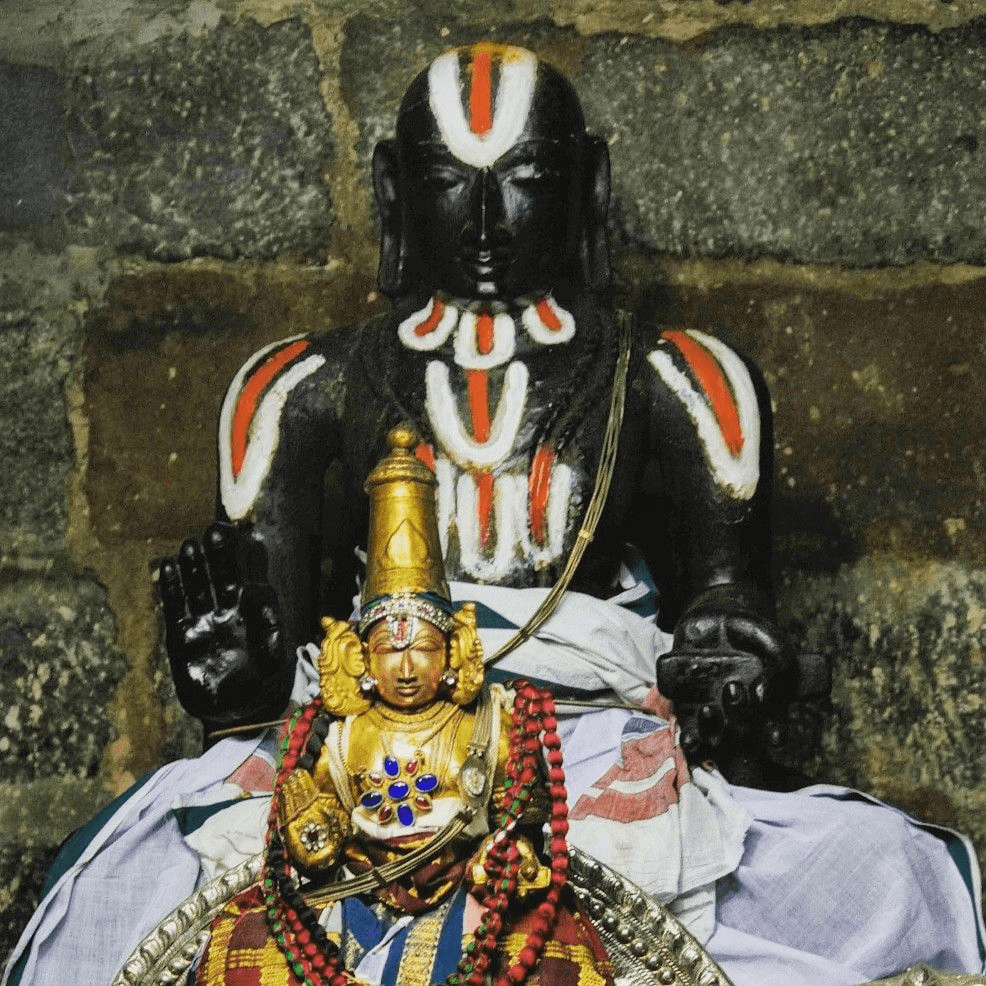
It was Sri Vedanta Desikan himself thus who had anointed the very first member of the Kanchipuram Thaathacharya family as the “Sri Karyam” of the Sri Varadaraja Temple after being convinced he was indeed the fittest person with the best “sampradaayic” credentials to serve in that position. That member was Sri Tirumalai Srinivasacharya Thathachariar. Since then, the office of Sri Kaariyam got institutionalized as the hereditary patrimonial right of the Thathacharya family to occupy the formal office of Sri Kaaryam.
Therefore, in countering the Tenkalai narrative challenging the Legitimacy of the Thathaacharya-clan to hold stewardship positions in the Kanchi temple, the Vadakalai narrative defends the rights of the Thaathachaarya family by assertions that are effectively, as it were, below:
“So what if Sri Ramanujacharya did not himself in person — or through the sanction of any sacred “kovil ozhukku” for the Kanchi temple — ordain the Thaathacharyas?! Is it not the due mandate of Thaathachaarya-s to exercise power of oversight and control over the temple of Kanchi by virtue of being direct descendants of Sri Pillaan, Sri Tirumala Nambi and Sri Naathamuni ? And do they not also enjoy legitimacy because they were appointees of the great Vedantaacharya, Sri Vedanta Desikan, he who himself adorns an exalted position in the long post-Ramanuja “acharya paramparai” of the “ubaya vedaantins”?!”
A clash thus of the above two narratives of the Tenkalai and Vadakalai over the power and legitimacy of the Thaathacharya-vamsha erupted in Kanchipuram soon thereafter. It became the very genesis of their sectarian conflict and it certainly does help explain why and how, historically, the “Desika sampradaayam” of the Vadakalais too began evolving as a distinct sectarian offshoot of the larger “ubaya-vedaanta” tradition, and later grew and flourished under Sri Vedanta Desika as its “paramaacharya“.
(to be continued)
Sudarshan Madabushi