Throughout the 16th-17th century CE, there always persisted an undercurrent of tension and conflict in Kanchipuram amongst the “ubaya-vedaantins“. It kept simmering beneath the surface and rarely erupted in any serious external clashes or skirmishes of the ugly sort being witnessed today between Tenkalai and Vadakalai not only inside the precincts of the Kanchi Sri Devarajaperumal Swami temple but also more frequently in battles in the open courtrooms.
Amongst the “ubaya vedaantins” of those times, (to use a modern-day phrase) a vacuous and frozen state of “cold war”, unacknowledged but unmistakable, seemed to have prevailed between those whose loyalties lay with the “southern” or “tennaachaarya sampradayam” of the Sri Rangam-based generations of preceptors in the Sri Ramanuja lineage and those who were gradually beginning to see themselves as “northern” or “vadakalai” “ubaya-vedaantins“. The latter group, while steadfastly following Sri Ramanuja “siddhaatham“, were however at the same time, also more closely aligned to and in sympathy with the lineage of Kanchipuram-based preceptors . Slowly but with increasing frequency and clarity, the Tenkalais began to sense that the Vadakalais, although had not yet begun to walk it, had nonetheless begun to at least whisper if not talk “Desika sampradaayam”…..
The superficial cracks within the “ubaya-vedaantins” began to sprout and appear unnoticed even though it did take at least another century and a half before they fully fractured into a grievous sectarian fault-line sometime during the last decades of British 18th century CE colonial rule.
With regard to broader common goals such as propagating “raamaanuja siddhaantham“, conducting studies in Visistaadvaitic scripture (i.e. H&S) or the management of all generally common affairs of temple-management the cracks or mild fissures between the two different groups of “ubaya vedaantins” remained imperceptible and muted under a veneer of cordiality and intra-communal congeniality. But then slowly and parallelly, a certain element or tinge of rivalry or competition also began to creep into their mutual relations when it came to their seeking political patronage from powerful royal dispensations of that time….. viz. the Vijayanagaram, Naayak and Mysore Wodeyaar dynasties.
As already explained in Part-12, the great Vijayanagar Dynasty ruled the Deccan and Tamil regions of South India through the latter part of the 15th century CE followed by the 16th century CE. After its decline in the mid–17th century CE its erstwhile vassals the Naayak kings of Pandyan Madurai and the Wodeyaar kings of Mysore countries emerged powerful for brief periods of time. All these dynasties being avowedly Hindu “saamraats” or kingdoms, as a matter of sound and sagacious state policy, always sought to publicly assert and affirm their Hindu identity. In the face of the rampant and continual invasions that they faced from the northern and western borders of their empires by the marauding Moghul Emperors of Delhi and from the Turkic Bahmani Sultans of Bijapur respectively, these Hindu dynasts had to ensure at all costs that the support and sympathies of the vast Hindu populations in their empires always remained firmly in their favor. Therefore the most prominent and influential Hindu religious establishments in which they knew the population reposed faith had to be cultivated, developed, supported, generously patronized and sustained.
The Vijayanagara dynasts — and the Naayak and Wodeyaar kings who briefly succeeded them — therefore spared no effort and left no stone unturned to invest enormously and variously, both in terms of huge physical and financial resources as well as moral and regal support, in the Sri Vaishnava and Saiva temples and their respective affiliated “Muttams” in the land.
In the land of the “ubaya vedaantins” that lay between Sri Rangam and Kanchipuram, the Sri Vaishnava temples and religious-establishments also had to vie with each other to secure and accumulate into their vast temple-treasuries and grain=granaries as much of royal political patronage as possible. It was, really in effect, what we know to be the classic power-nexus between the Church and the State in the same metaphoric sense in which one finds it chronicled in the medieval history of Christianity between Christian Kings across Europe and the Papal seat in Rome. The entire Hindu religious ecosystem in the Deccan and Tamil country of south India came to be sustained by the royal philanthropic largesse that the Vijayanagara Kings, generously and graciously, were so willing, ready and capable of granting it.
In the ebb and flow of history, it so happened that between the “thenn” or southern groups of “Achaaryas” in Sri Rangam and their “vadakku” counterparts in the north in Kanchipuram too there arose mild competition i.e. over which of the two would be able to cozy up more closely and more strategically with the powers-that-be in the distant capital city of Vijayanagaram of the great Raaya Dynasty — i.e. Sangama, Tuluva and Aravidu generations.
Throughout the 15th and 16th centuries CE, there is evidence to show that both Sri Rangam and Kanchipuram “ubaya vedaantin” groups actively and parallelly sought to gain trust, political confidence and financial support from the Vijayanagara Dynasties. They competed with each other not in any aggressive sort of way but through means of what today in the modern world is often referred to as exercising “soft power”. Both the Sri Rangam and Kanchi “achaaryas” tried to gain and exercise such “soft power” and influence in the Royal Courts of the Vijayanagara Kings by trying to secure for themselves the vital post of “Raaja-Guru” of the ruling king — the Royal Advisor to the king in matters of religious and extra-religious matters too.
The post of “raaja-guru” was a unique position. Through it an Achaaya or spiritual-mentor of the King could wield and command enormous power, prestige, influence and resources. In that position he could not only act as the King’s eyes and ears but also as his mind and conscience. The ‘raaja guru” could influence the King’s decisions on a wide variety of matters — internal security, diplomacy, appointment of ministers, governors, military-generals… why, even on intimate and confidential matters of palace family-matters such as marriage alliances, the education of princes, health-care and personal plots and conspiracies….. In the history of India, many a “raaja-guru” of a king was known to have acted as his royal emissary, a part-time regent… and even as an interim stop-gap successor on the throne…. !
It was thus quite possible for a “raaja guru” who was endowed with exceptional learning, experience, wisdom, gravitas, intelligence, other superior qualities of heart and head to become the king’s “alter ego”. In those historical times, it was indeed such an exalted position in the king’s court that many a man of religion and spirituality often aspired to hold…. Serve as “raaja guru” for good or bad!
It was precisely such “soft power” at the Courts of the Vijayanagara Dynasts that the most eminent of Acharyaas of both the southern and northern “ubaya vedaanta” traditions too competed for and sought to gain. It thus so happened that in the political as much as in the purely religious arena a certain element of competition sprang and lingered for a while. To the intra-communal relations between Sri Rangam and Kanchipuram it caused perhaps a bit more abrasion making the chemistry between them a tad more tense than they were already within the temple environs.
Some accounts in the Sri Rangam “kovil ozhukku” have been narrated of a few major events that happened in the context of what, for a want of a better expression, may be characterized as politico-religious tension that permeated the relations between north and south “ubaya vedantins“. The events happened more or less contemporaneously, although it would be difficult to say for sure if they happened likely in reaction to each other causally.
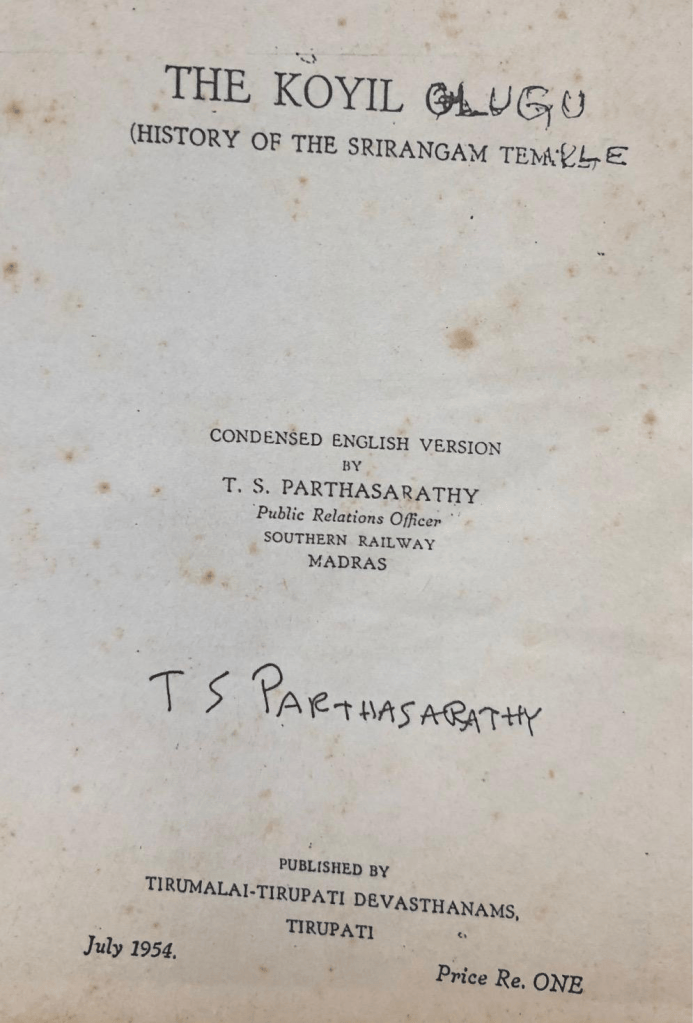
Whatever may be the actual facts, a bare reading of the “Sri Rangam Ozhukku” does corroborate the fact that Sri Rangam Achaaryas attempted as much as the Kanchi Thaathaacharyas to vie for royal patronage and position. That competitive bid, if at all it may be termed so, is to be understood only as being no more than yet another aspect of the dissonance in the two sectarian narratives relating how Power and Legitimacy came to be enjoyed by the Kanchipuram Thaathachaarya family and the Sri Rangam Uttama Nambi family.
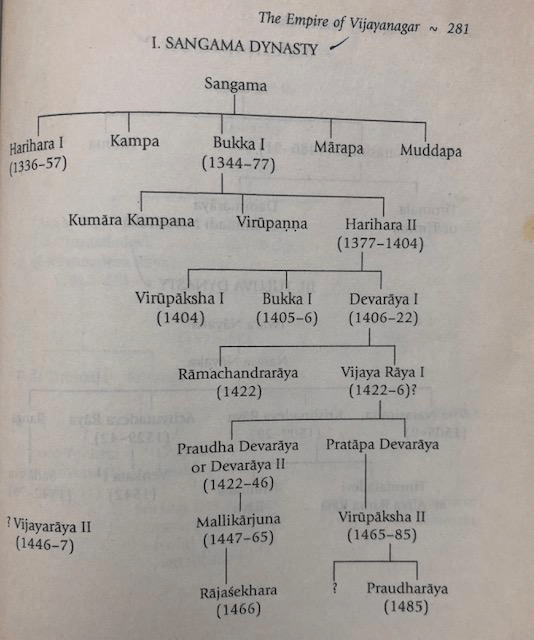
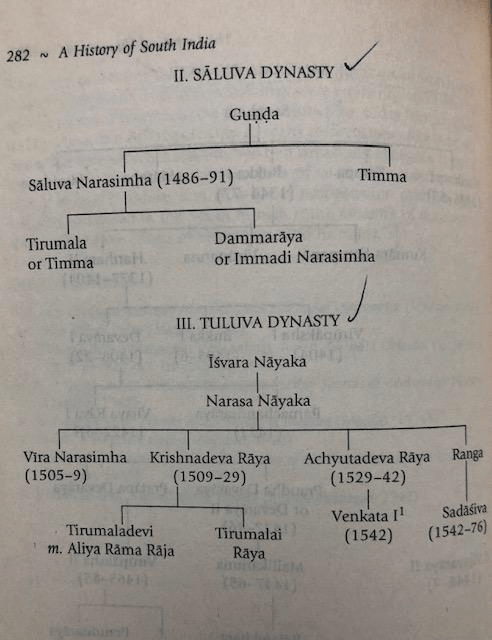
To be able to understand this aspect of the dissonance between Tenkalai and Vadakalai historical narratives of engagement with the dynamics of the 15th century-17th century CE “power-nexus” as it existed between metaphoric Church and State, it is important for the reader to first get a firm mental-fix on the timelines running across dozens of generations of the Vijayanagara Dynastic kings who ruled the empire. To enable the reader to visualize those extensive timelines, a few charts are reproduced below which clearly trace the historical date–spans within which the dynastic succession of the Sangama, Tuluva and Aravida kings of the Vijayanagara kings took place. To these datelines then the timeline of both the Thaathachaarya and Uttamanambi “vamsham” members — engaged politically with the State on behalf of their religious constituencies in Kanchipuram and Sri Rangam respectively — may be mapped and matched.

(to be continued)
Sudarshan Madabushi