There can be no doubt that it was the Sri Rangam hinterland that bore the far greater brunt of the Ghaznivid and Malik Kafur depredations than Kanchipuram. (Please see the map in Part-18).
The state of ruin and penury to which the Vishnu temples in the southern provinces in and around the Sri Rangam temple had been reduced was most certainly more direly felt than those in the north at Kanchipuram. For either some strange tactical or inadvertent reason, the Muslim invaders were sated by the enormous loot they had plundered from temples in and around Sri Rangam and, hence perhaps, had mercifully ignored the northern fringe of Tamil Country while returning to their base in Delhi. It is a matter thus of historical record that the Sri Devarajaperumal Swamy temple escaped unscathed from the same havoc of Islamic attacks which the Sri Ranganathaswamy Temple at Sri Rangam had to unfortunately suffer.
In view of the above fact, the tenability of his narrative cannot be questioned when Prof. Sampathkumaran writes about the significant but slow and painstaking work of restoration and renovation that the southern community of Sri Vaishnava “ubaya vedaantins” of Sri Rangam (i.e. so-called “tennaachaarya”) might have had to engage in for years — perhaps decades even — to restore the temples to the state of organization as previously had prevailed under the Sri Ramanuja Order.
What however mars his thesis thereafter is when Prof. Sampathkumaran’s article clearly seeks to introduce sectarian elements into the narrative without historical substantiation or support. The sudden transformation in the tone and intent of the narrative will be so obvious to a modern-minded reader by even merely glancing at the selective passages reproduced below.
Here are the extracts:

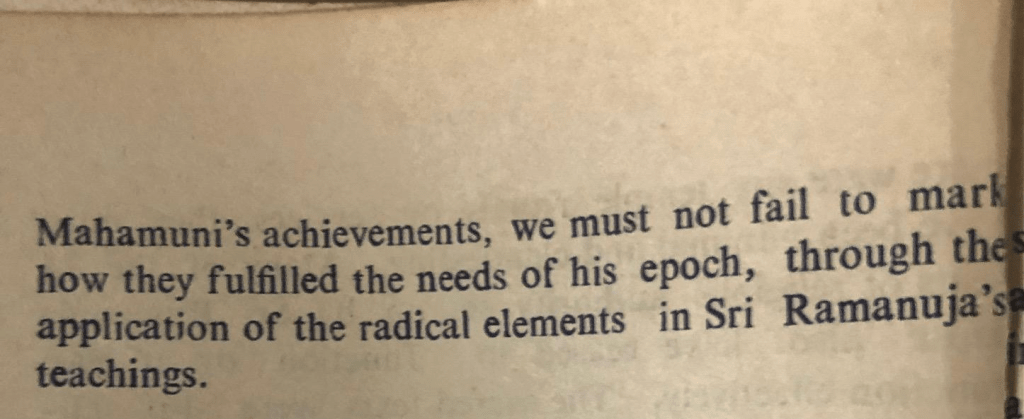
Anyone reading the above passages, and between the lines too, cannot fail to see that Prof. M.R.Sampathkumaran makes a giant leap midstream in his essay suddenly from narrating history to narrating self-serving legend. And the purpose becomes clear: Start weaving a pre-fabricated, pre-conceived and pre-meditated story of a so-called “rift in tradition”!
What “rift in tradition” is the Professor talking about?! Wherefrom did it arise out of nowhere?! In the larger context of rebuilding Sri Rangam temple from the ruins of Muslim vandalism, what on earth prompts any possible connection with a “rift in tradition“?! In the early 15th century CE, when a completely devastated Sri Rangam was still limping back to normalcy, and all the energies and efforts of “ubaya-vedaantins” of the time and region would have been focused only on the herculean tasks of rebuilding and rehabilitating Sri Rangam temple, what “rift in tradition” could ever possibly be imagined to have suddenly arisen amongst them as to divide them?! It makes no sense whatsoever.
In which passage of the “upadesa rathnamala” cited by Prof.Sampathakumaran is there any specific mention of this so-called “rift in tradtion”?! Or, is there any direct quote of Sri Manavaala Maamuni himself to be cited which is found to be either stating or even implying that his “success in the difficult task of re-establishing the authority of Sri Ramanuja’s administrative arrangements” in the “spiritual capital of Sri Vaishnavism” at Sri Rangam was due to his being able to close such a “rift in tradition”?!
Prof. Sampathkumaran further makes the sweeping general claim in the words extracted above which simply give away his intention: “During the pilgrimages he undertook, Sri Varavara Muni (aka Manavaala Maamuni) must have renovated numerous temples and reorganized rituals and worship”. The use of the phrase “must have” here causes one to pause and mentally ask Prof. Sampathkumaran this: “Which temples?! Do you have a historical or epigraphical record of them? If you say “must have renovated…. etc.” then aren’t you only speculating?!”
It is precisely thus which is the wonted way how Sri Vaishnava narrative-builders go completely overboard while offering exaggeration as hagiography, and if the real intent of Prof. Sampathkumaran were to be made clear here it would perhaps have to be stated in crude but accurate terms such as this:
“To make out a case that the revitalization of Sri Vaishnavism in the post-Sri Ramanuja-era and after the Muslim invasions of the 14th century CE was accomplished singlehandedly by none other than Sri Manavaala Maamuni alone and to whom, therefore, all subsequent generations of “ubaya-vedaantins” and Sri Vaishnavas must remain forever beholden and deferential!”
*************************************
Prof. Sampathkumaran’s essay, we find, gets even more vitiated and polluted by unwarranted, ‘non-sequitur‘ claims of same such sectarian superiority (Tenkalai) being made through yet more such similar narratives. If it weren’t for such claims, his genre of writing might in fact have otherwise made excellent, well-meaning and pious biographical sketch of one of the most illustrious Achaaryas in the lineage of Sri Vaishnava preceptors, Sri Manavaala Maamuni.
Sri Manavaala Maamuni after his many successes in Sri Rangam in restoring Sri Ramanuja’s Order to temple administrations and rituals, is reported to have set out on a triumphant pilgrimage to Kanchipuram in 1420 AD with the ostensible purpose of extending the benefits of his renovative mission and rehabilitative programs to the Kanchipuram Sri Varadarajaswamy Temple as well.
The Kanchi temple-city had remained relatively unscathed by the horrors of Muslim invasion Sri Rangam had suffered. Life was calmer and more or less normal. There was no great ruinous state to repair nor any great disruption in the temple administration calling for any great missionary work of re-organization or re-ordering. The Thaathaachaaryas of Kanchipuram and the “ubaya-vedaantin” laity were pretty much in control of the situation and the affairs of the northern temples were being conducted pretty much as normal and as it had been always been generally in accordance with the “sampradaaya” laid down by the “sri bhaashya simhaasanaadhipathi” tradition of Sri Pillaan, Sri Appullaar and Sri Vedanta Desikan.
Sri Manavaala Maamuni probably returned thus to Sri Rangam without making so much of any noticeably big impact in the Kanchi temple… not certainly as much as by all accounts, including the “upadesa rathnamala”, he had been able to make in other temples in the south. In Kanchipuram unlike in the southern Tamil countryside, the writ of the so-called “tennaachaarya sampradayaam” did not seem to have run as strongly.
It is this marked absence of any “noticeable impact” of Sri Manavaala Maanuni’s visit to Kanchipuram in circa. 1420 CE, or of resembling anything as resoundingly successful events as that which had similarly been achieved in Sri Rangam regions, that led to the creation of the great myth called “rift in tradition” — Tenkalai and Vadakalai —which generations of writers in the genre called “Sri Vaishnava sampradaaya history” have since been able to repeat ad infinitum, ad nauseum until their narratives have become unchallenged, de facto history today!
While the great Achaarya, Sri Manavaala Maamuni himself may have been least bothered about Kanchipuram’s lukewarm response to his triumphalist tour of the temple there, the latter day narrative-builders of the Tenkalai sect however were however greatly miffed at the apathy of their northern brethren shown towards he whom they regarded as their “prathama Achaarya”. The cast was thus set…. and the “rift in tradition” became historical reality retold and revisited a thousand times! Over the period of the last 200 years the Goebellesian Effect shaped and stereotyped the modern Sri Vaishnava sectarian divide….. i.e. simply by repeating a myth, a narrative became reality!
Having created out of a sense of sectarian peevishness the idea or myth of a “rift in tradition“, and having given it strong roots too as far back in history as the 15th century CE — a 100 and more years after Sri Vedanta Desika and Sri Pillai Lokaacharya ! —, the narrative-builders had to give it both sustainability and a grave air or plausibility also.
Such plausibility was once again woven around a web of even more creative figments of imagination and extraneous elements of red herring in the form of (a) abstruse doctrine (called “ashtadashabheda vichaara” or the 18 doctrinal differences on “prapatti” between Tenkalai and Vadakalai), (b) appropriating Sri Ramanuja exclusively for the Tamizh language (thereby alienating Sanskrit), (c) inventing a schism in the lineage of Achaaryas (Azhwaars’ Dravida Veda Vs Sri Bhaashyam schools) and (d) conjuring up so-called norms and standards of strict fidelity in conduct of temple rituals and customs that were claimed to have been laid down by Sri Ramanuja in the Sri Rangam temple.
Dramatically, a so-called “rift in tradition” rapidly arose from feelings of pure and petty human peevishness! And suddenly it started acquiring the character of a deep sectarian fault-line with all of the four dimensions described above! And it went on to cut asunder the ranks of the great ubaya-vedaantins right down the middle into Tenkalai and Vadakalai!
It was a historic tragedy!
And how that tragedy unfolded in later centuries and how sectarian narratives thereafter were created and constructed to further enlarge and embellish those 4 dimensions of the “rift in tradition” is exemplified in and by Prof. Sampathkumaran’s own words in his essay being reproduced below:
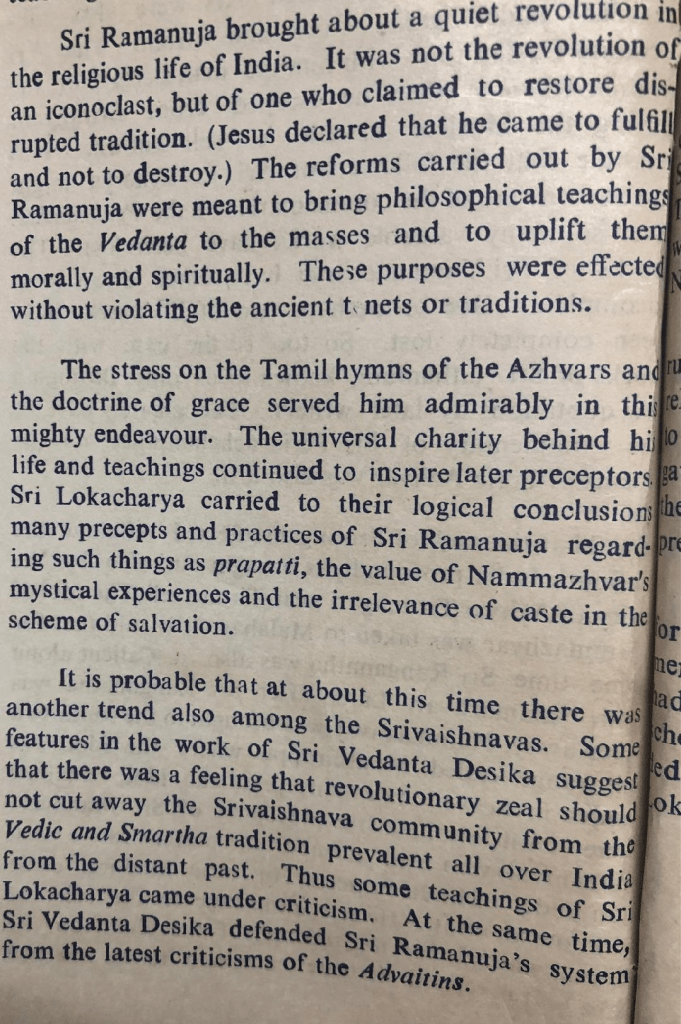
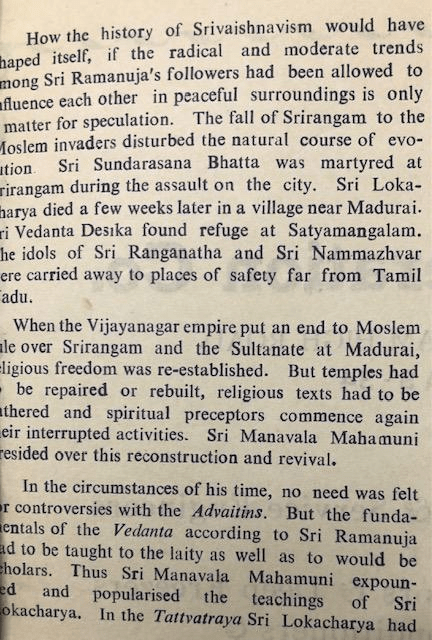
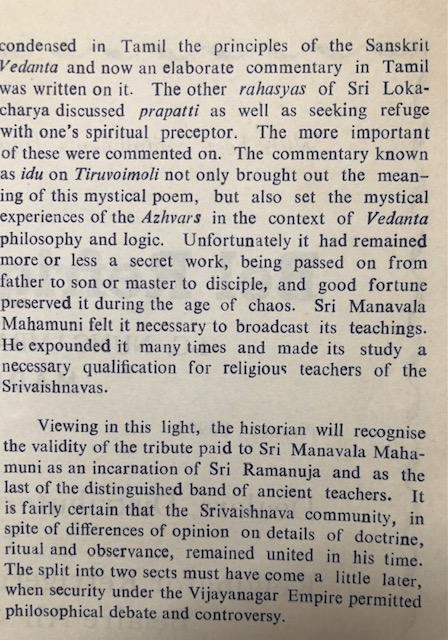
(to be continued)
Sudarshan Madabushi