In 1732 CE, the Persian marauder, Nadir Shah, invaded the Mughal capital of Delhi and carried out sheer unspeakably barbarian-scale mayhem, slaughter, loot and plunder for 57 days! The historian William Dalrymple writes (in his book, “The Anarchy”) that at the end of his expedition, the value of the loot that Nadir Shah took back with him to Persia can be estimated in today’s equivalent monetary terms to be “around GBP. 9.2 billion!”
No historian to date, however, has been able to similarly estimate reasonably the aggregate value of loot that was plundered by all other Islamic invaders into India, starting with Alauddin Khilji until Nadir Shah. Nor has any historian, past or present, old or young, ever cared to, or been able to similarly research successfully and arrive at any educated estimate of the total value of looting by Islamic Mughal invaders of 100-odd Sri Vaishnava temples in South India.
After having suffered for more than half-a-millennium from the ravages and depredations inflicted upon them by Islamic invasions across India, the great temples of South India — Saivite, Vaishnavite and others — continued to face unrelenting tribulations in the ensuing two centuries (19th and early-20th century CE) too under British Rule.
Although the temples did not have to face violent loot and plunder as before during Islamic rule, they had to perforce, all the same, suffer extreme financial tyranny under the weight of very oppressive governmental interference into their management and affairs by the administrators and officers of the British East India Company and later the British Crown.
Utsa Pattnaik, a renowned economist from India, wrote a research article in Columbia University Press in 2018. Patnaik concluded that Britain plundered almost $45 trillion from India between 1765 CE to 1938 CE, based on nearly two centuries of precise tax and trade data. https://historyofyesterday.com/how-britain-looted-45-trillion-from-india-2e923dfb2efb . How much of this estimated plundered value can possibly be attributed to plunder through the British rentier-system, and through extraction from their tyrannical taxation-system inflicted upon the temples of South India and Tamil country is yet another piece of research that no historian has ever ventured to undertake to date.
The temples of the Sri Vaishnavas across the Tamil province — a majority of which already since the 18th-19th-century CE was being claimed as belonging to them alone by the Tenkalais — were no exception. For the British East India Company, all Hindu temples — big or small, rich or not-so-rich — were potential sources of revenue that had to be maximized through every possible means so as to fill its own coffers and the vaults of the British Treasury back home in England.
Part of the revenues so collected were used by the Company to also fund its frequent military campaigns against the French colonial presence in India as well as in expeditions against native and recalcitrant adversaries like Tipu Sultan and the Marathas. And part of the same revenues were also used to finance the administrative costs of running the British Government, its bureaucracy and its budgetary expenditures in India. There was no doubt at all that temples were being impoverished, slowly and steadily, of much of their commonwealth, riches and spirit by the British.
The slow bleeding of most of the Sri Vaishnava temples in the Tamil provinces although well known to the community, however, still remains a subject of only hearsay, guesswork, conjecture and speculation. The Sri Vaishnavas have not attempted to research and record the subject-matter in the methodical and objective manner of modern historians. There is little available today in the annals of the Sri Vaishnava community that can be said to be of really any use as genuine and valuable historical information on the subject. This is yet another failure of the Sri Vaishnavas to build authentic archives and chronicles of fact and real events related to the history of their temples.
The community however is overly fond of preserving and cherishing the respective “sthala puraanams” of their famed temples. The “sthala-puraanams” unfortunately belong more to the realm of Mythology than to History as known to us today in the academic sense. Both the Tenkalais and Vadakalais, through the centuries after Sri Ramanuja’s time, expended their collective energies on creating fanciful and incredible narratives to buttress their respective case in narrow, internecine sectarian skirmishing they were long engaged in. Had they instead used even only half of such energy in faithfully and dispassionately recording true facts and updating events related to their temples, the same “sthala-puraanams” might then surely have served a far greater and significant social purpose for posterity.
Since so little of authentic history is available today about how much of wealth and revenues from the 100-odd Sri Vaishnava temples the British ferreted away through stealth and taxation, the only possible other means to somehow reconstruct in our minds of what might have happened during those times can only be roughly surmised and inferred. Such surmises about British kleptocracy and its mendacity can be inferred from published records available which relate to no more than but a handful and they relate mostly to only the largest and most famous Sri Vaishnava temples that were well known even in those times to have possessed fabulous and prodigious wealth — such as Tirumala, Sri Rangam, Melkote and others located in the riparian delta provinces of Tanjore, Trichnopoly, Tirunelveli and Mysore as well as those like Kanchipuram and Sri Perumbudur situated in the northern districts along the banks of the Paalar and Pennaar rivers. At these temples, large-scale revenue-diversion and wealth-expropriation by the British was being conducted right under the noses, as it were, of the traditional custodians and administrators, the hereditary Jeeyars, Ekaangis, “Srikaaryams and such other age-old functionaries who were rapidly losing all their power, grip, pre-eminence, hold and entitlements in what used to be once their exclusive domain of priesthood influence and leverage.
The British with their formidable military and political muscle effectively staged a large-scale takeover of the temples and brought the traditional priesthood, managers and temple overseers to their knees. Over the ensuing hundred-odd years they wrought and brought about a complete revolution in the model and ways in which temple-institutions had hitherto been set up to function by none other than Sri Ramanujacharya himself since the 11th century CE.
The old order was clearly changing and yielding place to new! The entire Sri Vaishnava temple-ecosystem began to undergo a glacial but fundamental transformation. Their traditional spirit of spiritualism in which it was steeped was crossing over to mercantilism thanks to British interventions. Although the British piously kept claiming, for the sake of public consumption and records, that their Queen in England had decreed that her Government in India would scrupulously adopt a hands-off policy towards native religious establishments, customs, sentiments and religious practices, it became evident the ground reality was, quite to the contrary, very different. The temples were now functioning as per the “Bruce Code” that was slowly replacing the “Ramanujacharya code”….! (more about this further below).
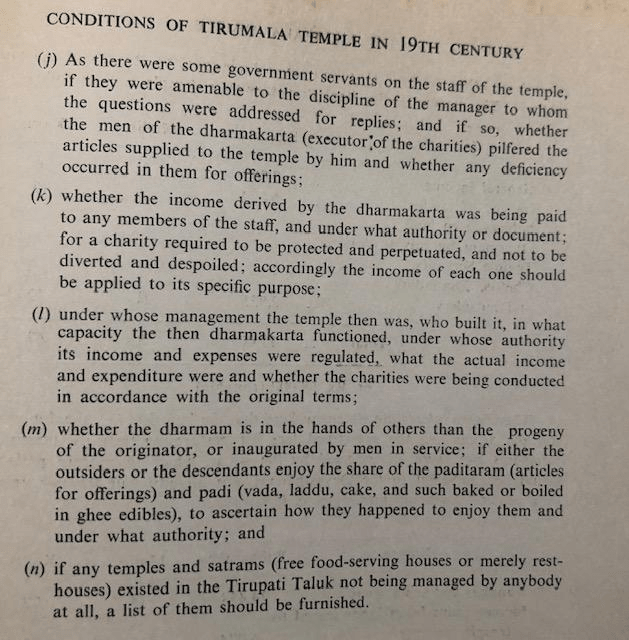
There is well-researched and comprehensive history of the Tirumala Temple published by the Tirumala-Tirupati Devasthanam (TTD) (referred earlier in Part-13) that contains very authentic accounts of how the British administration systematically bled revenue and wealth from the famous Temple of Lord Venkateshwara for several decades under their political rule. Reading the several accounts of what happened to, and at the Tirumala-Tirupati temple helps one to easily understand and realize that what similarly might have happened to other smaller Sri Vaishnava temples across South India, would have differed from Tirumala only in degree of scale but no temple could have escaped the same fate.
A wide-angle perspective of all the machinations British Rule resorted to at the Tirumala Temple can be easily gained by perusing through a sampling few of very graphic passages reproduced below from the TTD book . They are self-explanatory and give one a pretty good idea of the slow but steady impoverishment the temples of the Sri Vaishnavas suffered under British Rule throughout the 19th and early 20th centuries CE.
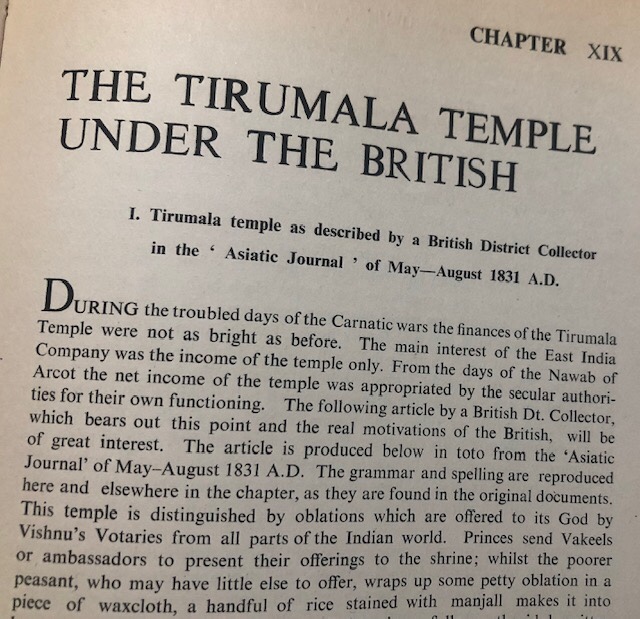
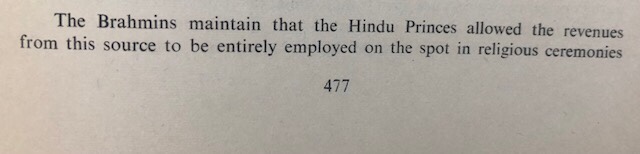
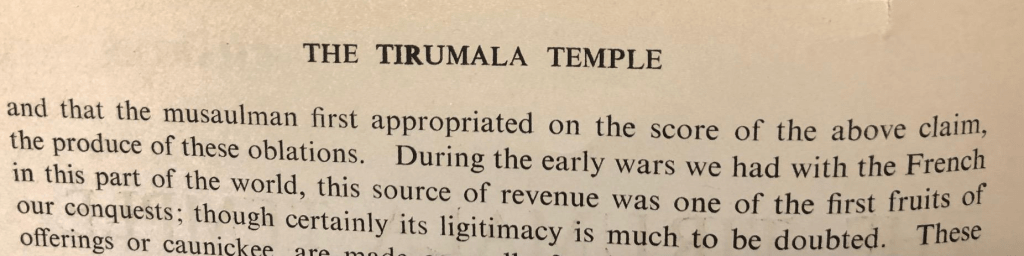
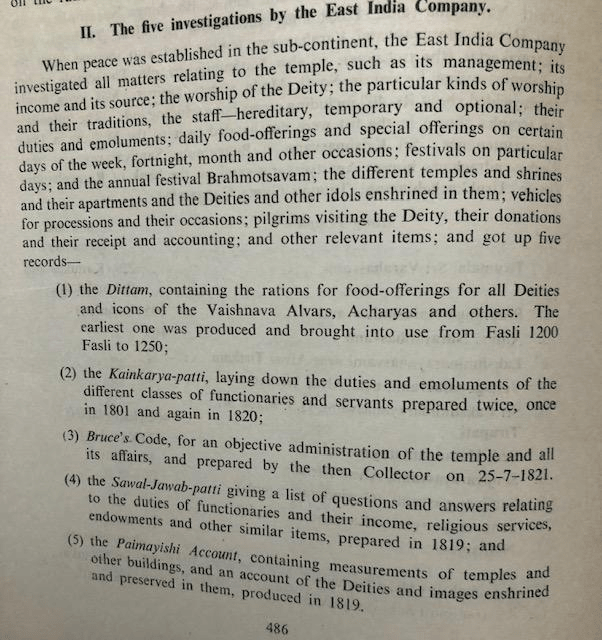
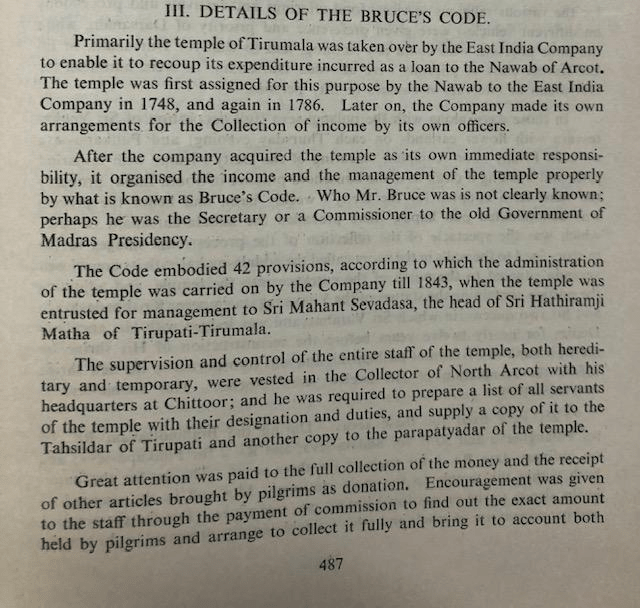
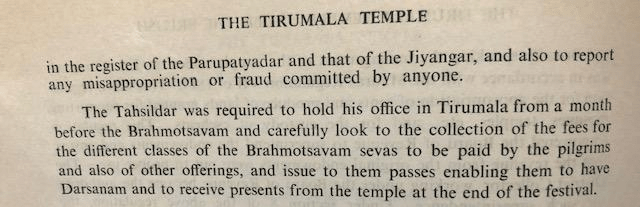
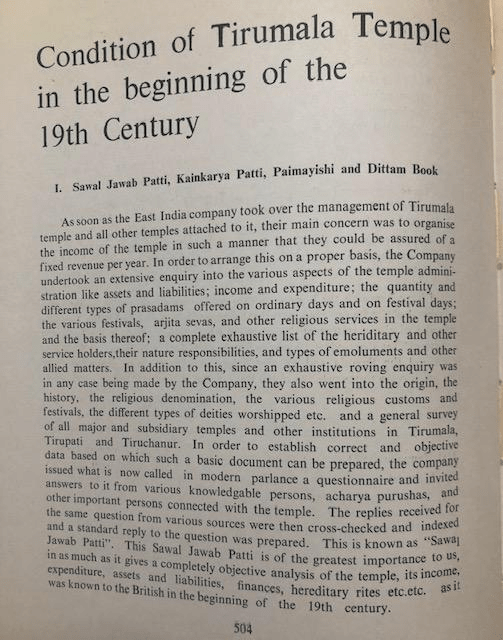
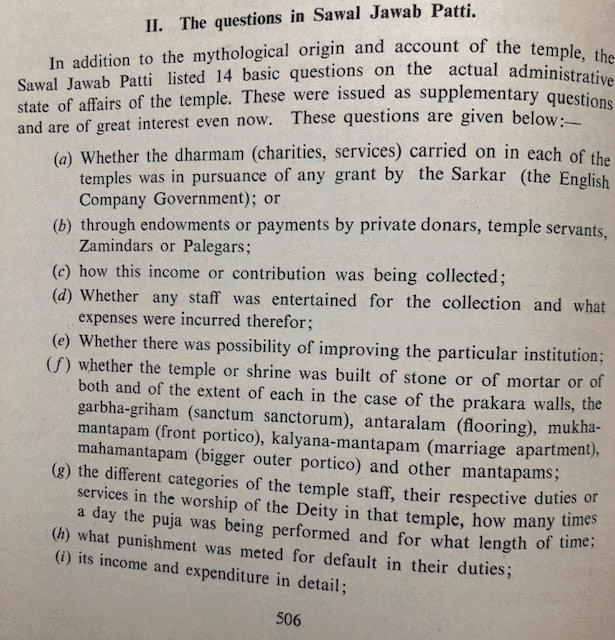
Indeed, the “Bruce Code” gradually came to be established as the emerging new “Gold Standard of Best Practices” for administering Sri Vaishnava temples, thus overshadowing much else of all that Tenkalai temple-priesthood had hitherto claimed was their own hallowed code of temple administration derived from the first principles they averred had been laid down by Sri Ramanuja in the 11th century CE.
(to be continued)
Sudarshan Madabushi