In the decades after Indian Independence — and especially after the Dravidianist Movement triumphed in the 1967 State elections and captured the seat of power in Tamilnadu and held on to it continually thereafter until the present day — the small community of “ubaya-vedaantins”, along with the entire Brahmin populace in the state, suffered traumatic decline which uprooted their cultural values as never before in their history… not even during perhaps the era of Muslim invasions or British colonialism.
Beleaguered by several court-rulings and the working of the new laws of the land in the name of Secularism which became the touchstone by which under the Indian Constitution all other Hindu social values and religious customs and practices were judged, and besieged as well by the electoral dynamics of the brand of politics — i.e. of “social justice” and “anti-caste, anti-Brahminism” — waged by the Dravidianists of Tamil Nadu, the Sri Vaishnava community witnessed steady decline and fall in both its tangible and intangible wealth. As explained in previous Parts, the intangibles lost were mainly (i) Sanskrit, the native language and crucible of cultural heritage, (ii) social status the old order of “varna-ashrama” had conferred on it but now stood outlawed, (iii) traditional priesthood vocations (iv) livelihoods within the rural ecosphere or village-temple economy lost due to mass migration to urban India and above all, (iv) loss of control over temple revenues and wealth.
While the beleaguered community waged losing battles, in the court-rooms and the corridors of political power, against the aggressive intrusion of the State into affairs of the community’s temples through slow, steady and incremental expropriation of temple tangible wealth, it was next soon also getting constantly bedeviled by Dravidian propaganda apparatchiks and “anti-Brahmin” missionaries who began setting their sights on appropriating the most valuable item of its non-tangible wealth: two of the most revered icons in Sri Vaishnavism who had given the community its distinctive historical identity:
Ramanujacharya, the 11th century CE preceptor of “ubaya-vedaanta” tradition, the founder of a unique Vedantic school of philosophical thought, the builder of Sri Vaishnava temple-institutions across India, the pioneering pontiff of Sri Rangam and one of the greatest socio-religious reformers in modern Indian history.
Andal, the only woman-saint in the pantheon of the twelve mystic Tamil saints known as the holy Azhwars (c. 4th century CE to 8th century CE)
*******************************
Throughout the post-Independence decades, the most eminent amongst Dravidianist ideologues — Periyar, Annadurai Karunanidhi and son, M.K.Stalin — mostly adopted an openly aggressive and adversarial posture against the enemy they identified as the “Aryan-Brahmin-Sanskrit” combine. The posture was at the very core of their ideology and it was a very uncompromising one indeed. It greatly helped them succeed electorally for well over 50 years in Tamil Nadu politics since the electorate during the period had become riddled and riven by rabid casteism. Anti-Brahmanism became both a powerful philosophical credo and a political manifesto. Thumping and repeated successes at the hustings gave the Dravidian political parties all the ample Constitutional legitimacy, room and opportunity they needed to redraw, redefine, re-engineer through deconstructing the old societal architecture of what was said to be the Brahminical template and re-engineering it establish a new Dravidian one in Tamil Nadu. One amongst several other goals of such a sweeping social re-engineering program (“samoogapuratchi” it was called in Tamizh) was to wrest power and control over the entire tangible wealth of temples from the custody of Brahmin classes and transfer it effectively into hands of the Dravidianist State to sub-serve state policy and ideological interest.
Out of the 38,652 temples in the State having annual incomes over ₹2 lakh and above, no more than 1003 of them (i.e. 2.6% of the total) combined to handsomely provide the State with many billions of rupees in leviable revenue-streams every year and many more billions in terms of hard, tangible asset-base available as land and property, gold and precious jewelry. In fact, the State could easily do better even today without having to control and supervise the other 97.4% of the total number in the State, or 37, 649 temples which contribute only measly annual revenue-streams…. say, between Rs.10,000 and Rs.200,000. Yet, the State’s HR& CE Commission would not and never has ceded control of the low-yielding temples or returned them back to the traditional trustees or community custodians?
Why?
The answer is the Dravidianist ideologists knew they could not rest content with just electoral successes and consequent expropriation of temple tangible wealth alone. The more important wealth that had to be raided and taken over was a cultural intangible. It was more important for them to wage a “culture war” against Brahmins and the upper-classes. The Dravidian philosophy was fundamentally and wholly atheistic (they called it “rationalist” though) and its proponents knew they had to transform the entire temple-centric culture of the native Tamil peoples and remold it to their very own “heart’s desire” for generations to come. That important task could not be undertaken without necessarily retaining and exercising administrative and regulatory control under statute of not only the 1000-odd high-revenue, high-tangible asset-owning temples of Tamil Nadu but also control over the 37,000-odd low-yielding, much smaller and very poor-revenue-earning temples too. The State could therefore never give up oversight of any temple — big or small, money-spinning or note — in favor of community trustee-groups nor cede any space to Brahminism- Vs. Dravidianists culture war being waged relentlessly.
No work of modern history of the Sri Vaishnavite community would be complete without at least a cursory telling of how the Dravidianists went about waging the culture-war against Brahmin cultural hegemony on the battle-grounds which 38,000-odd temples in Tamil Nadu combinedly became. The strategy they adopted to achieve the goal of appropriating the non-tangible heirloom of the temples may be called — for want of a more telling expression — as classic “salami-slicing”.
**********************
What is “salami-slicing” strategy?
Salami slicing is said to be a divide and conquer process of threats and alliances used to overcome opposition. With it, an aggressor can influence and eventually dominate a landscape, typically socio-political, in piecemeal fashion. Opposition is eliminated “slice by slice” until its members realize, usually too late, that it has been virtually neutralized in its entirety. The tactics include the creation of several factions within an opposing party, a prey or an adversary, followed by its dismantling from the inside, without giving the affected party the opportunity to protest or react. Salami tactics most often succeed when its perpetrators keep their true long-term motives hidden and maintain a posture of cooperativeness and helpfulness while engaged in gradual subversion.
The strategy adopted by Dravidianism to “salami slice” the Brahmin in Tamil Nadu was to recognize, target and manipulate the several factions within the Brahmin community in “piecemeal fashion” and “dismantle it from the inside“. The sub-sectarian factions within the Brahmins were only too well known to the Dravidian ideologues and hence became the points upon which social pressure could be effectively applied to create fissures within the community and be cynically exploited to advantage. In the State, the Saivite, Saiva Siddhaantist, Advaitin, Smaartha, Madhwa and Sri Vaishnavas communities were all very distinct religious factions.
Within the Sri Vaishnava community the schism between Tenkalai and Vadakalai was deep and rancorous caused by the Sanskritic Vs Tamil divide. And within the Sri Vaishnava community there was further factionalism that existed along various “sub-sampradaya” lines that emanated from “acharya parampara” or schools of different preceptors. As already explained in previous chapters, the ‘schism’ as understood in the colonial period by the historians involved a series of disputes between the Vatakalais and Tenkalais over the temple administration. A short historiographical treatise (https://docslib.org/doc/8886035/srivaisnava-community-in-history-and-historiograph) explains this fact elaborately as follows:
QUOTE:
“This feature was also characteristic of the pre-colonial period. Although direct evidence is not available, it can be inferred from the epigraphical as well as textual sources that tensions between various sects and religious leaders existed. The case of Uttamanambis, Sriranganarayana Jiyar and Kandadais at Srirangam….” are cases in point which too have been elaborated upon in more than one previous chapters. “…… the presence of several prominent leaders in a temple center would hardly encourage peaceful co-existence. However, over a period, the alignments across Sanskritic and Tamil ones were gradually crystallizing into strong sub-sects. The coming of the British and their interactions with the religious institutions led to the reworking of the entire power relations…” between the two. In the early years of the colonial rule, the British government decided the temple disputes. Perhaps, then the need arose to establish distinct sectarian identities cutting across the regional frontiers based on common interests. Therefore, the Sanskritic affiliations came to be identified as the Vatakalai and the Tamil ones as the Tenkalai.
“The Vatakalai-Tenkalai notion of Srivaisnavism has altered the entire identity pattern of the community. The daily practices of both the sub-sects have too much specificity that has the rational for the assertion of Vatakalai-Tenkalai identity. For instance, the external sect marks (like the namam) and other rituals of the respective sects reiterate the differences that strengthen the sectarian affiliations for the Srivaisnava psyche.
“The assumption that Tenkalais attached secondary importance to caste and Vatakalai stressed on caste injunctions is not correct. The entire history of Srivaisnavism right from Ramanuja’s time indicates the domination of the
brahmanical hierarchy, where varnasramadharma was always upheld and readjustments and realignments were made within this framework.
“The delineation of the Srivaisnavas in the textual tradition as a homogenous community by its predominantly brahmanical leadership involved the structuring of a cohesive and distinct identity around Visnu as the supreme universal god. ….. Such a normative projection of homogeneity often deliberately camouflaged the diversity of affiliations and multiplicity of identities that existed. The non-brahmanical elements, possessing distinct identities in the form of caste, occupational groups and regional origins, were not highlighted, although they were an integral part of the community. However, the discourse on a single universal community structure was never final. The consolidation of religious network implied the development of a broad social base. This required continuous interaction and assimilation of the autochthonous traditions, majority of which were centered on” … local cults….. “Although the community hierarchy accommodated all these traditions reflecting the supremacy of the Srivaisnava community, there were tensions in such a structured incorporation. The local cultic identities never were subsumed. Rather, the Srivaisnava identity was added on to them. These developments had important ramifications for the notion of a ‘community’. Multiple regional identities remained distinct and were acknowledged within the larger uniform Srivaisnava framework…. Multiple affiliations and identities thus had developed within the Srivaisnava community, and the Srivaisnava community at no point of time could sustain its claim to uniformity and homogeneity.
UNQUOTE
Today, the Tenkalai and Vadakalai sects can indeed be classified as belonging to several different Muttams headed by Acharyas of varying regional or “sampradaya” identities that are almost cultic. Below are only a few of those enumerated in the Tenkalai fold:
H.H. Sri Sri Appan Parakala Embar Ramanuja Jeeyar Swami, Sriperumbadur
H.H. Sri Sri Madurakavi Ramanuja Jeeyar Swami, Vanamamalai
H.H. Sri Sri Perarulala Ramanuja Jeeyar Swami, Thirukkurungudi
H.H. Sri Sri Periya Kovil Kelvi Appan Satagopa Ramanuja Periya Jeeyar Swami, Thirumalai
H.H. Sri Sri Ilaya Kovil Kelvi Appan Govinda Ramanuja Chinna Jeeyar Swami, Thirumalai
H.H. Sri Sri Emberumanar Ranga Ramanuja Jeeyar Swami, Alwar Thirunagari
H.H. Sri Sri Ethiraja Jeeyar Swami, Sriperumbudur
H.H. Sri Sri Tridandi Srimananarayana Chinna Jeeyar Swamy, Hyderabad
H.H. Sri Sri Vadikesari Azhagiya Manavala Jeeyar Swami, Kanchipuram
H.H. Sri Sri Sadagopa Ramanuja Jeeyar Swami, Thirunarayanapuram
H.H. Sri Sri Sadagopa Ramanuja Jeeyar Swami, Srivilliputtur
H.H. Sri Sri Sendaalankara Sampathkumara Ramanuja Jeeyar Swami, Mannargudi
H.H. Sri Sri Tridandi Devanatha Ramanuja Jeeyar Swamy, Hyderabad
H.H. Sri Sri Tridandi Ahobila Ramanuja Jeeyar Swamy, Hyderabad
H.H. Sri Sri Tridandi Astakshari Sampathkumara Ramanuja Jeeyar Swamy, Vijayawada
H.H. Jagadguru Sri Ramabhadracharyaji Maharaj, Chitrakoot
H.H. Jagadguru Sri Lakshmiprapanna Jeeyar Swamyji Maharaj, Buxar, Bihar
H.H. Sri Sri Tridandi Srirangaramanuja Jeeyar Swamy, Kakinada

Similarly, amongst the Vadakalai sect, the following are the various sub-sectarian sub-sampradaya factions: Sri Ahobila Mutt, Sri Parakala Mutt, Sri Srirangam Srimad Andavan Ashramam and Sri Poundarikapuram Andavan Ashramam to name only a few besides several thousands of “ubaya-vedantins” who calling themselves, as “svayamaachaaryas“, remain unaffiliated to any Mutt, choosing to project themselves as independent Sri Vaishnavas.
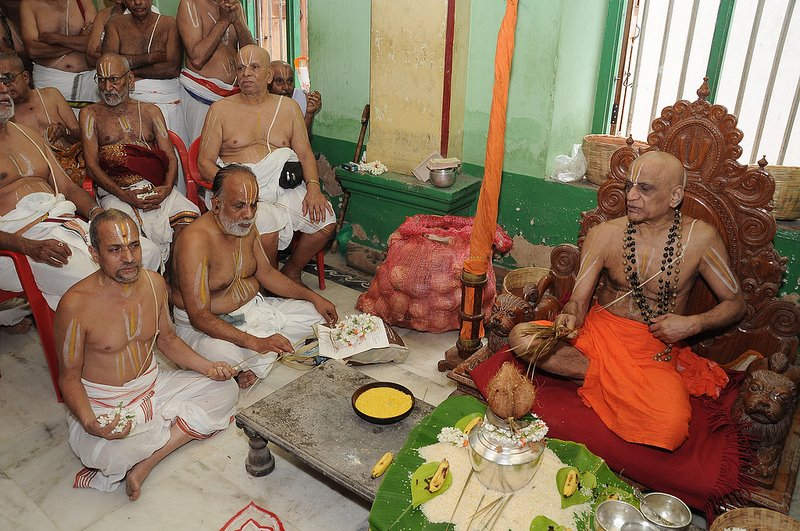
Among these Mutts, Parakala Mutt is more than 700 years old, and the oldest. The Ahobila Mutt is a 700+ year old monastic order, and the second oldest. Srirangam Srimad Andavan Ashramam is a 300+ year old organisation, which came into existence by the 18th century CE, while Poundarikapuram Andavan Ashramam is 100+ years old. Traditionally, places of high importance with significant Vadakalai populations included Kanchipuram, Kumbakonam, Tiruvallur, Mysore and Kurnool district. The numerically superior population of Tenkalais dominate the rest of the regional dispersal of Sri Vaishnava within the state of Tamil Nadu and Andhra Pradesh.
****************************
The “salami slicing” of the Tamil Brahmin was executed thus through a two-pronged tactic of the Dravidianists.
The first one was to appropriate to themselves, the important historic icons of Brahmins, of which a few of those of the Sri Vaishnavas alone are being highlighted here. below. There are two of them which are to be principally noted:
A. The attempted appropriation of Sri Ramanujacharya
B. The attempted de-apotheosizing of Sri Andal
The second tactic consisted mainly of efforts to encourage and incite the upending of the cultural value-systems of so-called… or so-labeled… “brahminism” which was done through deliberate distortion and degradation of its socio-cultural profile within Tamil society. The most egregious of such attempts in recent years have been the following two:
C. The deliberate assault on the most sacred institution of Hindu personal law: the Brahmin wedding ritual
D.The attempt to de-Brahminize the classical music traditions of Tamil Nadu
The above 4 tactics will be narrated next in Part-48.
*******************************
(to be continued)
Sudarshan Madabushi