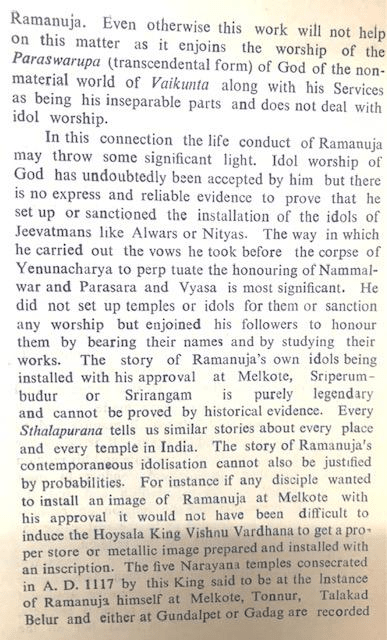
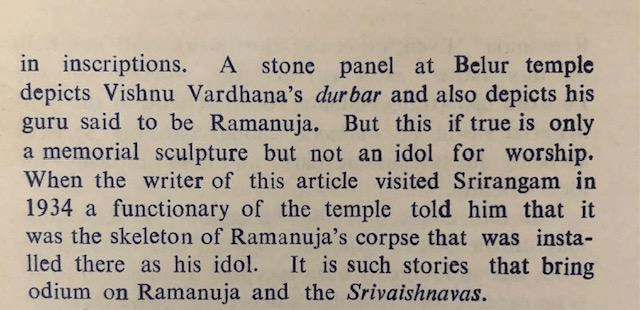
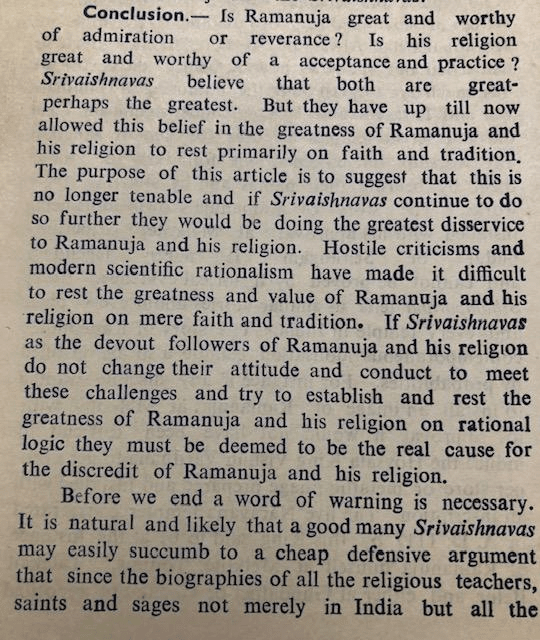
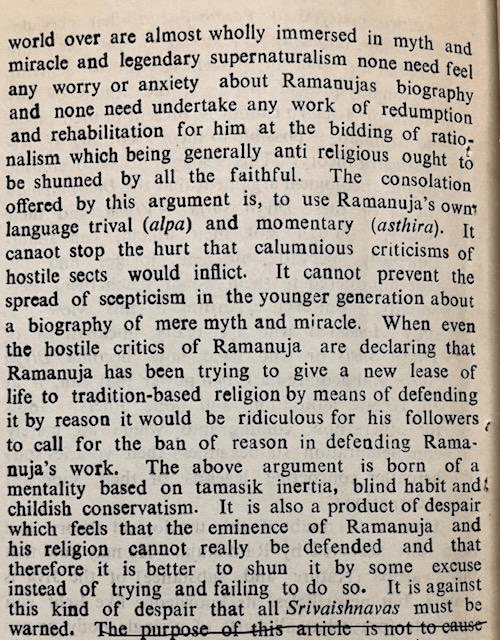
In this section in the little-known c.1960s pamphlet titled “Ramanuja and Sri Vaishnavas” the subject dealt with by Doraiswami Iyengar is the rather delicate and controversial question of Idolatry which according to him has become almost a defining characteristic of the modern Sri Vaishnava identity.
Once again a brief explanatory note is being penned below to help the reader avoid hastily misunderstanding or grossly misconstruing the well-meaning intent with which Doraiswamy Iyengar expressed his very bold views so emphatically to drive home his points.
*****************************
In most monotheistic religions of the world, the practice of idol-worship or idolatry carries a certain stigma since it is historically associated with primitivism or animism.
The Visishtadvaita philosophy in which “ramanuja-darsana” is firmly rooted is essentially Vedantic monotheism. Its vision of Godhead is an Upanishadic ideal. It is founded on the conception of a formless, nameless, omnipotent and omniscient entity called Brahman. While this philosophy of the Upanishad conceives of worship of Brahman as “upaasana” or “dhyaana” — i.e. meditative contemplation on the formless Deity — it does not speak anywhere of worship of God in the form of an object. The pure Advaitic vision does indeed conform to this very Upanishadic ideal of a formless, shapeless and undefinable Divinity.
Ramanuja’s Visishtadavaita, or qualified monistic philosophy, however simply ignores such stigmatic prejudice against idolatry. While the foundation of his philosophic “darsana” was monotheistic in the true Upanishadic sense, he built his theology however within a paradigm that was altogether different. It was a theology wherein idol-worship — “archamurthi Aradana” — was in fact glorified as a special form of “upaasana” or worship of God. Ramanuja institutionalized idol-worship inside temples. Idolatry was legitimized on the authority of Sri Vaishnava scriptural “Agama saastras”‘ which comprised a vast Veda-based body of ageless, quasi-occultist, quasi-cultic Tantric science and systems of worship. These Agama-systems were derived and distilled by Ramanujacharya from several esoteric but authoritative texts of “smriti“, “samhita” and “sutra“…. such as the “paancharaatra agama”, “vaikhaanasa agama”, “lakshmi-tantra”, “satapata braahmana”, “ahirbudhniya samhita, harita-samhita“…. to name only a few…. besides elements drawn from subsidiary “upa-vedas” such as “vaastu“, “shilpa” and “kalpa” “-sastras”
Sri Vaishnava idolatry thus got founded upon a unique Sri Vaishnava theology which posited Divinity being accessible by means and medium of Agama practices, rites, mantra, yantra and tantra and other semi-occult rituals. Divinity by means of Agama could be inhered into specifically configured idols which then could also be consecrated within specifically designed architecture, erected and constructed as temple-structures and sanctums, and maintained strictly as per the Agama sastra . The temple idols (archa) so consecrated through a process called pratishta according to Agama sastra became virtually thus a locus of powerful latent divine energy concentrated in the form of a Deity that was cast in rare stone (granite), fossilized ammonite (salagraama) or metallic-alloy (panchaloha). The investiture of the idol of the Deity within the sacred precincts of a temple was then duly completed. Highly ritualized and sacerdotal worship offered by a devotee to the idolized Deity enabled him or her to attain soulful communion with God.
Ramanuja’s Agama-based theology rested thus entirely on the fundamental principle that no stigma could ever be attached to the practice of idolatry so long as it conformed strictly to the prescribed canonical rules of the Agama sastra.
*************************
Inside the great Sri Vaishnava temples seen even today, the Deity of Vishnu is worshipped as an “archa murthy” or idol sculpted as per norms conforming to Agamic iconography. The temple too — with its sprawling complex of towers, concourses, the flagstaff “dhvaja-stambha”, outer and inner sanctum or “sannidhis”, the altars or “bali-peetam“, the “vimaana” and “kalashams“, the multi-pillared “mantapams“, “praakaras“, “mahaadwaaras“, concourses etc. — is constructed as per architectural design and blueprints of the Agama sastra. No deviations are allowed since a breach of the Agama rules is believed to result in grievous defects in the mode of worship inside the temple and, consequently, the experiencing of dire and possibly malefic effects which are in fact warned about in the Sastra itself.
The canons of the Agama sastra broadly mentioned above all strictly relate only to the consecration of idols made in the image of the Deity Vishnu adorned by his divine weapons (panchaayudha), his Divine Consorts (Sri and Bhu Devi), accompanied by “nithyasuris” or the heavenly archangels such as Ananthan (the divine serpent-bed of Vishnu), Vishvaksena (the celestial chief-of-staff), Peria-tiruvadi (Garuda, the divine avian vehicle of Vishnu) and a few other sub-deities subordinated to Vishnu. Generally speaking, the iconography of Agama sastras was never conceived to allow for the ritual consecration (pratishta) of idols sculpted in the image of any mortal or human being nor to permit enshrining them within temple precincts inside smaller shrines or “sannidhis” for purpose of worship outside the sanctum-sanctorum of the main Deity. In the post-Ramanuja era however, there began to trend gradual departures and relaxations from the strict theological canons of Agamic worship. In the great Vishnu temples (divya-desams) of Tamil Nadu, Andhra Pradesh and Karnataka, the Sri Vaishnava priesthood and laity began circumventing if not flouting the Agamic rules that proscribed “pratishta” of idols made in the image of man no matter how high-souled or worthy of veneration and worship he might be.
Gradually, through the years between the 17th century CE to the 21st century CE, as the Tenkalai Vs Vadakalai sectarian divide grew wider and more rancorous, a new idolatrous trend began to emerge in the mode of temple-worship practiced by the Sri Vaishnavas all in the name of “Acharya bhakthi“. Inside the great Vishnu temples that Ramanujacharya himself had in his time consecrated — such as in Sri Rangam to name only one outstanding example — the idols of Sri Vaishnava Acharyas and preceptors soon began to get installed and enshrined as subsidiary “sannidhis“. These shrines of the Acharyas — nearly a dozen or more of them — erected at various corners of the vast sprawling “praakaras” (concourses) around the sanctum were meant to not only attract devotees to offer worship and donations there but also to commemorate a particular lineage of “Acharyas” (i.e. Acharya paramapara) belonging to a one or the other sect of Sri Vaishnavas …. either the Tenkalai or Vadakalai fold. To these consecrated idols of the Acharya, the temple priests would render specific liturgical services in terms of daily offerings (“nithya padi neivedyam“) and grand festive honors (“saatrumarai“, “mangalaasaasanam“, “uthsava purapaadu“… etc.
At first the idols in the image of Ramanujacharya himself were installed and enshrined. Then as time wore on and the sectarian rivalry between Tenkalai and Vadakalai grew more and more strident and animated, the former group with a view to affirming and asserting aggressively their “Draavida-Veda sampradayam” began installing idols of the pantheon of the 12 Azhwars inside the temple precincts. This led to the Vadakalai “ubaya-vedantins” retaliating by installing, within the temples that they controlled, idols of not only Ramanuja and the Azhwars but also those principal Acharyas in their very own long lineage of preceptors — beginning with Nathamuni, Alavandar, Uyyakondar, Manakkal Nambi, Vedanta Desikan et al….
Thereafter as centuries rolled by, and as the simmering sectarian tensions between the two groups further flared up, the cycle of one-upmanship that was getting exhibited through competitive idolization of their respective Acharya parampara began to only spiral out uncontrollably leaving the Sri Vaishnava leadership — i.e. the heads of Muttams and Ashrams, Jeeyars, gurus and community-elders — either helplessly witnessing the spectacle or else getting embroiled themselves in the competitive fray.
In times that followed even more competitive demonstrations of sectarian jingoism occurred: the Tenkalais started giving pride of place within the sacred precincts of Vishnu temples they controlled to the consecration of their principal Acharya, Manavaala Maamuni excluding all other important preceptors in the Vadakalai lineage. His idol or “sannidhi” alone came to be installed within special quarters outside the main sanctum in all Tenkalai-administered temples– such as their main one at Sri Rangam. This signaled short-shrift in such temples being accorded to the “acharya-paramapara” held dear and venerated by the “desika ubaya-vedanta sampradaya“. They retaliated then by erecting “sannidhis” within temples administered by them — such as the great temple of Varadaraja temple at Kanchipuram or of Devanatha temple at Tiruvaheendrapuram — reserved exclusively for Vedanta Desikan and his “acharya paramapara”. They deliberately and totally ignored the “tennaacharya paramparai” or the long lineage of preceptors in the Tenkalai sectarian fold!
********************************
Sometime around perhaps circa. 16th century CE, a daily litany of hymns — called “saatrumarai kramam” — chanted in praise of their respective Acharya-lineage was composed (exact authorship unknown to this day) by each of the two sects separately. This litany became a standard fixture in daily and festive temples services (“seva kaalam“). It was was to be rendered in chorus by priests, devotees and pilgrims assembled at the sanctum every day.
Now, it so happened that the Tenkalais would not allow the chanting of the Vadakalai “sattrumarai kramam” within their temples … and so was it vice versa!
Taking umbrage against each other in petty show of mutual sectarian spite, the Tenkalais in their temples would also never permit any Tamil hymn other than that of the “naalaayira divya prabhandhams” of the Azhwars to be sung during the daily and festive temple services. In retaliation, the Vadakalais, within their own temples, would insist that besides the recital of the Azhwar “prabhandhams“, equal importance would be granted to the recital of the Tamil “prabhandhams” composed by their Acharya, Sri Vedanta Desikan, which they hailed to be “desika prabhandham”.
To the Tenkalai sect, the equating of Vedanta Desikan to the spiritual status of the holy Azhwars tantamounted to heresy! Thus, the ensuing spat arising continually from dispute over whose litany of “saatrumarai kramam” enjoyed greater primacy and importance soon became the source of the bitterest squabbles and most hostile feuding between Tenkalai and Vadakalai in all Sri Vaishnava temples.
The sad irony of all the tit-for-tat squabbling is this: that the spiteful sectarian competition in erecting shrines for Manavala Maamuni and Vedanta Desikan inside their temples — as for other Acharyas too belonging to their respective lineage — came to regarded by both camps as demonstrating their zealous “Acharya-bhakthi”… their genuine, ardent veneration of the Acharya!
In reality, it was however little more than pugilistic war over whose turf inside the ring of sectarian strife was holier… It was little else but jingoistic jousting quite often taken to limits both acrimonious and puerile….
***************************
Although the strict rules of Agama-sastra do not concede to the “pratishta” of idols representing any Deity other than Vishnu inside the temple… and generally does not envisage consecrating idols or icons of mortal souls even if they happen to be venerable Acharyas… the Sri Vaishnava laity and community however goes on to justify even today the worship of such iconic objects. How? On a rather dubious theological pretext that draws authority adduced from the Agama saastras but which cannot be said to be indisputable. The justification is that the idolized consecration of Acharyas is on par with the iconizing forms of Divinity… and that Acharyas are not mere human beings but are, in fact, quasi-avatars of the Deity Vishnu himself! Thus, the 12 Azhwars idolized within temples are to regarded as the “amsha avatars” of Vishnu in the following order:
Poigai Azhwar: the avatar of “paanchajanyam” or the Conch of Vishnu
Boothath Azhwar: the avatar of “kowmodaki” or the Mace of Vishnu
Peyy Azhwar: the avatar of “nandakam” or the Sword of Vishnu
Tirumazhisai Azhwar: the avatar of “sri chakra” or the Discus of Vishnu
Namm Azhwar: the avatar of Vishvaksena or the celestial Chief-of-Staff of Vishnu
Madurakavi Azhwar: the avatar of Kumudan or the lieutenant of Vishvaksena
Kulasekhara Azhwar: the avatar of Kowsthubham or jewel-necklace worn around the neck of Vishnu
Periya Azhwar: the avatar of Garuda or the avian vehicle of Vishnu
Andal: the avatar of Bhu Devi or the second Consort of Vishnu
Tondaradipodi Azhwar: the avatar of Vanamala, or the flower-garland worn by Vishnu
Tiruppaan Azhwar: the avatar of Srivatsa or the auspicious birthmark found on Vishnu’s chest
Tirumangai Azhwar: the avatar of Saarangi or the great bow of Vishnu
***************************
The competitive idolatry in which Sri Vaishnavas of both sectarian camps are engaged in the manner described above, continues to this very day in the 21st century CE. It has become eventually a rather pathetic, often ludicrous travesty of the lofty theological canons of Agamic “archa-murthy” worship upon which Ramanujacharya had instituted it originally in the great temples of Vishnu such as those of Sri Rangam or Melkote.
The most recent exhibition of such extreme idolatry on the part of Sri Vaishnavas is to be seen in the city of Hyderabad in the State of Telengana (erstwhile Andhra Pradesh).
In 2017, the millennial birth anniversary year of Ramanuja, the muttam of Sri Chinna Jeeyar, a very popular and influential Acharya of the Tenkalai sampradayam, came up with the idea of erecting Ramanujacharya’s “216 feet high statue to commemorate his teachings“. It is built on an approximately 35-acre site near Hyderabad. The statue is surrounded by miniature replicas of “108 small temples called Divyadesams“. On the walls and pillars of these temples, the life of Ramanujacharya is portraited. The complex also includes a library and research center. On the upper floor, there is a shrine or “sannidhi” in which a 120kg gold idol of Ramanujacharya has been consecrated for performing daily rituals. The grand 216 feet statue is made of Panchaloha, which is five metallic elements viz. gold, silver, copper, brass and zync. There are statuettes of 5 lotus petals, 27 Padma Peetham, 36 elephants, and 108 footsteps have been made to reach the towering statue. Along with an Omnimax theatre and a Vedic school on the premises, this monument has been declared to be a “state-of-the-art ancient knowledge-center in the new India”!
Doraiswamy Iyengar in his pamphlet calls out all such extreme forms of idol-worship — past and present — that has been practiced by Sri Vaishnavas. He describes it all as “spurious worship”...! His charge is that Sri Vaishnavas have verily reduced and diminished Ramanuja in stature…. from the icon of the lofty Vedantic school of Visishtadvaita that he certainly was, to a commoner’s symbol of almost primitive idolatry in popular imagination.
********************************
(to be continued)
Sudarshan Madabushi