Here’s my own take on this editorial published in the latest issue of of The Economist UK : (please scroll right down to read the reproduced piece)
1. The title should have been rephrased as “ America’s new best fair-weather friend”.
2. India is certainly more democratic and far less liberal than the West. Why? That’s because America is really more a plutocracy than a democracy. And its liberal values are imperialistic — in essence, nature and intent. Which is why whatever form and shape the Biden -Modi Agreement is going to be, it will only be — as the Economist perspicaciously says — “an alignment of interests, not principles”. In other words, it’s going to be a live-in relationship not a marriage .
3. “India is part of the Quad, a security grouping that includes America, Australia and Japan.”
Back sometime in 2020 EAM Jaishankar issued a statement that said “The four countries in the Quad had come together because they find it useful to consult on issues of mutual interest, such as maritime security, connectivity counter-terrorism, resilient supply chains and humanitarian assistance and disaster relief”. There was no mention of Security Arrangement at all then !
Now, three years later , suddenly INDIA is part of a Security Grouping called Quad ?!
Next week the agreement Biden and Modi sign will make it so very obvious that Quad will become unalterably hyphenated with AUKUS ?
4. “America’s foreign policy has always combined realism with idealism.” Well, in fact, post WWII history tells us that clearly America’s foreign policy has always only tried to masquerade realism as idealism.
5. “America is promoting a series of defence deals, some of which may be signed in Washington next week, to enhance military-technology co-operation. The Biden administration reckons this would be the biggest milestone in the bilateral relationship since the striking, in 2005, of a civil-nuclear co-operation agreement.”
Does anyone in India truly know — or else has been able to fully and transparently make known to the public at large — what exactly has been all the costs and all the real benefits that have accrued to the country since 2005 … 18 long years ago ! … from the much feted and trumpeted about Indo-US civil nuclear Co-operation agreement?
The answer to the question above is .. very ironically … being provided in the editorial itself : “Can both sides gain the business and security benefits of co-operation even as they share fewer principles than they may care to admit?”
6. The Editorial observes : “Ideologically, India is suspicious of Western countries and flatly rejects their claim to global leadership. From Jawaharlal Nehru to Mr Modi, India considers the post- war order to have offered it little more than another bout of domination by other countries.The result of these contradictory impulses is disorientating.”
The “disorientation” on the American side is being accurately described as
“It is not clear how much support, if push came to shove, America could expect from India. (India only) wants to bolster its land defences against China, not fight over Taiwan.”And the “disorientation” in Indian foreign policy henceforth is always going to be this ?: that “
The Biden administration’s efforts to accelerate technology transfer to India … (is) to wean it off dud Russian weapons and provide an affordable new source of arms for other Asian democracies.”
So , in the long run will India turn into America’s arms manufacturing subcontractor-cum-dealer in the Asia-Pacific region ?! Is that really the route that INDIA should be taking in its ambitious journey to “super-power-hood” or “vishwaguru” status ? Will INDIA ultimately become one among America’s “dogs of war” — a pack called QUAD-AUKUS ?
7. “Other areas of co-operation could include clean energy and tech, where both seek to avoid relying on China.”“Clean energy”?! Don’t we all know that it is the biggest joke if not fraud upon Humanity ? The world’s two largest polluters of the planet are America-EU on one side and Russia-China on the other side . And India wants to buy technology from one side to spite the other ?! Duh!
Sudarshan Madabushi
******.********
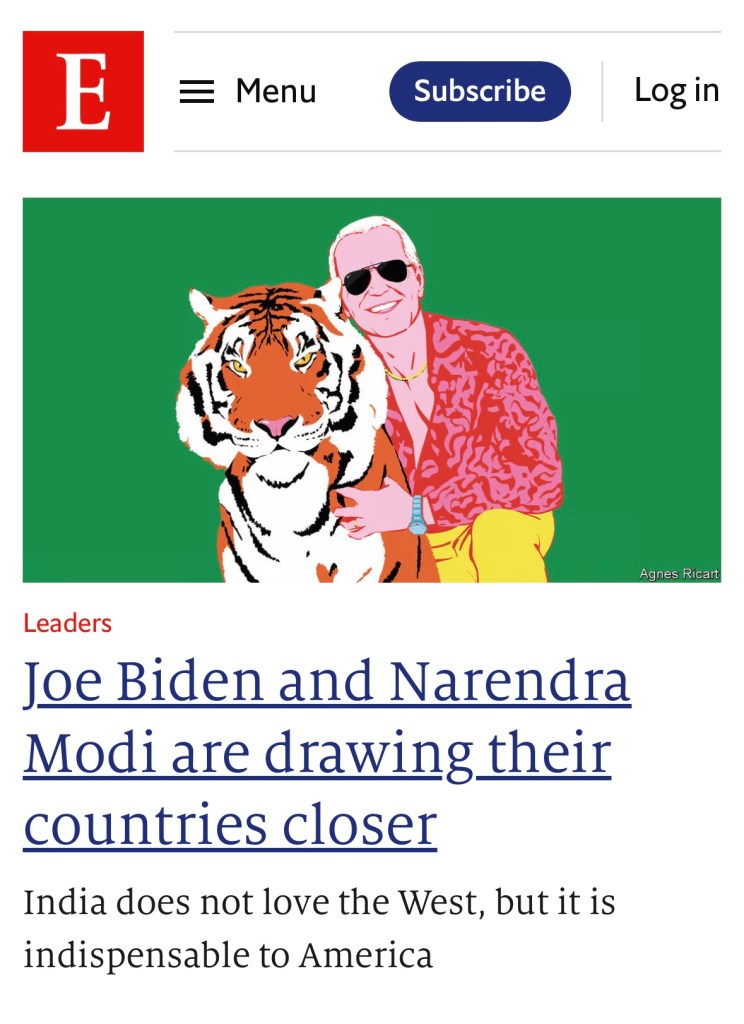
America’s new best friend
The Economist, June 15, 2023
Joe Biden and Narendra Modi are drawing their countries closer….. India does not love the West, but it is indispensable to America
No country except China has propped up Russia’s war economy as much as oil-thirsty India. And few big democracies have slid further in the rankings of democratic freedom. But you would not guess it from the rapturous welcome Narendra Modi will receive in Washington next week. India’s prime minister has been afforded the honour of a state visit by President Joe Biden. The Americans hope to strike defence deals. Mr Modi will be one of the few foreign leaders, along with Winston Churchill, Nelson Mandela and Volodymyr Zelensky, to address a joint session of Congress more than once. The praise gushed on Capitol Hill about the partnership makes no mention of Ukraine, democracy or grit in the gears of America’s new best friendship.
As our Asia section explains, the global clout of the South Asian giant is rising fast. Its economy is the world’s fifth biggest. Its 18m-strong diaspora is thriving, from America to the Gulf. And India has become indispensable to America’s effort to assert itself in Asia and deter Chinese aggression. Yet though huge, capitalist, democratic and wary of China, India is also poor, populist and, as our interview with Subrahmanyam Jaishankar, its foreign minister, outlines, dismissive of the vestiges of the post-1945 Western order. The relationship is therefore a test case for the messy alliance of democracies emerging in a multipolar world.
Can both sides gain the business and security benefits of co-operation even as they share fewer principles than they may care to admit?
India’s ascent is an uplifting story. One of the fastest-growing economies, its GDP is expected to overtake Japan’s and Germany’s by 2028, even as it treads a novel path towards getting rich. In contrast to East Asia’s Tigers, India’s exports are powered by services, of which it is the world’s seventh-largest vendor. Think not just of call centres but data scientists for Goldman Sachs. Infrastructure has also improved under Mr Modi and his immediate predecessors, and manufacturing may pick up as supply chains diversify from China: Apple assembles 7% of iPhones in India. India’s chief failing is its vast numbers of unskilled, jobless young people. It is trying to help them by pioneering a digital welfare state.
Thanks in part to its diaspora, India’s soft power is world-beating. The bosses of Alphabet, IBM and Microsoft are of Indian descent, as are the heads of three of America’s five top business schools. Reflecting the accomplishment of Indian-Americans, 70% of the wider American public views India favourably, compared with 15% for China.
You might think all this makes America and India natural partners. Certainly, a 25-year effort to develop ties has been unaffected by political changes in either country. India is part of the Quad, a security grouping that includes America, Australia and Japan. In order to augment India’s hard power, America is promoting a series of defence deals, some of which may be signed in Washington next week, to enhance military-technology co-operation. The Biden administration reckons this would be the biggest milestone in the bilateral relationship since the striking, in 2005, of a civil-nuclear co-operation agreement. Yet the relationship faces two potential sources of friction. First, India’s pro-Western tilt— which became more pronounced after border skirmishes with Chinese troops in 2020—is essentially pragmatic. Ideologically, it is suspicious of Western countries and flatly rejects their claim to global leadership. From Jawaharlal Nehru to Mr Modi, India considers the post- war order to have offered it little more than another bout of domination by other countries.
The result of these contradictory impulses is disorientating. India is an American strategic partner that mistrusts the West, is unlikely ever to enter a formal alliance with America and is attached to Russia, which supplies it with arms. It is not clear how much support, if push came to shove, America could expect from India. It wants to bolster its land defences against China, not fight over Taiwan.
The second sticking-point is Mr Modi’s attacks on liberal norms. Under his Hindu nationalist, Islamophobic party, India is increasingly hostile to over 200m of its own people. Lynchings and the dispossession of Christians and Muslims are becoming more common. The press is cowed and the courts are largely pliant. Though India seems sure to remain a democracy— not least because Mr Modi is almost guaranteed re-election next year—it is an illiberal one.
The fact that only 60m of its 1.4bn people have formal jobs is a potentially explosive situation in a country prone to rabble-rousing.
Some suggest that America risks repeating its history with China, by showering economic advantages on a rival that ends up turning against it. That seems unlikely. Mutual suspicion of China alone should keep India close. Primly rejecting co-operation with India because its ideology and democracy do not conform to Western ideals would only empower China. It would also show that America has failed to adapt to the multipolar world that lies ahead.
Instead, America and its allies should be realistic about where India’s sympathy lies—with its interests, not theirs—and creative in their efforts to find overlaps between the two. That means layering the relationship with common endeavours. The Biden administration’s efforts to accelerate technology transfer to India seem a promising example. By boosting India’s defence industry, America hopes to wean it off dud Russian weapons and provide an affordable new source of arms for other Asian democracies. Other areas of co-operation could include clean energy and tech, where both seek to avoid relying on China.
An alignment of interests, not principles
America’s foreign policy has always combined realism with idealism. So America must speak out against attacks on democratic norms and human rights, even as it works more closely with India. For its part, India must get used to the idea that, as it grows more powerful, it will face more scrutiny. Discount the expressions of unconditional friendship and brotherhood in Washington next week. To work, the relationship will have to function like a long-term business partnership: India and America may not like everything about it, but think of the huge upside. It may be the most important transaction of the 21st century.