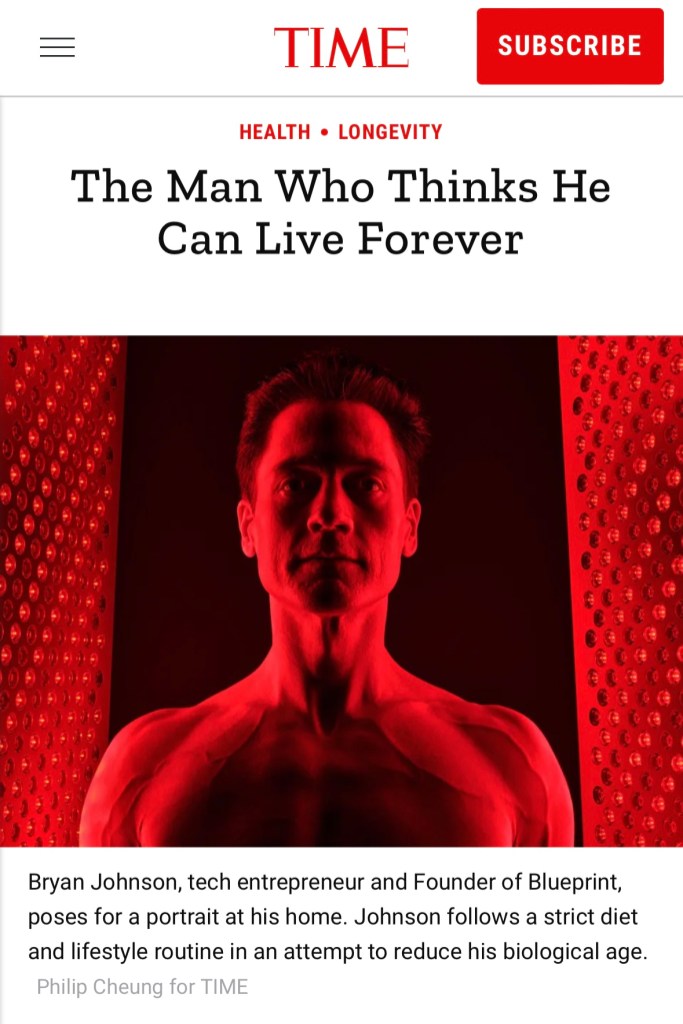
A long, fascinating read. One man (and a woman’s) quest to beat the odds on Life and Death. Is an immortal Life on earth really possible and even worth it?
Decide for yourself by reading the article by clicking on below link:
But if you want to know what I think about the subject, please carry on reading below:
QUOTE : “Some scientists do believe that limited age-reversal is possible. In still controversial and contested work, researchers at Harvard Medical School have claimed they’ve rejuvenated older mice, and are currently testing whether the aging clock can be turned back in human skin and eye cells. But those experiments are being done according to established scientific conventions. Johnson, in contrast, has made himself a human guinea pig, adopting nearly every age-related treatment at once and seeing what works.”UNQUOTE
This is a philosophical subject matter .
What does the phrase “living forever” really mean?
Most schools of Western philosophy tend to approach Living as a spatio-temporal experience on earth. So Life itself gets regarded as an experience that is enabled and supported by the sense organs.
In that philosophical view or framework, Death occurs when the sensory organs cease to function. The cognitive faculties expire , the mind disintegrates and the body goes lifeless. So, the philosophy underlying the approach towards prolonging life is to try and extend as long as possible the functional term or shelf-life of the sense organs: i.e. the philosophical quest is to know how to keep the sense organs working as long as possible to keep death at bay or render it “not inevitable”.
That is a very narrow and self-limiting philosophical approach.
Vedanta philosophy, on the contrary, transcends such a very narrow conception of life.
Life is not equated with the sensory experience on earth which is fundamentally time-bound by a given shelf-life. The soul or what is called Atma is however an entity that is not limited in time and space. It is eternally self-existent. It knows no death. It was not created. And it is indestructible.
The Atman assumes many bodily forms as a consequence of its own choices and actions — I.e. karma. The human bodily form it assumes is only one such in a series of forms which it dons and sheds repeatedly in its endless journey of repeated “reincarnations”.
Through its karmic actions, the individual atma, being an entity endowed naturally with cognition and intelligence, pursues its own purpose. If it cannot fully realise the purpose in one lifetime, it continues the effort of pursuing it in yet another lifetime in another bodily form. That journey goes on — again and again and yet again — in a progressive series of life-forms.
In each life form, the Atma is endowed with bodily sense organs. They are mere functional aids or instruments which the soul employs as tools to maintain the momentum of progression towards realising Purpose.
The bodily form —called “Sarira” in Sanskrit— is but a toolkit whose utility however lasts only so long as the term of its biological shelf-life endures and lasts. Beyond the expiry of that time -period, the tool-kit no longer serves the Atma any purpose at all. So, the soul then simply sheds its “Sarira” and moves on to assume yet another “Sarira” in yet another lifetime. The capacity and versatility of facultative skill-sets — or the cognitive toolkit — of each bodily form are determined by the atma’skarma.
This philosophic approach of Vedanta therefore focuses not on extending the functional shelf-life of sense-organs which are merely a toolkit. The focus is rather squarely on realisation of soulful Purpose with whatever sensory or facultative toolkit the Atman is endowed with in its “Sarira”, its present bodily form and condition. In this approach, it really makes no sense whatsoever to prolong a life-form that is defined solely by sensory experience since the Atma relentlessly pursues a purpose that far transcends the senses.
In the Vedantic framework of philosophy, all “age-defying” or “age-reversal” effort or experimentation is not only futile but humanly purposeless.