A pilgrim’s jottings on a 3-day whirlwind pilgrimage, May 4th, 2024 (Tirunelveli-Tuticorin) of Nava Tirupati temples
***********
“Mind blogging!” is probably the first expression that tumbles out of us whenever we happen to read sensational news reports about how astronomers and astrophysicists have discovered some new hitherto unknown facet of the dark unravelled mysteries of outer space, or have been able to get a rare glimpse at a deep secret that it had for long kept hidden from them.
The news-reports below are very recent and they are about how astrophysicists, with their giant telescopes in high-tech Observatories and deep-space remote-sensing Satellite equipment, have captured high-resolution imagery of never before charted depths of the expanding universe of our galaxy. They all make for fascinating, “mind boggling” reading indeed for ordinary folks like us.
Just sample the 3 small reports at the links below:
1. https://www.ndtv.com/science/dark-energy-camera-captures-godshand-reaching-for-the-stars-5658800
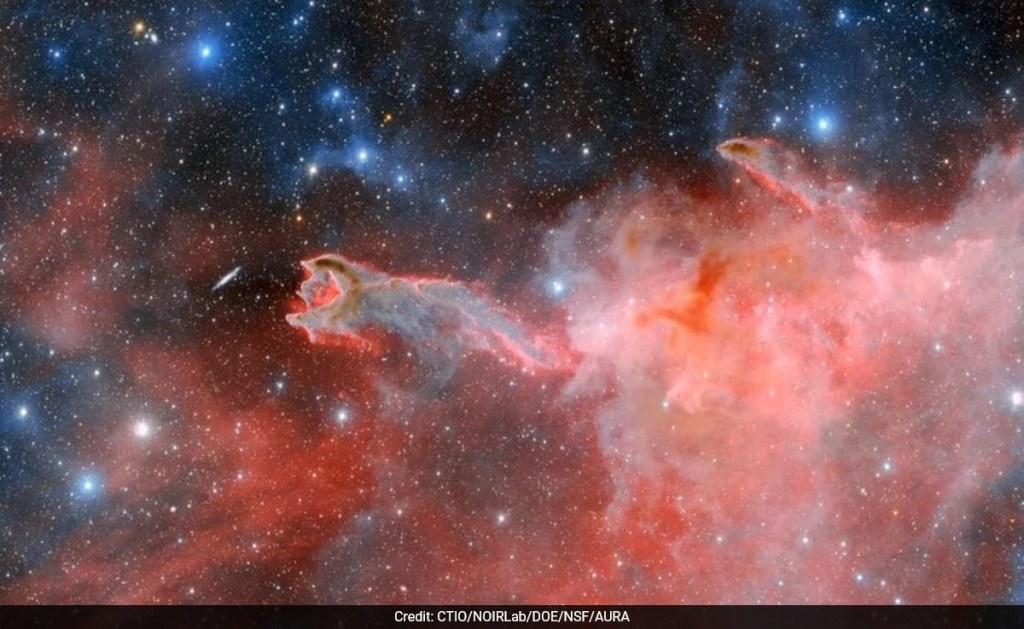
“A series of spectacular images have been captured by a Dark Energy Camera (DECam), revealing what looks like a ghostly hand extending towards a distant spiral galaxy. Nicknamed “God’s Hand”, the celestial structures are clouds of gas and dust. The DECam, installed on Victor M. Blanco Telescope in Chile, captured this rare phenomenon, known as a cometary globule, giving a glimpse into the depths of our universe”.
************
2. Astronomers found new Earth-sized planet where days and nights are never-ending!
http://dhunt.in/UxJJ0
***************
3.
Scientists at NASA have used the ‘Discover’ supercomputer to simulate a virtual experience of a ride around and into the black hole past the event horizon.
Event horizon is a boundary around a black hole beyond which nothing, not even light, can escape — a point of no return.
Before going past the event horizon, we orbit around a hot, glowing disk of gas called the accretion disk starting from 640 million kms away.
NASA is simulating a black hole similar to the one at the centre of our Milky Way galaxy with a mass 4.3 million times that of our Sun.
In this simulation, event horizon spans about 25 million km (about 17% of the distance between Earth and Sun).
The ample stretching, squeezing, bending, and swirling in this simulation is held together by the darkness of the Singularity at the centre.
Singularity is a region of infinite density at the centre of a black hole. Here, the laws of physics as we know them break down.
For the faint-hearted, there’s a kinder option of a fly-by around a black hole instead of the thrilling plunge.
The simulation computed by ‘Discover’ in five days would have taken “more than a decade” on a regular laptop.
While ‘Discover’ used only 0.3% of its processing power, the project generated about 10 terabytes of data.
The creator of these visualisations, astrophysicist Jeremy Schnittman says “If you have the choice, you want to fall into a supermassive black hole.”
Because if it isn’t massive enough, you run the risk of ‘spaghettification‘ — getting ripped apart from head to toe due to the vertical stretching and horizontal compression.
Anmol N Jain ( — in the Swarajya)
**************
There’s a hidden yet clear irony that becomes obvious after one reads such news.
The astro-telescopes reveal “fantastic never-before seen images” to the excited scientists whose joy of discovery makes them want to then share images and photos with the rest of the world.
Every new photo-image of the Universe captured becomes for the astro-scientific fraternity a trophy celebrating their slow but incremental triumph in space research. It makes them think they are slowly but surely gaining ground in their progress towards scientifically uncovering more and more of the secrets of the Universe.
The scientists are perhaps right too in feeling so … who knows, maybe one of their “one small steps” could potentially and prospectively turn out to be “a giant leap for mankind”?
When scientists begin describing or interpreting what their great Hubble telescopes reveal, the astro-scientists begin resorting to all kinds of fancy terminology, don’t they? Otherwise, why would we left struggling to make sense of the news reports and the colourful images? And of all the accompanying scientific jargon too which only sounds so much like gobbledygook to us?
When we are all told about such unheard of, unseen and inconceivable things in outer Space we have to get acquainted with strange terms such as “spaghettification”, “darkness of Singularity”, “event horizon”, “endless days and nights”, “spiral galaxies” and (the most intriguing of all!) “God’s Hand” and so on. It makes us pause and first ask ourselves what is it really that “mind-boggles” us all? Is it the telescope images vividly captured in photos scientists show us? Or, is it their rather exotic, colourful language describing the photo-images that simply “wows” us? Or both?
So, the irony is in the fact that we ordinary folks just don’t really know. We can’t really tell either which one fascinates us more and why.
The high-resolution and dazzling telescope images shown to us appear only so much like phantasmagoria. It’s seen floating out there somewhere in space and is said to be trillions of kilometres away. The scientists describe them as giant clouds of cosmic dust, gaseous “globules” of pure iridescence. They are incandescent, glowing nebulae, or dark abysmic holes; a kaleidoscopic array of clusters of unnamed stars, planets, exoplanets, and giant floating, swirling, fizzling, and sparking meteors …!
What is seen through the giant telescope by the scientists appears to our eyes though only as a medley of brilliant blotches of colour, lots of dark billowing clouds and weird shapeless, nameless forms… They are forms given new un-spellable, un-pronounceable names by the scientists themselves — such as “infinite density”, “black hole”, “God’s Hand”, “speculoos 3b”!
It all gets presented to us in the news in a language of astro-physics made up by the astro-scientists for themselves. The language makes sense to them but to many of us it’s nothing but gibberish. But then we would be shy to admit our true feelings about them for fear that we might look like scientific philistines to other people —- i.e. unable to appreciate modern science and incapable of understanding its exciting new findings.
Ironically thus, all of us will avidly gaze long at the Hubble or NASA telescope images, feign great curiosity or interest and lap up all the scientist’s sensational narratives out in the news and go gushing over it, “Wow! Mind boggling”!
***********
We cannot and should not really blame the scientists for our very own pretensions, though.
The universe perhaps indulges scientists with only tantalisingly little peep-shows of itself but gives them no big clues with which to uncover its bigger truths or secrets and then speak about them meaningfully. Maybe astro-physicists will never be able to get right the real Big Picture of the universe.
The Universe remains an inscrutable territory into which the human mind can probably make only minor forays but hardly any great ground. The more scientists are able to get to know it through telescopes, the more unknown it gets! As the well-known Tamil scholar and novelist, Indira Parthasarathy put it once to me: “I think God has thrown our way an infinite mass of complex riddles in the universe for us to solve. As one is solved it raises an infinite number of more questions and this goes on and on till infinitum!”.
Albert Einstein, perhaps the greatest of astrophysicists, accurately summed up the predicament faced by his branch of science as follows:

When a science can’t explain itself simply, then it most probably doesn’t understand itself well enough. And when it hasn’t quite yet understood itself well enough, how can it go about explaining itself well enough?
When understanding wobbles, language will most certainly have to sound garbled.
The real problem therefore is this ;
Astrophysics does not yet possess the requisite language, grammar or vocabulary to meaningfully describe all that its telescopes unravel and decipher from the skies… i.e. the “infinite number of riddles and questions” which crop up every time a new break-through discovery is made.
Scientists hence have to constantly struggle to come up with new and strange words, phraseology and semantics that are intelligible to the ordinary people who just cannot otherwise understand what exactly the Hubble or satellite imagery captured is really all about. The astronomer’s Language is thus forever trying to play catch-up with his Science.
So what then are astro-scientists to do?
Well… they invent a special kind of language that is so much their very own but which they contrive somehow to make comprehensible. Such contrivances include using poetic metaphors and other linguistic expedients to explain themselves just so ordinary folks can at least get some fuzzy idea of what they themselves are able to see, fathom or understand thanks to the telescopes. And while crowing over the brilliant satellite images, and getting us all very excited too over them, scientists end up speaking about them in pretty much the same sort of language as that of poets mystics and saints ….. in other words, they use mostly the language of riddles and poetic metaphors!
The Hubble lens shows only blurred images of distant dark nebulae and ultra-cooled red dwarf stars, galactic exoplanets, all seen as misshapen blobs and amorphous swathes of brilliant, dazzling red, blue, pink, purple and indigo colour. According to the scientists they are at best all to be understood by us as “God’s Hand” or “Days and nights that are endless“, or “event horizon”!
*************
In the famous Shakespearian drama, “Hamlet”, the Prince of Denmark and his friend, Horatio, one night go up to the battlements of their castle and from where, as they look out into the dark and starry night, suddenly they believe they are seeing ghosts from the nether world of the dead!
Horatio is fascinated by what he sees and exclaims: “O day and night, but this is wondrous strange!” Those words remind us at once recall the astronomer’s own which we have read above. They sound exactly like what the astrophysicist too said, that “On SPECULOOS 3b, days and nights are endless”...!
Hamlet then replies to Horatio: “There are more things in Heaven and Earth, Horatio, than are dreamt of in your philosophy.”
Human imagination is very limited and that there are many things we don’t know, things that haven’t been discovered and, in fact, things we haven’t even dreamt of… And therefore what we can’t even imagine or dream of, how can it be described? So, asks the poet, Shakespeare.
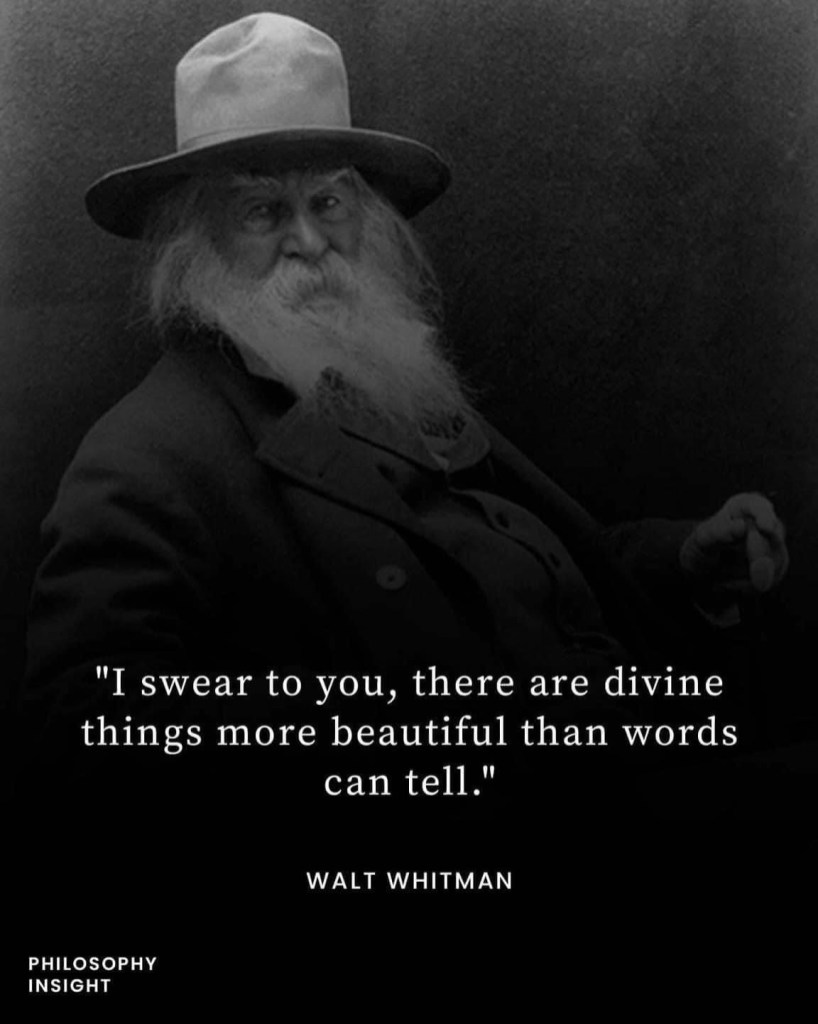
Another poet, the American, Walt Whitman too meant to ask really the same thing but he put it differently as below:
************
It’s not only Astro-physicists and great poets who speak in riddles about what their respective imaginations perceive … and then struggle so hard to express themselves in any coherent ways other than through metaphor and imagery … Mathematical geniuses did it too …!
Srinivasa Ramanujan was probably the greatest of pure mathematicians in the 20th century. He was also a mystic of sorts too. Mathematics was his Observatory and Numbers were his Hubble Telescope. With them he sought to unravel the mystery of the universe.
He once said this:

But even Ramanujan like astro-scientists could hardly talk about his mathematical discoveries without switching to inexact, will o’ the wispy language of fanciful metaphors and word-images. Ramanujam in fact himself confessed that when he was working with Numbers and Equations, he actually saw what he called “The Hand of God” guiding him!
“While asleep, I had an unusual experience. There was a red screen formed by flowing blood, as it were. I was observing it. Suddenly a hand began to write on the screen. I became all attention. That hand wrote a number of elliptic integrals. They stuck to my mind. As soon as I woke up, I committed them to writing.” – he once wrote.
Ramanujan credited his greatest mathematical theories to Divinity — to the inspiration he got from the goddess he worshipped , Devi Namagiri.
**********
Talking about “divine things more beautiful than words can tell”, does inevitably bring us to the question of how mystic-saints have spoken about about what they witnessed as mysteries and wonders of the vast, limitless Universe.
Mystic-saints have no use for Observatories or Hubble telescopes. To plumb the depths and secrets of Space — to perceive the distant, surrealist colours of incandescent red and blue, the blazing iridiscence of stars and planets in the firmament — they rely upon the use of the power of their own minds.
For the mystic-saints, the Hubble is their own Yogic Intuition. And their Satellite-Observatory is a very special mental state called Bhakthi, roughly translated as “God-besotted-ness”.
Telescopes are turned outward and directed high towards the heavenly spheres. But the telescope of the mystic-saint is intuition which is turned inward into the vast universal space within itself.
In the deep South of India, in Tamil Nadu, in a small temple-town called Tirukkurughur (now Azhwar Tirunagari), around the 7th-8th century CE, there lived a mystic-saint whose name was Nammazhwar.
He was born with strange, mysterious mystic powers. It was known that even as a mere child he went into deep meditative states and remained there for months on end, without food or water, lost in complete absorption with some “divine things more beautiful than words can tell”.
None around him could ever explain what was happening to him in that state or what he was seeing and experiencing in such an immersive state of mind.
The mystic boy-saint would now and then — about once every few months — suddenly wake up from the deep trance and then begin to sing spontaneously many inspired hymns in Tamizh all in effusive praise of Vishnu or Narayana, the Almighty. More than a thousand of such of his Hymns were later collected and compiled by a disciple of his named, Madhura Kavi. They are known today as “Tiruvoimozhi”, “Tiruviruutam” and “Tiruvasiriyam”…
What the collections of cosmological satellite-images captured by telescopes are to astrophysicists, so can we say also were collections of images that Nammazhwar himself beheld in his yogic trances and then sung about in the above three poetic works left behind for posterity .
For Nammazhwar the objects of his observation were neither the galaxies in deep space or black holes nor infinite density or singularity. His observatory post was located inside the small hollow of a large tamarind tree-trunk just outside the Tirukkurughur temple where he remained holed up all his life.
From this unique observatory of his, Nammazhwar used yogic intuition as his telescope and it was through which he went on gazing at cosmic objects as they appeared to him within the expanse of his own consciousness.
What were those cosmic objects he gazed at ?
They were the iconic temples of Vishnu which were located out over many provinces all across South India and in a few places in the North too. Those temples and the Deity within (archa murthy) were visualised by him through sheer intuition and all his exquisite Tamizh poetic outpourings in hymns were inspired recordings indeed of those mystic visions.
***********
If you read Nammazhwar, the mystic-saint’s Tamizh hymns you’ll find that he too speaks about his inward visions and revelations using only poetic metaphor and other figures of speech… so much like astrophysicists and pure mathematicians indeed.
If the Hubble telescope produced vivid images of deep outer space in the form of images in blazing blotches of red, orange or blue, Nammazhwar’s own telescopic vision too saw the same as coral red haze in a blaze of brilliant images … And in describing what he saw , he too employed strange metaphors.
*************
In one of the most famous of his verses in the Tiruvoimozhi, we learn how Nammazhwar was once caught in the throes of the extreme mystic ecstasy. It was induced by what he was actually seeing in his trance-state. In that heightened perceptive state of mind, he was mentally transported to the great ancient and beautiful temple of Sri Venkateshwara up on the sylvan Hills of Tirumala. In that immersive meditative vision what Nammazhwar saw exactly was later made known to us through this his “paasuram” :
வந்தாய் போலே வாராதாய்!*
வாராதாய் போல் வருவானே,*
செந்தாமரைக் கண் செங்கனிவாய்*
நால் தோள் அமுதே! எனது உயிரே,*
சிந்தாமணிகள் பகர் அல்லைப் பகல்செய்* திருவேங்கடத்தானே,*
அந்தோ அடியேன் உன பாதம்* அகலகில்லேன் இறையுமே.
(Meaning)
You play games with me, O Venkatesha! You never come when I think you come hither… And when I think you have come hither , it then only seems to be so ! You are the elixir of my soul … Do not slip away from me! My Lord, You with lotus eyes, coral lips and four arms! O Lord of Venkatam, where brilliant gems turn night into day! Alas, I cannot bear the separation from you even for a moment!”
As one reads and savours the beauty of the verse in Tamizh language one can’t help noticing the remarkable similarity of imagery used by the mystic-saint and that of both the astrophysicist and mathematician we have seen above.
The lotus eyes and coral lips — செந்தாமரைக் கண் செங்கனிவாய் — are but metaphors again for the dazzling colours , incandescent gaseous nebulae swirling in the distant galaxies….
And நால் தோள் … “the four arms” Nammazhwar saw … are again metaphors for what the astronomer peering through the telescopes saw and called it as God’s Hand and which the mathematician, Ramanujan, too had seen as the Hand that wrote for him his numbers in elliptic integers ….
And finally , the phrase of Nammazhwar — சிந்தாமணிகள் பகர் அல்லைப் பகல்செய் (“in Venkatam where brilliant gems turn night into day!”) — seem so very redolent again of only that mystic sense of wonder the NASA astronomer himself expressed when he said “On SPECULOOS 3b, days and nights are endless”...!
*************
Sudarshan Madabushi