It is election season now and for me it is quite fascinating to do some laid-back voting analysis while waiting for D-DAY on June 4th. You may call it idling time but it’s still worth it because it gives me a slightly better understanding of our voting system.
Going back to the subject of glaring anomalies of our voting system:
I revisited the results/statistics of the 2019 elections https://en.wikipedia.org/wiki/Results_of_the_2019_Indian_general_election
The anamolies the figures show up really did hit me in the face.
1. The votes-polled in 2019 was 615 millionagainst total eligible vote-pool of 912 million (67.4%). So, 297 million eligible voters did not cast votes. That nearly the whole population of the USA!
No one knows why…. To the best of my knowledge, till date in our country, no scientific survey has been conducted nationwide — neither by ECI nor any think-tank or NGO — to unearth the fundamental causes for nearly 35% voting-failure rate occuring consistently in almost every Lok Sabha elections since Independence — and fix it.
Voter apathy is mysterious human behaviour to psephologists, psychologists and politicians alike. The mystery may never get solved perhaps… Freedom loving people that we proud Indians are, the freedom not to vote is a fundamental right for a quarter of our population.
2. With votes-polled to vote-pool ratio being what it is at around 60-65%,I think it is absurd for statisticians and political analysts to keep calculating individual Vote Share percentage of a party on the basis of Votes Polled as in the table below: (All parties shown in the table below polled at least 1% or more of votes-polled).
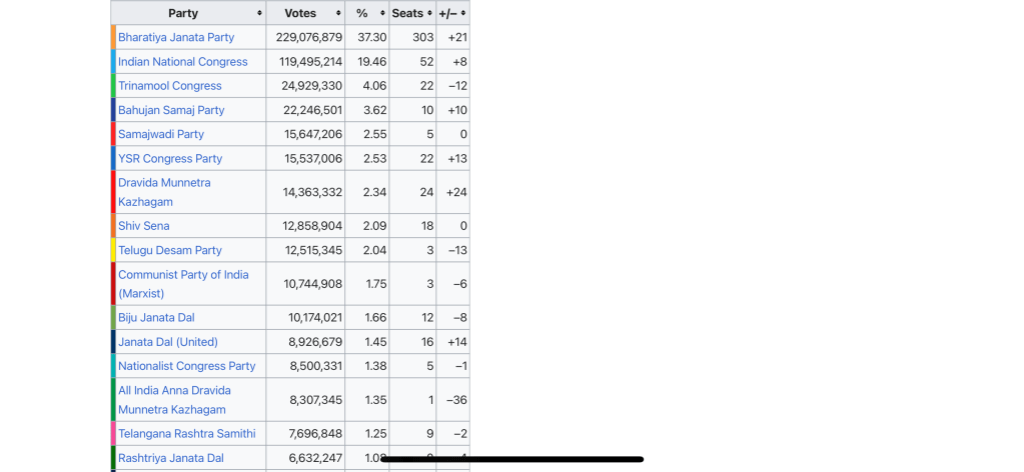
Every vote-share % of every Party shown in the table below gives the lie to that great myth and cliche of Democracy that “oh, every vote counts!”… In India, every 4 out of 10 votes does not count!
3. The other great myth of Indian democracy is that the Party that wrests power is the Party that is the voice of the majority of the population. And the myth is based on Vote Share %.
The fact however is that Vote Share and No. of Seats won are neither correlated nor proportional to each other in any statistical way. They are only circumstantially related and the relationship is largely determined by the no. of parties in the fray in each constituency. In the 2019 Elections apart from the parties listed in the table above (that won 1% or above vote share), there were nearly 700 other politically fragmented rag-tag contestants who polled crumbs and all put together grabbed 22 % of votes! But they got no seats in Lok Sabha at all!
It certainly makes one wonder why at all these parties contest at all ! Why can’t the ECI bar all parties from ever contesting again if they failed to secure less than 1% of vote-share in the previous election?
4. In 2019, BJP reportedly polled 37.3% vote-share but got 56% of the 543 MP seats in Lok Sabha. Shiv Sena won 2.09% vote-share captured 18 seats in the Lok Sabha, while the TDP, trailing behind by a just a couple of pips at 2.04%, got only 3 seats in the Lok Sabha!
The NDA combined vote share was 45.3% but its combined seat-share was 65.2%! So, even as a coalition, the ruling dispensation during 2019-24 did not really represent the majority of We the People and yet was firmly seated in the driver’s seat of the government.
Nothing can logically explain the above anomalies except the time-worn and old moth-eaten excuse that Sorry, Sir, but that is how the FPTP (first past the post) rule works in our system.
The FPTP system has got shoved down the people’s throat, like it or not, for 75 years now! It’s now engraved in sacred, saligrama or rudraksha stone and people say it can therefore never be changed.
5. The other glaring anomaly is that the Vote Share % credited to each Political Party is not a true reflection of its democratic credentials. That is because what is shown against its name as Vote-Share % has not been de-rated to reflect its vote-share relative to the total vote-pool, which, in fact, is the true indicator of the democratic mass of India.
Such de-rating ought to be done using the overall average de-rating factor of 67.3%. The de-rated vote-share % of each Party in the table would then look like this below:
1. BJP 37.3 % X 67.4% = 25.1 %
2. INC 19.46 = 13.1 %
3. TMC 4.06 = 2.7 %
4. BSP 3.62 = 2.4 %
5. SP 2.55 = 1.7 %
6. YSR 2.53 = 1.7 %
7. DMK 2.34 = 1.6 %
8. SS 2. 09 = 1.4 %
9. TDP 2.04 = 1.4 %
10.CPM 1.75 = 1.2 %
11. BJD 1.66 = 1.1 %
12. NCP 1.38 = 0.9 %
13.ADMK 1.35 = 0.9 %
14 TRS 1.25 = 0.8 %
15. RJD 1.08 = 0.7 %
If the above were to taken into reckoning, then a Party representing only 25% of the voting-pool — and hardly 30.5% of it even in a coalition ! — was ruling the whole country between 2019 and 2024.
The sheer absurdity of all this boggles my mind as an ordinary citizen of the world’s largest democracy.
It makes me wonder why our election commission and wise constitutional experts do not contemplate a rule in the Representation of Peoples Act that says this: In a constituency where the vote-polled to vote-pool ratio is less than 50%, the ECI will order re-poll … Why not make the apathetic voters suffer for their apathy rather than let them get away with making a mockery of democracy in India?
Best Regards,
Sudarshan Madabushi
Absurd observations done by A Self Proclaimed Intellectual… Bharath is Not US UK or Auz… Even there the voting% age doesn’t cross 75% and could you preach your Dogmatics ideas over there??? In India, we are tolerant to Various Ideosyncracies, like this one and therefore people like you are Shouting from the roof tops for Undue attention..!!!
“Self-proclaimed intellectual”? No, I’m neither .
Very good analysis. Our entire voting exercise is a mockery. Even after 75 years since independence , there are constituencies( mostly urban), where the voting percentage is a pathetic 50 to 55.
Unless some penalties / disincentives are made mandatory, our voting percentage, at the national level will never improve.
Kudos to you for looking at this subject, from a new angle. Hope the new Govt will bring some drastic changes in our voting system and EC .