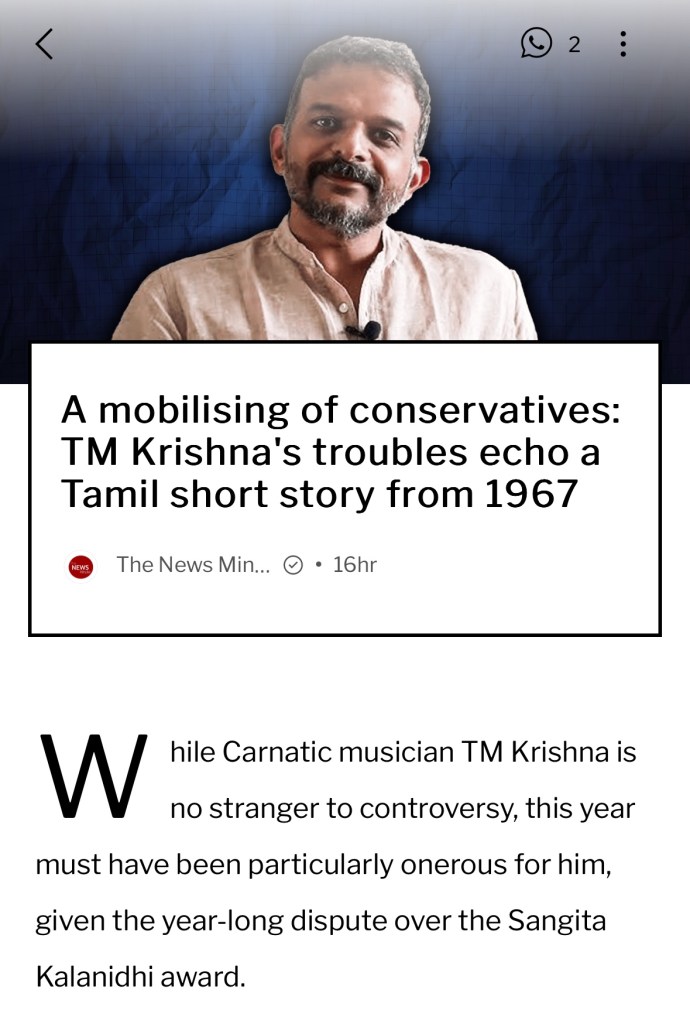
A mobilising of conservatives: TM Krishna’s troubles echo a Tamil short story from 1967
http://dhunt.in/XQa4Q
(The News Minute 2 December 2024)
This Op-Ed piece is complete nonsense .
No one in the Brahmin community of Carnatic music rasikas has ever disdained T M Krishna’s so-called “progressive liberal” efforts to take Carnatic music to the masses in the name of “democratising and secularising it” …
What is disappointing to note is that TMK today has precious little to show really for all his tall talk about “de-Brahminising” Carnatic music. His toil hasn’t yielded any big harvest of new-generation, “non-Brahmin talent”. He hasn’t produced or mentored even one outstanding talent from the Olcott Kuppam, has he?
TMK for over a decade has now been spreading a canard about “Brahmin domination” in the Carnatic Music world. He has gone to town on the subject having written several books , numerous articles and given interviews to umpteen newspapers and magazines in the country about his pet subject. Did the Tamil Brahmin community do anything by way of stopping him from exercising his freedom of expression except by way of chiding him for his waywardness?
TMK however did cross a cultural red line when he began spouting fancy and perverse theories : that the Bhakthi tradition had really nothing to do with Carnatic music art-form and opining that “one can possibly sing a Thyagaraja kriti on Rama or on a dog” to equal effect and still have rasikas raving about it. TMK’s theory was that musicality in Carnatic music is what matters and could, technically speaking, even override and transcend spirituality. That was way over the top indeed for scandalised rasikas.
After saying so, there was no stopping TMK from journeying further down the path of degrading the essential Bhakthi element in Carnatic music. He went strutting around the land putting up big performances to showcase his social activism which amongst other things also consisted in perversion of the tradition while singing new-age compositions in praise of anti-Brahmin, anti-Hindu iconoclasts such as E V Ramaswami and other casteist-atheist ideological outfits in Tamil Nadu. (Saint Thyagaraja was known to have refused to dedicate Krithis to mortals, even if they happened to be kings or nobility!).
TMK’s “social activism” greatly pleased the leftmost fringes of the pseudo-secular communities across the state and country. He soon became a poster-boy for those who clamoured for “Gaana music”, “oppari”, “fusion” and other gospel-inspired musical genres to infiltrate into and co-habit space inside the age-old bastion of the Madras Music Academy which once upon a time used to be known as the institution striving to preserve, protect and perpetuate the pristine-ness and excellence of the classical Carnatic Music tradition.
In TMK’s colourful personality and in his professed ideological leanings, Dravidianists of Tamil Nadu saw some kind of a Che Guevara-wannabe capable of bringing “social revolution” right into the heart of the Carnatic music world and weaponising it to serve their decades-long virulent political campaign against Sanatana Dharma and, more generally, in their cultural war against so-called Brahminical domination of the fine arts in Tamil country.
********* ********** **********
In Tamil Nadu today , there are many youngsters and students of music (like the young lady from Stella Maris College in Chennai who wrote the above Op-Ed piece) who are great fans of TM Krishna for the same reason why perhaps Che Guevara, both in his own times and to this day, still enjoys the status of a romanticised revolutionary hero. They defend TMK and his social progressiveness (whatever that means!) as stoutly as a washed -up Bolivian university campus communist might do today.
Their defence of TMK is that he represents Change. And change, they all aver, even in traditionally hidebound Carnatic Music world, is inevitable and must be welcomed not resisted.
What these young passionate students do not appreciate, however, is that belting out new-age compositions (of the kind that TMK has sought to popularise through paeans on Thanthai Periyar (or through his support for gaana and oppari) can never capture the spirit of the soulful lyrics of the traditional “vaageyakaaras”. If the grammar, format, idiom, soul and salience of the traditional “paataantharam” of Carnatic music is sought to be changed or tinkered with then what would result is travesty and tragic chaos … not “revolution”.
The young Stella Maris College Op/Ed writer I’m sure will not agree with me at all . But then for for an old-timer Rasika being “political correct” is too a high a price to pay for acquiescing with the wanton experimentations of youth. Why must I out of politeness force myself to put up with the waywardness of the young? Why should I look the other way when I see them mutilating and going about destroying the very foundations of sampradaayam music just as TMK and his sishyas I see are doing with absolute impunity ?
Many oldie-rasikas amongst us also sometimes tell me to cool down a bit and regain sane perspective: “Oh come on, what’s so wrong in being a little being indulgent towards youthful exuberance here …?”, they ask me.
I tell them that I find it wrong to become complicit in their licentiousness… not exuberance. We’re all only playing chicken in this matter. We’re scared to condemn this nonsense for what it is and call a spade a spade. We put up with their pretentious tosh only to appease juvenile delinquents — these cultural Wokes whose Greta Thunberg happens to be our own TM Krishna.
But my antagonists still continue to argue with me: “Its young talent that needs to be encouraged. Change is the only thing that does not change. TMK is a harbinger of such change in Carnatic Music and it’s going to be unstoppable”.
My counter to them is this:
Tradition survives as a continuum … Trying to revolutionise it can easily destroy it .
Think of this music form as a plant breed … It was seeded ages ago and carefully cultivated. Past so many generations of musicians — both Brahmin and non- Brahmin, BTW! — have protected it from metaphorical ravages like soil erosion, desertification, pestilence and parasites …
The rare plant breed was provided special nutrients, it was grafted scientifically with certain other species of plants to give it organic robustness , its outgrowth was nurtured too by giving it TLC (tender loving care) in nurseries and greenhouses…
It took ages before the painstaking culturing off this plant and sapling species began to yield results —- in the form of lush growth, foliage, flowering , fragrance and abundant fruition.
Imagine , then suddenly a gardener coming around and upturning the methods and technology of cultivating such a tender , rare and fragile plant species… He throws out all the old gardening methods and introduces wholly new untested and bizarre forms of cultivation …
The plant species is traumatised. It withers away unable to withstand the harsh new conditions introduced … In time , the species itself dies out and becomes extinct …
Likewise, I say, it took centuries for the Carnatic Music art-form of South India to gradually evolve and develop into the fine specialised aesthetic which it is today…. From seed to sapling to fruit yielding tree…
It’s a truly rare species of music … a genre that has to be handled with great TLC if it must continue to retain its distinct features , identity or innate spirit. It needs a certain predefined, pre-controlled environment and conditions under which it can thrive . It’s a delicate and very fragile ecosystem under which the music can really survive .
If TMK and his ilk start messing around at will with the technology, methods of cultivation or the delicate environmental conditions in which this traditional music-form has for so long been nurtured and developed by earlier generations of Vidwans , you risk its disappearance from the face of the planet within the lifetime of a couple of generations .
There is something called musical ecology … Please believe me. It is as fragile and vulnerable as bio-ecology. It’s something that TM Krishna and his tribe of enfant terrible (rebels without a cause such as this Stella Maris Op-Ed columnist) don’t seem to understand at all.
Sudarshan Madabushi