When I read the Jan 19th 2025 article below in THE HINDU (“Wide Angle” feature article) penned by the well known Hindu mythologist, Devadutt Patnaik (the author of 50 books on mythology, art and culture), it at once reminded me of the controversial speech the Tamil Cinema lyricist, Vairamuthu had made seven years ago in 2018 about the Sri Vaishnavite Saint and mystic-Poetess Sri Andaal (she is one amongst the pantheon of the 12 Holy Azhwars) and which had created a public furore amongst thousands of Hindus in Tamil Nadu. (to jog your memory, click on this link: https://www.thenewsminute.com/tamil-nadu/poet-vairamuthu-lands-controversy-speech-andal-expresses-regret-74443
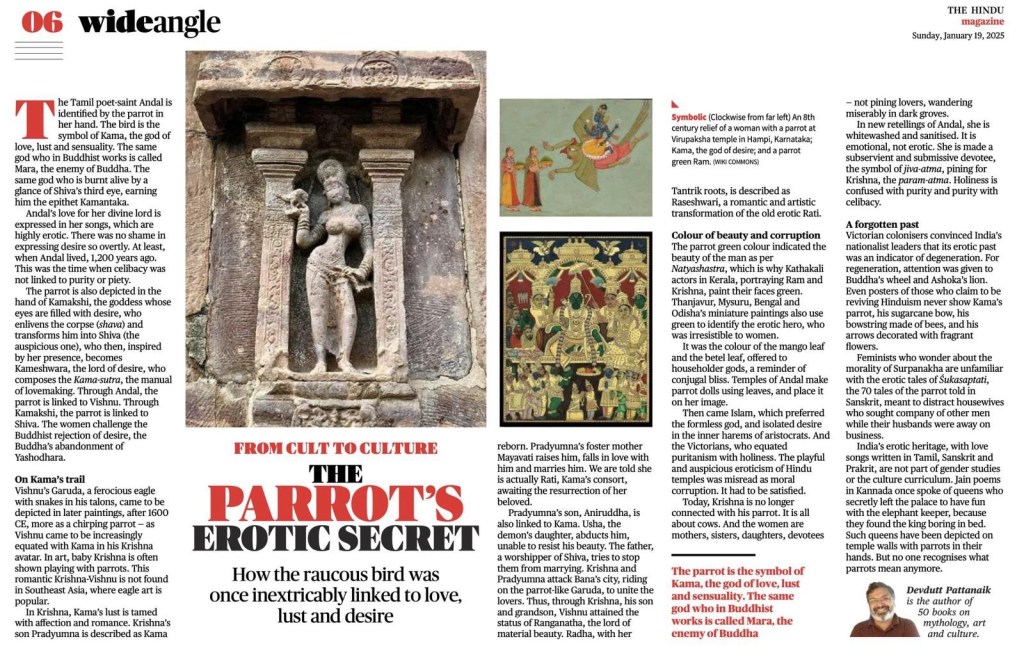
Devdutt Pattnaik begins the above essay with the following provocative lines
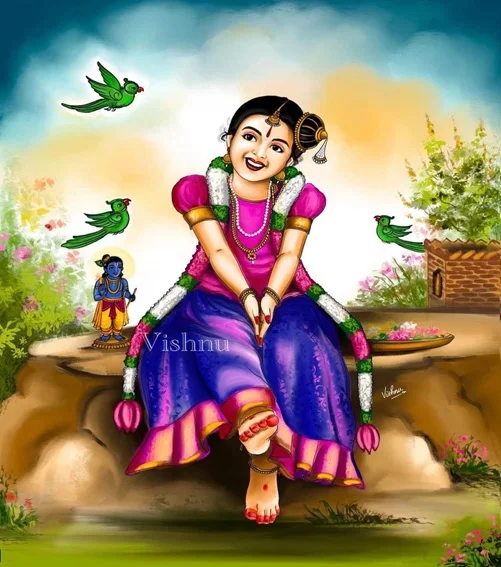
QUOTE: The Tamil poet-saint Andal is identified by the parrot in her hand. The bird is the symbol of Kama, the god of love, lust and sensuality.… Andal’s love for her divine lord is expressed in her songs, which are highly erotic. There was no shame in expressing desire so overtly. At least, when Andal lived, 1,200 years ago. …. This was the time when celibacy was not linked to purity or piety.
The parrot is also depicted in the hand of Kamakshi, the goddess whose eyes are filled with desire, who enlivens the corpse (shava) and transforms him into Shiva (the auspicious one), who then, inspired by her presence, becomes Kameshwara, the lord of desire, who composes the Kama-sutra, the manual of lovemaking. Through Andal, the parrot is linked to Vishnu. Through Kamakshi, the parrot is linked to Shiva”. UNQUOTE
Anyone of the Hindu faith reading the above lines as a standalone statement — and certainly someone like me who is a practising Sri Vaishnava who venerates Sri Andal as an avatar of Vishnu’s Consort, Bhudevi piraatti — might find it to be as offensive, repulsive and lurid as were the thoughts that Vairamuthu had in the past expressed about Andal’s antecedents (… he had called Andal as a devadasi, a member of the elitist concubine community). Pattnaik’s essay, which THE HINDU not suprisingly has chosen to give prominent and very generous space on its pages, seems however to have gone entirely unnoticed or ignored by the general public and there’s been no outcry at all whatsoever, and certainly nothing of the kind that followed after the Vairamuthu affair. I haven’t seen a single “Letter to the Hindu Editor” expressing even mildest indignation over Pattnaik’s essay containing rather unsavoury, risque comments on Andaal. Hence, I decided that I would, on my humble part as a Sri Vaishnava, at least do my least bit in penning this blogpost to deplore the intentions and insinuations which, in my opinion, Devdutt Patnaik’s piece clearly contains.
************
The reason why Sri Vaishnavites like me who are amongst the readers of Pattnaik’s essay have remained mute and apathetic is that while Vairamuthu in his speech spoke the language of a dyed-in-wool Dravidianist political ideologue, and on behalf of his masters in the powerful DMK Party, Pattanaik speaks, on the other hand, as an apolitical, “independent” scholar of Hindu mythology, customs and scriptural legends. He is being given the benefit of doubt… that he is after all free of any bias or malice.
Everything Pattnaik writes about Andaal also tends to get forgiven when one further reads his carefully worded disclaimer that has been unobtrusively inserted into his piece. It serves him well in being able to deflect, ever so cleverly and deftly, any possible public outrage that perhaps he might well have aroused and attracted directly towards himself. His disclaimer conveys the subtle message that the songs of Andaal appear “highly erotic” when viewed in the perspective of Islam religion and British colonialism… but it is not necessarily his own view.
Here is the disclaimer:
QUOTE: Then came Islam, which preferred the formless god, and isolated desire in the inner harems of aristocrats. And the Victorians, who equated puritanism with holiness. The playful and auspicious eroticism of Hindu temples was misread as moral corruption. It had to be satisfied.… UNQUOTE
Very subtly and cleverly, Devdutt Pattnaik thus distances himself from the misreading of “playful and auspicious eroticism” which he accuses Victorian “puritanism” of. He also blames Islam … Islamic puritanism … and British Colonialism for the “moral corruption” of the Hindu temples … And we all know that both the person and the legend of Sri Andaal have always been associated with the temple.
Clearly, Devdutt Pattnaik is blowing hot and blowing cold here over Andaal and which is precisely why he leaves us all, his readers, so confused over what exactly is he trying to convey. Pattnaik prides himself as a Post-Modernist authority on Hinduism and therefore he seems to be suggesting that Hinduism, in general, ought to be staging a return to what he calls the old cultural paradigm of “playful and auspicious eroticism”:
QUOTE: Today, Krishna is no longer connected with his parrot. It is all about cows. And the women are mothers, sisters, daughters, devotee — and are not pining lovers, wandering miserably in dark groves. In new retellings of Andal, she is whitewashed and sanitised. It is emotional, not erotic. She is made a subservient and submissive devotee, the symbol of “jiva-atma”, pining for Krishna, the “param-atma”. Holiness is confused with purity and purity with celibacy. …. Even posters of those who claim to be reviving Hinduism never show Kama’s parrot, his sugarcane bow, his bowstring made of bees, and his arrows decorated with fragrant flowers“. UNQUOTE
Pattnaik goes on to further pretentiously moan and groan in the same pious vein:
QUOTE: India’s erotic heritage, with love songs written in Tamil, Sanskrit and Prakrit, are not part of gender studies or the culture curriculum. Jain poems in Kannada once spoke of queens who secretly left the palace to have fun with the elephant keeper, because they found the king boring in bed. Such queens have been depicted on temple walls with parrots in their hands. But no one recognises what parrots mean anymore”. UNQUOTE
It is not very difficult therefore to figure out what Pattnaik is insinuating in this so-called wide-angle essay of his. Very simply put, it is nothing but this:
Bring back the parrot of Andaal and resurrect its eroticism in today’s modern cultural imagination of Hinduism and Hindu worship in temples… The bird is the symbol of Kama, the god of love, lust and sensuality.… There is no shame in expressing desire so overtly as Andaal did…
**********
Devdutt Pattnaik’s insinuations made about Andaal in this Hindu article only reinforce and confirm — to me at least — what was written about him by Subhodeep Mukhopadhyay in the book (2023) “Ten Heads of Ravana: A Critique of Hinduphobic Scholars” (edited by Rajiv Malhotra and Divya Reddy):
QUOTE: “Pattnaik trivializes profound philosophical concepts and reduces complex personalities and heroes to uni-dimensional caricatures…. Instead of going into a detailed bottom-up exploration of Indian knowedge systems in general, and Hindu philsophy in particular, Pattnaik seems content to tread the surface and keep his analysis perfunctory. Such cursory perusal serves his purpose, as his target audience, the English-speaking urban Hindu elites tend to have superficial knowledge of Hindu darshanas and samparadayas. They have neither the time, nor the wherewithal nor the inclination to explore deep philosophical concepts. For them, Pattnaik is a guru of Hinduism, who offers them glib feel-good sound bites on Hindu ideals, in a language they know and using idioms they can relate to, while at the same time not shying away from exposing, to all intents and purposes, alleged evils of Hindu and Indian society”. UNQUOTE
In this essay of his with the suggestive title “The Parrot’s Secret: from cult to culture” in the HINDU, Pattnaik is truly and wholly guilty of every fault and foible that in the above passage has been written by way of characterising him as a Hindu mythologist. Pattnaik does trivialize the profound philosophical concept of bridal mysticism in the Bhakthi tradition to mere carnal eroticism; Pattnaik does reduce the complex and heroic personality of Andaal — and her parrot — to a uni-dimensional caricature: and then he does also serve up for his favourite urban Hindu elitist readership of The HINDU no more than a cursory and superficial, glib and feel-good sound bite of a facetious theory of his own on how in Hindu mythology the parrot, the raucous bird was once inexricably linked to love, lust and desire…
Not stopping there, Devdutt goes even further by merrily traipsing down “on Kama’s trail”! He pulls out another rare nugget of mythology unearthed by him wherein the erotic parrot becomes Garuda the “ferocious eagle“, the vehicle on which Vishnu travels! Further delving into the puraanic lores, Pattnaik then continues and completes caricaturing the erotic parrot by putting the bird in the hands of Krishna while he carries on his dalliance with the Gopika maidens of Gokulam-Brindavan! And that’s when according to Pattnaik, Eroticism gets duly “tamed with affection and romance“!
QUOTE: “Vishnu’s Garuda, a ferocious eagle with snakes in his talons, came to be depicted in later paintings, after 1600 CE, more as a chirping parrot – as Vishnu came to be increasingly equated with Kama in his Krishna avatar. In art, baby Krishna is often shown playing with parrots. This romantic Krishna-Vishnu is not found in Southeast Asia, where eagle art is popular. In Krishna, Kama’s lust is tamed with affection and romance”. UNQUOTE
************
Devdutt Pattnaik’s readership and following is huge and worldwide. Nothing that an Unknown Sri Vaishnava like me who protests against his blatant caricaturing of Andaal’s personality is going to dent his mass popularity. Nothing that I am going to write refuting Pattnaik’s specious interpretations of mythology is going to change the minds of his followers and admirers — they will continue to be in thrall of his falsehoods about the parrot being an erotic symbol of Andaal; and they will not stop lapping up his trivialization of the concept of Kama in Hindu philosophy…
Yes, none of my protestations is ever going to change the urban English-speaking elitist, The Hindu-reading admirers of Devadutt Pattnaik.
But then as a lover of Tamizh poetry of the Azhwars and as a Sri Vaishnava who has a modicum of knowledge about his “sampradaaya“, I consider it my duty to at least place on record my counter to the grotesque misrepresentations of Devdutt Pattnaik.
In the following two more blogposts, I shall state my case.
Sudarshan Madabushi