In his article, “The Parrot’s (Andal’s) Erotic Secret”, published in THE HINDU dt. 19 January 2025, Devdutt Pattnaik, in my view, erred on two principal counts. He failed to fully understand what the word Eroticism means. And secondly, he erred in conflating Andal’s religious feelings of Bhakthi towards her beloved deity with feelings of Eroticism.
Any dictionary will tell us that Eroticism refers to a state of being related to erotic feelings, desires, or experiences. It involves a strong emotional and sensual connection, often associated with intimacy, attraction, and pleasure.
There are some words whose meanings change drastically with the times. Vairamuthu realized that harsh fact when he mindlessly used the term “devadasi” to describe Andal. The term in olden times referred to a community of temple-dwelling women who were professional dancers, musicians, story-tellers and entertainers. Being excellent exponents of “naatyasastra” and “sangitha sastra” — what in Tamil is also celebrated as “iyal, isai, naatakam” too — they were well-versed in the fine or performing arts. Kings, chieftains, aristocrats and noblemen patronised this community since they contributed much to the enrichment of art and culture of society. However, as time passed and the age of royalty went into terminal decline, the “devadasi” community and system too fell into social neglect and decay. The members of this community had to support and sustain themselves no longer on royal largesse and philanthropy but by serving as concubines of local zamindars, landlords, shroffs, mirasidars, patrons and political figures. The term devadasi thus no longer came to hold its old connotation of artistic merit but began to be used pejoratively to refer to the mistresses of society’s rich and venal.
In 2018, when Vairamuthu faced public ire over his specious theory that Andaal might have been a temple “devadasi” who lived in Sri Villiputtur and Sri Rangam, he defended himself by protesting that he had used the term to connote the old, noble meaning of “devadasi” and that he had never intended to imply it in the modern sordid sense of concubinage. People were however left unconvinced and Vairamuthu had to face much public wrath.
Devdutt Pattnaik similarly uses the term “eroticism” too cavalierly while describing Andaal’s personality and her sacred songs that are a part of the “4000 Divya Prabhandham”, a collection of the four thousand hymns of the Holy Azhwars in mystic praise of Vishnu. It is a very unfortunate, if not downright offensive choice of terminology. Pattnaik ought to have known that the word is in utterly bad taste since, in the modern world, it commonly connotes sleaze and lurid pornography. To choose the title of his article to be “The Parrot’s Erotic Secret” is in fact as tittilating as modern sleaze can be. It is ironic, however, that while Vairamuthu faced tremendous backlash for his faux pas, Pattnaik gets away scot free now with his own delinquent piece written for the HINDU…
**************
Devdutt, the premier mythologist of India that he is renowned to be, ought to have known that eroticism is not typically considered a religious emotion at all. Eroticism is a human emotional and sensual experience, distinct from spiritual or religious feelings. True religious experience as one can see reflected in the Tamizh hymns of Sri Andaal (“tiruppaavai” and “naachiyaar tirumozhi“) has absolutely no trace of sensuality in the sense in which Pattnaik’s essay suggests.
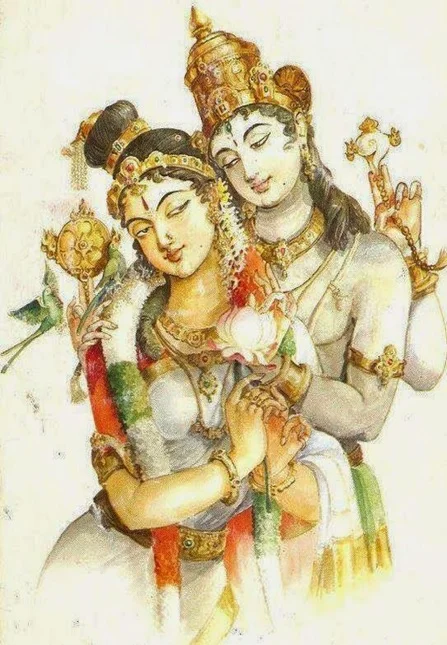
Andaal’s parrot has no “secret” to hide.
Pattnaik makes matters even worse when he goes on further to misinterpret the Sanskrit word “Kama” as denoting “erotic passion” and symbolises it by relating it to Andal’s green parrot. While one cannot, of course, deny that in a few Hindu mythological stories to which Pattnaik’s esssay alludes (e.g. Kamadeva, Mohini or those about even Rishi Vishwamitra and Menaka, Rambha et al) there are indeed representations of the parrot as a metaphor for sensual love, passion, and fertility, it can be said emphatically that the parrot that Andal holds in her hand symbolises neither philia nor eros. If Devdutt Pattnaik would like to comprehend it better through familiar terms of Greek mythology, the parrot of Andaal can be said to perhaps transcend even agape..
Pattnaik might then well ask me: If the Andaal’s feelings are far removed from eroticism, what is the parrot that is held to be a symbol of sensual love in a few of the Hindu mythological narrations, doing perched as the bird is on her shoulder? Why in her hands the parrot is a symbol of “transcendent religio-spiritual feelings? Is it not a paradox?
The answer to that question lies in a fact that Pattnaik either overlooked or did not care to elaborate upon in his article. It is a very grave omission indeed and one that makes him guilty of peddling a salacious narrative about the personality of Andaal and the “erotic secret of her parrot“.
The fact is that the emotion of Kama is not simply lust or other such omnibus feelings of human concupiscence. Even an AI tool like Meta understands the fact but the scholarly Devdutt Pattnaik misses it and fails to underscore or make it explicit in his article. Meta says this very clearly: “In Hinduism, eroticism and spirituality are not mutually exclusive. The parrot’s association with both Kamadeva and eroticism highlights the complex and nuanced view of human experience in Hindu mythology, where sensual and spiritual aspects are intertwined”.
To understand this “complex and nuanced view” of Kama wherein its “sensual and spiritual aspects are intertwined”, one can look towards an illustrative example in the Sanskrit poesy of the great Kalidasa… Meghadootha. Please read the below Kalidasa verse and its rough English translation:

What should we make of the above Kalidasa verse? It waxes eloquent with feelings of love, a heart pining away for a spouse in Kailasa and about the pain of separation… Now is this feeling erotic or spiritual? If it is Kama or Eroticism that Kalidasa is describing then why is it being experienced as an “embrace that feels like home“?
In Sri Vaishnava theology of which Sri Andaal is a true icon, the Kalidasa experience is described in terms of spirituality not eroticism. It is called “naayika-naayaka bhaava” … where the individual soul, the ‘naayika‘ yearns for the ’embrace that feels like home‘ in the arms of the universal soul, the “naayaka“.
***********
The word Kama is one of the words in Sanskrit language described as being un-translatable by Rajiv Malhotra and Satyanarayana Das Babaji in their book “Sanskrit Non-Translatables: The importance of Sanskritizing English” (2020). Here is an extract from what they write and Devdutt Pattnaik would have done well to have familiarised himself with it before penning his article for The Hindu:
QUOTE:
“The concept of Kama is not simply lust.
The pursuit of kama is the result of the disconnect between a jivatma and the ananda of the Brahman (Sachidananda), and is due to the jiva identifying itself only with material reality. It is this pursuit which manifests in yearning for various objects, furthered by misidentifying oneself with physical, emotional and mental entities. Hinduism recognizes this entanglement and provides a structure to legitimately pursue kama without letting it degenerate into mere lust. According to Hindu dharma, kama should not be satisfied in a way that becomes self-perpetuating and an obstacle to dharma or artha.
In Hinduism there are four types of shastra-s corresponding to the four aims of human life: Kamashastra, Arthashastra, Dharmashastra and Mokshashastra. All these shastra-s provide guidance to lead a balanced life by satisfying the legitimate needs of a human. The ancient Indian treatise of Kamasutra written by Vatsyayana says that indulgence in kama, which means ‘sexual enjoyment’ in this treatise, should not be at the expense of dharma and artha. Similarly, in the Arthashastra, written by Kautilya, it is said that a person should not make money in a way that goes against the dharma. Thus, the word kama used in the shastra-s denotes a concept which is regulated by the scriptural injunctions and is not an unbridled pursuit like lust. The process of karma-yoga as well as the concept of varnashrama dharma in Hinduism is meant to gradually bring a person out of this lower nature owards the higher principles of life.
One of the names of Shri Krishna is Kamadeva and in the Bhagavad Gita, he says that He is kama which is not against dharma.
बलं बलवतां चाहं कामरागविवर्जितम् |
धर्माविरुद्धो भूतेषु कामोऽस्मि भरतर्षभ || 7.11||
balaṁ balavatāṁ chāhaṁ kāma-rāga-vivarjitam
dharmāviruddho bhūteṣhu kāmo ’smi bharatarṣhabha
Several scholars with a superficial knowledge of Hinduism, such as Wendy Doniger, desacralize the word Kama and use it to distort the divine relationship between the Gopikas and Bhagavan Sri Krishna.
Atmavan manyate Jagat …. A person sees the world according to one’s own mental conditioning. UNQUOTE
Devdutt Pattnaik is simply unable to understand Kama in terms other than that of eroticism or lust simply because … well … “Atmavan manyate jagat“…!
It is the only way he, much like Wendy Doniger (the other head of Ravana) is mentally conditioned to see the world. Devdutt simply is incapable of appreciating what Kalidas alludes to as the “embrace that feels like home“; and which is precisely why Pattnaik writes what he does below, and quite disdainfully if not contemptuously about Andaal:
QUOTE: “And the women are mothers, sisters, daughters, devotee — they are not pining lovers, wandering miserably in dark groves. In new retellings of Andal, she is whitewashed and sanitised. It is emotional, not erotic. She is made a subservient and submissive devotee, the symbol of “jiva-atma”, pining for Krishna, the “param-atma”. Holiness is confused with purity and purity with celibacy. …” UNQUOTE
************
The poor bird, Andaal’s parrot too gets shabbily treated by the hands of Pattnaik in his essay.
He sees the parrot as “a raucous bird inextricably linked to love, lust and desire”. He is dead wrong to think so because Andaal’s parrot far from symbolising eroticism is actually a symbol of transcendence of eroticism. To borrow a phrase from the book, “Sanskrit Non-Translatables“, the parrot in Andaal’s hands represents the human folly of “misidentifying oneself with physical, emotional and mental entities …” and the resultant “… entanglement” with them.
Before penning his article for The Hindu, Pattnaik really cannot reasonably have been expected to take the trouble to study a few of the Tamizh verses of the Holy Azhwars — like those of Sri Tirumangai Azhwar in the “4000 divya-prabhandhams”. Had he however delved deep and done so, he might then well have found answers for the paradox of the parrot’s “erotic secret”. If he had cared to familiarise himself even a little bit with Sri Vaishnava ‘sampradaaya‘ before writing about Andaal, Pattnaik could have easily disproved what his detractor, Subhodeep Mukhopadhyay wrote about him: “Pattnaik seems content to tread the surface and keep his analysis perfunctory. Such cursory perusal serves his purpose, as his target audience, the English-speaking urban Hindu elites tend to have superficial knowledge of Hindu darshanas and samparadayas”.
I daresay however that it would have been beyond Devdutt Pattnaik’s intellectual bandwith to try and unravel Andaal’s “erotic secret” by studying the 10 wonderful Tamizh verses found in Sri Tirumangai Azhwar‘s “Peria-Tirumozhi 5.5″ (fifth centum fifth decad). These verses clearly reveal what the symbolism of the Parrot of Andaal is all about.
Out of the 10 verses I wish to offer translation of only four below which I think are sufficient to drive home my central point viz. the parrot symbolises human folly in “misidentifying oneself with physical, emotional and mental entities …” and the resultant “… entanglement” with them
In the 4 verses below, one sees the Azhwar imagining himself to be a girl i.e. a “naayika” — much like Sri Andaal herself did in her own Tiruppaavai and Naachiyaar Tirumozhi. The Naayika pines away for the Deity at Sri Rangam, her God, and spends her days and nights in an endless trance … She is unable to bear separation from her divine paramour. She is utterly love-lorn and lives her days doing nothing but thinking constantly of Sri Ranganatha, the God of Sri Rangam. The girl’s name is Parakaala Naayaki.
Now, Parakaala Nayaaki’s mother wails about the love-besotted state of her daughter. She gets the anxious about what she perceives to be the infatuated mental state of her daughter… She is going slowly mad with hopeless love, the mother thinks. The mother, in fact, seems to think exactly like Devdutt Pattnaik, unable to recognise anything but erotic fervor in her daughter’s behaviour.
The aggrieved mother hence begins to beat her breast, moan and wail over her daughter’s love-lorn condition and blames and accuses the Lord of Sri Rangam for having reduced her daughter to such pathetic state. Let us enjoy the Tamizh verses:
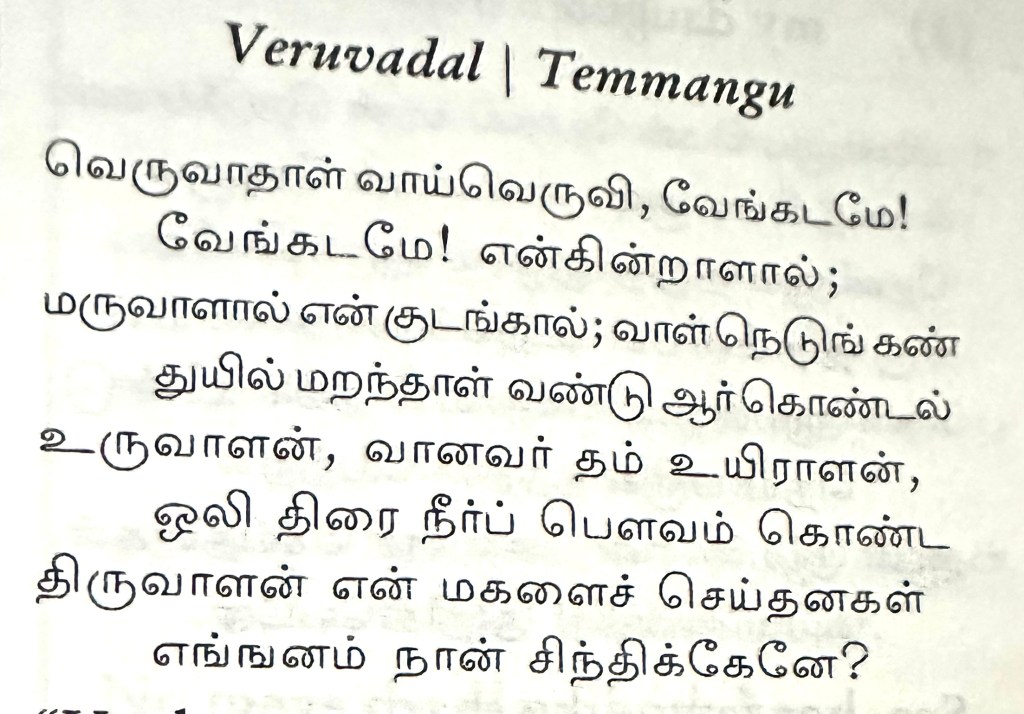
veruvAdhAL vAy veruvi vEngadamE! vEngadamE! enginRALAl
maruvALAl en kudangAl vAL nedungaN
thuyil maRandhAL vaNdAr koNdal
uruvALan vAnavar tham uyirALan
oli thirai nIrp pauvam koNda
thiruvALan en magaLaich cheydhanagaL
enganam nAn sindhikkEnE?
“All day, without fear of any shame or shyness, my daughter spends her time prattling in a frenzy to herself : “O my Lord, my Lord who lives in thiruvEngdam!”. I try to calm her down, comforting her by taking her in my arms and resting her head upon my motherly lap… Alas! She finds no comfort in me and wants to rest her head only upon his lap! At night I see her wide unblinking eyes peering about in the dark and gleaming like the steel of sharp swords … She mumbles to herself that she waits for the day when she shall see “sarvESvaran”, with his glowing divine form resembling in complexion a cloud shrouded by black beautiful beetles: He is the life of the celestials, the “nithyasUris”, he is the dear consort of “periya pirAttiyAr”, the daughter of the milky ocean of high tides…. O see what He has done to my daughter! To whom shall I go and cry about what he did to my daughter?!“
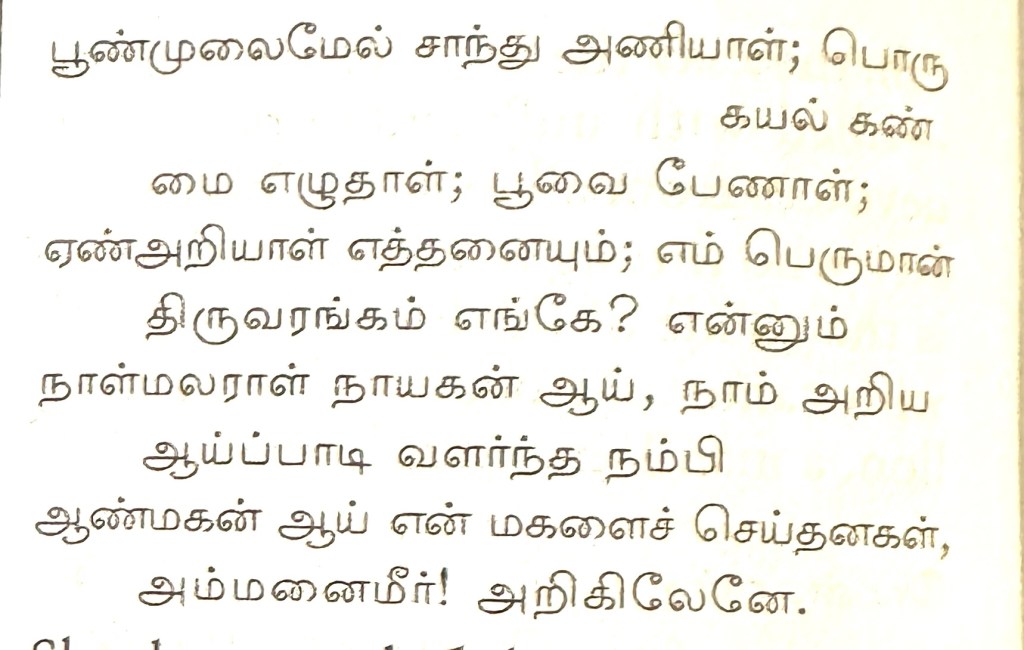
pUN mulai mEl sAndhaNiyAL
poru kayal kaN mai ezhudhAL pUvai pENAL
ENaRiyAL eththanaiyum
emperumAn thiruvarangam engE ? ennum
nANmalarAL nAyaganAy
nAmaRiya AyppAdi vaLarndha nambi
ANmaganAy en magaLaich cheydhanagaL
ammanaimIr! aRigilEnE
“My daughter now doesnt bother to groom herself… she doesn’t smear her young lithe body with sandalwood paste, nor does she tend to her young, swelling bosom; she no longer lines her beautiful fish-shaped eyes with collyrium; she does not even have time for her beloved pet parrot; she thinks of nothing else but Him, her handsome beloved; constantly she asks herself as in a besotted trance “O where is the “dhivyadhESam”, that temple named Srirangam where my lord resides?… Where is he who hails from Gokulam!” O listen to my wails, ye womenfolk! I don’t know what spell he cast upon my daughter that she is now in this sorry state”.
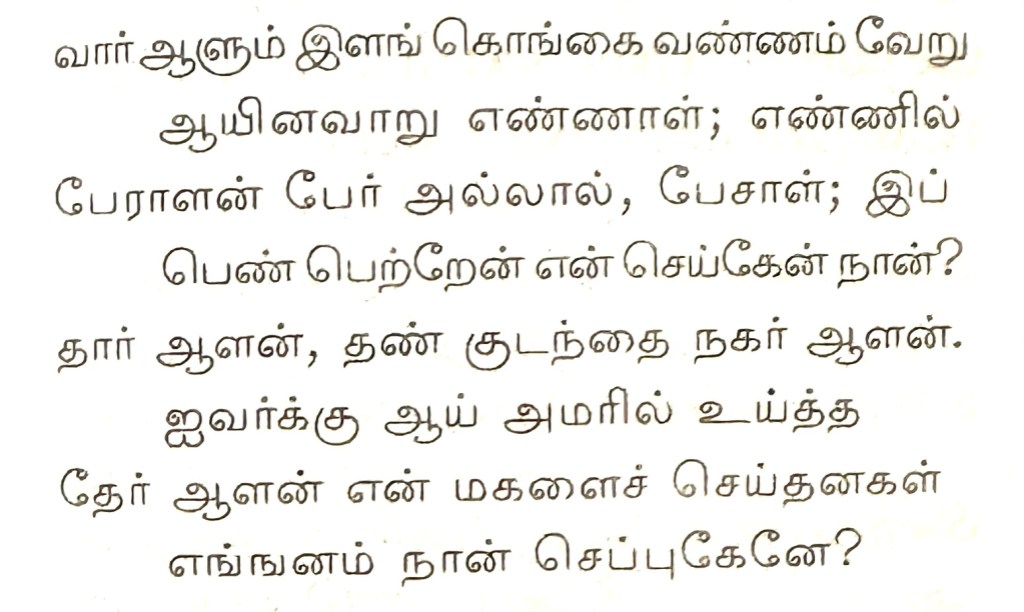
vArALum iLangongai vaNNam
vERAyinavARu eNNAL eNNil
pErALan pErallAl pEsAL
ippeN peRREn en seygEn nAn?
thArALan thaN kudandhai nagarALan
aivarkkAy amaril uyththa
thErALan en magaLaich cheydhanagaL
enganam nAn seppugEnE?
“She doesn’t see the wilting complexion of her youthful bosom nestled tight inside her firm corset; She has no thought in her mind other than the divine names of the great lord of Sri Rangam! What shall I do with this enchanted girl now, I the mother who gave birth to such a girl as this one? He who wears a divine garland; he who journeyed to the the cool climes of “thirukkudandhai”; he who rode the chariot for the “pancha pANdavas” in that great war … He is the one who has utterly bewitched my girl and reduced her to this pathetic state… O what did he do to my daughter? And to whom shall I go now and wail about it?!“
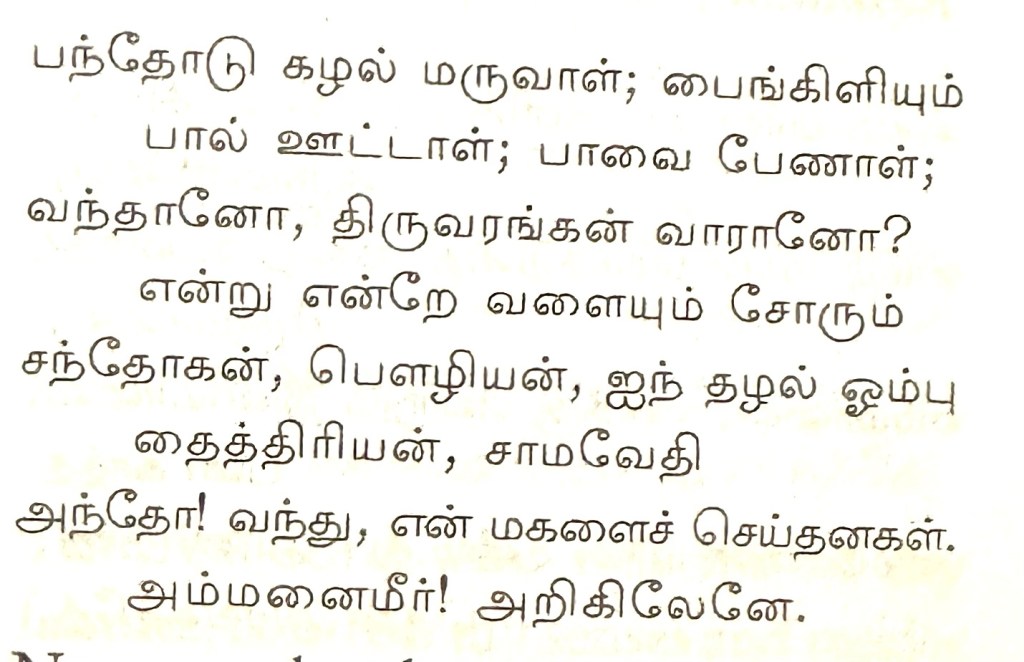
pandhOdu kazhal maruvAL paingiLiyum
pAlUttAL pAvai pENAL
vandhAnO! thiruvarangan vArAnO!
enRenRE vaLaiyum sOrum
sandhOgan pauzhiyan ainthazhal Ombu
thaiththiriyan sAma vEdhi
andhO! vandhu en magaLaich cheydhanagaL
ammanaimIr! aRigilEnE
“She has lost all interest in the sports she once used to be thrilled by — playing with ball or unripe fruit known as kazhal; no longer does she feed milk to her green parrot; she has thrown away all her lovely dolls! Now and then she wakes up as if from a dream and cries: “azhagiya maNavALan”, my beloved has mercifully arrived! O how Wonderful!” and then in the next moment she falls back weeping to the ground in disappointment… imagining, “Alas! He is not coming!”. She then wilfully crushes the bangles on her wrists and asks herself : why, my “emperumAn” who is master of all the “saama vEdha, the brAhmaNas”, knows all about the conduct of the five Vedic sacrificial fires and is the cause for performing all the sacred ritual fire-sacrifices … O! why does he not appear before me yet?!” This is how my daughter cries, Oh ye womenfolk! This is the state to which he has brought my poor darling daughter! To whom shall I go and ask “What he did and why he did this to my darling daughter! Alas!”
In the above verse, the phrase “… paingiLiyum pAlUttAL…” is very significant in that it conveys the meaning that Parakaala Naayaki no longer feeds her pet parrot with milk because her mind now is riveted firmly on only one thought to the exclusion of everthing else in the world— viz.: the thought of the God of Sri Rangam… and everything else, every other trace of Kama, therefore has been entirely blanked out or erased from her consciousness. There is no other desire left inside her… Exactly the same intensely spiritual expression of religious sentiment of Parakaala Naayaki is also voiced by Sri Andaal in that beautiful penultimate verse 29 of her Tiruppaavai in the very last line — “mattrai nam kaamangal maatru elor!” — “Let my heart hold no other desire except my kama for Thee!”
சிற்றஞ்சிறுகாலே வந்துன்னைச் சேவித்துன்
பொற்றாமரையடியே போற்றும் பொருள்கேளாய்!
பெற்றம் மேய்த்துண்ணும் குலத்தில் பிறந்து நீ
குற்றேவல் எங்களைக் கொள்ளாமற் போகாது
இற்றைப் பறைகொள்வான் அன்றுகாண் கோவிந்தா!
எற்றைக்கும் ஏழேழ் பிறவிக்கும் உன்தன்னோடு
உற்றோமே யாவோம் உனக்கேநாம் ஆட்செய்வோம்
மற்றை நம் காமங்கள் மாற்றேலோர் எம்பாவாய்.
So, are Parakaala Nayaki and Sri Andaal in the throes of Kama? Then why throw away the parrot or starve it if the raucous bird really was, as Pattnaik believes it is, a stark symbol of Eroticism?
**************
There is one other very significant Tamizh phrase in the above verse of Tirumangai Azhwar “paasuram” which is : “…. sandhOgan pauzhiyan ainthazhal Ombu thaiththiriyan sAma vEdhi andhO!“. It too must be examined in the present context of Kama. It will be taken up for explication in the next concluding blog — Part-3.
Sudarshan Madabushi
By the statement “…. Devdutt, the premier mythologist of India that he is renowned to be…. ” you are erring way too generously on the generous side.
Initially I thought Shri Devadutt was authentic, what with his impressive writing style. It did not take me long to realise the shallowness of his knowledge & the way he has sensationalised every aspect of our Itihasa by blending/ juxtaposing them quite mindlessly or even at times inappropriately with western management thought. This article in The Hindu is just another example among a ton of such.