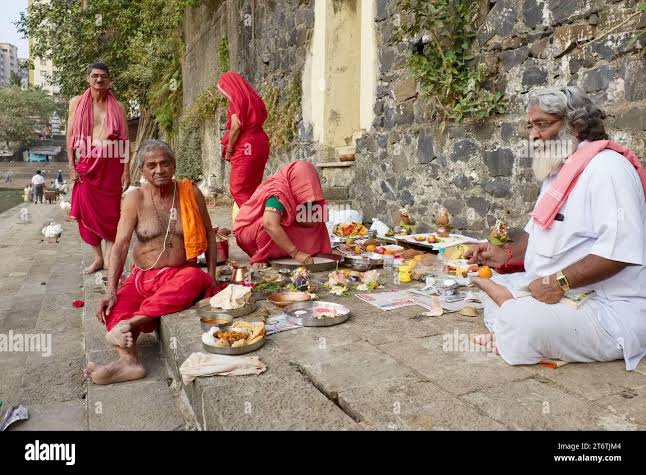
Today, Thursday 27 February 2025 … is Amaavasya day (New Moon day)… a day when I must perform the “pitru tarpanam” rite mandated by Vedic “sastra” in remembrance and obeisance of my parents, grandparents and great grandparents, both paternal and maternal.
***** ***************** ******
These days youngsters in even Tambrahm families and homes demand “rational, logical” explanations for anything and everything related to Vedic rituals and observance of even basic “Nithya-Naimittika” traditions of their old ways of life. When they see me being scrupulous in performing “Ammavasya Shraddham” or annual “pitru paarvana Shraddham”, they often challenge me to give a rational explanation for why I do it and what purpose is realised through it.
When challenged thus by highly intelligent, highly educated youngsters within my extended family circles — and I’m referring here to top-notch young engineers, doctors , IT whiz-kids and AI-specialists of foreign origin and foreign-returned origin as well — who outnumber senior-citizen fossils like me, I’m often at a loss to tell them about the rituals in a language and idiom of their own , or in terms and in a manner that’s convincing to them .
In such situations I try to hold my ground usually by quoting the Vedic scriptures to buttress my explanations. But that immediately turns them off ….
I try telling them that the Upanishad is the authority I abide by in so far as practising Vedic rituals is concerned ; and then I proceed to draw their attention to how the Taittiriya Upanishad Seekshavalli lists many Karmas in life that one should never abandon and I especially underscore the importance of “pitru kaarya” :
स्वाध्यायान्मा प्रमदः । आचार्याय प्रियं धनमाहृत्य प्रजातन्तुं मा व्यवच्छेत्सीः । सत्यान्न प्रमदितव्यम् । धर्मान्न प्रमदितव्यम् । कुशलान्न प्रमदितव्यम् । भूत्यै न प्रमदितव्यम् । स्वाध्यायप्रवचनाभ्यां न प्रमदितव्यम् । देवपितृकार्याभ्यां न प्रमदितव्यम् ॥ ३ ॥
From study swerve thou not. Having offered dear wealth to the teacher, cut thou not the progeny’s line. From the true it will not do to swerve, nor from Dharma, nor from welfare. Neither will it do to swerve from well-being, nor from study and teaching, nor from duties to Devas and Pitṛs.
But no sooner have I quoted to them the above passage, they begin to shake their heads impatiently and roll their eyeballs towards the roof and tell me in exasperation :
“But Uncle , I didn’t ask you what the Upanishad or the Sastra says , did I ? I want to know what is your own reasoning , your very own conviction about the matter !
“Explain to me what is it that personally impels you to abide by all these rituals? If you say there’s nothing else but scriptural injunction that you follow implicitly, then please say so ! Admit it that you perform these rituals out of blind unquestioning faith … and not out of any rational thought … Be honest to yourself and to us … At least then we’ll know why you do what you do! Why give us instead mumbo-jumbo.., all this Sanskrit “jargon monoxide” to bamboozle us?”
In the face of such formidable challenge thrown at me by a stripling nephew, cousin or other young relative, I often go cowering into a defensive shell …
How on earth would it be possible to explain to these brainy, hi-IQ summa-cum-laude young disbelievers the deep significance of “pithru Karyam”?
I’d then take recourse to the next best line of defence.
I’d recommend to them to read up the wonderful expositions on the subject already that has been provided by our Vedantic Acharyas and preceptors such as our Azhagiyasingars and gurus like Kanchi Paramacharya who in his splendid book “deivattin kural” has lucidly explained the profound significance of these forms of Vedic ancestral obeisance and veneration through ritual. But then these youngsters have no patience to read such works. Their shaky knowledge of Sanskrit and Tamil disables them from appreciating the worth of such works and expositions and they therefore pay scant attention to them.
So, what am I to do? These young almost fiendishly intelligent youngsters won’t accept any explanation from me unless it passes their own so-called test of “reason and sensibility”?
***** ****** ******
One evening , all the above that I’ve described came up as a subject of casual discussion with a dear friend of mine. He sympathised with me when I told him about the quandary I found myself in coming up with an explanation for the ritualism of Vedic ancestral worship to my family youngsters which they demanded should be free of what they mockingly called “jargon monoxide”.
“Of course, I can understand your situation … it’s not easy to convince the young in our families these days … Their irreverence stems from an obsession with Logic and Rationality… It’s the Age of Artificial Intelligence you see … They are all blessed with algorithmic faculties. They thus wear with a sense of pride their ignorance of Vedic scriptures and ritualism on their sleeves as a badge of superior intelligence”.
We both then continued our desultory conversation on the subject of ancestry and ancestral roots in a very general sort of way ….
My friend for some reason began to speak on his recent efforts to trace his own family’s ancestral history with the aid of DNA reading… !
It was interesting for me to see how suddenly but rather a little late in life — he was just a couple of years older to me in age — he had developed great, passionate curiosity about his personal and family ancestry. What had triggered it? Why the sudden intense need to connect with the mists of his past lineage ?
As I kept wondering silently about his newfound curiosity into his ancestral roots, my friend went into a contemplative monologue of sorts:
“I had drawn out our family tree with the help of my grandfather, extending my mother’s side till around 1300 CE. Apparently they had a method of maintaining a detailed chart of “banthukkal“. The stories, struggles, events good (and not so good too) that I heard from him, just made me realise my own insignificance today. He narrated even the social and political happenings of those times.
“My ancestors evidently came down from somewhere in south-Jammu to somewhere in UP near Ujjain. Then there was long migration to Tirupathi, with some of them branching off to Kanchipuram, and finally to Kumbakonam… Very long story of migration.
“The ancestors had (like most others’ of our community) experienced so much turmoil, lost so much , suffered so much at the hands of foreign invaders, and had to live through many trials and tribulations for generations … It’s fascinating today to get at least some glimpses into their patchy history …
“Not much of those stories however was actually written down by anybody. Except for one sketchy book listing the lineage of heads of our family for about 23 preceding generations .
“They are only apocryphal, scattered, patchy or anecdotal accounts … very skimpy …. But they have survived and become the stuff of our family legends… And they speak about age-old reference to places, landmarks of their locations and quaint family stories…
“If you take the lineage of gothras you can easily find out where all your distant cousins who came from the same family tree had spread out geographically; and generally, there is in our religious literature here and there a few time-markers that serve as very rough clues to how the ancestral roots are spread out across vast regions.
“Scientifically, if you want to follow the ancestral trail in today’s times, there are institutions which help us to trace the origins of our ancestry using DNA genome sequencing. You have to send a swab of saliva from your mouth and they will subject it to DNA tests and send back to you reports from soft copies in their website, tracing your ancestors from the time Homo sapiens came out of Africa , some 75000 to 80000 years ago….
“So yes … we all do carry some DNA traces of Neanderthal & Denisovan genomes! I got my test done with NatGeo about 10 yrs ago. The facts about my ancestral trail that I came to know of truly had me floored me … it left me wondering how much into an infinitely tiny cocoon of a cosmic time-capsule I was living in… .
“Through such DNA-history findings, I now know that the institutions also have an updating service which keeps track of my record and is able to tell me when the same family DNA connections as mine mine get tracked and identified as and when another person gets tested anywhere across the world. The matching then pops up on their database and I’ll get notified at once! I didn’t of course sign up for the service . … it’s a little scary!
“The ancestral migration of my lineage could have begun some 3000+ years ago and continued in small trickles over thousands of years. Generations travelling in such small waves of humanity across the Indian expanses may have brought them say in several swathes of 500-km each … southwards and one at a time.
“In my case, it could’ve been from 1300 CE to 1800 CE from far north to Kumbakonam in the south. Each little migration adapting to that local place and surroundings. Learning the local language and forgetting the earlier language. My ancestors were perhaps Nomads of different genre or genetic types …
“According to the records that my grandfather kept, our forefathers arrived at Kanchipuram around 1600CE from the banks of the Narmada after having moved from the banks of the Saraswathi several centuries earlier
Interestingly, they moved from there to Mysore at the invitation of the Maharaja of Mysore 7 generations before mine and finally moved to Aravangulam, Tirunelveli district. My great grandfather became Ghar Jamai in Desamanickam, which is approx 16 km upcountry from Tirunelveli.
***** ******* *******
After patiently listening to my friend’s monologue on ancestry , I couldn’t help within my own mind trying to instinctively connect everything he’d just told me with my own struggle to explain ancestry through the Vedic Ritualism of “Tarpanam” and “Shraadham” … without the use of the asphyxiating “jargon monoxide” that the youngsters in my family had told me sternly they would not accept from me.
So, after my friend had delivered his monologue, I responded to him with mine own. Here is a paraphrase below :
“I am truly able to understand your newfound fascination for trying to unravel your deepest ancestral roots all the way to its very origins. Do you know what it tells me, my friend?
“It tells me that deep within all us there lurks a very primal desire to share in primordial ancestral memory …
“It’s not mere knowledge of ancestral identity , ancestral history or ancestral fate that we really want to acquire . What we actually wish to acquire is deep insight into the accumulated and collective memories that had resided inside the minds of entire generations past. It’s verily the key to that vast number of layers of memory that have piled one upon another and accumulated over time which we really want to unravel …. Because that accumulated memory is what will tell us such a lot more about ourselves than what merely knowing the facts of ancestral identity and migration will provide .
“How to find that wonderful key that will magically, as it were, open up the grand but dark cave inside which will be found the collective, accumulated memory of the ancestors? That key, in fact, is the secret to understanding our true self … “Who are we? Where did we come from? And where are we going?”
“Gothra pravaram” is all that we have to fall back upon to keep somehow ancestral memory alive within us … The nature of Time is such that it will erase all memory and all subliminal impressions deep inside our consciousness .
Some traces of it might now and then flash inside our brains … but they’d all be very inchoate and phantasmic … I’m sure all of us experience such a thing as deja vu … i.e. something happens right before our eyes and suddenly it seems to us that we’ve experienced the same somewhere , sometime long ago … but we can’t figure out where when and how … but it streaks through our mind as some fleeting apparition …
That experience is, if one thinks about them deeply, ancestral memory spiking momentarily inside the cortex of our brain … our deepest level of consciousness at a non-verbalised level … This is what modern science has come to describe as “neuro–theology”
It is precisely to be somehow able to still preserve the subtle and indescribable and such collective ancestral memories within our deepest selves that the ritual of pitru Kaaryam or Shraadham , Tarpanam was devised in our Vedic system of faith .
Ritualised recollection of the collective memories of ancestral past lineage is what is aimed at in Tarpanam and Shraddham . The mantras and incantations related to the ritual are in fact sonic waves that are intended to penetrate and preserve the subtle memories within ourselves …
It is done through the invocation of the primal Gothra Pravaram … and invoking the souls of at least three of our parental ancestors, both on the paternal and maternal side …
The belief is that that ritual alone is sufficient to keep ancestral memory preserved and alive within us from one generation to another … Its like each of us keeping the DNA-code fresh and alive in the spiritual space we inhabit as Homo sapiens …
It’s really like writing on a subconscious palimpsest what as Ancestral Collective Memory survives through endless expanse of time … i.e. what comes down to us from the very beginnings of our time as per the cosmic grandfather clock ! (Pardon the pun!)
******** *********** *******
The long and short of this, I reckon, is only this : in the end , how should I offer the youngsters in my family the personal justification they demand from me for my performing the “pitru tarpanam” or “paarvana shraadham? Justification that will sound to them “logical, rational”? Should I use the “jargon monoxide” of ancient Sanskrit traditional terminology or that of modern psycho-babble?
Sudarshan Madabushi