I chanced to read the below quote of the famous English philosopher Bertrand Russel.
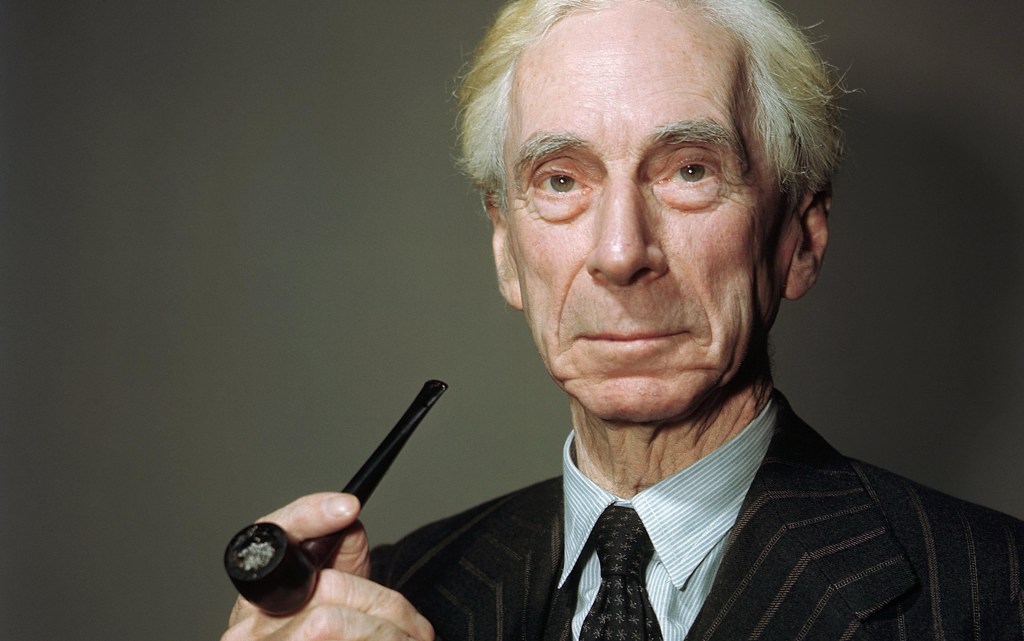
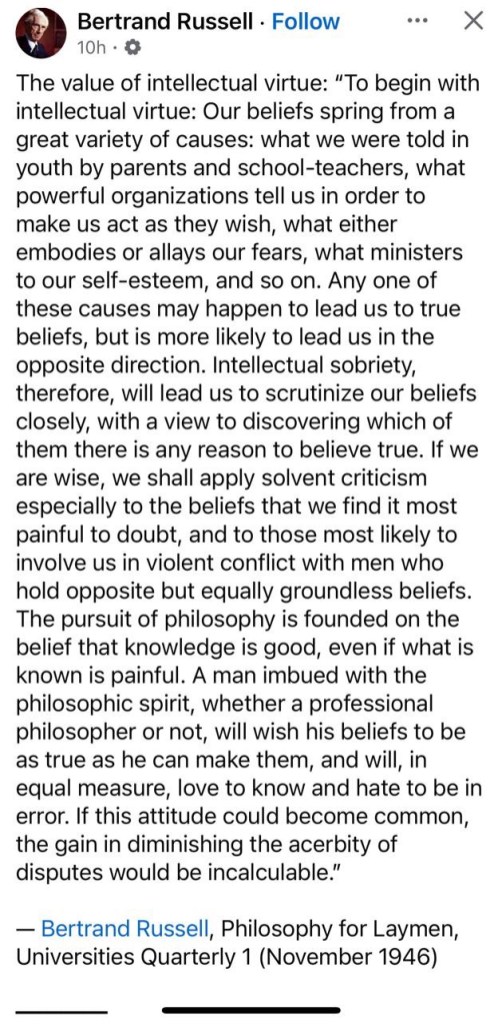
When I read it I found it truly so thought-provoking that I could not resist the urge to share it online with many of my dear friends and family who are thoughtful souls too .
One of them is a very dear friend and ex-colleague of mine. Let’s call him just Krish .
I told Krish this after sending him the above Russel quote :
The key word here is “intellectual sobriety”… a virtue that I’ve been trying to cultivate all my life …. With varying, erratic degrees of success !
Krish immediately replied with this message below ⬇️
Loved reading it !
- Solvent critisism – inside oneself & not expressed to opposite brick walls of adherants concreted by beliefs.
- True liberation: understanding ‘belief’ itself imbibes bias and oxymoron to ultimate abject reality.
- Our core beliefs, except for distilled moral/humane life – r not created by us; it is borrowed & solidified.
- Beliefs are core reason for conflicts, misery & cuelty.
Did not understand: “gain in diminishing the acerbity”. Pl explain.
*************************************
Krish my friend is a vigorous thinker .. someone who will not stand convinced of any view unless it is “logical , rational and factual”. Often I find it extremely difficult to satisfy his voracious appetite for “rational arguments”. So, being asked by him to “explain” Bertrand Russel — who was himself a most formidable philosopher of Rationalist School of Thought of the 20th Century — I could not but feel a bit of trepidation as I tried to give Krish a suitable answer . Still, I braved the following response :
Krish, IMHO, the key philosophical questions to ask are these… at least as far as I’m concerned:
- “If beliefs are core reason for conflict, misery and cruelty” … as Russel says … can man ever conceive a belief-less state of existence ? A belief-less state of being is Nihilism… and that in fact can cause more “misery and cruelty”.
- Therefore , it stands to reason that Belief by itself is not wrong and beliefs by themselves are not the cause for conflict . It is only dangerous , evil-rooted and perverted beliefs that arouse intolerance, hatred and conflicts .
- So , it stands to reason that societies must construct , devise and affirm a set of normative beliefs for themselves; and such beliefs have to be healthy , untoxic and they can minimise the causes for individual or social conflicts . Such a set of normative beliefs is what is called the Social Contract by philosophers in the West . We in India have called it Dharma or Dharma Sastras.
- Now , the real problem is not in the way Social Contracts or Dharma sastras are constructed . They are all well-intended . The problem however is that human nature is riddled with doubt. We doubt the intentions of every belief-system . The more enduring and ancient a belief-system becomes over the course of time , the less and less trustworthy it becomes in the eyes of society . Beliefs are seen to become stagnant, obscurantist or rigidly traditional because they are seen to be enforced by power-equations and dynamics . This distrust was famously described in one brilliant and famous epigram by George Orwell: “All pigs are equal but some pigs are more equal” . Human nature is wired to distrust belief systems as being instruments of inequity . Don’t ask why ? Human nature is human nature. And perhaps modern education has something to do with creating the seeds of distrust amongst one another . Human nature is human nature . Period .
- Under the circumstance, social contracts and dharma sastras get challenged and they themselves become the subject and source of deep conflict . Some clamour to have them changed . Some want them thrown to the winds. Beliefs themselves thus become the source of “conflict, misery” and when conflict gets out of control it becomes “cruelty “.
- So, one thing we must all believe in is this : somewhere deep within the human psyche is this rational streak which breeds Doubt and Distrust … both of which tend to destroy the Social Contract and Dharma .
This was exactly the message that was conveyed by Sri Krishna in the Bhagavath Gita :
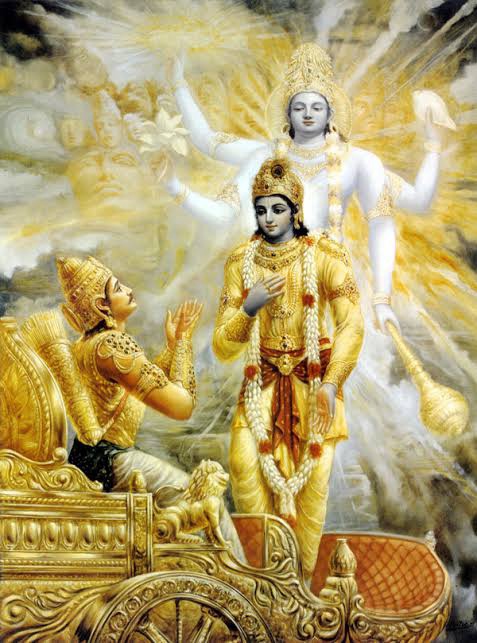
अज्ञश्चाश्रद्दधानश्च संशयात्मा विनश्यति |
नायं लोकोऽस्ति न परो न सुखं संशयात्मन: || 40||
ajñaśh chāśhraddadhānaśh cha sanśhayātmā vinaśhyati
nāyaṁ loko ’sti na paro na sukhaṁ sanśhayātmanaḥ
BG 4.40: But persons who possess neither faith nor knowledge, and who are of a doubting nature, suffer a downfall. For the skeptical souls, there is no happiness either in this world or the next.
*************************************
I did not send my friend Krish this further thought of mine :
Bertrand Russel and Bhagavath-Gita each represent two very distinct approaches to embracing a belief-system. Which one to choose? The choice is left really to each man to decide for himself .
Sudarshan Madabushi