After watching the video-clip above, if you are intrigued with the word பூகோளம்…, you are also likely to wonder how old the word would be and how it originated.
The Tamil word “பூகோளம்” (pūgōḷam) means “globe” or “the terrestrial globe,” referring to the Earth as a spherical object. It is a compound of “பூ” (earth/land) and “கோளம்” (sphere/round shape), where “கோளம்” itself means a spherical or ball-like shape.
Regarding its age, “பூகோளம்” is a classical Tamil word found in traditional Tamil lexicons such as the Tamil Wiktionary and Chennai University lexicons, indicating it has been in use for centuries, likely since classical Tamil literature periods.
The root “கோளம்” is a fundamental geometric term in Tamil, used in literary and scientific contexts historically. However, exact dating is difficult without specific epigraphic or literary references, but it is safe to say the word is ancient and well-established in Tamil vocabulary.
In summary, “பூகோளம்” is an old Tamil word with classical roots, meaning “globe” or “sphere,” used traditionally to describe the Earth or any spherical object.
“BHU” is Sanskrit. It’s the first word in the Gayatri mantra aavrithi… It means this terrestrial space .
There is however another space called universal space .
Another word associated with bhu is the Sanskrit word “mandala” …. which denotes “universal” space.
Bhu mandala” , “surya mandala”… are very evocative Sanskrit words. The fact that our ancients were able to conceive these words itself shows that their cosmogony findings were well advanced …. and centuries ahead of Galileo or Copernicus .
“Mandala” means “centre” … as in the centre of a circle , sphere or a vast space of universe ….
The cosmogony of the ancients was already well aware of a heliocentric universe even while the western astronomers were still struggling to come to grips with the concept — both scientifically and spiritually —- right until the 15th century CE.
The Sanskrit word mandala translates to “circle” or “center.” It symbolizes wholeness and is often associated with geometric designs representing the universe or cosmos in Hinduism.
The heliocentric universe is often referred to as Sūryamaṇḍala Brahmāṇḍan and it aligns with the meanings of these terms.
• Sūryamaṇḍala (सूर्यमण्डल) signifies the “solar sphere” or “circle of the Sun,” symbolizing the Sun’s central and radiant energy in both spiritual and astronomical contexts.
• Brahmāṇḍa (ब्रह्माण्ड) refers to the “cosmic egg” or the universe, emphasizing the vastness and interconnectedness of creation.
Together, this phrase highlights a cosmological model where the Sun (Sūrya) is central, surrounded by the universe (Brahmāṇḍa), reflecting both scientific and spiritual perspectives. The term maṇḍala reinforces the circular, harmonious structure of celestial systems. But spiritually , the ancients posited the human soul (atma), the seat of all consciousness, to be the centre of the universe .
This shows that not only did the ancients understand a heliocentric universe in terms of astronomy but also a “consciousness-centric” universe in terms of psychology .
Both the above aspects of “bhu” and “surya mandala” are borne out, in fact, in the sacred mantra which we chant daily as part of the Sandhyavandanam ritual :
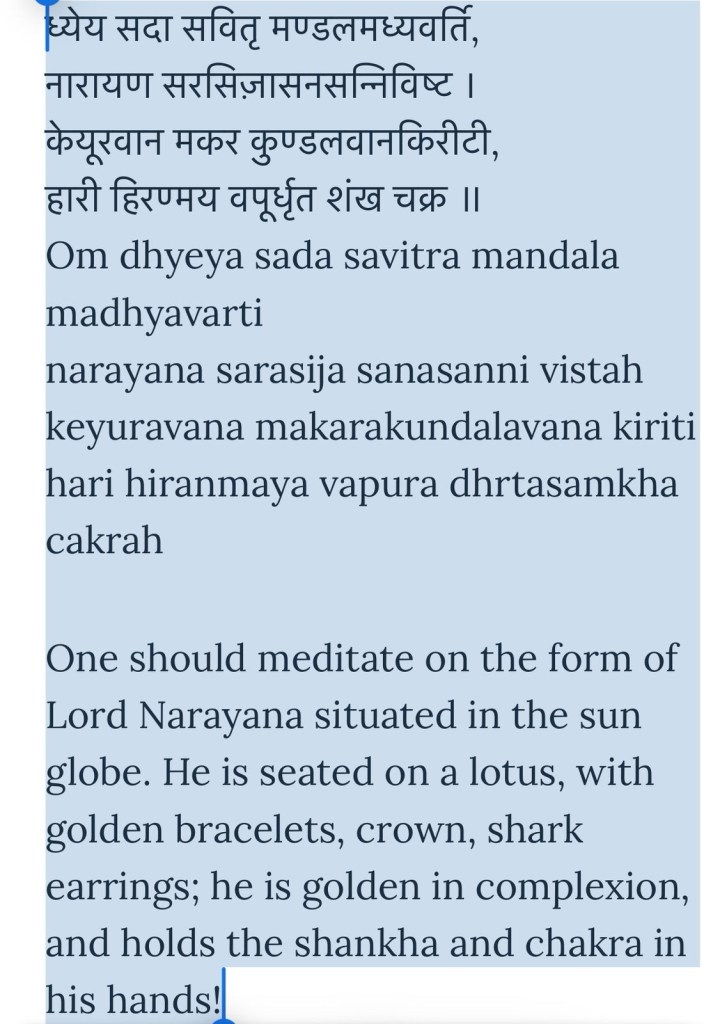
“Savitr mandala madhyavarti” … in the above mantra refers both to the sun being the centre of the terrestrial and cosmological universe as well as the “atma” (consciousness) being the centre of the psychic universe .
What a profound language indeed wherein a single word captures multilevel meanings ! No wonder then that Tamil cosmogony also borrowed the Sanskrit root of “bhu” to form the word “bhukolam”.
Sanskrit and Tamil are two Indic languages which really don’t have to compete at all with each other in ancient-ness. They both always had a symbiotic kind of relationship . The cross fertilisation process of language, thought and ideals that took place between the two had been going on for centuries . The process only added richness and profundity to both.
My revered friend and doyen of modern Tamil literature, Sri. Indira Parthasarathy (Eepa) affirms the 2-way street of symbiosis between Tamil and Sanskrit by pointing out to me the real root of the Sanskrit word , “pooja”: “According to the late Prof. Suniti Kumar Chatterjee, the father of Indian linguistics, ‘மீன‘ (star) has Tamil origin . ‘மின்‘ ‘to glitter’ and ‘Puja’ is also of Tamil origin ‘Poo’ meaning flower ‘பூ செய்‘ to worship with flowers!”
It is only this parochial politics of Tamil Nadu today that is creating a fictional divide between the two ancient languages only to rob both of their uniqueness and beauty.
Sudarshan Madabushi