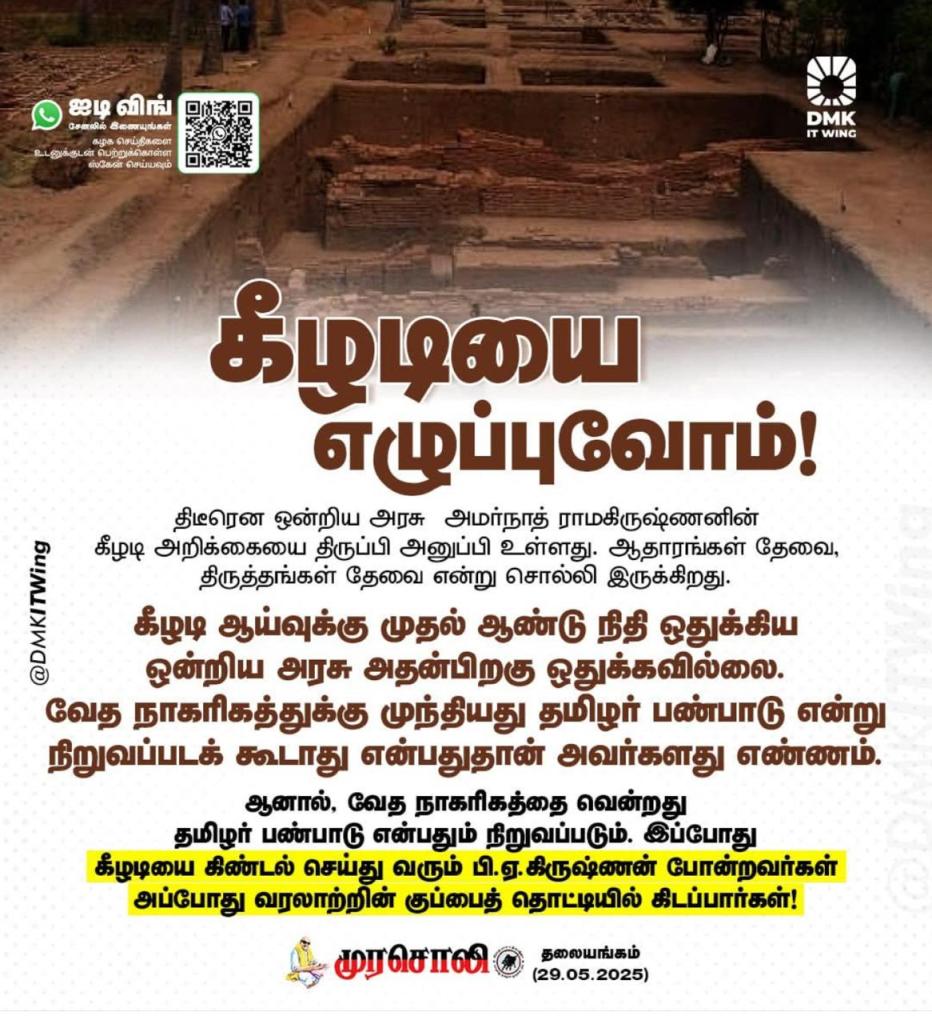
The meme-poster above is part of a broader campaign by the DMK and Tamil cultural organizations to pressure the Indian central government into recognizing Keezhadi’s historical importance, granting it protected status, and supporting further research and public dissemination of its findings.
The issue has become both a matter of regional pride and a flashpoint in the ongoing debate over the recognition of Tamil antiquity within Indian history. The Keezhadi site has become a symbol of Tamil identity, with the DMK and other Tamil groups accusing the central government (led by the BJP) of downplaying Tamil history in favor of North Indian narratives. There are ongoing demands for Keezhadi to be declared a protected site and for a museum of international stature to be established there, similar to how sites like Vadnagar and Sanauli in North India have been given prominence.
Why was archaeologist K Amarnath Ramakrishna asked by ASI to revise his report?
Archaeologist K Amarnath Ramakrishna was asked by the Archaeological Survey of India (ASI) to revise his Keezhadi excavation report primarily for the following reasons:
• Dating Justification: The ASI questioned the justification for the early dating of the Keezhadi site, particularly the claim that its earliest phase dates back to the 8th century BCE. The ASI’s letter stated that this time bracket “requires concrete justification” and suggested that, based on their view, the earliest date should be “at the maximum, somewhere in pre-300 BCE”.
• Scientific Rigor and Documentation: The ASI cited a need for “more authentic” data, better classification, clearer documentation, and improved scientific rigor. Specific requests included:
• Proper nomenclature or re-orientation for the three cultural periods identified in the report.
• Clearer presentation of chronological data, including marking layer numbers (not just depth) for comparative consistency.
• Replacement or improvement of certain maps and inclusion of missing documentation such as stratigraphy drawings, trench location plans, and contour maps.
• Feedback from External Experts: The corrections and revisions were based on feedback from two unnamed experts who reviewed the report for the ASI.
Ramakrishna, in response, defended his methodology and findings, stating that the periodization was based on established archaeological procedures, stratigraphic sequences, material culture, and AMS (Accelerator Mass Spectrometry) dating.
He asserted that all documentary evidence and chronological sequences were clearly explained in the report, and he considered the ASI’s demand for further examination as superfluous and contrary to the conclusive findings already presented. He agreed only to minor procedural updates, such as adding layer numbering if missing, and clarified that all required visual data had already been submitted.
Many independent scholars and observers have interpreted the ASI’s request as a possible attempt to delay or dilute the significance of Keezhadi’s findings, especially given the political and cultural importance of the site in Tamil Nadu. The controversy is further fueled by the fact that the ASI took more than two years after the report’s submission to request these revisions, and that the experts who suggested changes were not directly involved in the excavation.
What were the principal findings of the Ramakrishna Report?
The Report findings and evidence presented point to Tamil Nadu’s ancient civilizational identity being elevated from regional pride to global significance. It seeks to not only validate the cultural and historical claims of Tamils but also enrich the broader Indian and world understanding of early urban societies. The result: a more inclusive, pluralistic, and accurate narrative of India’s past—one in which it is Tamil Nadu that stands out as a pillar of ancient civilization.
It was thus that the claims of the Ramakrishna Report and the ASI’s challenging them which all turned and snowballed into not only an academic dispute but also into an arm-wrestling contest between the State and Central Government.
(to be continued)
Sudarshan Madabushi