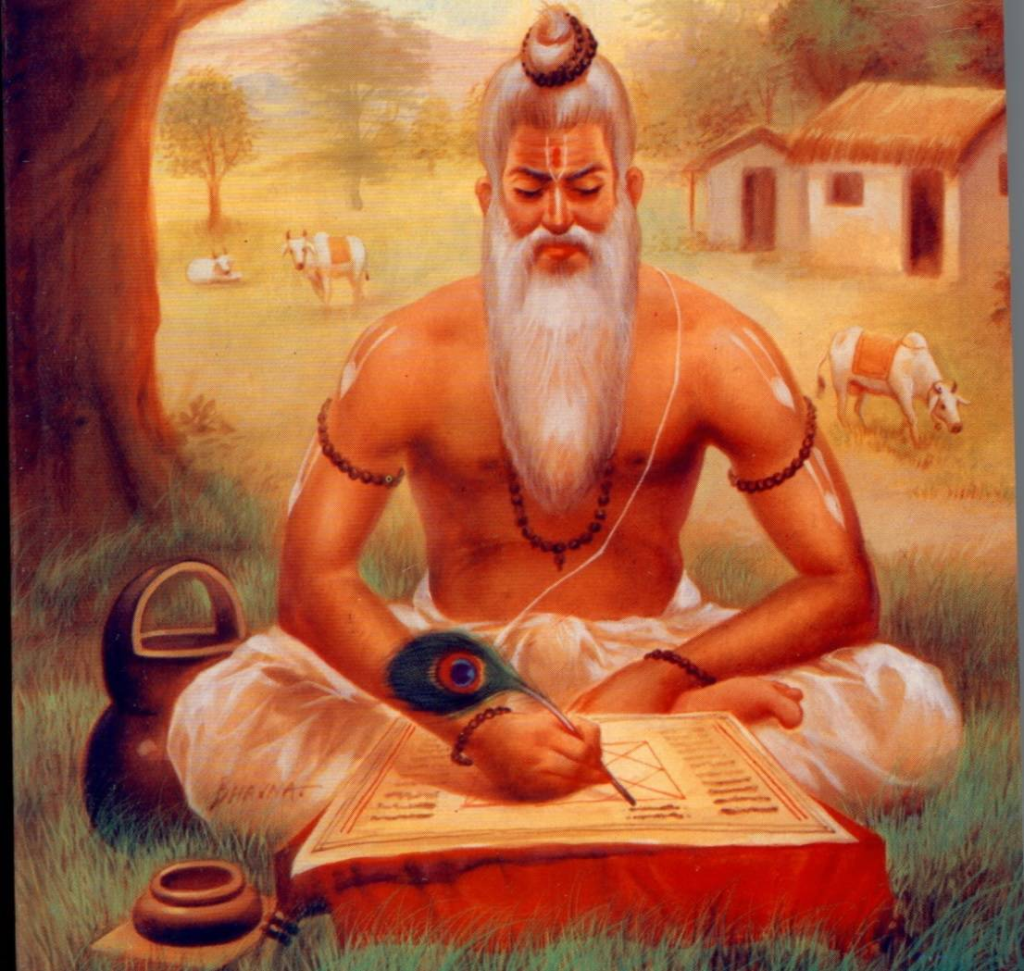
Let it not be misunderstood that today in the Democratic Republic of India, any body — not even an obscure, even maybe obscurantist writer like me — would be foolhardy enough to argue for the Manu Smriti to replace the Constitution of India. That would be sheer political sacrilege today in India… No, none of the views expressed here by me should be misinterpreted as any sort of call for cultural revanchism in bringing the spirit of Maharishi Manu back into political vogue or social practice. Leave Manu’s spirit aside…. yes … but do respect a few of his profound ideas.
In today’s political discourse in India, the Manu Smriti is regarded altogether as “untouchable“… i.e. it is as untenable and repugnant as pre-Galileo astronomy might have been when the Church posited the universe to be geocentric. Indian social norm and life has travelled far in the last 75 years after Independence. Today it revolves firmly and heliocentrically — and can never swerve from that very narrow orbital path — around the glorious sun of the Indian Constitution. So, it should be made clear by me here that the Manu Smriti is being referred to only in the specific context of the “Elite Overproduction” problem of modern societies that Peter Turchin, the American sociologist has analysed so deeply in his thesis “End Times: elites, counter-elites, and the path of political disintegration” (2023).
Manu Smriti did divide society into four varnas with distinct duties and rights assigned to each, according to their natural aptitudes (guna) and actions (karma). But the motive behind Manu’s “social engineering” was never to create “social dicrimination”. By explicitly prescribing different expectations, duties, and privileges for each class, Maharishi Manu created a framework in which aspirations for status, power, and vocation were “restructured” to suit broader social stability, thus aiming to avert widespread elite rivalry (“elite overproduction”). He cautioned that deviation from one’s prescribed role would lead to societal disorder. The Smriti thus was only reflecting a deliberate effort to minimize disruptive competition and align individual ambition with collective dharma.
The principle echoed in the Manusmriti, in fact, is clear: it stresses maintaining harmony and order, both by rewarding conformity to duty and punishing deviation, ensuring that no segment of society overreaches its prescribed sphere.
*********
In the Western world today, as Peter Turchin explained in his book, there are many forces in society operating powerfully to exacerbating the problem of “elite overproduction” which Maharishi Manu had clearly anticipated many millennia ago when he wrote his seminal Smriti.
What are those great forces?
I have been able to recognize at least four of them myself. There are perhaps many others too only far more percipient social observers than I — such as Turchin — can shed enough light upon. They are:
(a) AI, artificial intelligence
(b) Protectionism and Nationalism
(c) Immigration and
(d) Social Media
************
(a) AI, artificial intelligence: According to Peter Turchin and related analyses as AI takes over routine cognitive tasks previously reserved for credentialed elites, many who expected elite careers may face underemployment or marginalization, increasing social tensions around status and opportunity. AI and automation threaten to displace many traditional elite-aspirant jobs (e.g., lawyers, accountants, management consultants), reducing the number of high-status roles available relative to the growing number of highly educated aspirants. In fact, Turchin warns that generative AI and other advanced technologies will create a “huge destabilizing shock” in social systems, intensifying intra-elite competition and elite frustration, which are core drivers of instability in his model of elite overproduction. The “musical chairs” metaphor applies: with a roughly fixed number of elite positions, adding AI-driven displacement could mean even more players chasing fewer chairs, escalating conflict and alienation among elite aspirants.
(b) Protectionism and Nationalism: Worldwide today, and more especially, in America, Europe and United Kingdom, there is marked trend in Governments favouring a return to Protectionism and Nationalism. Donald Trump’s “tariff war” on the rest of the world is classic illustration of this trend. The question thus is: Does the problem of “elite overproduction” in society go away with governments of the world returning to Protectionism and Nationalism ?
Elite overproduction arises, as already explained earlier, when a society produces more educated and highly ambitious individuals than there are high-status positions available, typically due to sustained economic growth, rising educational attainment, and cultural narratives valuing elite success. Protectionism—tariffs, trade barriers, or import restrictions—can limit economic competition from abroad but rarely creates enough domestic elite positions to absorb excess aspirants. In fact, it may reduce economic dynamism and opportunities for upward mobility, increasing frustration among the local elites. Nationalism sometimes channels elite energy into domestic projects or government service, but unless structural reforms increase the number of meaningful elite positions or absorb surplus talent, nationalism risks intensifying intra-elite competition within the nation.
Turchin explains with historical and contemporary examples that when market size contracts due to protectionism, overproduction leads to more elite rivalry, “musical chair” competition, and political disruption—sometimes worse, because the competitive arena shrinks but aspirant numbers remain high.
(c) Immigration: Historically, outward migration allowed societies to “export” surplus elites—for example, Victorian Britain overcame elite overproduction partly via emigration to colonies, which absorbed elite ambition and relieved domestic competition. When talented or highly-credentialed individuals face saturation of elite positions domestically, immigration enables them to seek status, opportunity, and influence abroad, redistributing elite competition internationally. Host countries may benefit from incoming elites who bring skills, capital, and entrepreneurial energy, sustaining innovation and economic growth (see policies like skilled immigration and investor visas).
But there is a dangerous flipside or precipitous downside here. A surge of highly qualified immigrants can intensify competition for elite jobs, especially when combined with domestic elite aspirants, raising the risk of underemployment and credential inflation in the host society. If integration policies are poor or economic opportunities don’t expand, elite immigrants and aspirants may become frustrated, leading to intra-elite and cross-cultural conflict in the new country. This is precisely what is happening today in America, Europe and UK.
In the Manu Smriti, all immigrants into the country of Bharathavarsha were held to be “mlecchas” — outcastes. And the Smriti laid down very clear policies on how native societies or communities must deal with them to avoid the downsides of the immigration surge.
(d) Social Media : Social media exposes users—especially young people—to aspirational lifestyles, success stories, and elite role models, kindling ambitions and expectations that often exceed their immediate societal status or opportunities. The platforms magnify the voices and visibility of elites and successful individuals, which can create a perception that elite status is widely attainable and desirable, fueling competition for limited elite roles. Education and social media combined have empowered many youth to engage in social and political discourse, yet this often leads to disillusionment and frustration when structural barriers prevent actual elite status attainment given limited opportunities. Social media also facilitates the rapid spread of discontent and critique of elites by surplus aspirants, making visible the social contradictions that arise from elite overproduction, and sometimes fuelling political polarization or instability. The Indian example shows that social media has disrupted traditional political narratives, enabling more direct but also more fragmented elite and counter-elite interactions, elevating tensions from elite overproduction dynamics.
In times of Maharishi Manu, there was of course no such invention available called “social media”.
Finally, let us turn attention to India today.
India’s challenge with elite overproduction is acute and worsening, with an educational system producing millions of aspirants for relatively fixed or slowly expanding elite jobs. This mismatch has already led to high unemployment, underemployment, and social tension—making India one of the world’s salient examples of the elite overproduction phenomenon.
Prime Minister Narendra Modi’s vision for an “Atmanirbhar Bharat” (Self-Reliant India) and “Viksit Bharat” (Developed India), articulated especially in recent years culminating around 2025-2047 goals, primarily emphasizes economic self-sufficiency, technological innovation, energy independence, and global competitiveness. Modi’s policy framing largely focuses on building a robust, resilient economy and empowering citizens through entrepreneurship, innovation, and skill development, to create greater opportunities across sectors.
While the discourse stresses inclusive growth and expanded employment opportunities, there is no explicit public acknowledgment or direct policy reference to the sociological concept of elite overproduction—that is, managing the surplus of educated elite aspirants and their competition for scarce high-status roles. The social and political complexities around elite rivalries, credential inflation, or elite surplus as studied by scholars like Peter Turchin do not appear as distinct considerations in official speeches or policy lines identified so far.
The policy path on which India today is focused on is serving an “aspirational India” indeed risks giving rise to elite overproduction sooner or later if it does not also include mechanisms for structuring expectations. As more citizens attain higher education and professional qualifications under the banner of aspiration, the number of highly qualified individuals competing for limited elite roles inevitably rises.
Without social frameworks or institutions to channel these aspirations realistically—whether through accepted vocational diversity, regulated elite numbers, or differentiated social roles—the competition intensifies, causing underemployment and social frustration. Turchin wrote that “Elite overproduction historically leads to increased intra-elite rivalry, political dissatisfaction, and potential instability, as surplus aspirants struggle to find suitable status or influence positions“.
Manu Smriti’s Varnashrama system addressed the problem squarely. It deliberately structured expectations: assigning fixed societal roles and duties suited to natural aptitudes, and limited chaotic competition for elite positions. Removing or aggressively “hollowing out” such social structuring from all of Indian society without replacements is certainly going to risk repeating these dynamics of “elite overproduction”.
*********
What are the broad implications for India’s Development Path as it heads towards 2047 ?
India’s expansive goals of economic growth and democratized opportunity need complementary policies addressing managing elite expectations and diversifying opportunity structures beyond just education and urban jobs.
Elevating vocational training, promoting blue-collar work dignity, and creating credible alternate elite roles (e.g., entrepreneurship, rural leadership) can help balance elite aspirations against actual elite opportunities. Without such balancing mechanisms, the democratization of higher education and aspirational uplift may paradoxically deepen elite surplus, risking social fragmentation and instability.
India must embrace all that is best found in the wisdom of the Manu Smriti… and adapt it to the need of our times…. and not disrespect it as some obscurantist Brahminical text while throwing the baby out with the bathwater. Realising aspirations in India will have to go hand-in-hand with the need to structure those aspirations and expectations carefully, echoing ancient wisdom found in systems like Varnashrama or its modern variants and adaptations, if elite overproduction and its social risks are to be avoided. Yes, pursuing a policy path that serves an “aspirational India” without simultaneously structuring expectations is likely to lead to elite overproduction.
Jai Hind! Jai Bharath!
(Concluded)
Sudarshan Madabushi