
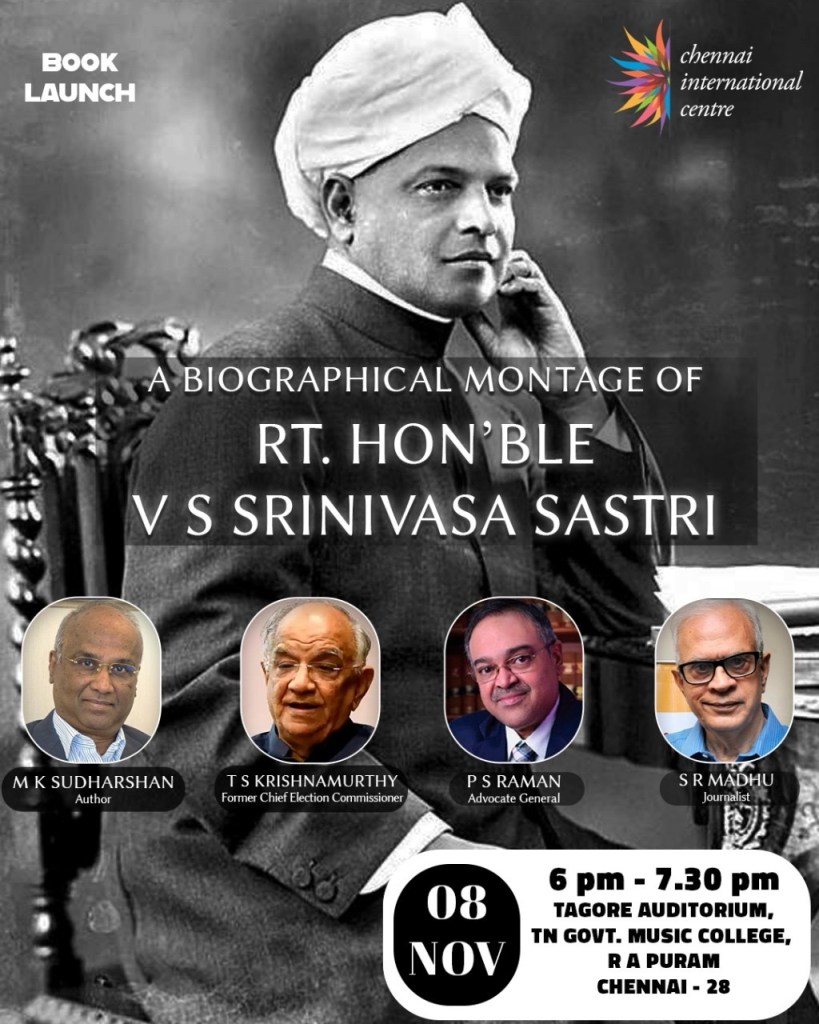
Good evening, friends, colleagues, and fellow lovers of ideas.
I want to begin by thanking CIC’s Kasturi Venugopal, Chandramouli, Sabarivas for hosting this event this evening. My gratitude also goes to the distinguished guest speakers on stage — S R Madhu, T S Krishnamurthy, Bharath Ram. Thanks also to my publishers in New Delhi, M/s Blue Rose Publishers. My very special gratitude also goes to all the family members of Srinivasa Sastri who are present amongst us. Last but not the least, thanks to my dear wife Divya… she’s my inhouse editor and hawkeyed proof-reader… who read the book only last evening and has told me she has already spotted the proverbial Printer’s Devil, a few minor grammatical errors and one bloomer. That gives me hope for a revised edition sometime in the future if this one should do reasonably well.
A question now to the audience. Please answer honestly.
How many of you here are serious students of History, especially Indian History? Raise your hands?
And how many of you here have read anything before on Rt Hon’ble Srinivasa Sastri?
(About less than a 20 hands went up in an audience of nearly 150)
This evening isn’t merely a book launch. It is an invitation to rediscover a remarkable yet largely forgotten figure in Indian history: V. S. Srinivasa Sastri. My journey to this book began unexpectedly through a friendship with his great-grandson, which led me deep into Sastri’s letters, speeches, and an extraordinary moral vision that I felt demanded to be heard again in our country.
When I was an undergraduate in college, I had admired Sastri only as an extraordinary Sanskrit scholar of Valmiki Ramayana and a dazzling splendid orator in English. The new discovery I made in writing this book is that behind that literary eloquence there was also a man who was a farsighted statesman, a brilliant, astute diplomat, and a tireless freedom fighter who all his life had wrestled with existential questions that remain urgent in Indian politics even today:
How do we reform without destroying what matters?
How do we dissent without bitterness?
How do we live morally in the public eye?
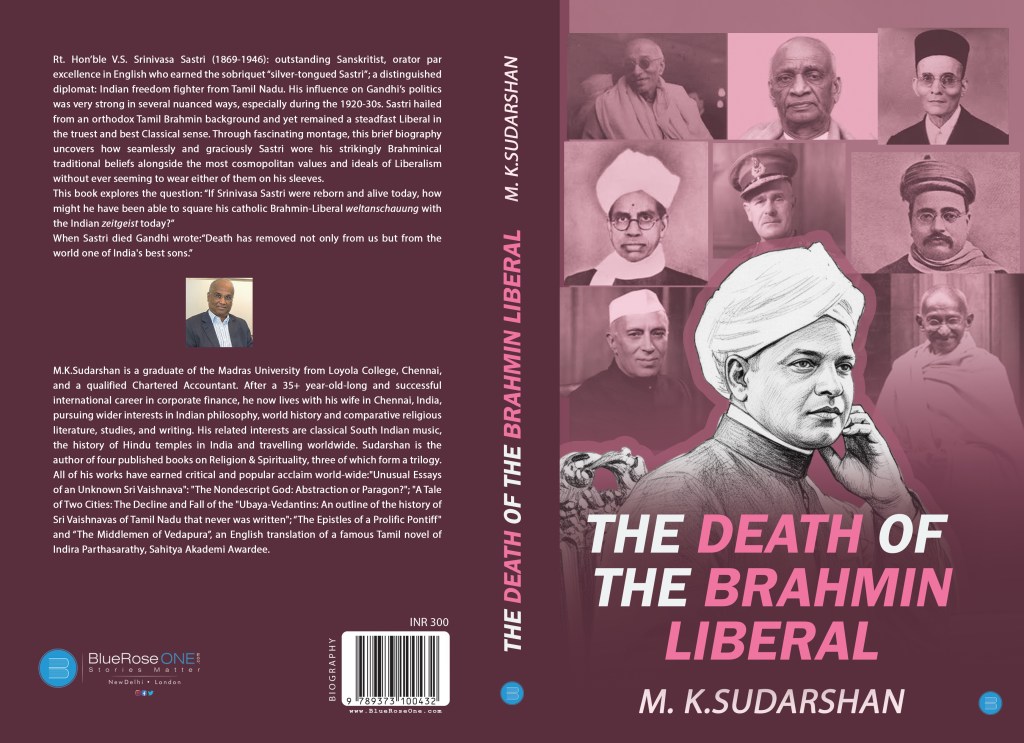
“The Death of a Brahmin-Liberal”! The title of my book may sound dark and funereal, but it signifies a deeper fading away — the disappearance of a culture of dignity, restraint, and the courage of the moderate liberalist. Sastri’s kind of leadership—marked by gentle strength, courteous speech, and principled independence—has all but vanished from our public life in India.
Sastri lived in an age of giants—Gandhi, Nehru, Rajaji—and yet he never was overshadowed by them. He challenged Gandhi on the ethics of means and ends, cautioned Nehru against haste without harshness, and debated Rajaji on tradition with affection. Above all, he stood firm in his convictions without venom or personal rancour.
This book draws out three vital lessons from Sastri’s life— they are lessons, I believe, essential for the survival of Indian democracy today:
First, tradition and reform can—and must—coexist.
Second, democracy is not chaos, but a discipline—a discipline of manners, not noise.
Third, to be a moderate and a conscientious liberal is often a lonely path, but it is indispensable.
Writing this book for me was a journey of moral reckoning. I sought to admire Sastri without idolizing him, to argue with him without dismissing him. At times, Sastri unsettled me as any true moral exemplars should—reminding me that intellectual honesty demands facing one’s own biases, not escaping them.
Why bring Sastri’s voice back now? Because Indian democracy desperately needs discourse that debates ideas without disdain, that argues with conviction not fanaticism. The “Brahmin-Liberal” is no caste label—it is a moral ideal, a call to lead with humility, to speak with restraint, and to balance power with conscience.
Sadly, voices like Sastri’s are today facing a shrinking public space in India. As one Western thinker has noted:
QUOTE “Public intellectuals aren’t becoming difficult to find because we’re in any kind of deficit of brilliant thinkers, but only because the space for these figures has nearly disappeared. Intellectual influencer’s today—though brilliant in their own right—have to contend with branding themselves for social media. They have to publish articles and make content that generate engagement rather than encourage deep thought. The complexity and weight of ideas is often sacrificed for the sake of appealing to the masses. When your goal is not only to present ideas but to make them palatable and digestible for a distracted audience, the boundaries of intellectualism start to blur. Ideas are no longer for discussion, they’re for consumption” UNQUOTE
Sastri’s legacy invites us to relearn respect—the art of disagreement without disrespect. This book will challenge all readers to imagine a Parliament echoing with reasoned debate, a civil society honouring bridge-builders, not firebrands, an education that nurtures civic manners, and a judiciary that celebrates principled dissent… and with the permission of Sri T S Krishnamurthy here, may I also add… an Election Commission that will be left alone to do its work diligently.
Ladies and Gentlemen, this book is no nostalgic homage. It is an urgent call: so tonight, when you walk out from here, please carry Sastri’s spirit with you—let it shape how you debate, dissent, how you vote and decide who leads us.
Pick up this volume not just to remember, but to renew our democratic future—where civility, wisdom, and moderation will still have their rightful place.
Thank you. May our conversations honour the thoughtful courage and dignified spirit that Sastri entrusted to us all.
Sudarshan Madabushi