
ಮೊದಲು ಸ್ವಾಮೀಜಿಗೆ ನಮಸ್ಕಾರ ಮಾಡಿ ಅವರ ಆಶೀರ್ವಾದ ಕೇಳುತ್ತೇನೆ. ವೇದಿಕೆಯಲ್ಲಿ ಇರುವ ಎಲ್ಲ ಗೌರವನೀಯರಿಗೆ ನಮಸ್ಕಾರ. ರಸಿಕರೂ, ಕಲಾವಿದರೂ ಎಲ್ಲರಿಗೂ ನನ್ನ ನಮಸ್ಕಾರ. ಉಳಿದ ಭಾಷಣ ಇಂಗ್ಲಿಷ್ನಲ್ಲಿ ಮಾಡುತ್ತೇನೆ, ಕನ್ನಡ ಸುಲಭವಾಗಿ ಹೇಳಲು ಇನ್ನೂ ಬರಲಿಲ್ಲ. ಕ್ಷಮಿಸಿ. ಧನ್ಯವಾದಗಳು.
(At the outset I offer my humble prostrations to the Swamiji to seek his blessings. I wish to offer my greetings to all the eminent persons on the dais here and my humble salutations to one and all “Rasikas” and artistes seated in the audience. I now apologise to switching to English in the rest of my address as I’ve still not been able to speak Kannada with ease. Kindly pardon me. Thank you).
Ladies and Gentlemen,
I am here on behalf of and representing the Dr. Smt. Mani Krishnaswami Foundation, Chennai. It is a private trust dedicated to the promotion of the cause of Carnatic Music and Classical Art. The Foundation was set up in 2004 by my father Sri. M.Krishnaswami (MK) in memory of my mother Sangitha Kalanidhi Dr. Smt Mani Krishnaswami (Padma Shri awardee).
Both my parents were devoted to many causes that sustained and cherished Carnatic Music but the one most close to Mani Krishnaswami’s heart was to encourage young talent across the country to pursue this wonderful classical music tradition. The Foundation in its own quiet way today supports many such efforts and also those endeavours of other organizations like this in Surathkal/Mangalore/Udupi viz. the Mani Krishnaswami Academy.
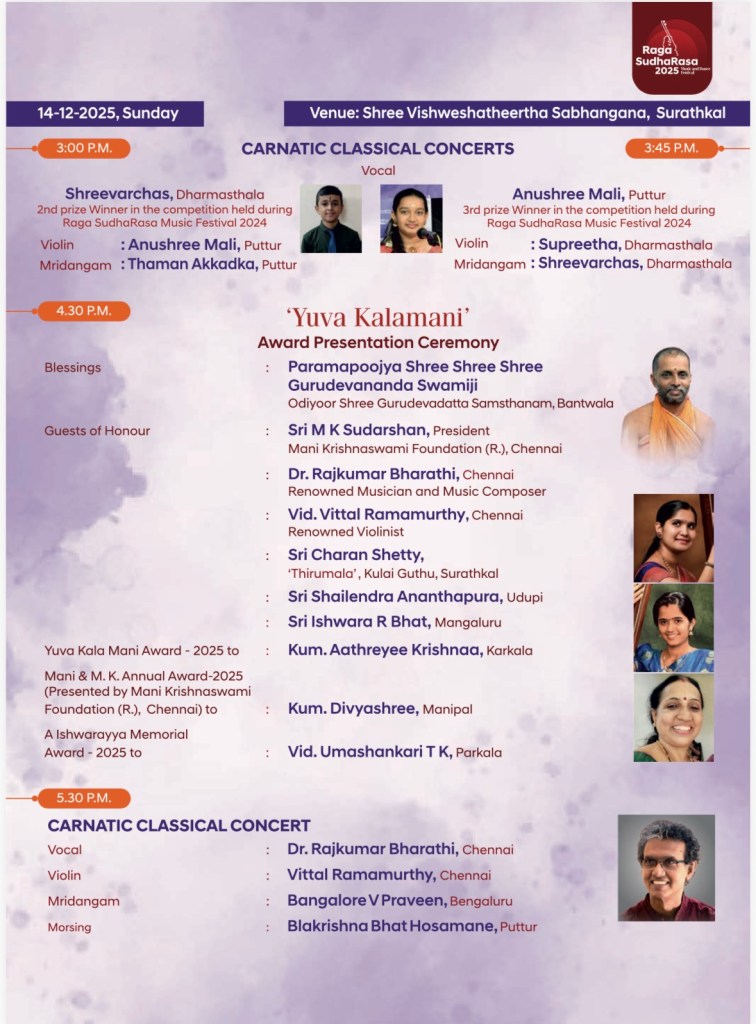
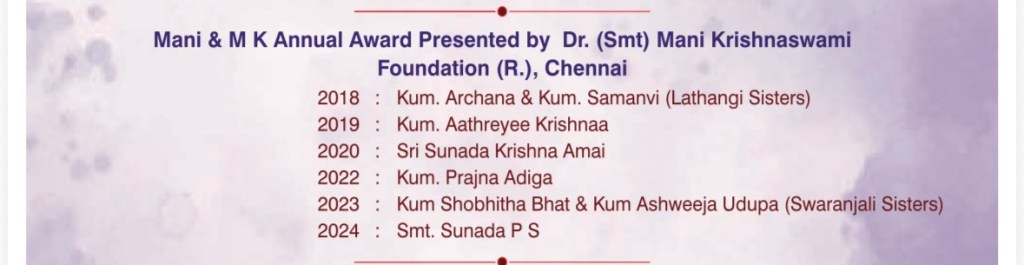
In the invitation card of the 2025 Annual Music Festival, RAAGASUDHA, you will see the list of all the young talented Awardees who were conferred the “MANI AND MK Annual Award for OUTSTANDING YOUNG TALENT” since 2018. They are:
Kum. Archana & Kum. Samanvi (Lathangi Sisters)
Kum. Athrayee Krishnaa
Sri Sundada Krishna Amai
Kum. Prajna Adiga
Kum. Shobhita Bhat & Kum. Ashweehja Udupa (Swaranjali Sisters)
Smt. Sunanda P.S.
And now in 2025
Kum. Divyashree Bhatt
It is a matter of great pride for the Mani Krishnaswami Foundation and the family members of both “Mani and MK” that many of the young musicians listed above — e.g. Athrayee Krishna and others like Shreya Kolatheya and Aneesh Bhatt — all have made tremendous strides in their musical journey of the last 5 years. The Music Season in Chennai this year is featuring the kutcheris of many of these young artistes from Karnataka. This is great progress indeed!
The footprints of many more of such young talented musicians — spotted and nurtured by the Mani Krishnaswami Academy and recognized by Mani Krishnaswami Foundation — will hopefully get bigger and bigger in the capital city of Carnatic Music, Chennai, in the years ahead.

**************
Ladies and Gentleme, now, I wish to make some general observations about the world of Carnatic Music as we all see it today. I have been given permission by Sri Nithyananda Rao of the Mani Krishnaswami Academy to make these general observations in this forum here since they are not specific to any one region (or institution) but to everywhere in the world where Carnatic Music is sung and enjoyed, whether it is here in Surathkal/Mangalore or in Mylapore, Chennai or in Cleveland, Ohio, America. There are 3 reasons why I wish to make these general observations on this occasion:
- Firstly, we all know that in the years and decades ahead, more young talented music artistes, all recognized by the Academy and the Foundation, are going to emerge from this region of Karnataka. These young musicians should therefore know what the real nature of the music world is which they will be entering.
- Secondly, the observations I make are not something that other present day senior vidwans (like Sri. Rajkumar Bharathi or Vittal Ramamurthy, seated here on stage) or even retired vidwans will ever make in public forums like this one because they fear their words will be misunderstood and be dubbed “politically incorrect”. But I am a rasika … and an old one too… I have been an ordinary rasika since the 1970s, 1980s, through the 1990s to the present day. I do not have to fear anyone or any institution to speak my mind. In this forum of Mani Krishnaswami Academy, I have a right, in fact, to speak my mind as a Trustee of the Mani Krishnawami Foundation.
- Lastly, I make these general observations here today, because I can make them in Surathkal on a public platform. In Chennai, I cannot make them because no one would ever care to listen or pay attention.
Now, let me proceed to make my general observations.
I say first that the world of Carnatic Music today increasingly resembles the corporate world. The music ecosystem today is getting increasingly corporatised. I can say this with confidence because I know both worlds quite well … My professional career as a Chartered Accountant stretched to 35 and more years in the corporate world both in Indian and abroad. So, what I say now is spoken with both with sincerity and truth.
*************
Corporate sponsorship in Carnatic music has boosted visibility and opportunities for young artistes, sustaining festivals like Chennai’s much celebrated Mega Margazhi season and other such Music festivals organised in many other cities. Corporatising Carnatic music does help in sustaining the classical Carnatic music ecosystem.
Benefits
Sponsorships from banks and corporates fund multiple daily concerts, pay performers directly, and preserve the tradition as a niche art. Youth initiatives, amplified by such funding, have created slots for emerging talents in major sabhas, attracting younger audiences to the scene and drawing crowds through innovative events.
It is in this context, that Mani Krishnaswami Academy’s tireless efforts and initiatives taken in this part of Western India are admirable since they have in the last 10-15 years helped to popularise youth-driven programs. This is why the Academy’s entire team led by Dr. Harikrishna Punarooru, Capt. Ganesh Karnik, Nithyananda Rao, Arvind Hebbar, Vibhu Rao, Dr. Arvind Hebbar, Vidwan Nagesh Boppanadu, B.Seetharama Tholpadhitaya, Smt Prarthana Sai Narsimhan and Sri Vibhu Rao must all be greatly applauded.
Drawbacks of Corporatisation of Carnatic music ecosystem
It is the nature of the corporate world to commercialise everything it touches, and Carnatic Music cannot be exempt from commercialisation.
Commercial pressures prioritize popularity, fusion concerts, gimmickry in the name of experimentation. They sponsor recommendations over rigorous curation of new talent scouting. That leads to a crowded field wherein family ties influence selections. Such trends signal risks to authenticity and depth in the art of Carnatic music.
Sponsorships often lead to diluted artistic integrity, with performers selecting safer kritis or fusion elements to align with sponsor-recommended themes or demographics, sidelining deeper manodharma or exposition of rare ragas and kritis that define classical depth. This shift risks turning concerts into homogenized events, where family legacies or sponsor preferences overshadow merit-based innovation rooted in guru-shishya parampara.
We see today many artistes — both senior as well as youth — opting for shorter, high-energy, high-decibel jazzy kutcheri formats delivering catchy well-known pieces. They seem aimed to maximize sponsorship visibility in social and TV media. What this trend does is reduce space for elaborate alapana or lesser performed kritis that preserve cultural nuance. Commercial demands exacerbate this favouring of thematic songs more suited for branding image than for authentic exploration of Carnatic’s vast musical inventory. This potentially erodes repertoire diversity.
To sum up, while sponsorship acts as a great boon for survival of the art and for access to large audiences, in a financially challenged ecosystem, Corporatisation of this Art form leans toward more towards the bane through overcrowding and quality erosion unless it is balanced by a much stronger curation system.
Competitive Pressures: Corporate sponsorship in Carnatic music fosters also a very competitive environment where young artistes often enter a rat race for stage time, prioritizing visibility over artistic depth.
The influx of sponsorship-funded slots during Chennai’s Margazhi Season creates intense rivalry, with young performers relying on competitions, family networks, and sponsor endorsements to secure prime sabha stages amid hundreds of daily concerts throughout December-January. This leads to rushed preparations, formulaic repertoire, and social media promotion battles, sidelining rigorous training in favour of quick limelight grabs.
Youth-focused series amplify opportunities, but they only further heighten the scramble, as limited senior slots push newcomers into cutthroat auditions and thematic events tailored for sponsors. fan-clubs and cheer-leading “Rasika forums”. Everything thus only ends up highlighting the declining standards, with overcrowding forcing artistes to chase “cuts” (performance slots) rather than nurture the genuine art form.
Long-term Effects
This atmosphere risks burnout and superficiality. Behind it is equally competitive and unchecked mentorship that perpetuate a cycle whereby stage presence trumps tradition. Corporate sponsorships and overcrowding in Carnatic music thus push young performers toward showmanship and social-media hype, dramatic stage entries —flashy displays, audience-pleasing improvisations, and visual flair—over genuine artistry like nuanced manodharma in singing krithis. All this is driven by survival needs in a competitive field.
Consequences
Parents of young Carnatic music students and their teachers, mentors and schools also cannot escape responsibility for these corporatising trends. It is they who often contribute to the belief that showmanship in their disciples and wards will help their careers by prioritizing competition wins and stage-ready polish to secure sponsorship slots, over immersive artistry training.
Music schools today host kutcheri competitions mimicking sabha and TV Show formats, rewarding visual flair, confident banter, and social media appeal alongside a slick technique that fosters a “perform-to-win” mindset from very early ages.
There are teachers today who openly emphasize that short, flashy renditions of popular kritis with extended neraval and crowd-pleasing raagas are the best way to prepare students for auditions in sponsor-funded series. Deep exploration of rare compositions or prolonged “saadhana” is not important anymore.
Patronage Shift
The world of Carnatic music and the way musicians lived and worked 60 years ago (around the 1960s and earlier) contrasted sharply with today’s corporate-driven, overcrowded scene. That world was rooted in royal patronage, guru-shishya intimacy, and ritualistic purity rather than commercial competition.
Pre-1960s, musicians thrived under princely states and zamindars who provided lifelong sustenance via court positions, eliminating financial pressures for showmanship; post-independence, sabhas replaced this with ticketed events amid low attendance, birthing corporate sponsorship dependency now in the 2020s. The old-world life was centred on temples and chamber concerts (private soirées), not mass kutcheris, fostering depth over volume.
Training and Performance
Teaching methods and the gurukula system in Carnatic music evolved dramatically from the immersive, oral tradition of 60 years ago (1960s and earlier) to today’s structured, accelerated academies, shifting from holistic mentorship to competition-oriented training. In the Gurukula Era (Pre-1960s) students lived with gurus in residential setups, absorbing alankaras, varnams, and krithis through shravana (listening), manana (reflection), and nididhyasana (practice) over 10-20 years, with no fixed syllabus—progress depended on individual aptitude and guru’s oral transmission. Emphasis lay on character, devotion, and manodharma via doing routine chores, religious rituals, and private tutorial sessions, free from fees via patronage, fostering unhurried depth in rare ragas and kritis.
Gurukula system demanded several decades of residential immersion in sarali varisai, alankaras, and varnams before rare public debuts, prioritizing manodharma fidelity; artistes balanced music with devotion, often as temple vidwans or court retainers, valuing heritage over fame; today’s rat race demands branding, short sets, and sponsor-pleasing themes, eroding the unhurried artistry of yesteryears.
Modern Career Span (Post-1960s)
Post-independence, urban academies and schools adopted weekly classes, notations, and graded exams (e.g., from institutions like Music Academy Madras), shortening training to 5-10 years for quick arangetrams amid sponsorship demands. Digital aids, group batches, and competition prep now prioritize stage polish—short kritis, flashy neraval—over prolonged alapana, diluting personalized guru-shishya bonds for scalable, fee-based models.
New entrants, often in 20s-30s after prolonged gurukula immersion, enjoyed lifelong careers (50-70 years) as court vidwans, wedding kutcheri-performers, or temple retainers, performing on sabha stages till age 80s-90s with community and rasika support ensuring financial security and gradual mastery without any rat-race dilution.
By contrast, today’s young Carnatic artistes face shorter career spans of 20-30 years post-arangetram due to intense competition, burnout from rapid debuts, and diversification needs, contrasting sharply with 50-60+ year tenures 60 years ago under stable patronage.
Young performers debut in teens after 8-12 years of academy training, sustaining via sponsorship slots for 2-3 decades before fading amid overcrowding, social media pressures, and supplemental gigs like teaching or fusions; many peak early (20s-30s) then pivot by 40-50.
The Need for overhauling the Curation System that assesses young talent in Carnatic Music:
- We need to start using multi-category rubrics evaluating tone, intonation, rhythmic accuracy, articulation, and interpretation (e.g., dynamics, phrasing, style adherence), with descriptive criteria for nuanced feedback rather than simply giving overall scores favouring charisma.
- We need to make far better and more extensive use of Formative Recordings and Reflection: Audio/video recordings should be used to analyze candidate’s alapana elaboration, neraval creativity, and rare krithi handling, paired with self/peer critiques focusing on guru-shishya fidelity over applause metrics. Carnatic music tutelage must include not only conspicuous skill development but also character.
- Teachers, mentors and Carnatic music schools must also start assessing in a proper way the core elements of musical effect and technique separately, ensuring that expression (manodharma depth) weighs equally to the basics, and avoid single-event judgments.
THANK YOU
M.K.SUDARSHAN